
In recent years, perovskite solar cells have garnered significant attention due to their exceptional optoelectronic properties, including high absorption coefficients, long carrier diffusion lengths, and tunable bandgaps. These attributes contribute to the rapid advancement in power conversion efficiency (PCE), which has now surpassed 26% in state-of-the-art devices. However, challenges related to stability, cost, and scalability hinder the commercialization of perovskite solar cells. Carbon-based perovskite solar cells (C-PSCs) offer a promising alternative by leveraging low-cost carbon electrodes, which exhibit suitable Fermi levels and excellent environmental stability. Despite these advantages, the performance of C-PSCs is often limited by inefficient charge carrier transport and recombination at interfaces, particularly within the electron transport layer (ETL).
To address these limitations, we explore the integration of ferroelectric materials into the ETL structure. Ferroelectrics, such as PbTiO3, possess inherent polarization properties that can enhance built-in electric fields, facilitate carrier separation, and reduce interfacial recombination. In this study, we focus on the in-situ formation of PbTiO3 on a dense TiO2 (c-TiO2) ETL, followed by polarization treatment, to improve the photovoltaic performance of perovskite solar cells. We systematically investigate the morphological, optical, and electrical characteristics of the modified ETL and analyze the underlying mechanisms driving performance enhancements. Our findings demonstrate that PbTiO3 modification combined with polarization treatment significantly suppresses carrier accumulation at interfaces, leading to improved open-circuit voltage (Voc), short-circuit current density (Jsc), and overall PCE in perovskite solar cells.
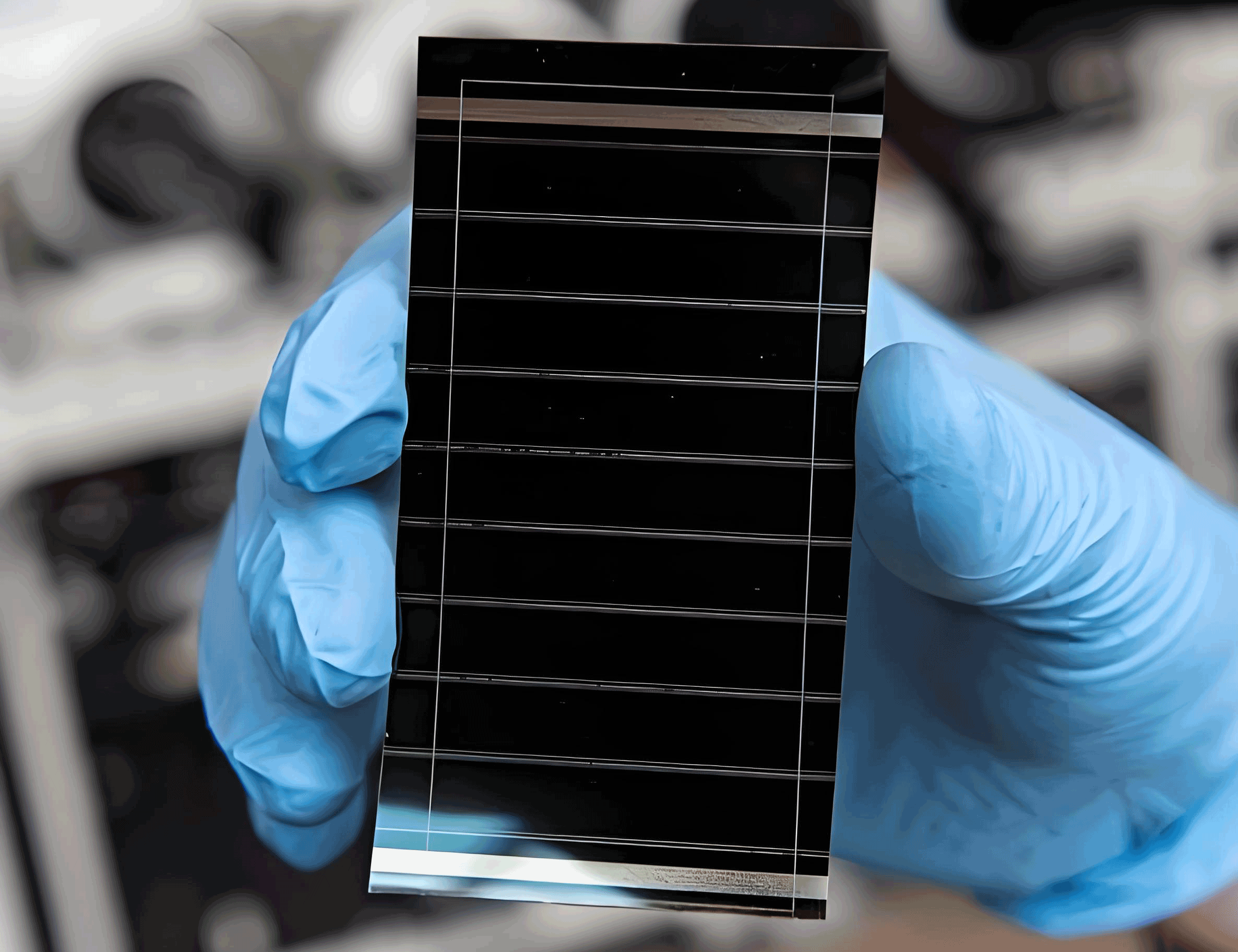
The fabrication of perovskite solar cells begins with the preparation of fluorine-doped tin oxide (FTO) substrates. The FTO glasses are etched, cleaned sequentially with detergent, glass cleaner, distilled water, and ethanol under ultrasonication for 15 minutes each, and then dried. The c-TiO2 layer is deposited by spin-coating a precursor solution—composed of titanium isopropoxide, isopropanol, and hydrochloric acid—at 2000 rpm for 60 seconds, followed by annealing at 500°C for 30 minutes. For the c-TiO2/PbTiO3 layer, the c-TiO2-coated FTO is immersed in a 10 mmol/L lead acetate trihydrate solution in ethylene glycol monomethyl ether for varying durations (10, 30, 120, and 300 seconds) at room temperature. After rinsing with distilled water and ethanol, the substrate is dried at 70°C and annealed at 500°C for 30 minutes to form PbTiO3. The mesoporous TiO2 (m-TiO2) layer is applied by spin-coating a TiO2 paste diluted with ethanol (1:7 mass ratio) at 3000 rpm for 30 seconds, followed by annealing at 500°C for 30 minutes. A TiCl4 treatment is performed by immersing the substrate in a 0.05 mol/L TiCl4 solution at 70°C for 30 minutes, followed by annealing. The perovskite layer (CH3NH3PbI3) is deposited via a one-step method with anti-solvent technique: a 1.2 mol/L perovskite solution in DMF:DMSO (4:1 volume ratio) is spin-coated at 1000 rpm for 10 seconds and then at 5000 rpm for 30 seconds, with chlorobenzene dropped at the 7th second of the second step. The film is heated at 60°C for 2 minutes and 120°C for 10 minutes. Finally, the carbon electrode is applied by doctor-blading a carbon paste—composed of graphite, carbon black, ethyl cellulose, and chlorobenzene—and heating at 100°C for 1 hour. All steps are conducted in ambient air.
Polarization treatment is carried out using a custom setup with a polytetrafluoroethylene (PTFE) protective layer to prevent dielectric breakdown. The structure FTO/c-TiO2/PbTiO3/PTFE/FTO is subjected to DC voltages of 20, 40, 50, and 60 V for polarization. The PTFE layer is removed after treatment, ensuring it does not affect the final device performance.
Characterization techniques include scanning electron microscopy (SEM) and energy-dispersive X-ray spectroscopy (EDS) for morphological and elemental analysis, X-ray photoelectron spectroscopy (XPS) for chemical bonding assessment, UV-visible spectroscopy for transmittance measurements, and a solar simulator (AM1.5G, 100 mW/cm²) for current density-voltage (J-V) profiling. Electrochemical analyses, such as Mott-Schottky, electrochemical impedance spectroscopy (EIS), voltage decay, dark current, capacitance-frequency, and steady-state photocurrent measurements, are performed using an electrochemical workstation under dark conditions.
The surface morphology of the c-TiO2/PbTiO3 layer is examined through SEM and EDS. Uniform distribution of O, Ti, and Pb elements is observed, indicating homogeneous formation of PbTiO3 on the c-TiO2 surface. XPS analysis confirms the presence of PbTiO3, with shifts in Ti2p and O1s peaks aligning with standard PbTiO3 binding energies. The transmittance spectra of the c-TiO2/PbTiO3 layer show a slight improvement at 350 nm wavelength compared to pristine c-TiO2, while remaining comparable across other wavelengths. The electrical conductivity of the c-TiO2/PbTiO3 layers is evaluated using I-V curves, and the conductivity (σ) is calculated using the formulas:
$$ \rho = \frac{V \cdot S}{I \cdot d} $$
$$ \sigma = \frac{1}{\rho} $$
where ρ is the resistivity (Ω·cm), V is voltage (V), I is current (A), S is the effective area (0.15 cm²), d is the film thickness (500 nm), and σ is the conductivity (mS·cm⁻¹). The results are summarized in Table 1.
| Reaction Time (s) | Resistance (Ω) | Resistivity (Ω·cm) | Conductivity (mS·cm⁻¹) |
|---|---|---|---|
| 0 | 22.61 | 5.65×10⁵ | 1.77×10⁻³ |
| 10 | 23.64 | 5.91×10⁵ | 1.69×10⁻³ |
| 30 | 24.89 | 6.22×10⁵ | 1.61×10⁻³ |
| 120 | 28.98 | 7.24×10⁵ | 1.38×10⁻³ |
| 300 | 55.20 | 13.79×10⁵ | 7.25×10⁻⁴ |
The conductivity decreases gradually with longer reaction times, with a sharp drop at 300 s, indicating increased carrier transport resistance due to excessive PbTiO3 formation. This highlights the importance of optimizing the reaction time for perovskite solar cell applications.
The photovoltaic performance of perovskite solar cells with PbTiO3-modified ETLs is assessed through J-V measurements. The devices exhibit enhanced Jsc and PCE with a reaction time of 30 s, while longer times lead to degradation. The parameters are listed in Table 2.
| Reaction Time (s) | Voc (V) | Jsc (mA/cm²) | FF (%) | PCE (%) |
|---|---|---|---|---|
| 0 | 0.88 | 13.84 | 51.51 | 6.26 |
| 10 | 0.88 | 13.92 | 51.55 | 6.31 |
| 30 | 0.89 | 14.12 | 51.77 | 6.49 |
| 120 | 0.93 | 11.99 | 52.56 | 5.88 |
| 300 | 0.94 | 9.81 | 42.00 | 3.85 |
Polarization treatment further improves the performance of perovskite solar cells. Applying a 40 V polarization voltage to the c-TiO2/PbTiO3 layer results in the highest PCE of 7.11%, with Voc = 0.93 V, Jsc = 14.83 mA/cm², and FF = 51.16%. Higher voltages do not yield additional gains, as the polarization direction saturates. The results are detailed in Table 3.
| Polarization Voltage (V) | Voc (V) | Jsc (mA/cm²) | FF (%) | PCE (%) |
|---|---|---|---|---|
| 0 | 0.88 | 14.12 | 51.18 | 6.41 |
| 20 | 0.89 | 14.39 | 51.25 | 6.53 |
| 40 | 0.93 | 14.83 | 51.16 | 7.11 |
| 50 | 0.93 | 14.95 | 51.35 | 7.11 |
| 60 | 0.93 | 15.00 | 51.20 | 7.12 |
To elucidate the carrier transport mechanisms, we perform Mott-Schottky analysis. The Mott-Schottky equation is given by:
$$ \frac{1}{C^2} = \frac{2}{q \epsilon_0 \epsilon_r A^2 N} \left( V – V_{\text{bi}} – \frac{kT}{q} \right) $$
where C is capacitance (F), q is elementary charge (1.6×10⁻¹⁹ C), ε₀ is vacuum permittivity (8.854×10⁻¹² F/m), εᵣ is relative permittivity (28.8), A is area (0.15 cm²), N is carrier concentration (cm⁻³), Vᵢ is built-in potential (V), k is Boltzmann’s constant (1.38×10⁻²³ J/K), and T is temperature (K). The carrier concentrations derived from the slopes of Mott-Schottky plots are summarized in Table 4.
| Condition | Carrier Concentration (cm⁻³) | Reduction in Carrier Accumulation (%) |
|---|---|---|
| Pristine c-TiO2 | 8.879×10¹² | – |
| c-TiO2/PbTiO3 (30 s) | 2.640×10¹² | 29.7 |
| c-TiO2/PbTiO3 polarized at +40 V | 6.020×10¹¹ | 6.78 |
The reduction in carrier accumulation with PbTiO3 modification and polarization treatment indicates improved carrier separation, which is critical for enhancing the performance of perovskite solar cells. EIS Nyquist plots show larger recombination resistances (Rᵣₑc) for modified and polarized devices, suggesting suppressed carrier recombination. Voltage decay measurements reveal slower decay rates for polarized perovskite solar cells, implying longer carrier lifetimes. Dark current curves demonstrate lower leakage currents, while capacitance-frequency responses indicate reduced interfacial carrier accumulation. Steady-state photocurrent outputs confirm higher current densities for treated devices, affirming the role of PbTiO3 in optimizing carrier dynamics.
The enhancement in perovskite solar cell performance is attributed to the ferroelectric properties of PbTiO3. The polarization treatment aligns the dipoles within PbTiO3, creating a depolarization field that reinforces the built-in electric field. This synergistic effect promotes efficient carrier extraction and minimizes recombination, leading to higher Voc and Jsc. The optimized reaction time of 30 s for PbTiO3 formation ensures minimal impact on conductivity while maximizing interfacial benefits. These strategies demonstrate the potential of ferroelectric materials in advancing perovskite solar cell technology toward commercial viability.
In conclusion, we have successfully demonstrated that PbTiO3 modification and polarization treatment of the ETL significantly enhance the photovoltaic performance of carbon-based perovskite solar cells. The in-situ formation of PbTiO3 on c-TiO2 reduces carrier accumulation at interfaces, and subsequent polarization further optimizes carrier transport. Our systematic approach, combining morphological, optical, electrical, and electrochemical analyses, provides deep insights into the underlying mechanisms. The achieved PCE of 7.11% with improved stability underscores the practicality of this method for developing high-efficiency, low-cost, and durable perovskite solar cells. Future work will focus on scaling up the fabrication process and exploring other ferroelectric materials to push the boundaries of perovskite solar cell performance.