
The transition towards clean and sustainable energy systems, driven by global decarbonization goals, is accelerating the integration of renewable energy sources. However, the inherent variability and stochastic nature of resources like wind and solar photovoltaic generation introduce significant challenges to power system stability. A primary concern is the reduction of system inertia and diminished frequency regulation capability, which can threaten grid security. In this context, Battery Energy Storage Systems (BESS) have emerged as a pivotal technology due to their high control precision and rapid response characteristics. By providing fast-responding active power support, BESS can effectively participate in grid frequency regulation, ensuring a swift rebalance between generation and load, thereby enhancing overall system stability and reliability. This article delves into an advanced control strategy for BESS participation in primary frequency regulation, focusing on the critical aspect of State of Charge (SOC) management to optimize performance and battery longevity.
The fundamental architecture of a grid-connected BESS typically comprises the energy storage battery packs, a DC/DC converter, a DC/AC inverter (or PCS – Power Conversion System), a step-up transformer, and sophisticated control and management systems. The core control objective for frequency regulation is to modulate the active power output of the BESS based on real-time grid frequency measurements. This is achieved by setting the active power reference for the inverter’s outer control loop as a function of the frequency deviation. Common control paradigms mimic traditional generator behavior: droop control responds to the magnitude of frequency deviation, while virtual inertia control responds to its rate of change. A simplistic approach employs fixed coefficients for these controls, but this often leads to inefficient use of the energy storage battery and can cause deep discharge or overcharge, potentially triggering protection shut-offs and causing secondary frequency disturbances.
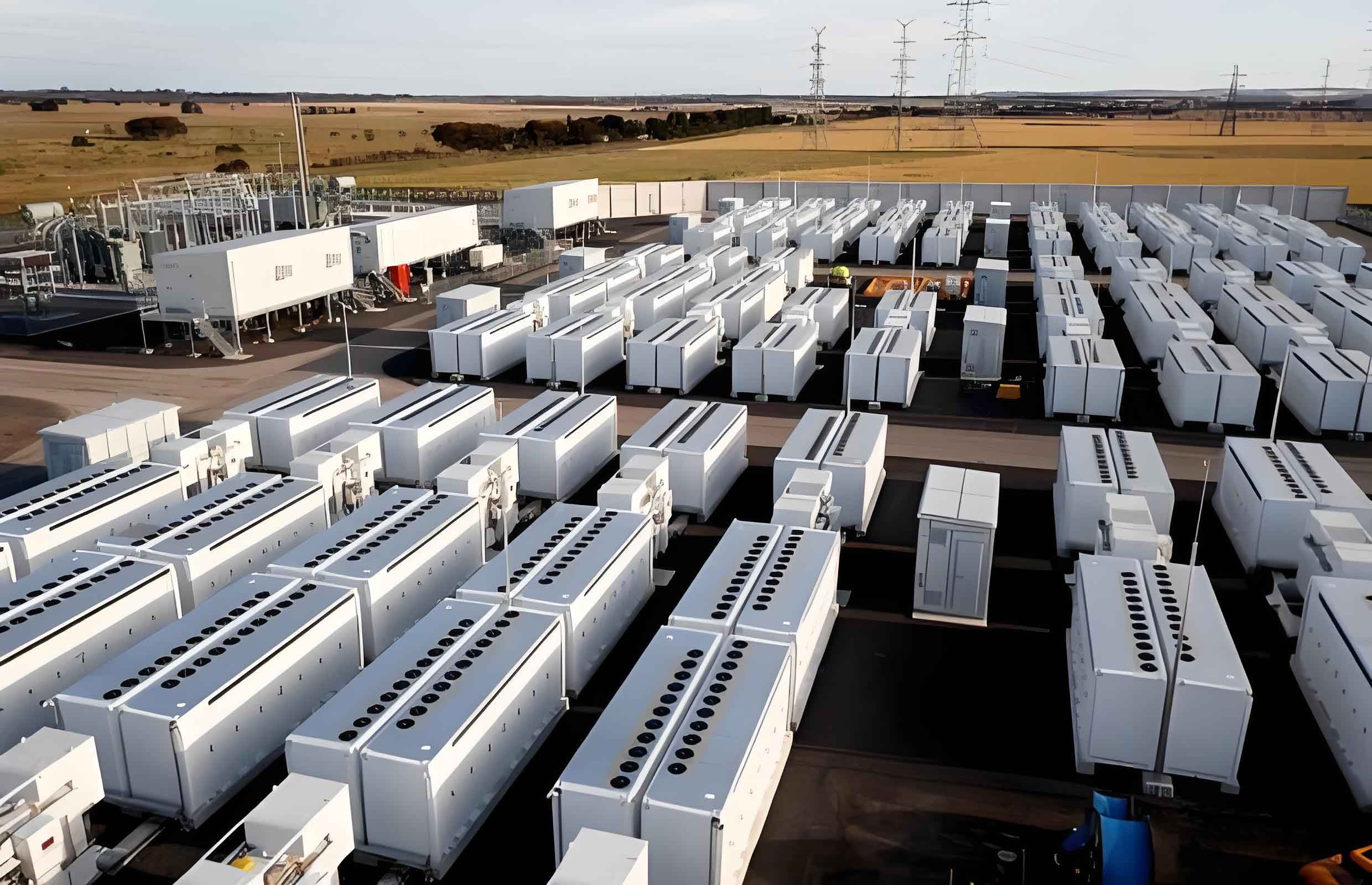
The proposed strategy introduces a dynamic, SOC-aware framework that coordinates droop and virtual inertia control. The cornerstone is the design of adaptive coefficients for both control modes based on the real-time SOC of the energy storage battery. This prevents operation at extreme SOC levels, thus safeguarding the battery’s cycle life and ensuring continuous availability for frequency support. The droop coefficient, $K_{Dr}$, is designed as a piecewise linear function of SOC ($Q_{SOC}$). For the discharge mode, it is defined as:
$$
K_{Dr\_dis} =
\begin{cases}
0, & Q_{SOC} \in [0, Q_{SOCmin}] \\
K_{Drmax} \cdot \frac{Q_{SOC} – Q_{SOCmin}}{Q_{SOClow} – Q_{SOCmin}}, & Q_{SOC} \in [Q_{SOCmin}, Q_{SOClow}] \\
\frac{K_{Drmax}}{2} + K_{Drmax} \cdot \frac{Q_{SOC} – Q_{SOCref}}{2(Q_{SOClow} – Q_{SOCref})}, & Q_{SOC} \in [Q_{SOClow}, Q_{SOCref}] \\
K_{Drmax}, & Q_{SOC} \in [Q_{SOCref}, 1]
\end{cases}
$$
Similarly, the virtual inertia coefficient $K_{In}$ is made proportional to the droop coefficient, $K_{In} = k_{In/Dr} \cdot K_{Dr}$, where $k_{In/Dr}$ is a scaling factor to balance the power contributions from both control loops, accounting for the different physical scales of frequency deviation $\Delta f$ and its derivative $d\Delta f/dt$.
To synergistically combine the advantages of both control methods—droop for steady-state error correction and virtual inertia for arresting rapid frequency changes—a weighted combination is employed. The total primary frequency regulation (PFR) power output $\Delta P_{PFR}$ is given by:
$$
\Delta P_{PFR} = w_{Dr} \cdot \Delta P_{Dr} + w_{In} \cdot \Delta P_{In}
$$
where $\Delta P_{Dr} = -K_{Dr} \cdot \Delta f$ and $\Delta P_{In} = -K_{In} \cdot d\Delta f/dt$. The weighting coefficients $w_{Dr}$ and $w_{In}$ are dynamically adjusted based on the absolute value of the frequency deviation $|\Delta f|$, relative to a threshold $\Delta f_{setw}$:
$$
\begin{aligned}
w_{Dr} &=
\begin{cases}
0.5 + \frac{|\Delta f|}{2\Delta f_{setw}}, & |\Delta f| \in [0, \Delta f_{setw}] \\
0.5 + \frac{|\Delta f|}{2\Delta f_{setw}}, & |\Delta f| \in [\Delta f_{setw}, 2\Delta f_{setw}] \quad \text{(Note: Typically increases to 1.5)} \\
1.5, & |\Delta f| \ge 2\Delta f_{setw}
\end{cases} \\
w_{In} &= 1.5 – w_{Dr}
\end{aligned}
$$
This design ensures that during small frequency deviations, virtual inertia receives a higher weight to dampen oscillations, while during large deviations, droop control is prioritized to provide substantial correcting power. Furthermore, to prevent virtual inertia from opposing frequency recovery during the restoration phase, $w_{In}$ is set to zero when the frequency is recovering from a disturbance.
For severe grid disturbances leading to large frequency excursions beyond a fault ride-through threshold $\Delta f_{setFRT}$, a dedicated support mode is activated. In this mode, the outer loop controller is bypassed, and the BESS is commanded to inject or absorb a maximum preset current to aggressively support frequency recovery until the deviation falls below the threshold.
A crucial component for the long-term viability of the energy storage battery is an SOC recovery mechanism. When the grid frequency is stable (within a small deadband $\Delta f_{setRE}$) and the SOC is outside a desired range ($Q_{SOC} < Q_{SOCRElow}$ or $Q_{SOC} > Q_{SOCREhigh}$), a recovery mode is triggered. In this mode, the BESS operates at a controlled charge/discharge current $I_{B\_RE}$ to gently bring the SOC back towards a nominal reference value $Q_{SOCref}$, preparing it for future frequency regulation events. This current is also a piecewise linear function of SOC to ensure smooth transitions.
To quantitatively evaluate the performance of different control strategies, specific evaluation metrics are proposed, focusing on both frequency regulation quality and SOC maintenance.
| Scenario | Frequency Regulation Metrics | SOC Maintenance Metrics |
|---|---|---|
| Step Load Change | Maximum frequency deviation $\Delta f_m$, Rate of frequency decline $V_{de}$ | SOC deviation after long-term operation $\Delta Q_{SOClong}$ |
| Random Load Fluctuation | Frequency peak-to-valley difference $\Delta f_{p-v}$, Root-mean-square of frequency deviation $\Delta f_{rms}$ | SOC peak-to-valley difference $\Delta Q_{SOCp-v}$, RMS of SOC deviation $\Delta Q_{SOCrms}$ |
| Transient Fault | $\Delta f_m$, $\Delta f_{p-v}$ | $\Delta Q_{SOCp-v}$ |
| Intermittent PV Output | $\Delta f_m$, $\Delta f_{p-v}$ | $\Delta Q_{SOClong}$ |
Simulation studies were conducted on a test system comprising a synchronous generator and a BESS under various disturbance scenarios. The proposed SOC-aware coordinated strategy was compared against conventional methods: fixed-gain droop (“Fixed K”), variable-gain droop (“Variable K”), and a combined fixed-gain droop and inertia (“Fixed K & M”) control. Key parameters for the proposed strategy are summarized below.
| Parameter | Value |
|---|---|
| $Q_{SOCmin}$ | 0.1 |
| $Q_{SOClow}$ | 0.3 |
| $Q_{SOCref}$ | 0.5 |
| $K_{Drmax}$ (MW/Hz) | 20 |
| $\Delta f_{setw}$ (Hz) | 0.025 |
| $\Delta f_{setFRT}$ (Hz) | 0.1 |
The results consistently demonstrated the superiority of the proposed strategy. Under a step load increase, it achieved the smallest maximum frequency deviation ($\Delta f_m = -0.0522$ Hz) and the slowest rate of decline ($V_{de} = 0.0078$ Hz/s) compared to other methods. Critically, while strategies with fixed coefficients caused the BESS to deplete completely, triggering a shut-off and a secondary frequency dip, the proposed strategy and the “Variable K” method gradually reduced output as SOC decreased, avoiding abrupt exit and maintaining smoother frequency recovery. The SOC deviation $\Delta Q_{SOClong}$ was also minimized with the proposed approach, indicating superior management of the energy storage battery’s energy reserve.
For random load fluctuations, the proposed strategy yielded the lowest frequency peak-to-valley difference ($\Delta f_{p-v} = 0.0144$ Hz) and RMS deviation ($\Delta f_{rms} = 0.0030$ Hz), showcasing its effectiveness in smoothing frequency variations. The SOC metrics remained within an acceptable range, comparable to other methods. During a simulated transient three-phase fault, the strategy again provided the best damping, minimizing both $\Delta f_m$ and $\Delta f_{p-v}$. Finally, in a scenario with intermittent photovoltaic generation, the strategy effectively mitigated frequency swings and, through its SOC recovery function, successfully returned the energy storage battery’s SOC towards its reference level after the disturbance subsided, which other strategies failed to do.
In conclusion, the integrated control strategy for BESS primary frequency regulation, which dynamically adjusts droop and virtual inertia contributions based on both real-time frequency deviation and the state of charge of the energy storage battery, presents a significant advancement. It effectively addresses the twin challenges of providing superior frequency stabilization and maintaining the energy storage battery within a healthy operational state. This approach mitigates the risk of premature saturation or depletion that can lead to protective tripping and secondary system disturbances. The strategy ensures that the valuable resource of the energy storage battery is used efficiently and sustainably, enhancing its longevity and readiness for continuous grid support. The simulation-based findings provide a compelling template for the design and parameterization of control systems in commercial BESS installations, contributing directly to improved grid performance and resilience in the face of increasing renewable energy penetration. The core innovation lies in the seamless coordination of multiple control objectives—rapid frequency response, battery SOC preservation, fault ride-through support, and autonomous recovery—into a unified, adaptive framework.