
With the increasing emphasis on renewable energy under China’s dual-carbon goals, wind power has emerged as a critical component of the energy transition. However, the inherent intermittency and instability of wind resources pose significant challenges to grid integration. Energy storage systems (ESS) have become indispensable for mitigating these challenges, enabling stable power supply, load balancing, and efficient resource utilization. This article explores the technological advancements, practical applications, and future directions of energy storage systems in wind power generation.
Core Energy Storage Technologies for Wind Power Systems
Modern wind power systems rely on diverse energy storage technologies to address fluctuating energy outputs. Key technologies include:
| Technology | Energy Density (Wh/kg) | Power Density (W/kg) | Cycle Life | Efficiency (%) |
|---|---|---|---|---|
| Supercapacitors | 5–20 | 1,000–10,000 | >100,000 | 90–95 |
| Lithium-ion Batteries | 100–265 | 250–340 | 2,000–6,000 | 95 |
| Hydrogen Fuel Cells | 300–1,500 (H₂) | 100–500 | 5,000–10,000 | 40–60 |
| Flywheel Storage | 10–30 | 500–1,500 | >20,000 | 85–90 |
Supercapacitors, for instance, excel in rapid charge/discharge cycles and high power density, making them ideal for short-term grid stabilization. The stored energy in a supercapacitor can be calculated as:
$$E = \frac{1}{2} C V^2$$
where \(E\) is the energy (J), \(C\) is the capacitance (F), and \(V\) is the voltage (V).
Hydrogen Fuel Cell Storage Systems
Hydrogen-based energy storage systems (HESS) offer long-duration storage capabilities. Proton Exchange Membrane Fuel Cells (PEMFCs) are widely adopted due to their low operating temperatures and high efficiency. The overall reaction is:
$$2\text{H}_2 + \text{O}_2 \rightarrow 2\text{H}_2\text{O} + \text{Electrical Energy}$$
The efficiency (\(\eta\)) of a PEMFC is given by:
$$\eta = \frac{V_{\text{cell}}}{1.48} \times 100\%$$
where \(V_{\text{cell}}\) is the cell voltage. HESS integrates electrolyzers, hydrogen storage tanks, and fuel cells to store excess wind energy as hydrogen during low-demand periods and regenerate electricity during peak demand.
Hybrid Energy Storage Systems
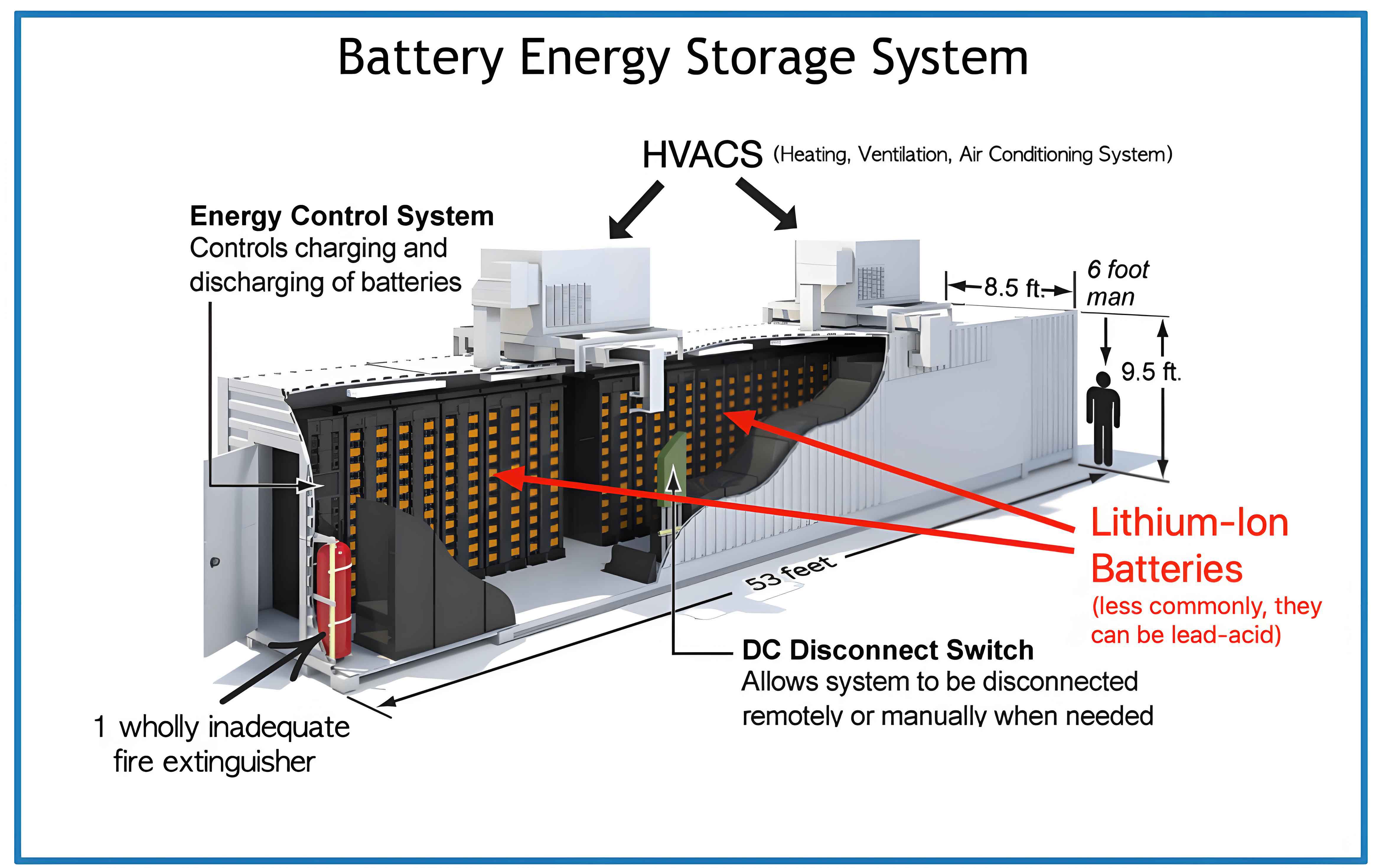
Combining lithium-ion batteries with supercapacitors in hybrid energy storage systems (HESS) optimizes performance. The battery handles base-load requirements, while the supercapacitor manages high-power transients. The power allocation between the two can be modeled as:
$$P_{\text{total}} = P_{\text{battery}} + P_{\text{supercapacitor}}$$
Such systems enhance cycle life and reduce battery stress, lowering maintenance costs.
Integration Strategies for Energy Storage Systems
Energy storage systems can be integrated into wind farms in two configurations:
- Distributed Storage: Deploys smaller ESS units at individual wind turbines. This approach improves local grid stability but increases installation complexity.
- Centralized Storage: Connects a large-scale ESS to the main grid interface. This simplifies management and reduces costs but requires robust power conversion systems.
Optimization and Economic Analysis
The economic viability of energy storage systems depends on capital costs, operational efficiency, and lifetime. A simplified cost model is:
$$LCOE = \frac{C_{\text{cap}} + \sum_{t=1}^{N} \frac{C_{\text{op}}(t)}{(1 + r)^t}}{\sum_{t=1}^{N} \frac{E_{\text{output}}(t)}{(1 + r)^t}}$$
where \(LCOE\) is the levelized cost of energy, \(C_{\text{cap}}\) is the capital cost, \(C_{\text{op}}\) is operational cost, \(E_{\text{output}}\) is energy output, and \(r\) is the discount rate.
Future Directions
Advancements in solid-state batteries, flow batteries, and AI-driven energy management systems will further enhance the role of energy storage systems in wind power. Key research areas include:
- Material innovations for higher energy density.
- Grid-forming inverters for enhanced stability.
- Multi-market participation (frequency regulation, capacity markets).
In conclusion, energy storage systems are pivotal to unlocking the full potential of wind power. By addressing technical and economic barriers, these systems will accelerate the global transition to sustainable energy.