
In today’s world, the growing demand for energy coupled with the depletion of traditional fossil fuels has necessitated a shift toward renewable sources. Among these, solar photovoltaic (PV) systems stand out as a promising solution for sustainable power generation. However, the inherent intermittency of solar energy—due to factors like daily and seasonal variations—poses a significant challenge for consistent power supply. As I explore this topic, it becomes clear that energy storage systems are indispensable for bridging the gap between energy production and consumption in a solar system. This article delves into the principles, characteristics, and applications of various energy storage technologies tailored for solar PV systems, emphasizing their role in enhancing reliability, efficiency, and grid stability. Throughout this discussion, I will incorporate tables and formulas to summarize key concepts, aiming to provide a comprehensive analysis that underscores the importance of integrating storage solutions into solar systems.
The solar system, in the context of photovoltaic applications, refers to the entire setup that captures sunlight and converts it into electrical energy. This includes PV panels, inverters, controllers, and crucially, energy storage units. Without storage, the solar system would only supply power during sunny periods, leaving loads underserved at night or on cloudy days. Thus, the integration of energy storage transforms a solar system into a more robust and dependable power source. In this analysis, I will examine three primary categories of energy storage systems: electrochemical batteries, flywheel energy storage, and superconducting magnetic energy storage, along with other emerging technologies like supercapacitors. Each of these contributes uniquely to the solar system’s performance, and their combined use can optimize energy management.
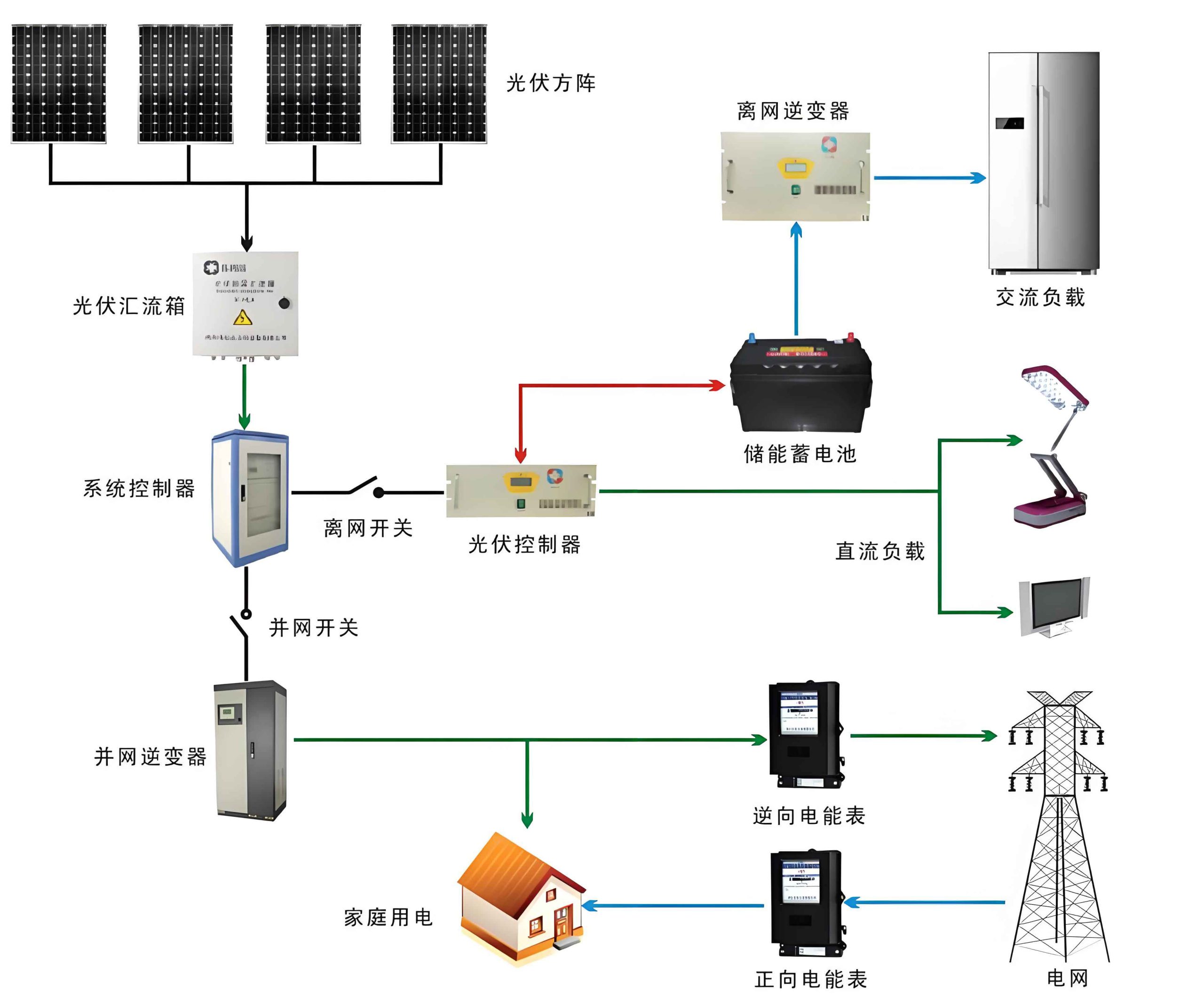
To begin, let’s consider the fundamental need for storage in a solar system. The power output from a PV array can be modeled as a function of solar irradiance and temperature, often expressed as: $$ P_{pv} = \eta \cdot A \cdot G \cdot (1 – \beta (T_c – T_{ref})) $$ where \( P_{pv} \) is the PV power output, \( \eta \) is the conversion efficiency, \( A \) is the panel area, \( G \) is the solar irradiance, \( \beta \) is the temperature coefficient, \( T_c \) is the cell temperature, and \( T_{ref} \) is the reference temperature. This equation highlights the variability in generation, which storage systems help mitigate by storing excess energy during peak production and discharging during deficits. In a well-designed solar system, the storage component ensures uninterrupted power, making it essential for both off-grid and grid-tied applications.
Electrochemical batteries are among the most common storage solutions for solar systems. They work by converting chemical energy into direct current (DC) electricity through redox reactions. The energy stored, \( E_b \), in a battery can be approximated by: $$ E_b = C \cdot V $$ where \( C \) is the capacity in ampere-hours (Ah) and \( V \) is the voltage. Batteries are characterized by parameters such as energy density, power density, cycle life, and efficiency. Below is a table comparing different battery types used in solar systems:
| Battery Type | Energy Density (Wh/kg) | Cycle Life (cycles) | Efficiency (%) | Typical Application in Solar System |
|---|---|---|---|---|
| Lead-Acid | 30-50 | 500-1000 | 70-85 | Residential and commercial backup |
| Lithium-Ion | 100-265 | 1000-3000 | 90-95 | High-performance solar systems |
| Nickel-Cadmium | 40-60 | 1000-2000 | 70-90 | Industrial solar installations |
| Flow Batteries | 10-30 | >5000 | 70-85 | Large-scale solar farms |
In my experience, lead-acid batteries remain popular due to their low cost and maturity, but lithium-ion batteries are gaining traction for their higher efficiency and longer lifespan. Factors affecting battery life in a solar system include depth of discharge, temperature, and charge-discharge rates. For instance, the Arrhenius equation describes temperature dependence: $$ k = A e^{-E_a/(RT)} $$ where \( k \) is the degradation rate, \( A \) is a pre-exponential factor, \( E_a \) is activation energy, \( R \) is the gas constant, and \( T \) is temperature. Proper thermal management in a solar system can thus extend battery life significantly.
Flywheel energy storage systems represent another innovative approach for solar applications. They store energy kinetically in a rotating mass, with energy given by: $$ E_f = \frac{1}{2} I \omega^2 $$ where \( I \) is the moment of inertia and \( \omega \) is angular velocity. Flywheels offer high power density, rapid response times, and long cycle life, making them suitable for smoothing fluctuations in a solar system. A key advantage is their ability to handle frequent charge-discharge cycles without degradation, which complements the intermittent nature of solar power. The table below summarizes flywheel characteristics:
| Parameter | Typical Value | Impact on Solar System |
|---|---|---|
| Power Density | Up to 5000 W/kg | Enables quick grid support |
| Energy Density | 5-100 Wh/kg | Sufficient for short-term storage |
| Efficiency | 85-95% | Minimizes losses in solar system |
| Response Time | Milliseconds | Stabilizes solar output rapidly |
In practice, flywheels can be integrated into a solar system to provide frequency regulation and peak shaving. For example, during cloudy periods when solar generation drops, a flywheel can discharge instantly to maintain grid stability. This responsiveness enhances the overall reliability of the solar system, ensuring continuous power delivery to loads.
Superconducting magnetic energy storage (SMES) is a high-tech solution that stores energy in a magnetic field created by direct current flowing through a superconducting coil. The stored energy is expressed as: $$ E_s = \frac{1}{2} L I^2 $$ where \( L \) is inductance and \( I \) is current. SMES systems boast extremely high efficiency (over 95%) and can discharge massive power almost instantaneously, ideal for mitigating short-term disturbances in a solar system. However, they require cryogenic cooling to maintain superconductivity, which adds complexity. Below is a comparison of SMES with other technologies for solar applications:
| Storage Technology | Discharge Time | Power Capability | Suitability for Solar System |
|---|---|---|---|
| SMES | Seconds to minutes | Very high (MW scale) | Grid stabilization and fault ride-through |
| Batteries | Minutes to hours | Moderate to high | Daily cycling and backup power |
| Flywheels | Seconds to minutes | High | Frequency regulation and smoothing |
| Supercapacitors | Milliseconds to seconds | Very high | Peak power support and quick response |
In a solar system, SMES can be deployed to handle sudden load changes or generation dips, thus protecting sensitive equipment and improving power quality. While not as widespread as batteries, ongoing research aims to reduce costs and enhance practicality for integration into renewable energy systems.
Beyond these, supercapacitors have emerged as a complementary storage solution for solar systems. They store energy electrostatically in an electric double layer, with capacitance \( C \) and voltage \( V \) related by: $$ E_c = \frac{1}{2} C V^2 $$ Supercapacitors offer extremely high power density and long cycle life, making them ideal for applications requiring rapid bursts of energy. In a solar system, they can be paired with batteries to handle peak loads, thereby reducing stress on batteries and extending their lifespan. The synergy between different storage technologies can optimize the performance of a solar system, as illustrated in the following table:
| Application in Solar System | Preferred Storage Technology | Reason |
|---|---|---|
| Daily energy shifting | Lithium-ion batteries | High energy density and efficiency |
| Frequency regulation | Flywheels or supercapacitors | Fast response and high power output |
| Backup power during outages | Lead-acid or flow batteries | Reliability and cost-effectiveness |
| Grid support and stability | SMES or hybrid systems | Instantaneous power delivery and scalability |
From my perspective, the choice of storage depends on the specific requirements of the solar system, such as scale, location, and load profile. For instance, in a residential solar system, a combination of lithium-ion batteries and supercapacitors might provide efficient daily cycling and surge protection. In contrast, a utility-scale solar farm could benefit from flywheels for grid services and flow batteries for long-duration storage.
The integration of energy storage into a solar system also involves power electronics and control strategies. The overall system efficiency can be modeled using: $$ \eta_{system} = \eta_{pv} \cdot \eta_{converter} \cdot \eta_{storage} $$ where each component’s efficiency affects the total. Advanced Maximum Power Point Tracking (MPPT) algorithms optimize PV output, while battery management systems (BMS) ensure safe operation. In a well-coordinated solar system, these elements work together to maximize energy harvest and minimize losses.
Looking at real-world applications, energy storage systems have been deployed in various solar projects globally. For example, in microgrids, storage enables islanded operation during grid failures, enhancing resilience. In hybrid systems combining solar with wind or diesel, storage balances generation and load, reducing fuel consumption. The economic viability of storage in a solar system can be evaluated using levelized cost of storage (LCOS), given by: $$ LCOS = \frac{\text{Total lifetime cost}}{\text{Total energy delivered}} $$ As technology advances, LCOS is decreasing, making storage more accessible for solar systems of all sizes.
Moreover, the environmental benefits of integrating storage into a solar system cannot be overstated. By enabling higher penetration of renewables, storage reduces greenhouse gas emissions and reliance on fossil fuels. Lifecycle assessments show that a solar system with storage has a lower carbon footprint compared to conventional power sources, especially when using recyclable materials in batteries and flywheels.
In conclusion, energy storage systems are pivotal for the success and scalability of solar photovoltaic applications. Through this analysis, I have highlighted the diverse technologies available—from electrochemical batteries to flywheels and superconducting systems—each offering unique advantages for different aspects of a solar system. By leveraging tables and formulas, I’ve summarized their characteristics and applications, emphasizing the need for tailored solutions. The future of solar systems lies in hybrid storage approaches that combine multiple technologies to address intermittency, improve efficiency, and ensure reliable power supply. As research progresses, innovations in materials and control will further enhance storage performance, driving the transition toward a sustainable energy landscape powered by solar systems.