
In recent years, the global maritime industry has increasingly focused on energy conservation and emission reduction, driven by environmental regulations and the need for sustainable operations. Traditional propulsion systems relying on fossil fuels are being supplemented or replaced by新能源 technologies, such as fuel cells and solar power. Among these, aluminum-air batteries have emerged as a promising energy source due to their high energy density, environmental friendliness, and ease of fuel replenishment. However, aluminum-air batteries exhibit limitations in dynamic response and peak power output, making them unsuitable for handling sudden load fluctuations in船舶 applications. To address this, we propose a hybrid power system combining an aluminum-air battery with a lithium-ion battery. The lithium-ion battery, known for its high power density and rapid response, complements the aluminum-air battery, enabling efficient energy management under varying operational conditions. This article explores the design, implementation, and energy management strategy of such a hybrid system, emphasizing the role of the lithium-ion battery in enhancing overall performance.
The aluminum-air battery operates through electrochemical reactions where aluminum serves as the anode fuel, generating electricity without the need for recharging. Instead, it requires periodic replacement of aluminum plates and circulation of electrolyte. With aluminum being abundant and cost-effective, this technology has seen applications in underwater power sources, backup power for communication base stations, and even electric vehicles. For instance, research has demonstrated aluminum-air battery-powered vehicles achieving ranges over 1000 km. Despite its advantages, the aluminum-air battery’s slow response and软 output characteristics hinder its standalone use in船舶, where power demands can vary rapidly due to waves, currents, and maneuvering. In contrast, the lithium-ion battery offers excellent power density and fast charge-discharge capabilities, but suffers from lower energy density and limited cycle life under deep discharge conditions. By integrating these two energy sources, we aim to leverage the strengths of each: the aluminum-air battery provides sustained energy for long voyages, while the lithium-ion battery handles transient power spikes, thereby improving system reliability and efficiency.
Our work focuses on developing an energy management strategy for this hybrid power system. We begin by analyzing different topological structures for connecting the aluminum-air battery and lithium-ion battery, selecting an optimal configuration based on factors like cost, efficiency, and control flexibility. Subsequently, we design the system’s electrical principles and select key components, including the aluminum-air battery, lithium-ion battery, DC/DC converters, and an electronic load for testing. A rule-based energy management strategy is then proposed, prioritizing the lithium-ion battery’s state of charge (SOC) and load power requirements to ensure the aluminum-air battery operates at constant high power for efficiency, while the lithium-ion battery adapts to variable power demands. Experimental tests validate the strategy’s effectiveness, demonstrating improved energy utilization and extended battery life. Throughout this article, we will delve into detailed discussions, supported by tables and mathematical formulations, to provide a comprehensive understanding of the hybrid system’s dynamics.
The topological structure of a hybrid power system critically influences its performance, cost, and controllability. We evaluated four common topologies for integrating an aluminum-air battery with a lithium-ion battery. In the first topology, both batteries are directly connected to the DC bus without DC/DC converters. This simple setup minimizes energy losses and cost, but it requires diodes to prevent reverse current flow into the aluminum-air battery, and voltage mismatches can degrade battery life. Moreover, power distribution cannot be actively controlled, reducing energy efficiency. The second topology involves connecting the aluminum-air battery to the DC bus via a unidirectional DC/DC converter, while the lithium-ion battery is directly linked. This maintains a stable DC bus voltage aligned with the lithium-ion battery’s voltage, but it necessitates that the aluminum-air battery’s output voltage exceed that of the lithium-ion battery, limiting operational flexibility. The third topology reverses this, with the lithium-ion battery connected through a bidirectional DC/DC converter and the aluminum-air battery directly attached. Here, the DC bus voltage fluctuates with the aluminum-air battery’s output, potentially reducing its efficiency and lifespan. Additionally, a bidirectional DC/DC converter for the lithium-ion battery increases cost and complexity. The fourth topology, which we adopted, employs separate DC/DC converters for both batteries. Although this adds cost and energy losses, it offers maximum control over power flow, allowing us to stabilize the aluminum-air battery’s output and precisely manage the lithium-ion battery’s charge-discharge cycles. This aligns with our goal of optimizing the lithium-ion battery’s role in the hybrid system.
To quantify the trade-offs, consider the following table summarizing the topological comparisons:
| Topology | Advantages | Disadvantages | Suitability for Hybrid System |
|---|---|---|---|
| Direct connection of both batteries | Low cost, minimal energy loss | No power control, voltage mismatch issues | Low |
| Aluminum-air battery with DC/DC,锂离子电池 direct | Stable DC bus voltage, efficient for锂离子电池 | Requires aluminum-air battery voltage >锂离子电池 voltage | Medium |
| Lithium-ion battery with DC/DC, aluminum-air battery direct | Flexible control for锂离子电池 | DC bus voltage不稳定, aluminum-air battery efficiency drops | Medium |
| Both batteries with DC/DC converters | Full power control, optimized operation | Higher cost and energy loss | High (selected) |
The electrical principle of our hybrid system is designed around the fourth topology. The aluminum-air battery is connected to a unidirectional DC/DC converter that steps up its variable output voltage to a fixed DC bus voltage of 60 V. The lithium-ion battery is linked to a bidirectional DC/DC converter, also set to maintain the bus voltage at 60 V, enabling both discharge and charge modes. A programmable logic controller (PLC) coordinates the system, receiving real-time data from the aluminum-air battery (e.g., temperature, voltage, current) and the lithium-ion battery’s SOC via a CAN-to-Modbus interface. Based on the energy management strategy, the PLC sends commands to the DC/DC converters to regulate power flow. An electronic load simulates varying ship power demands, allowing us to test the system under different conditions. This setup ensures that the lithium-ion battery can swiftly respond to load changes while the aluminum-air battery operates steadily, highlighting the critical support provided by the lithium-ion battery in balancing power.
Component selection is crucial for system reliability. We chose an aluminum-air battery with a rated power of 1000 W, voltage range of 36–65 V, and capacity of 72 kWh, capable of discharging for over 72 hours. The lithium-ion battery is a 51.2 V, 175 Ah unit with a maximum discharge current of 150 A and a cycle life exceeding 4000 cycles, making it ideal for handling high-power transients. The DC/DC converters are custom-designed: a unidirectional converter for the aluminum-air battery with 2 kW rating and 93% efficiency, and a bidirectional converter for the lithium-ion battery with similar specifications. The electronic load can handle up to 300 kW, enabling testing across a wide power range. These choices ensure that the lithium-ion battery can effectively complement the aluminum-air battery, as summarized below:
| Component | Key Parameters | Role in Hybrid System |
|---|---|---|
| Aluminum-air battery | 1000 W rated power, 36–65 V, 72 kWh | Primary energy source for sustained power |
| Lithium-ion battery | 51.2 V, 175 Ah, 150 A max current | Auxiliary source for peak power and dynamic response |
| DC/DC converter (aluminum-air) | 2 kW, unidirectional, 93% efficiency | Stabilizes output voltage to 60 V DC bus |
| DC/DC converter (lithium-ion) | 2 kW, bidirectional, 93% efficiency | Controls charge-discharge of锂离子电池 |
| Electronic load | 300 kW, 30–750 V range | Simulates variable ship power demands |
Before devising the energy management strategy, we investigated the discharge characteristics of the aluminum-air battery. Tests were conducted with and without a DC/DC converter to assess its performance under variable power. In the first experiment, the aluminum-air battery was directly connected to an electronic load set to stepwise constant power modes from 0% to 90% of rated power. Results showed that the battery’s output voltage decreased as power increased, while current rose correspondingly, following typical polarization behavior. The relationship can be expressed as: $$V_{Al} = E_{oc} – I_{Al} \cdot R_{int}$$ where \(V_{Al}\) is the output voltage, \(E_{oc}\) is the open-circuit voltage (around 55 V), \(I_{Al}\) is the current, and \(R_{int}\) is the internal resistance. This voltage fluctuation is undesirable for a stable DC bus. In the second experiment, we inserted a DC/DC converter between the aluminum-air battery and load, setting the converter output to a constant 60 V. The aluminum-air battery operated at a relatively constant power of about 960 W, with current around 23 A. The converter’s efficiency \(\eta\) improved at higher power levels, given by: $$\eta = \frac{P_{out}}{P_{in}} \times 100\%$$ where \(P_{out}\) is the converter output power and \(P_{in}\) is the aluminum-air battery input power. This confirms that the aluminum-air battery performs more efficiently at high, steady power outputs, justifying its operation in constant-power mode within the hybrid system.
Building on these insights, we developed a rule-based energy management strategy centered on the lithium-ion battery’s SOC and load power demand. The strategy aims to keep the aluminum-air battery at a constant high power output (e.g., 960 W) to maximize efficiency, while using the lithium-ion battery to absorb or supply power variations. The lithium-ion battery’s SOC is divided into three zones: low (SOC < 20%), normal (20% ≤ SOC ≤ 80%), and high (SOC > 80%). For each zone, rules dictate the power分配 based on load power \(P_L\), aluminum-air battery power \(P_{Al}\), and lithium-ion battery power \(P_B\). The power balance equation is: $$P_L = P_{Al} + P_B$$ where \(P_B\) is positive when the lithium-ion battery discharges and negative when it charges. The strategy ensures that the lithium-ion battery avoids overcharge or over-discharge, prolonging its lifespan. Below is a detailed table outlining the rules:
| SOC Zone | Load Power Condition | Aluminum-Air Battery Power | Lithium-Ion Battery Power | System Action |
|---|---|---|---|---|
| Low (SOC < 20%) | \(P_L \leq P_{Al}\) | \(P_{Al}\) | \(-(P_{Al} – P_L)\) (charging) | Aluminum-air battery supplies load, charges锂离子电池 |
| \(P_L > P_{Al}\) | \(P_{Al}\) | 0 | Aluminum-air battery alone, load reduced to \(P_{Al}\) | |
| – | – | – | – | |
| Normal (20% ≤ SOC ≤ 80%) | \(P_L \leq P_{Al}\) | \(P_{Al}\) | \(-(P_{Al} – P_L)\) (charging) | Aluminum-air battery supplies load, charges锂离子电池 |
| \(P_{Al} < P_L \leq P_B\) | 0 | \(P_L\) (discharging) | Lithium-ion battery alone supplies load | |
| \(P_B < P_L < P_{Al} + P_B\) | \(P_{Al}\) | \(P_L – P_{Al}\) (discharging) | Both batteries supply load hybridly | |
| \(P_{Al} + P_B \leq P_L\) | \(P_{Al}\) | \(P_B\) (discharging) | Both batteries, load reduced to \(P_{Al} + P_B\) | |
| High (SOC > 80%) | \(P_L \leq P_B\) | 0 | \(P_L\) (discharging) | Lithium-ion battery alone to reduce SOC |
| \(P_B < P_L < P_{Al} + P_B\) | \(P_{Al}\) | \(P_L – P_{Al}\) (discharging) | Both batteries supply load hybridly | |
| \(P_{Al} + P_B \leq P_L\) | \(P_{Al}\) | \(P_B\) (discharging) | Both batteries, load reduced to \(P_{Al} + P_B\) |
This strategy emphasizes the lithium-ion battery’s adaptability. In low SOC, it is charged to prevent damage; in normal SOC, it balances load demands; in high SOC, it is prioritized for discharge to avoid overcharge. The rules are implemented in the PLC, which continuously monitors SOC and load power. To validate the strategy, we conducted experimental tests on the hybrid system platform. For each SOC zone, the electronic load was programmed to step through increasing power levels, and we recorded the responses of both batteries. In the low SOC test (SOC = 10%), when load power was below \(P_{Al}\), the aluminum-air battery supplied the load and charged the lithium-ion battery, as indicated by positive power for charging. As load power approached \(P_{Al}\), the system limited it to \(P_{Al}\), protecting the锂离子电池 from over-discharge. This demonstrated the strategy’s effectiveness in safeguarding the lithium-ion battery. In the normal SOC test (SOC = 70%), the system transitioned smoothly from aluminum-air battery-only mode to hybrid mode as load power exceeded \(P_{Al}\). The aluminum-air battery maintained constant power, while the lithium-ion battery adjusted its output, confirming efficient power分配. In the high SOC test (SOC = 85%), the锂离子电池 was discharged first to lower its SOC, then both batteries collaborated for higher loads. All tests showed stable DC bus voltage at 60 V, thanks to the DC/DC converters.
The experimental data can be modeled mathematically. Let \(SOC(t)\) represent the lithium-ion battery’s state of charge over time, governed by: $$\frac{dSOC}{dt} = -\frac{I_B}{Q_{total}}$$ where \(I_B\) is the battery current (positive for discharge) and \(Q_{total}\) is the total capacity. The power分配 rules ensure that \(I_B\) remains within safe limits, optimizing the锂离子电池’s health. Furthermore, the overall system efficiency \(\eta_{sys}\) can be expressed as: $$\eta_{sys} = \frac{\int P_L \, dt}{\int (P_{Al} / \eta_{Al} + P_B / \eta_B) \, dt}$$ where \(\eta_{Al}\) and \(\eta_B\) are the efficiencies of the aluminum-air battery and锂离子电池 subsystems, respectively. By keeping \(P_{Al}\) constant and high, we maximize \(\eta_{Al}\), while the lithium-ion battery handles variations to maintain high \(\eta_{sys}\). This interplay underscores the lithium-ion battery’s pivotal role in enhancing system performance.
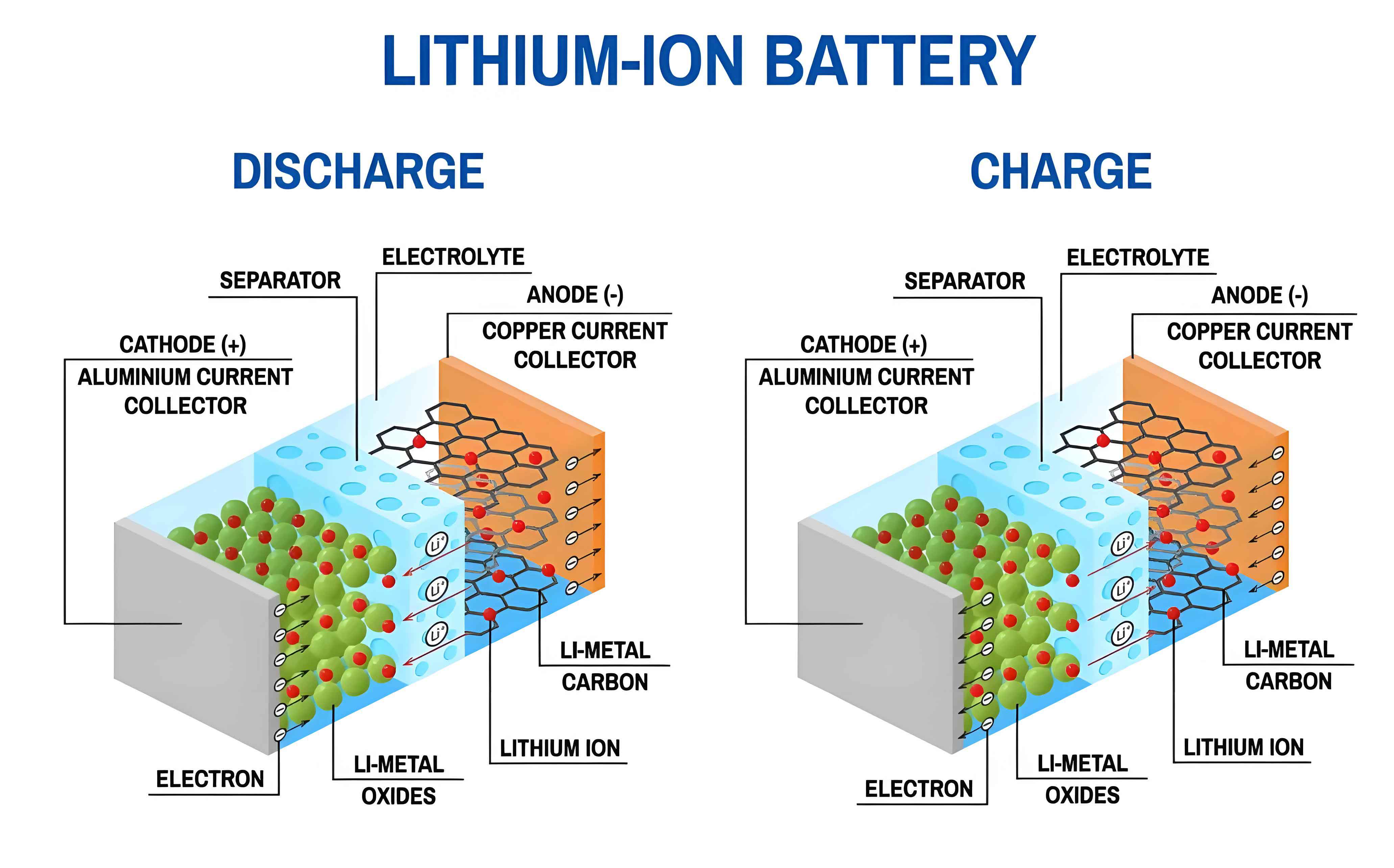
In addition to the rule-based approach, we explored potential extensions using optimization algorithms. For instance, a dynamic programming method could minimize total energy loss over a voyage profile, but it requires precise models and computational resources. Alternatively, a fuzzy logic controller could handle uncertainties in load predictions. However, our rule-based strategy offers simplicity and real-time applicability, crucial for船舶 operations where reliability is paramount. The lithium-ion battery’s fast response enables it to compensate for the aluminum-air battery’s inertia, as seen in the tests. We also considered the impact of temperature on both batteries. The aluminum-air battery’s efficiency drops at extreme temperatures, while the锂离子电池’s performance degrades if overheated. Future work could integrate thermal management into the energy strategy, further leveraging the lithium-ion battery’s robustness.
To summarize, our hybrid power system combining an aluminum-air battery and lithium-ion battery presents a viable solution for船舶 propulsion. The selected topology with separate DC/DC converters allows fine-grained control, enabling an energy management strategy that prioritizes the lithium-ion battery’s SOC and load demands. The aluminum-air battery operates at constant high power for efficiency, while the lithium-ion battery dynamically adjusts to power fluctuations, ensuring system stability and longevity. Experimental validation confirms that the strategy effectively prevents overcharge and over-discharge of the lithium-ion battery, a key factor in extending its service life. As the maritime industry moves towards greener technologies, such hybrid systems can significantly reduce emissions and operational costs. Future research will focus on adapting the strategy to real船舶工况, incorporating predictive control based on voyage data, and exploring other battery chemistries to enhance the lithium-ion battery’s synergy with aluminum-air batteries. Ultimately, the lithium-ion battery remains integral to this hybrid paradigm, offering the agility needed for modern maritime energy systems.
In conclusion, we have detailed the design and testing of a ship hybrid power system with an aluminum-air battery and lithium-ion battery. The energy management strategy, based on rule control, successfully balances power分配 to optimize efficiency and battery life. Through tables, formulas, and experimental results, we have demonstrated how the lithium-ion battery complements the aluminum-air battery, handling variable loads while maintaining system integrity. This work contributes to the advancement of新能源船舶 technologies, highlighting the critical role of the lithium-ion battery in achieving sustainable maritime operations. As we continue to refine these systems, the integration of advanced monitoring and control algorithms will further harness the potential of hybrid power, paving the way for cleaner and more efficient船舶 propulsion.