
Perovskite solar cells have emerged as a promising technology for next-generation photovoltaics due to their high power conversion efficiency and low-cost fabrication. Among them, inorganic perovskite solar cells, particularly those based on cesium lead halides, offer superior thermal and light stability compared to their organic-inorganic hybrid counterparts. However, the widespread adoption of inorganic perovskite solar cells is hindered by high defect densities and non-radiative recombination losses, which limit their efficiency. Additionally, most high-performance devices are fabricated in inert atmospheres, which complicates large-scale production. In this work, we demonstrate a strategy to fabricate efficient inverted inorganic perovskite solar cells in ambient air by incorporating 2-amino-5-bromobenzamide (ABB) into the perovskite precursor solution. This approach significantly improves the crystallinity of the perovskite film, reduces defect states, and enhances device performance and stability.
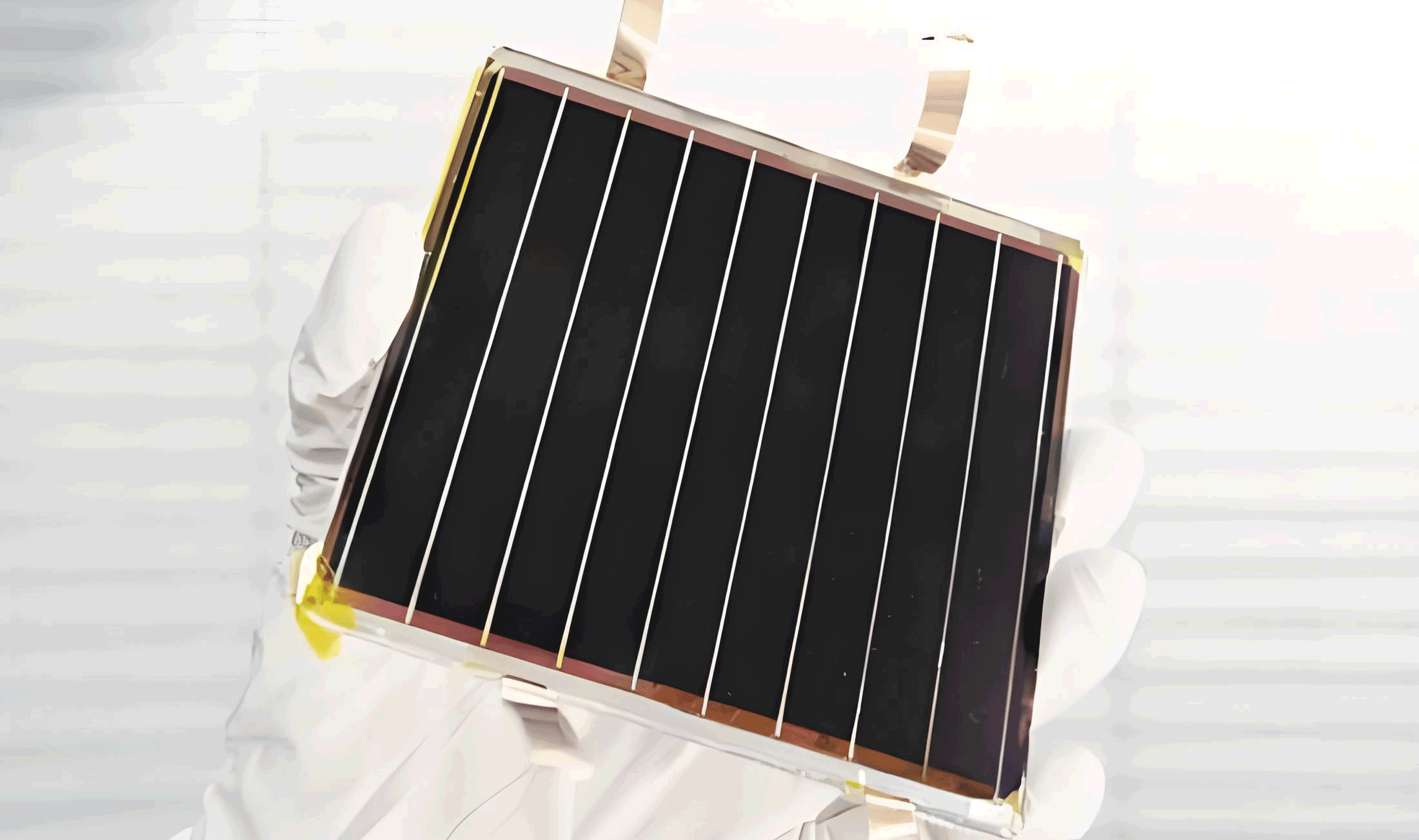
The inorganic perovskite solar cell structure employed in this study consists of ITO/NiOx/CsPbI2.85Br0.15/PC61BM/BCP/Ag, where the perovskite layer is deposited in air with relative humidity below 20%. The introduction of ABB into the precursor solution plays a critical role in modulating the crystallization process during thermal annealing. We observe that ABB molecules interact with the perovskite precursors, leading to a more uniform and pinhole-free film. This improvement is attributed to the coordination between ABB and lead ions, which slows down the crystallization kinetics and promotes the formation of larger grains with fewer defects. The enhanced film quality directly translates to reduced non-radiative recombination and higher efficiency in the resulting perovskite solar cell.
To quantify the impact of ABB on the optical properties of the perovskite film, we performed ultraviolet-visible (UV-vis) spectroscopy and steady-state photoluminescence (PL) measurements. The absorption spectra show no significant shift in the bandgap, indicating that ABB does not alter the fundamental optoelectronic properties of CsPbI2.85Br0.15. The bandgap energy, Eg, can be calculated using the Tauc plot relation:
$$(αhν)^2 = A(hν – E_g)$$
where α is the absorption coefficient, hν is the photon energy, and A is a constant. For both control and ABB-treated films, the bandgap remains approximately 1.71 eV, as derived from the Tauc plots. This consistency confirms that ABB primarily affects the morphological and electronic properties without changing the perovskite composition. However, time-resolved photoluminescence (TRPL) measurements reveal a notable increase in carrier lifetime for the ABB-treated film, from 140.36 ns to 132.16 ns, suggesting suppressed non-radiative recombination. The carrier lifetime τ can be modeled using a bi-exponential decay function:
$$I(t) = A_1 e^{-t/τ_1} + A_2 e^{-t/τ_2}$$
where I(t) is the PL intensity at time t, and A1 and A2 are amplitudes corresponding to fast and slow decay components, respectively. The prolonged lifetime in ABB-treated films indicates a reduction in trap-assisted recombination, which is crucial for high-performance perovskite solar cells.
The surface morphology of the perovskite films was characterized using scanning electron microscopy (SEM) and atomic force microscopy (AFM). The control film exhibits numerous pinholes and a rough surface, which act as non-radiative recombination centers. In contrast, the ABB-treated film shows a denser and more uniform morphology with reduced pinhole density. The root-mean-square (RMS) roughness decreases from 34.43 nm to 29.72 nm after ABB incorporation, as confirmed by AFM. This smoother surface facilitates better contact with subsequent charge transport layers, improving charge extraction and reducing interfacial recombination. Additionally, water contact angle measurements demonstrate enhanced hydrophobicity for the ABB-treated film, with contact angles increasing from 56.55° to 76.24°. This improvement in moisture resistance is vital for the stability of perovskite solar cells fabricated in air.
We evaluated the photovoltaic performance of the inverted inorganic perovskite solar cells through current density-voltage (J-V) measurements under standard AM 1.5G illumination. The key parameters, including power conversion efficiency (PCE), open-circuit voltage (VOC), fill factor (FF), and short-circuit current density (JSC), are summarized in Table 1. The ABB-treated devices show a significant enhancement in all parameters compared to the control devices. Specifically, the champion ABB-treated perovskite solar cell achieves a PCE of 19.24%, with a VOC of 1.253 V, FF of 80.17%, and JSC of 19.15 mA/cm², while the control device exhibits a PCE of 16.45%, VOC of 1.217 V, FF of 70.65%, and JSC of 19.13 mA/cm². The hysteresis effect, quantified by the difference between forward and reverse scans, is also reduced in ABB-treated perovskite solar cells, indicating improved interfacial charge transport and reduced ion migration.
| Sample | PCE (%) | VOC (V) | FF (%) | JSC (mA/cm²) |
|---|---|---|---|---|
| Control | 16.45 | 1.217 | 70.65 | 19.13 |
| ABB-treated | 19.24 | 1.253 | 80.17 | 19.15 |
The external quantum efficiency (EQE) spectra of both devices show broad spectral response from 300 to 800 nm, with integrated JSC values of 18.94 mA/cm² and 18.95 mA/cm² for control and ABB-treated perovskite solar cells, respectively, consistent with the J-V results. The minimal difference in JSC suggests that ABB does not significantly affect light absorption but primarily improves charge collection efficiency. To further understand the recombination mechanisms, we conducted dark J-V measurements and space-charge-limited current (SCLC) analysis. The dark current density of ABB-treated perovskite solar cells is lower than that of control devices, indicating reduced leakage current and suppressed shunt paths. The defect density (Nt) was calculated from the SCLC curves using the formula:
$$N_t = \frac{2εε_0 V_{TFL}}{eL^2}$$
where ε is the relative permittivity of the perovskite (assumed to be 30), ε0 is the vacuum permittivity, VTFL is the trap-filling limit voltage, e is the elementary charge, and L is the film thickness. The defect density decreases from 3.59 × 10¹⁶ cm⁻³ for control films to 3.32 × 10¹⁶ cm⁻³ for ABB-treated films, confirming the role of ABB in passivating trap states. This reduction in defect density is critical for minimizing non-radiative recombination and enhancing VOC in perovskite solar cells.
The stability of the perovskite solar cells was assessed under various environmental conditions, including storage in nitrogen, exposure to humid air (20-30% RH), thermal aging at 65°C, and continuous light soaking. The normalized PCE retention over time is summarized in Table 2. After 500 hours in humid air, the ABB-treated perovskite solar cells retain 84.01% of their initial PCE, compared to only 66.55% for control devices. Under thermal stress, the ABB-treated devices show 89.48% PCE retention versus 74.09% for controls. Similarly, after 500 hours of light soaking, the ABB-treated perovskite solar cells maintain 76.14% of their initial efficiency, while control devices degrade to 50.01%. These results highlight the superior stability of ABB-treated perovskite solar cells, attributed to the improved film morphology and reduced defect density.
| Test Condition | Duration (h) | Control PCE Retention (%) | ABB-treated PCE Retention (%) |
|---|---|---|---|
| N₂ storage (25°C) | 1800 | 92.29 | 98.45 |
| Humid air (20-30% RH) | 500 | 66.55 | 84.01 |
| Thermal aging (65°C) | 500 | 74.09 | 89.48 |
| Light soaking (100 mW/cm²) | 500 | 50.01 | 76.14 |
To elucidate the mechanism behind ABB’s effectiveness, we propose that the amino and bromo functional groups in ABB coordinate with undercoordinated lead ions and halide vacancies on the perovskite surface. This coordination passivates defects and modulates crystallization, leading to a more robust film. The crystallization process can be described by the nucleation and growth theory, where the addition of ABB increases the activation energy for nucleation, resulting in larger grains and fewer boundaries. The Gibbs free energy change for nucleation, ΔG, is given by:
$$ΔG = \frac{16πγ^3}{3(ΔG_v)^2}$$
where γ is the surface energy and ΔGv is the volume free energy change. By reducing γ through surface passivation, ABB promotes heterogeneous nucleation and improves film quality. Furthermore, the enhanced hydrophobicity of ABB-treated films reduces water ingress, which is a common degradation pathway for perovskite solar cells.
In conclusion, we have developed a simple and effective strategy to fabricate high-efficiency inverted inorganic perovskite solar cells in ambient air by incorporating ABB into the perovskite precursor. This approach improves film morphology, reduces defect density, and enhances device performance and stability. The champion ABB-treated perovskite solar cell achieves a PCE of 19.24%, with significant improvements in VOC, FF, and hysteresis. The stability tests confirm that ABB-treated devices retain over 76% of their initial efficiency after 500 hours under harsh conditions. This work paves the way for the scalable production of efficient and stable inorganic perovskite solar cells, which are essential for tandem applications with silicon bottom cells. Future studies will focus on optimizing the ABB concentration and exploring its effects in large-area modules to further advance the commercialization of perovskite solar cells.
The success of this perovskite solar cell fabrication method underscores the importance of molecular additives in modulating crystallization and passivating defects. By leveraging the synergistic effects of functional groups, we can overcome the limitations of air-processed perovskite solar cells and achieve performance comparable to devices made in inert environments. The insights gained from this study will contribute to the development of next-generation photovoltaic technologies, where perovskite solar cells play a central role in achieving high efficiency and low cost. As research progresses, we anticipate further innovations in additive engineering that will push the boundaries of perovskite solar cell performance and durability.