
In the context of growing global energy demands and increasing environmental awareness, the goals of carbon peak and carbon neutrality have become central to international efforts. As a key researcher in this field, I focus on advancing solar inverter technology, which plays a critical role in connecting photovoltaic modules to the grid. The performance of solar inverters directly impacts the efficiency and economic viability of solar power systems. However, solar inverters generate substantial heat during operation, and traditional cooling methods like natural convection or forced air cooling often fall short of meeting modern demands. Inefficient heat dissipation can lead to elevated temperatures, reduced efficiency, shortened lifespan, and potential failures in solar inverters. With the continuous improvement in power density of solar inverters, the need for advanced散热 structures has become more pressing. Therefore, I have dedicated my efforts to designing an efficient heat dissipation structure for solar inverters, aiming to enhance their performance and support the sustainable development of the photovoltaic industry under the dual-carbon objectives.
To achieve efficient heat dissipation in solar inverters, I began by selecting appropriate materials for the散热 structure. The choice of materials is crucial, as it influences thermal conductivity, weight, strength, and corrosion resistance. After evaluating various common materials, I compiled a comparative table of key performance parameters to guide the selection process. This analysis ensures that the materials not only meet thermal management needs but also align with the operational requirements of solar inverters in diverse environments.
| Material | Thermal Conductivity (W/m·K) | Density (g/cm³) | Tensile Strength (MPa) | Corrosion Resistance Level | Corrosion Rate (mm/year) |
|---|---|---|---|---|---|
| Aluminum Alloy | 140–240 | 2.30–2.80 | 110–450 | Low | < 0.010 |
| Copper | 380–400 | 8.96 | 200–300 | Low | < 0.010 |
| Stainless Steel | 14–16 | 7.80–8.00 | 500–2000 | Medium | 0.010–0.100 |
| Titanium Alloy | 15–22 | 4.50 | 280–550 | High | < 0.001 |
| Carbon Fiber Composite | 5–10 | 1.60–1.80 | 1000–1500 | Low | < 0.010 |
Based on the data in Table 1, I selected aluminum alloy for the outer shell of the heat dissipation structure in solar inverters. This choice leverages its lightweight nature, high strength, good thermal conductivity, and corrosion resistance, ensuring long-term stability in outdoor conditions for solar inverters. For the internal散热器, I opted for copper due to its superior thermal conductivity, which facilitates efficient heat conduction paths essential for high-load operations of solar inverters. This material combination addresses the specific needs of solar inverters, balancing performance and durability.
Next, I proceeded with the structural design of the heat dissipation system for solar inverters. The outer shell incorporates a streamlined shape to minimize air resistance and promote natural convective heat transfer. Additionally,散热 fins are integrated into the shell surface to increase the surface area, thereby enhancing thermal radiation efficiency. This allows heat to dissipate more effectively into the surrounding environment. The heat dissipation process in solar inverters involves three primary modes of heat transfer: conduction, convection, and radiation. For instance, heat conduction between the solar inverter chip and the internal散热器 can be described by the following equation:
$$ T_1 = -\eta S_1 \frac{\partial t}{\partial X} $$
where \( T_1 \) is the heat flux at the solar inverter chip surface, \( \eta \) is the thermal conductivity coefficient, \( S_1 \) is the surface area of the chip, and \( \frac{\partial t}{\partial X} \) represents the temperature gradient in the X-direction. Convective heat transfer between the散热器 fins and the air is governed by:
$$ T_2 = \mu S_2 \Delta t $$
where \( T_2 \) is the heat flow rate from the solar inverter chip, \( \mu \) is the convective heat transfer coefficient, \( S_2 \) is the surface area of the fins involved in heat exchange, and \( \Delta t \) is the temperature difference between the fin surface and the fluid. Thermal radiation is accounted for by:
$$ T_3 = \gamma \kappa S_3 Z (t_1^4 – t_2^4) $$
where \( T_3 \) is the heat flow rate due to radiation, \( \gamma \) is the emissivity, \( \kappa \) is the Stefan-Boltzmann constant, \( S_3 \) is the radiation area, \( Z \) is the shape factor between two radiating surfaces, and \( t_1 \) and \( t_2 \) are the absolute temperatures of the two surfaces.
To integrate these heat transfer mechanisms, I designed the散热器 using a heat pipe combined with air cooling. Heat pipes are highly efficient thermal transfer elements filled with a working fluid that undergoes phase change to facilitate heat conduction between the chip and散热器. When one end of the heat pipe (attached to the chip) is heated, the fluid evaporates and moves to the other end (near the shell), where it condenses and releases heat, completing a thermal cycle. This process is particularly effective for solar inverters, as it ensures rapid heat redistribution. Furthermore, to mitigate convective and radiative heat transfer issues, I incorporated a fan at the cold end of the散热器. The fan generates airflow that accelerates convective heat exchange on the散热器 surface, efficiently dissipating heat into the air. Innovatively, I adopted a staggered arrangement of扰流柱 within the散热器, where heat pipes are embedded to enhance fluid disturbance and mixing. This design increases the convective heat transfer coefficient and improves overall散热 performance. Additionally, a W-shaped heat pipe layout is implemented above the staggered扰流柱 to facilitate reverse reflux within the solar inverter’s散热 structure. This prevents uneven temperature distribution on the solar inverter chip surface caused by significant inlet-outlet temperature differences, ensuring uniform cooling across the device. The combination of a streamlined shell and the heat pipe plus air cooling design fulfills the efficient散热 requirements for solar inverters, addressing the challenges of modern high-power-density systems.
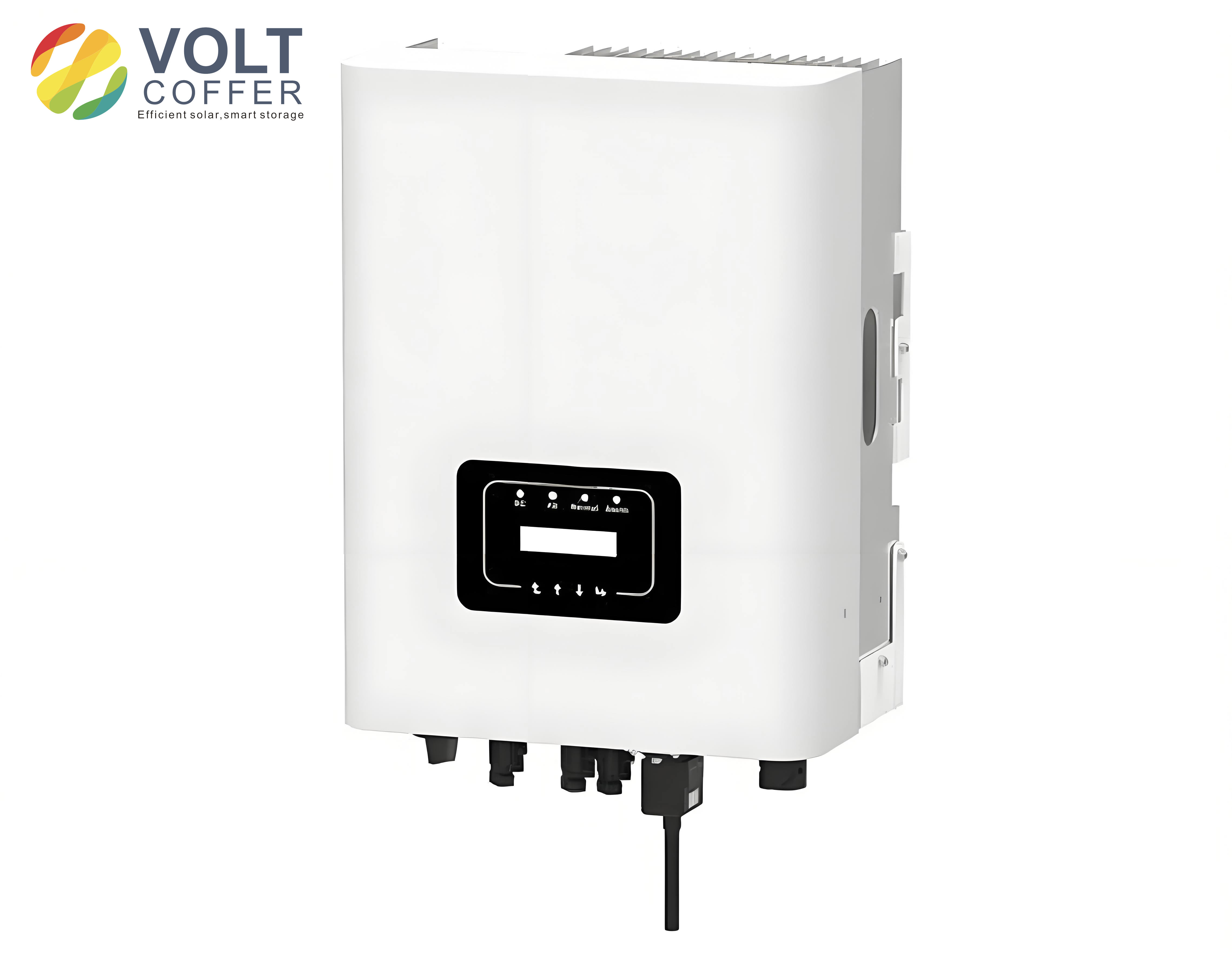
To validate the effectiveness of the designed heat dissipation structure for solar inverters, I conducted a comparative experiment. In this experiment, I prepared samples of solar inverters incorporating the efficient散热 structure as the experimental group. For control groups, I used solar inverters with traditional散热片 and fan air-cooling structures, as well as those with enhanced forced air-cooling structures. Each type of散热 structure was represented by three solar inverter samples to ensure reliability, and average measurements were taken as experimental results. The testing was performed in an outdoor photovoltaic power plant setting, where solar inverters were subjected to real-world conditions. The experiment consisted of two parts: evaluating the散热 performance under standard operating conditions and assessing the散热效果 under varying irradiance levels.
In the first part, the solar inverter samples were installed in designated locations under standard test conditions, including a direct irradiance of 1200 W/m², ambient temperature of 25°C, and wind speed of 3 m/s. The solar inverters were operated at rated power, and the surface temperature of the chips was measured using a T420 handheld infrared thermal imager. Temperature distribution cloud maps were generated using ICEPAK software, revealing that the experimental group’s solar inverters exhibited more uniform temperature distributions without significant hot spots, unlike the control groups which showed pronounced high-temperature areas and steep gradients. This demonstrates the superior散热 performance of the designed structure for solar inverters.
For the second part, I varied the direct irradiance from 1000 W/m² to 2000 W/m² and recorded the maximum chip surface temperature of the solar inverters at each irradiance level. The results are summarized in the table below, highlighting the temperature trends across different散热 structures.
| Irradiance (W/m²) | Experimental Group Temperature (°C) | Control Group 1 Temperature (°C) | Control Group 2 Temperature (°C) |
|---|---|---|---|
| 1000 | 22.0 | 26.0 | 28.0 |
| 1100 | 23.5 | 27.5 | 29.5 |
| 1200 | 24.0 | 28.0 | 30.0 |
| 1300 | 25.0 | 29.0 | 31.5 |
| 1400 | 26.0 | 30.0 | 32.5 |
| 1500 | 27.0 | 31.0 | 33.5 |
| 1600 | 28.0 | 32.0 | 34.5 |
| 1700 | 29.0 | 33.0 | 35.5 |
| 1800 | 30.0 | 34.0 | 36.5 |
| 1900 | 31.0 | 35.0 | 37.5 |
| 2000 | 32.0 | 36.0 | 38.0 |
As shown in Table 2, the experimental group’s solar inverters consistently maintained lower maximum temperatures across all irradiance levels compared to the control groups. The temperature rise in the experimental group was gradual, indicating stable散热 performance, whereas the control groups exhibited steeper increases, highlighting their inferior散热 capabilities. This can be attributed to the heat pipe and air-cooling design in the experimental solar inverters, which efficiently transfer heat from the chip to the散热 fins and dissipate it through forced convection. The staggered扰流柱 and W-shaped heat pipe layout further optimize heat distribution, preventing localized overheating and ensuring reliable operation of solar inverters under varying conditions. The results confirm that the designed散热 structure significantly enhances the散热 effect in solar inverters, contributing to improved efficiency and longevity.
In conclusion, my research on efficient heat dissipation structures for solar inverters has demonstrated the importance of material selection and innovative design. By using aluminum alloy for the shell and copper for the internal散热器, combined with a streamlined外壳 and heat pipe plus air-cooling system, I have developed a solution that effectively addresses the散热 challenges of modern solar inverters. The experimental validation under outdoor conditions shows that this structure reduces operating temperatures and ensures uniform heat distribution, thereby enhancing the performance and reliability of solar inverters. Future work should focus on further optimizing the散热 design, exploring new materials and technologies, and advancing散热 techniques for solar inverters in the context of carbon neutrality goals. This progress will support the continued innovation and adoption of solar inverters in renewable energy systems.
Throughout this study, I have emphasized the critical role of solar inverters in photovoltaic systems and the need for efficient thermal management. The integration of heat transfer principles, such as conduction, convection, and radiation, into the design process has enabled the development of a robust散热 structure for solar inverters. By continually refining these approaches, we can overcome the limitations of traditional cooling methods and pave the way for more efficient and durable solar inverters. The insights gained from this work not only benefit solar inverter technology but also contribute to the broader goals of sustainable energy development. As solar inverters evolve, their散热 structures must keep pace with increasing power densities and environmental demands, ensuring that solar power remains a viable and efficient energy source for the future.