
Perovskite solar cells have garnered significant attention in recent years due to their exceptional photovoltaic performance and straightforward fabrication processes, leading to rapid advancements in power conversion efficiency (PCE) and stability. Since the initial development of sensitized solar cells with a PCE of 3.81% using perovskite materials as light absorbers, the efficiency of perovskite solar cells has steadily increased, reaching a certified 26.95% in 2024, approaching the theoretical Shockley-Queisser limit of 33.7%. However, the long-term stability of these devices remains a critical challenge for practical applications. Optimizing the electron transport layer (ETL) is a key strategy to enhance both the PCE and stability of perovskite solar cells.
Tin dioxide (SnO2) has emerged as a prominent ETL material due to its high electron mobility, low-temperature processability, and excellent optical transparency. Despite these advantages, the fabrication of SnO2 ETLs often introduces numerous defects, such as tin interstitials (Sn_i) and oxygen vacancies (O_V), at the surface and grain boundaries. These defects can trap charge carriers, leading to severe non-radiative recombination losses that limit the PCE of perovskite solar cells. To address this issue, various modification strategies have been explored to passivate these defects and improve interfacial properties.
In this study, we propose a low-cost and efficient modification approach using acesulfame potassium (ACE-K) to enhance the SnO2 ETL. ACE-K is a commercially available compound with simple synthesis, low cost, and high chemical stability, making it suitable for large-scale applications. Its molecular structure includes sulfonyl and carbonyl groups, which can interact with undercoordinated Sn^4+ ions on the SnO2 surface, effectively passivating oxygen vacancy defects. We investigate the effects of ACE-K modification on the morphological, optical, and electronic properties of SnO2 films and the subsequent perovskite layers, as well as the overall performance of perovskite solar cells.
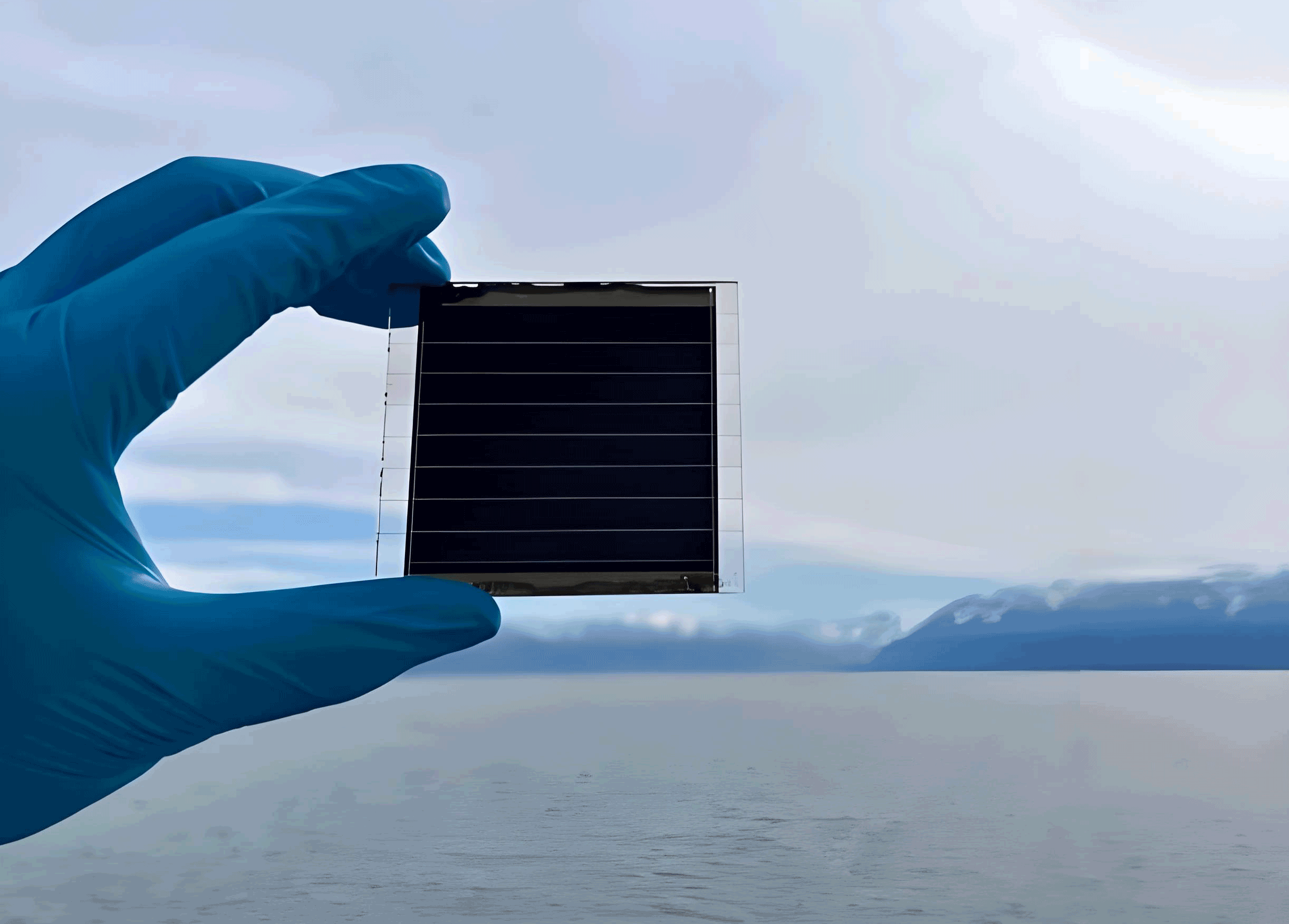
The SnO2 ETL was prepared by spin-coating a colloidal SnO2 solution diluted with deionized water (volume ratio SnO2:H2O = 1:5) onto pre-cleaned FTO substrates. ACE-K was dissolved in the SnO2 solution at various concentrations (0, 0.05, 0.1, 0.2, and 0.4 mg/mL) to form modified ETLs. The films were annealed at 150°C for 30 min. The perovskite layer was deposited using a two-step method: first, a PbI2-based precursor solution was spin-coated and pre-annealed, followed by the application of a formamidinium iodide (FAI) and methylammonium halide solution, with final annealing at 150°C. The hole transport layer (Spiro-OMeTAD) and silver electrodes were sequentially deposited to complete the perovskite solar cell devices.
Characterization techniques included scanning electron microscopy (SEM) for morphological analysis, X-ray diffraction (XRD) for crystallinity, atomic force microscopy (AFM) for surface roughness, ultraviolet-visible (UV-Vis) spectroscopy for optical properties, X-ray photoelectron spectroscopy (XPS) and Fourier-transform infrared spectroscopy (FT-IR) for chemical interactions, and electrochemical impedance spectroscopy (EIS) and space-charge-limited current (SCLC) measurements for defect and charge transport analysis. The photovoltaic performance was evaluated through current density-voltage (J-V) measurements and external quantum efficiency (EQE) spectra.
The modification of SnO2 ETL with ACE-K significantly influenced the film properties. XPS analysis revealed shifts in the Sn 3d binding energies, indicating strong interactions between ACE-K molecules and SnO2. The Sn 3d_{3/2} and Sn 3d_{5/2} peaks shifted from 494.90 eV and 486.40 eV in pristine SnO2 to 495.15 eV and 486.70 eV in ACE-K-modified SnO2, respectively. This suggests that the C=O and S=O groups in ACE-K coordinate with undercoordinated Sn^4+ ions, passivating oxygen vacancies. The O 1s XPS spectra showed a decrease in the oxygen vacancy ratio from 0.35 to 0.34 after modification, confirming defect passivation. FT-IR spectra further supported this, with the C=O stretching vibration shifting from 1637.26 cm^{-1} to 1643.05 cm^{-1}, and the appearance of a S=O vibration at 1176.3 cm^{-1}.
AFM measurements demonstrated that ACE-K modification reduced the root-mean-square (RMS) roughness of SnO2 films from 20.6 nm to 14.0 nm, indicating a smoother and more uniform surface. Contact angle tests showed a significant improvement in wettability, with the water contact angle decreasing from 23.6° to 9.9°. These morphological enhancements facilitated the growth of high-quality perovskite films, as observed in SEM images. The perovskite grain size increased from 970.90 nm on pristine SnO2 to 1071.20 nm on ACE-K-modified SnO2, leading to reduced grain boundaries and suppressed non-radiative recombination. XRD patterns confirmed improved crystallinity, with a higher intensity ratio of the perovskite (110) peak to PbI2 peaks, indicating fewer PbI2 impurities. UV-Vis absorption spectra showed enhanced light absorption in the 300–600 nm range for perovskite films on modified ETLs.
The electrical properties of the ETLs were also enhanced. The conductivity of SnO2 films, calculated using the formula:
$$\sigma = \frac{I \cdot L}{V \cdot A}$$
where $\sigma$ is the conductivity (S·cm^{-1}), $I$ is the current (A), $L$ is the film thickness (cm), $V$ is the applied voltage (V), and $A$ is the effective area (cm^2), increased from $4.60 \times 10^{-6}$ S·cm^{-1} for pristine SnO2 to $6.23 \times 10^{-6}$ S·cm^{-1} for ACE-K-modified SnO2. This higher conductivity promotes efficient electron transport and reduces charge accumulation at interfaces.
Steady-state photoluminescence (PL) and time-resolved PL (TRPL) measurements were performed to assess charge carrier dynamics. The PL intensity decreased for perovskite films on ACE-K-modified SnO2, indicating more efficient charge extraction. TRPL decay curves were fitted with a bi-exponential function, yielding shorter lifetimes ($\tau_1 = 39.85$ ns and $\tau_2 = 413.64$ ns) for modified samples compared to pristine SnO2 ($\tau_1 = 62.33$ ns and $\tau_2 = 632.12$ ns), confirming enhanced electron transfer to the ETL.
EIS analysis provided insights into the charge transport and recombination processes. The Nyquist plots were fitted with an equivalent circuit model, and the parameters are summarized in Table 1. The charge transfer resistance ($R_{ct}$) decreased from 53.97 kΩ for pristine devices to 38.47 kΩ for ACE-K-modified devices, while the recombination resistance ($R_{rec}$) increased from 136.09 kΩ to 154.69 kΩ. This indicates improved charge transport and suppressed non-radiative recombination in perovskite solar cells with modified ETLs.
| Sample | $R_s$ (Ω) | $R_{ct}$ (kΩ) | $R_{rec}$ (kΩ) | $C_1$ (×10^{-9} F) | $C_2$ (×10^{-8} F) |
|---|---|---|---|---|---|
| Pristine SnO2 | 23.3 | 53.97 | 136.09 | 5.0 | 8.52 |
| ACE-K-Modified SnO2 | 17.79 | 38.47 | 154.69 | 3.96 | 6.7 |
SCLC measurements were conducted on electron-only devices to quantify the defect density ($N_{trap}$) in perovskite films. The $N_{trap}$ was calculated using the formula:
$$V_{TFL} = \frac{e N_{trap} L^2}{2 \epsilon \epsilon_0}$$
where $V_{TFL}$ is the trap-filling limit voltage (V), $e$ is the elementary charge, $L$ is the film thickness (cm), $\epsilon$ is the relative permittivity of perovskite (46.9), and $\epsilon_0$ is the vacuum permittivity. The $V_{TFL}$ decreased from 0.96 V for pristine devices to 0.76 V for modified devices, corresponding to a reduction in $N_{trap}$ from $4.84 \times 10^{16}$ cm^{-3} to $3.83 \times 10^{16}$ cm^{-3}. This defect passivation contributes to higher open-circuit voltage ($V_{OC}$) and fill factor (FF) in perovskite solar cells.
The photovoltaic performance of perovskite solar cells was evaluated under standard illumination conditions. The J-V curves for devices with different ACE-K concentrations are shown in Figure 1, and the champion device parameters are summarized in Table 2. The pristine SnO2-based devices exhibited a PCE of 19.27%, with a $V_{OC}$ of 1.112 V, short-circuit current density ($J_{SC}$) of 22.85 mA·cm^{-2}, and FF of 75.90%. After ACE-K modification, the optimal concentration of 0.2 mg/mL yielded a PCE of 21.60%, with $V_{OC}$ = 1.135 V, $J_{SC}$ = 23.97 mA·cm^{-2}, and FF = 79.30%. The enhancement in $V_{OC}$ and FF is attributed to reduced non-radiative recombination, while the improved $J_{SC}$ results from better charge extraction and light absorption. The EQE spectra showed higher incident photon-to-current conversion efficiency across the visible spectrum, with integrated current densities of 22.48 mA·cm^{-2} and 23.47 mA·cm^{-2} for pristine and modified devices, respectively, consistent with the J-V measurements.
| ACE-K Concentration (mg/mL) | $V_{OC}$ (V) | $J_{SC}$ (mA·cm^{-2}) | FF (%) | PCE (%) |
|---|---|---|---|---|
| 0 | 1.112 | 22.85 | 75.90 | 19.27 |
| 0.05 | 1.127 | 23.84 | 77.00 | 20.68 |
| 0.1 | 1.128 | 24.32 | 76.10 | 20.87 |
| 0.2 | 1.135 | 23.97 | 79.30 | 21.60 |
| 0.4 | 1.129 | 23.71 | 77.40 | 20.72 |
The stability of perovskite solar cells is crucial for practical deployment. We assessed the operational stability by measuring the steady-state current output under continuous illumination. The ACE-K-modified devices exhibited more stable current output over 100 seconds compared to pristine devices. Long-term stability was evaluated by storing unencapsulated devices in a nitrogen atmosphere. After 2160 hours, the ACE-K-modified perovskite solar cells retained 91.67% of their initial PCE, while pristine devices retained only 82.63%. Humidity stability tests were conducted at room temperature and 60±5% relative humidity (RH). After 7 days, the modified devices maintained 62.12% of their initial PCE, whereas pristine devices degraded to 30.12%. The enhanced stability is attributed to the larger perovskite grain size, improved crystallinity, and reduced defect density resulting from ACE-K modification.
In conclusion, the incorporation of ACE-K as a modifier for SnO2 ETLs effectively passivates oxygen vacancy defects through chemical interactions between C=O/S=O groups and Sn^4+ ions. This leads to smoother and more hydrophilic ETL surfaces, promoting the growth of high-quality perovskite films with larger grains and reduced defects. The enhanced electrical conductivity, charge transport, and suppressed non-radiative recombination contribute to significant improvements in the PCE and stability of perovskite solar cells. This study demonstrates a simple and cost-effective strategy for advancing perovskite solar cell technology, with potential applications in scalable manufacturing. Future work could explore the integration of ACE-K with other ETL materials or its use in tandem perovskite solar cells to further push the efficiency limits.
The development of efficient and stable perovskite solar cells remains a key focus in photovoltaics research. The use of multifunctional molecules like ACE-K highlights the importance of interfacial engineering in achieving high-performance devices. As perovskite solar cells continue to evolve, strategies that combine defect passivation, morphological control, and enhanced charge transport will be essential for commercial viability. The insights from this study contribute to the broader effort of optimizing perovskite solar cells for renewable energy applications.