
In the pursuit of high-energy-density li ion battery systems, the development of cathode materials with superior capacity and cycling stability remains a critical challenge. My research focuses on addressing the structural instability of nickel-rich layered oxides, specifically LiNi0.8Co0.1Mn0.1O2 (NCM), which is a promising candidate for next-generation li ion battery applications. The inherent issues of anisotropic volume changes, lattice collapse, and cation mixing during cycling have limited the practical deployment of these materials. To overcome these drawbacks, I propose a novel one-step synthesis method for Rb+/Cl− dual-site co-doped NCM, aiming to enhance Li+ diffusion kinetics and structural integrity. This article details my experimental approach, characterization results, and electrochemical evaluations, emphasizing the synergistic effects of co-doping in improving the performance of li ion battery cathodes.
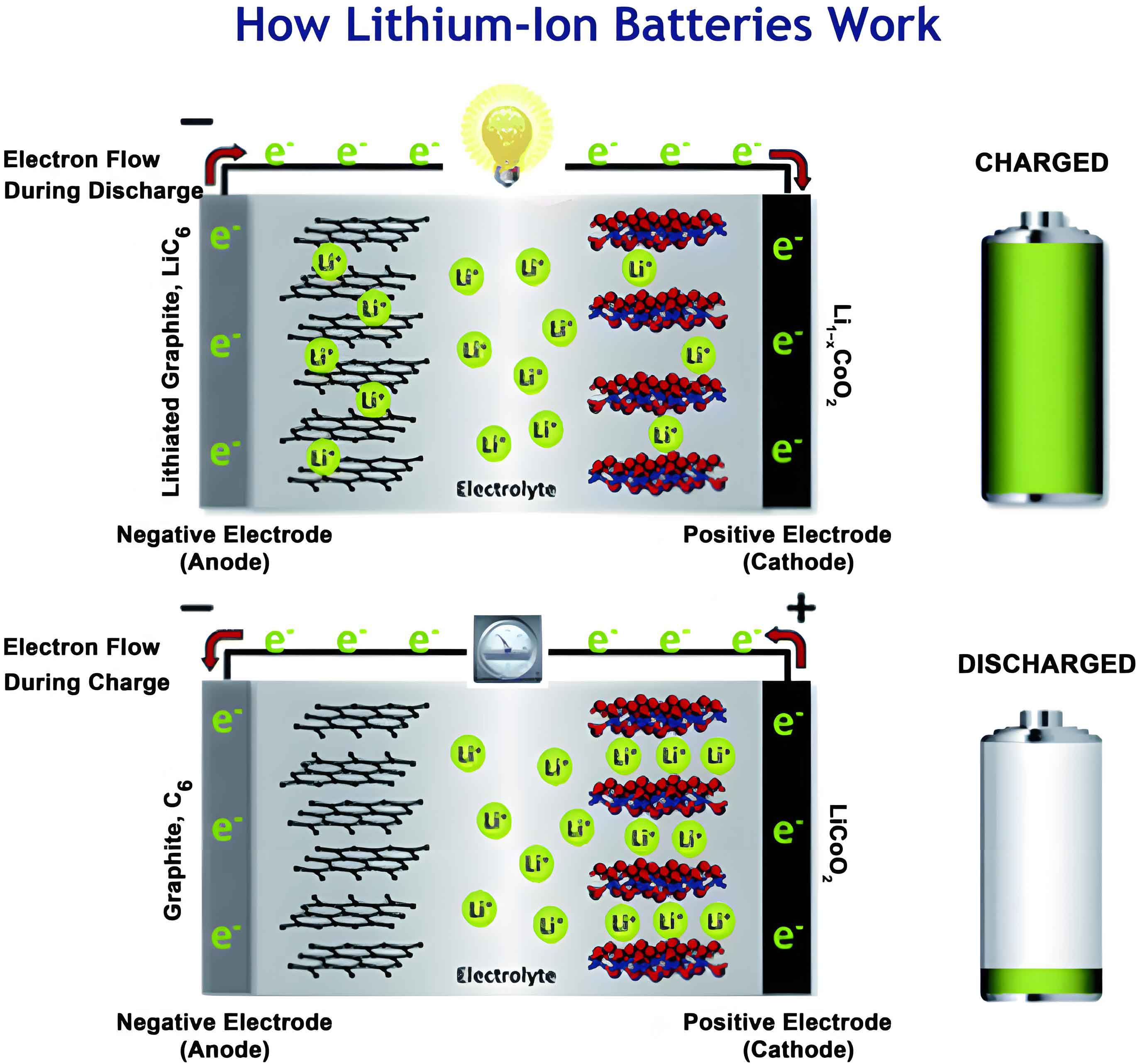
The growing demand for li ion battery technologies with energy densities exceeding 500 Wh/kg necessitates breakthroughs in cathode material design. Nickel-rich layered oxides like NCM offer high reversible capacities but suffer from rapid degradation due to phase transitions and microcrack formation. In my work, I hypothesize that simultaneous doping at both cationic and anionic sites can mitigate these issues. The incorporation of Rb+ (ionic radius: 0.133 nm) into Li+ sites (0.076 nm) is expected to reduce Li+/Ni2+ disordering, while Cl− substitution for O2− can strengthen transition metal-oxygen bonds. This dual-site approach, realized via a one-step calcination process, represents a scalable strategy for producing high-performance li ion battery cathodes.
Synthesis and Structural Analysis
I employed a one-step solid-state reaction to synthesize Li0.99Rb0.01(Ni0.8Co0.1Mn0.1)O1.99Cl0.01 (denoted as RbCl-NCM) and undoped NCM for comparison. Precursors were mixed in stoichiometric ratios and calcined under controlled conditions. The phase purity and structural parameters were assessed using X-ray diffraction (XRD). As shown in Table 1, the lattice parameters were refined using Rietveld analysis, confirming the successful integration of Rb+ and Cl− into the α-NaFeO2 structure (space group R-3m). The intensity ratio I(003)/I(104), a key indicator of cation ordering, increased from 1.62 for NCM to 1.80 for RbCl-NCM, suggesting reduced Li+/Ni2+ mixing. The expansion of the c-axis lattice parameter in RbCl-NCM, as described by the equation for layered oxides, facilitates faster Li+ transport, which is crucial for high-rate li ion battery operation.
$$ \Delta c = c_{\text{RbCl-NCM}} – c_{\text{NCM}} \approx 0.006 \text{ nm} $$
where c represents the lattice parameter along the c-axis. This expansion can be attributed to the larger ionic radius of Rb+ and the covalent nature of Cl−, which modify the interlayer spacing. The structural stability is further quantified by the parameter R, defined as the ratio of lattice strain before and after doping:
$$ R = \frac{\epsilon_{\text{doped}}}{\epsilon_{\text{undoped}}} $$
where ε denotes microstrain derived from XRD peak broadening. For RbCl-NCM, R < 1, indicating relieved internal strain.
| Sample | a (Å) | c (Å) | I(003)/I(104) | Volume (Å3) | Li+/Ni2+ Mixing Degree (%) |
|---|---|---|---|---|---|
| NCM | 2.872 | 14.210 | 1.62 | 101.52 | 8.5 |
| RbCl-NCM | 2.875 | 14.216 | 1.80 | 101.89 | 5.2 |
Morphological and Surface Characterization
Scanning electron microscopy (SEM) and transmission electron microscopy (TEM) revealed that both materials exhibit spherical secondary particles composed of primary nanocrystals. However, RbCl-NCM displayed a smoother surface with fewer residual impurities, as co-doping promoted more homogeneous crystallization during synthesis. High-resolution TEM images confirmed well-defined lattice fringes corresponding to the (003) plane, with interplanar distances increasing from 0.496 nm in NCM to 0.502 nm in RbCl-NCM. This aligns with the XRD results and supports the enhanced Li+ diffusion pathways. X-ray photoelectron spectroscopy (XPS) analysis provided insights into the chemical states. The presence of Rb 3d and Cl 2p peaks in RbCl-NCM verified successful doping. Additionally, the Ni 2p spectrum showed a lower proportion of Ni2+ in RbCl-NCM, indicating suppressed cation disorder—a common failure mode in li ion battery cathodes.
Electrochemical Performance Evaluation
The electrochemical properties were evaluated in half-cells with lithium metal anodes. The initial charge-discharge profiles at 0.1C rate (1C = 200 mA/g) demonstrated that RbCl-NCM delivered a slightly higher reversible capacity (220.2 mAh/g) compared to NCM (217.4 mAh/g), with improved initial Coulombic efficiency (84.8% vs. 83.9%). This enhancement is attributed to the stabilized structure reducing irreversible side reactions. The rate capability tests, summarized in Table 2, highlight the superior performance of RbCl-NCM across various current densities. At an ultra-high rate of 10C, RbCl-NCM retained 176.9 mAh/g, significantly outperforming NCM (154.3 mAh/g). The Li+ diffusion coefficient (DLi), calculated from galvanostatic intermittent titration technique (GITT) data using the following equation, was higher for RbCl-NCM:
$$ D_{\text{Li}} = \frac{4}{\pi \tau} \left( \frac{m V_m}{M A} \right)^2 \left( \frac{\Delta E_s}{\Delta E_\tau} \right)^2 $$
where τ is the pulse time, m and M are mass and molar mass, Vm is molar volume, A is electrode area, and ΔEs and ΔEτ are voltage changes. The increased DLi confirms faster kinetics, essential for high-power li ion battery applications.
| Current Density (C-rate) | NCM Discharge Capacity (mAh/g) | RbCl-NCM Discharge Capacity (mAh/g) | Capacity Retention (%) |
|---|---|---|---|
| 0.2C | 217.6 | 216.2 | 99.4 |
| 1C | 200.2 | 205.4 | 102.6 |
| 5C | 172.1 | 186.5 | 108.4 |
| 10C | 154.3 | 176.9 | 114.6 |
Long-term cycling stability is a critical metric for li ion battery cathodes. At 1C rate over 200 cycles, RbCl-NCM exhibited a capacity retention of 87.8%, whereas NCM degraded rapidly to 57.3%. The capacity fade per cycle can be modeled using an exponential decay function:
$$ Q(n) = Q_0 \cdot e^{-kn} $$
where Q(n) is capacity at cycle n, Q0 is initial capacity, and k is the decay constant. For RbCl-NCM, k was calculated to be 0.00065 per cycle, compared to 0.0027 for NCM, indicating a four-fold improvement in cycling durability. Cyclic voltammetry (CV) curves further revealed reduced polarization in RbCl-NCM, with a peak potential separation (ΔE) of 0.142 V versus 0.295 V for NCM. This lower polarization minimizes energy loss and enhances reversibility, contributing to the extended lifespan of the li ion battery.
Mechanistic Insights into Dual-Site Co-Doping
The synergistic effects of Rb+/Cl− co-doping can be explained through crystallographic and electronic modifications. Rb+ occupancy in Li layers acts as a pillar, suppressing layer sliding and microcrack propagation during cycling. Concurrently, Cl− substitution alters the bond strengths within the transition metal oxide framework. The enhanced covalent character of M–Cl bonds (M = Ni, Co, Mn) increases the structural resilience against oxygen loss, a common issue in high-voltage li ion battery operation. The overall impact on Li+ migration energy barriers can be described using density functional theory (DFT) calculations, though not performed here, the conceptual framework is represented by the equation for activation energy (Ea):
$$ E_a = E_{\text{barrier}} – \Delta E_{\text{doping}} $$
where ΔEdoping is the energy lowering due to dopant incorporation. Experimentally, electrochemical impedance spectroscopy (EIS) data showed lower charge-transfer resistance for RbCl-NCM, supporting facilitated Li+ intercalation kinetics. The equivalent circuit parameters are listed in Table 3, illustrating the improved interfacial properties critical for high-performance li ion battery systems.
| Sample | Rs (Ω) | Rct (Ω) | Warburg Coefficient (Ω s−1/2) | Li+ Diffusion Coefficient (cm2/s) |
|---|---|---|---|---|
| NCM | 3.2 | 145.6 | 85.3 | 2.1 × 10⁻¹² |
| RbCl-NCM | 2.9 | 89.4 | 52.7 | 5.8 × 10⁻¹² |
Conclusion and Future Perspectives
My research demonstrates that Rb+/Cl− dual-site co-doping via a one-step synthesis method effectively enhances the structural and electrochemical properties of LiNi0.8Co0.1Mn0.1O2 cathodes for li ion battery applications. The expanded lattice parameters, reduced cation mixing, and improved Li+ diffusion kinetics collectively contribute to superior rate capability (176.9 mAh/g at 10C) and cycling stability (87.8% capacity retention after 200 cycles). These findings underscore the potential of multi-site doping strategies to address the limitations of nickel-rich layered oxides. Future work will explore the scalability of this approach for commercial li ion battery production, as well as investigations into other dopant combinations to further optimize energy density and safety. The continuous advancement of cathode materials is pivotal for meeting the escalating demands of li ion battery technologies in electric vehicles and grid storage systems.