
In modern power systems, the integration of renewable energy sources heavily relies on grid-connected inverters. These devices convert DC power from sources like solar panels or wind turbines into AC power that can be fed into the electrical grid. Among various filter topologies, the LCL filter is widely adopted for grid-connected inverters due to its superior harmonic attenuation characteristics compared to simple L filters. However, the low-damping nature of LCL filters can lead to resonance issues, potentially causing instability in control systems. Digital control implementations introduce additional challenges, such as control delays and discretization errors, which degrade dynamic performance, compromise active damping, and exacerbate the impact of grid voltage background harmonics. In this article, I present a comprehensive discrete-domain current control strategy for LCL-type grid-connected inverters, focusing on enhancing dynamic response and suppressing background harmonics through a state-space framework combined with capacitor voltage feedforward.
The core of my approach lies in designing the controller directly in the discrete domain, incorporating control delays into the plant model. This allows for precise pole placement to achieve desired dynamic performance and active damping. Furthermore, I derive a capacitor voltage feedforward function in the discrete domain to reshape the output admittance, thereby reducing its magnitude at harmonic frequencies and improving immunity to grid voltage distortions. The control parameters are derived analytically based on physical system parameters, enabling automatic tuning and ensuring robustness. Throughout this discussion, the term ‘grid connected inverter’ will be frequently emphasized, as it is the central application of this research.
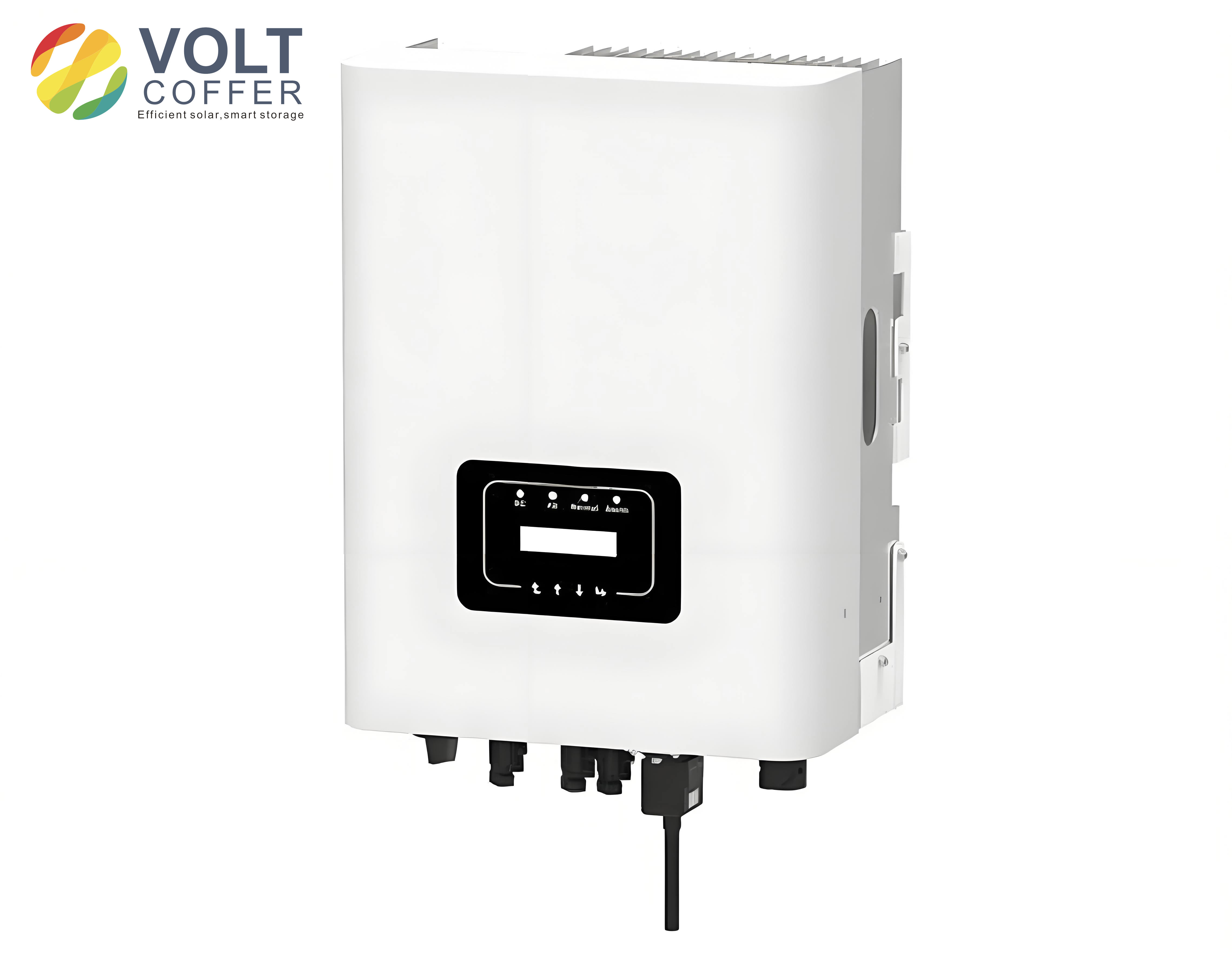
To establish a foundation, let us first consider the mathematical model of a three-phase LCL-type grid connected inverter. The system topology includes a DC-link capacitor, a three-phase inverter bridge, an LCL filter (comprising inverter-side inductor $L_{fc}$, filter capacitor $C_f$, and grid-side inductor $L_2$), and the grid with an equivalent impedance $L_g$. The grid-side total inductance is $L_{fg} = L_2 + L_g$. In the synchronous reference frame ($dq$-frame), the state-space model using complex vector representation (where a variable like inverter-side current $i_c = i_{cd} + j i_{cq}$) is formulated. Defining the state vector as $\mathbf{x} = [i_c, u_f, i_g]^T$, where $u_f$ is the capacitor voltage and $i_g$ is the grid current, the continuous-time state equations are:
$$\dot{\mathbf{x}} = \mathbf{A} \mathbf{x} + \mathbf{B}_c u_c + \mathbf{B}_g u_g$$
$$i_c = \mathbf{C}_c \mathbf{x}$$
with the matrices defined as:
$$
\mathbf{A} = \begin{bmatrix}
-j\omega_g & -\frac{1}{L_{fc}} & 0 \\
\frac{1}{C_f} & -j\omega_g & -\frac{1}{C_f} \\
0 & \frac{1}{L_{fg}} & -j\omega_g
\end{bmatrix}, \quad \mathbf{B}_c = \begin{bmatrix} \frac{1}{L_{fc}} \\ 0 \\ 0 \end{bmatrix}, \quad \mathbf{B}_g = \begin{bmatrix} 0 \\ 0 \\ -\frac{1}{L_{fg}} \end{bmatrix}, \quad \mathbf{C}_c = [1, 0, 0].
$$
Here, $\omega_g$ is the grid angular frequency, $u_c$ is the inverter output voltage, and $u_g$ is the grid voltage. The open-loop transfer function from $u_c(s)$ to $i_c(s)$ is:
$$G_{ol}(s) = \mathbf{C}_c (s\mathbf{I} – \mathbf{A})^{-1} \mathbf{B}_c = \frac{1}{L_{fc}} \cdot \frac{(s + j\omega_g)^2 + \omega_z^2}{(s + j\omega_g)[(s + j\omega_g)^2 + \omega_p^2]},$$
where the anti-resonance frequency $\omega_z$ and resonance frequency $\omega_p$ are:
$$\omega_z = \frac{1}{\sqrt{L_{fg} C_f}}, \quad \omega_p = \sqrt{\frac{L_{fc} + L_{fg}}{L_{fc} L_{fg} C_f}}.$$
For digital implementation, a discrete-time model is essential. Assuming a zero-order hold for the inverter output and a constant grid voltage in the synchronous frame over a sampling period $T_s$, the exact discretization yields:
$$\mathbf{x}(k+1) = \mathbf{\Phi} \mathbf{x}(k) + \mathbf{\Gamma}_c u_c(k) + \mathbf{\Gamma}_g u_g(k)$$
$$i_c(k) = \mathbf{C}_c \mathbf{x}(k),$$
where $\mathbf{\Phi} = e^{\mathbf{A} T_s}$, $\mathbf{\Gamma}_c = \int_0^{T_s} e^{\mathbf{A} \tau} e^{-j\omega_g (T_s-\tau)} d\tau \, \mathbf{B}_c$, and $\mathbf{\Gamma}_g = \int_0^{T_s} e^{\mathbf{A} \tau} d\tau \, \mathbf{B}_g$. The explicit expressions for these matrices, while detailed, are functions of $\omega_p$, $\omega_z$, $\omega_g$, and $T_s$. To account for the one-sample computational delay inherent in digital control, the model is augmented. The delay is represented as $u_c(k) = u’_{c,ref}(k-1)$, where $u’_{c,ref}$ is the delayed reference voltage. The augmented discrete plant model becomes:
$$\mathbf{x}_d(k+1) = \mathbf{\Phi}_d \mathbf{x}_d(k) + \mathbf{\Gamma}_{cd} u’_{c,ref}(k) + \mathbf{\Gamma}_{gd} u_g(k)$$
$$i_c(k) = \mathbf{C}_d \mathbf{x}_d(k),$$
with $\mathbf{x}_d = [\mathbf{x}^T, u_c]^T$, $\mathbf{\Phi}_d = \begin{bmatrix} \mathbf{\Phi} & \mathbf{\Gamma}_c \\ \mathbf{0} & 0 \end{bmatrix}$, $\mathbf{\Gamma}_{cd} = [\mathbf{0}, 1]^T$, $\mathbf{\Gamma}_{gd} = [\mathbf{\Gamma}_g, 0]^T$, and $\mathbf{C}_d = [\mathbf{C}_c, 0]$. This augmented model explicitly includes the delay state, forming the basis for the discrete-domain controller design for the grid connected inverter.
The proposed control strategy for the LCL grid connected inverter consists of two main parts: a state-feedback current controller with integral action and a capacitor voltage feedforward path. The control law is given by:
$$u’_{c,ref}(k) = k_t i_{c,ref}(k) + k_i x_I(k) – \mathbf{K}(\mathbf{z}) \mathbf{x}_d(k),$$
where $i_{c,ref}$ is the reference current, $x_I$ is the integral state ($x_I(k+1) = x_I(k) + i_{c,ref}(k) – i_c(k)$), $k_t$ is a reference feedforward gain, $k_i$ is the integral gain, and $\mathbf{K}(\mathbf{z}) = [k_1, k_2 – G_{cvf}(z), k_3, k_4]$ is the state feedback gain vector. The term $G_{cvf}(z)$ is the discrete-domain capacitor voltage feedforward function, which will be detailed later. Initially, considering $\mathbf{K} = [k_1, k_2, k_3, k_4]$ without feedforward, the closed-loop system can be described by an augmented state-space model. The pole placement design is performed in the z-domain. The desired closed-loop characteristic polynomial is set as:
$$a(z) = z^5 + a_4 z^4 + a_3 z^3 + a_2 z^2 + a_1 z + a_0.$$
The poles are assigned based on performance specifications: two dominant poles ($\alpha_1, \alpha_2$) determine the bandwidth $\omega_{cd}$ and are often placed with critical damping ($\xi_{cd}=1$), two poles ($\alpha_3, \alpha_4$) are placed near the LCL resonance frequency $\omega_p$ with light damping ($\xi_{cr}=0.2$) to provide active damping, and one pole at the origin accounts for the delay. The coefficients $a_i$ are calculated from these desired poles. By matching the actual closed-loop characteristic polynomial derived from the state-feedback system to the desired one, the controller gains $k_1, k_2, k_3, k_4, k_i$ can be solved analytically. The feedforward gain $k_t$ is designed to cancel one of the dominant poles, typically $k_t = k_i / (1 – \alpha_1)$, simplifying the system to approximate first-order dynamics. This state-feedback approach significantly improves the dynamic response of the grid connected inverter.
To enhance the grid connected inverter’s ability to reject background harmonics in the grid voltage, a capacitor voltage feedforward path is introduced. The feedforward function $G_{cvf}(z)$ is designed directly in the discrete domain to modify the output admittance of the inverter. The output admittance, defined as the transfer function from grid voltage $u_g$ to grid current $i_g$, determines the harmonic rejection capability. A lower magnitude at harmonic frequencies indicates better suppression. The proposed feedforward function is:
$$G_{cvf}(z) = \frac{k_{c1}(z-1)}{(z-\lambda_1)(z-\lambda_2)} + \frac{k_{c2}(z-1)^2}{(z-\lambda_1)(z-\lambda_2)(z+0.6)},$$
where $\lambda_1$ and $\lambda_2$ are complex conjugate poles constructed at a target harmonic frequency (e.g., for 5th and 7th harmonics in the abc frame, corresponding to 6th harmonic in the dq-frame, $n=6$):
$$\lambda_{1,2} = \exp\left[\left(-\omega_c \pm j\sqrt{(n\omega_g)^2 – \omega_c^2}\right) T_s\right].$$
Here, $\omega_c$ is a bandwidth parameter for the feedforward filter. The coefficients $k_{c1}$ and $k_{c2}$ are derived based on the system parameters to ensure proper admittance reshaping. Their expressions are:
$$k_{c1} = 0.002 \left( \frac{m_0}{K_{pwm}} + C_f k_1 j\omega_g + C_f k_i – \frac{C_f L_{fc} \omega_g^2}{K_{pwm}} + k_2 + k_4 (1 – C_f L_{fc} \omega_g^2) \right),$$
$$k_{c2} = 48 \left( \frac{m_1}{2} \frac{C_f L_{fc} j\omega_g}{K_{pwm}} + 2k_4 C_f L_{fc} j\omega_g + \frac{1.5T_s (1 – C_f L_{fc} \omega_g^2)}{K_{pwm}} + C_f k_1 \right),$$
where $K_{pwm}$ is the PWM gain, and $m_0, m_1$ are tuning coefficients related to the filter design. This feedforward effectively reduces the output admittance magnitude at the selected harmonic frequencies without affecting the reference tracking performance, as the introduced zeros cancel the added poles. The integration of this feedforward into the state feedback law yields the final control signal for the grid connected inverter.
The performance of the proposed discrete-domain control strategy for the LCL grid connected inverter was validated through simulations and experiments. The system parameters used are typical for a 50 kW inverter and are summarized in the table below.
| Parameter | Symbol | Value |
|---|---|---|
| DC-link Voltage | $V_{dc}$ | 660 V |
| Grid Voltage (RMS) | $V_g$ | 380 V |
| Grid Frequency | $f_g$ | 50 Hz |
| Switching Frequency | $f_{sw}$ | 15 kHz |
| Sampling Time | $T_s$ | $1/15000$ s |
| Inverter-side Inductor | $L_{fc}$ | 0.6 mH |
| Filter Capacitor | $C_f$ | 20 µF |
| Grid-side Inductor | $L_2$ | 0.4 mH |
| Design Bandwidth | $\omega_{cd}/(2\pi)$ | 300 Hz |
| Resonance Frequency | $\omega_{p}/(2\pi)$ | $\approx 1.15$ kHz |
Simulation studies were conducted to evaluate dynamic response and harmonic rejection. The step response of the inverter-side current showed a rise time of approximately 2 ms with minimal overshoot, confirming the high dynamic performance achieved by the state-feedback design. The impact of grid impedance variation was also studied. As the grid inductance $L_g$ increased, the current response exhibited slightly more overshoot and coupling between d and q axes, but the system remained stable within a reasonable range. The table below summarizes the step response characteristics under different grid short-circuit ratios (SCR).
| Grid Impedance $L_g$ | SCR | Rise Time (approx.) | Overshoot |
|---|---|---|---|
| 0 mH (Small) | >10 | 2 ms | Negligible |
| 1 mH | 8.25 | 2 ms | Moderate |
| 2 mH | 4.1 | 2-3 ms | Increased |
For harmonic suppression, the grid voltage was distorted with 8% of 5th and 7th harmonics. Without the capacitor voltage feedforward, the grid current total harmonic distortion (THD) was as high as 15.44%, which is unacceptable for grid codes. With the proposed feedforward enabled, the grid current THD was reduced to 2.17%, demonstrating excellent background harmonic rejection capability for the grid connected inverter. The output admittance Bode plots confirmed a significant reduction in magnitude at the harmonic frequencies (300 Hz and 350 Hz for 5th and 7th harmonics, respectively) when the feedforward was active.
Stability and robustness are critical for any grid connected inverter control system. A parameter sensitivity analysis was performed. The closed-loop system remained stable for substantial variations in LCL filter parameters: the inverter-side inductance $L_{fc}$ could vary from 20% to 200% of its nominal value, the filter capacitor $C_f$ from 50% to 200%, and the grid-side inductance $L_{fg}$ from 20% to 200%. Furthermore, the system maintained stability for grid impedance variations corresponding to a short-circuit ratio (SCR) down to approximately 2.75. The phase margin decreased with increasing grid inductance, but remained sufficient for stability. The following table outlines the stability margins under different grid conditions.
| Grid Impedance $L_g$ | SCR | Phase Margin | Stability |
|---|---|---|---|
| 0 mH | >10 | >85° | Stable |
| 1 mH | 8.25 | 85° | Stable |
| 2 mH | 4.1 | 72° | Stable |
| 3 mH | 2.75 | 63° | Stable |
Experimental validation was carried out on a 50 kW three-phase LCL grid connected inverter prototype. The experimental results corroborated the simulation findings. The current step response exhibited a fast rise time of about 2 ms under normal grid conditions. When connected to a real grid with inherent background harmonics (containing 5th, 7th, 13th, 17th, and 19th harmonics), the control strategy without feedforward resulted in a grid current THD of 13.26%. Enabling the discrete-domain capacitor voltage feedforward reduced the THD to 2.72%, clearly demonstrating its practical effectiveness. The system also operated stably for grid impedance variations up to $L_g = 2$ mH (SCR=4.1).
The discrete-domain design methodology offers several advantages for controlling an LCL grid connected inverter. By incorporating the computational delay into the plant model, the controller is optimized for the actual discrete-time system, avoiding performance degradation due to approximation. The state-feedback with pole placement allows direct control over the closed-loop dynamics and resonance damping. The analytical derivation of control parameters from desired pole locations and physical parameters simplifies the tuning process and enhances repeatability. The supplementary capacitor voltage feedforward, designed in the z-domain, provides a targeted reduction in output admittance at specific harmonic frequencies, effectively decoupling the grid current from distorted grid voltages without compromising dynamic response.
In conclusion, this article has presented a robust and high-performance discrete-domain current control strategy for LCL-type grid connected inverters. The approach combines state-feedback control with capacitor voltage feedforward, both designed explicitly in the discrete domain. Key outcomes include improved dynamic response with configurable bandwidth, effective active damping of LCL resonance, and significant suppression of grid voltage background harmonics. The controller parameters are derived analytically, promoting automatic tuning based on system specifications. Simulation and experimental results on a 50 kW platform confirm the strategy’s efficacy, showcasing fast transient response, low harmonic distortion in grid current, and robust stability under parameter variations. This work contributes to advancing the control techniques for modern grid connected inverters, which are pivotal for the reliable integration of renewable energy sources into the power grid.