
The accumulation of dust and particulate matter on the surface of solar panels is a significant operational challenge, particularly in regions with high solar insolation but arid, dusty environments. This soiling layer directly attenuates incident sunlight, leading to substantial reductions in power output and overall energy yield. Conventional cleaning methods, predominantly high-pressure water washing or mechanical sprayers, are heavily reliant on water resources. This dependency poses a severe constraint in precisely the water-scarce regions where large-scale photovoltaic (PV) plants are often deployed. Furthermore, these methods can be labor-intensive, potentially damaging to panel surfaces, and inefficient on soft terrain. To address these critical shortcomings, this study focuses on the design, development, and field validation of a novel, water-free cleaning solution: a Movable Dry Cleaning System (MDCS).
The detrimental impact of soiling on solar panels is well-documented. The deposited dust layer reduces the transmittance of the protective glass, directly decreasing the irradiance reaching the photovoltaic cells. The power loss is not linear and can become severe over short periods without rain or cleaning. Studies have shown efficiency drops exceeding 20% with moderate dust accumulation. Beyond energy loss, uneven soiling can create hot spots, leading to long-term degradation and potential safety hazards. The economic imperative for effective and frequent cleaning is clear, yet the logistical and environmental cost of water-based methods is unsustainable. This paradox underscores the urgent need for alternative cleaning technologies that are efficient, economical, and independent of water.
The proposed MDCS is engineered as a comprehensive mobile platform. The core innovation lies in its integrated cleaning head, which combines a rotating roller brush with a synchronized vacuum absorption mechanism. This dual-action approach is designed to first dislodge adhered dust and debris and then immediately capture the airborne particulates, preventing secondary deposition on already cleaned sections of the solar panels. The system is mounted on a versatile tracked or wheeled carrier vehicle, allowing it to navigate between rows of solar panels on typical, unprepared ground. A multi-degree-of-freedom hydraulic manipulator arm positions the cleaning head against the panel surface at the optimal angle and distance, adaptable to various installation tilts common in fixed-tilt solar farms. A critical subsystem is the surface protection mechanism, which employs distance sensors on the cleaning head shroud. These sensors provide real-time feedback to a controller, which automatically adjusts the arm’s posture to maintain a safe, consistent gap between the brush and the delicate surface of the solar panels, preventing scratches or impact damage.
A fundamental aspect of the development was the selection of an appropriate material for the roller brush. The material must be effective at removing dust yet gentle enough to avoid causing micro-abrasions on the glass surface of the solar panels over hundreds of cleaning cycles. Several candidate materials were tested, including wool, various nylon filaments, foam, and cotton cloth. Test panels of solar panel glass were subjected to repeated dry cleaning cycles simulating years of operation. The key metric for evaluation was the relative loss rate of sunlight transmittance, defined as:
$$ \eta_c = \frac{T_o – T_c}{T_o} \times 100\% $$
where $T_o$ is the transmittance of the original, uncleaned glass and $T_c$ is the transmittance after cleaning. A lower $\eta_c$ indicates less surface wear. The results, summarized in the table below, clearly indicated that a specific nylon PA filament brush caused the least optical degradation, making it the optimal choice for long-term use on solar panels.
| Brush Material | Transmittance After 80 Cycles (%) | Relative Loss Rate $\eta_c$ (%) | Transmittance After 240 Cycles (%) | Relative Loss Rate $\eta_c$ (%) |
|---|---|---|---|---|
| Original Glass | 91.18 | 0.00 | 91.14 | 0.00 |
| Wool | 91.08 | 0.11 | 91.04 | 0.11 |
| Nylon PA | 91.14 | 0.04 | 91.08 | 0.07 |
| Cotton Cloth | 91.12 | 0.07 | 91.01 | 0.14 |
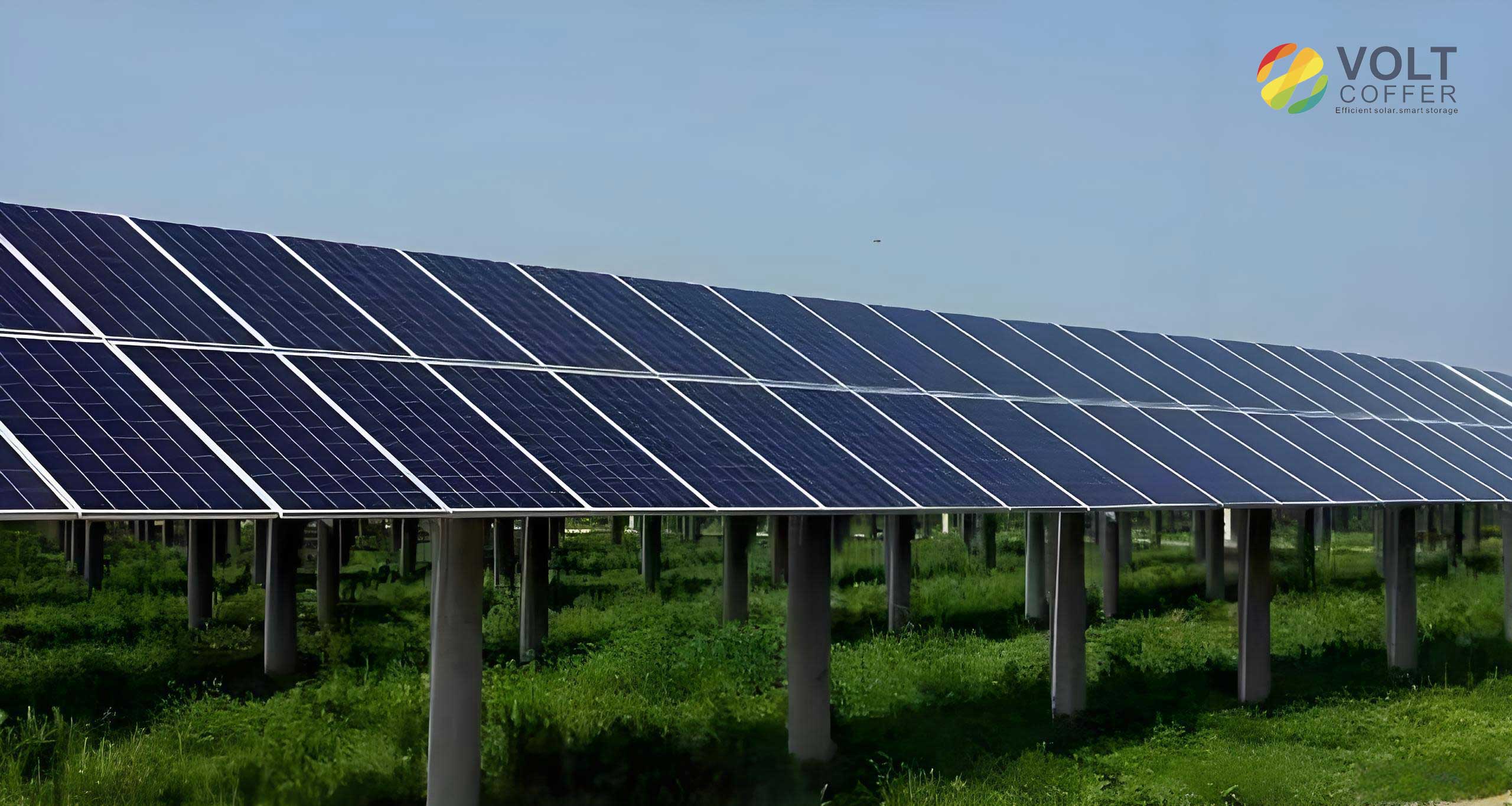
Following the design and prototyping phase, the MDCS was subjected to extensive field trials at a utility-scale photovoltaic power plant in Northern China. The solar panels had a fixed tilt angle of 43°. The operational parameters for the dry cleaning system were set as follows: a travel speed of 21 meters per minute, a roller brush rotational speed of 220 RPM, and a vacuum system pressure of -15 kPa. The primary objective was to quantify the power recovery achieved by cleaning. Multiple arrays of solar panels were monitored, comparing the real-time output of cleaned arrays against adjacent, soiled control arrays under identical solar irradiance conditions. The power increase rate $\eta_P$ was calculated as:
$$ \eta_P = \frac{P_c – P_f}{P_f} \times 100\% $$
where $P_c$ and $P_f$ are the output power of the cleaned and soiled (fouled) solar panel strings, respectively. Tests were conducted under high, medium, and low irradiance conditions after different soiling periods. The results demonstrated consistent and significant power recovery, proving the effectiveness of the dry cleaning process for solar panels.
| Test Condition (Soiling Period) | Average Solar Irradiance (W/m²) | Average Power Increase Rate $\eta_P$ (%) |
|---|---|---|
| High Irradiance (6 days) | ~880 | 3.14 |
| Medium Irradiance (14 days) | ~650 | 6.71 |
| Low Irradiance (9 days) | ~350 | 4.56 |
The operational performance was also characterized. The cleaning rate for the system was measured at approximately 1.5 hours per Megawatt (h/MW) of installed solar panel capacity. This metric is crucial for planning cleaning schedules for large solar farms.
A comprehensive techno-economic model was developed to evaluate the viability of the MDCS against traditional water washing. The total annual cost for dry cleaning $C_d$ depends on the plant capacity $P$ (in MW) and the number of cleaning cycles per year $n_c$. It includes variable costs (fuel and labor for operation) and fixed costs (annual depreciation and maintenance of the equipment):
$$ c_d = (c_f + c_l) \times P + \frac{c_m + c_s}{n_c} $$
$$ C_d = c_d \times n_c = 0.028 \times P \times n_c + 9.6 \text{ (in 10,000 RMB)} $$
where $c_f$ and $c_l$ are the unit capacity cost for fuel and labor per cleaning, $c_m$ is the annual maintenance cost, and $c_s$ is the annual depreciation cost. The model uses a base MDCS unit cost of 800,000 RMB with a 10-year life. In contrast, the annual cost for water washing $C_w$ is typically based on a per-unit-area fee:
$$ C_w = 0.31 \times P \times n_c \text{ (in 10,000 RMB)} $$
The most telling metric is the investment payback period $T_{pp}$ when replacing water washing with the MDCS. It is the time required for the cumulative savings to equal the initial investment in the dry cleaning system:
$$ T_{pp} = \frac{Q_{i,d} – Q_{i,w}}{N_{c,d} – N_{c,w}} \approx \frac{80}{C_w – C_d} \text{ (in years)} $$
where $Q_i$ represents the initial investment cost and $N_c$ the annual net cost. Analysis shows that the payback period is highly sensitive to plant size and cleaning frequency. For a 50 MW solar plant cleaning quarterly ($n_c=4$) or monthly ($n_c=12$), the payback periods are 1.71 years and 0.50 years, respectively. The economics become even more favorable for larger plants. Scaling this analysis to the national level, if all solar panel farms in China adopted the MDCS for monthly cleaning instead of water washing, the annual cleaning cost could be reduced to approximately 11.6% of the conventional cost, representing savings of hundreds of millions of RMB while conserving vast quantities of water.
In conclusion, the development and field validation of the Movable Dry Cleaning System present a compelling solution to the pervasive problem of soiling on solar panels. The system successfully integrates mechanical brushing with vacuum recovery to achieve efficient, water-free cleaning. Field tests confirm its capability to restore significant power output (3-7% increases after typical soiling intervals) with a high operational cleaning rate. Crucially, the techno-economic analysis demonstrates that the MDCS is not only an environmentally sustainable alternative but also a highly economically advantageous one, with short investment payback periods, especially for large-scale or frequently cleaned solar panel installations. This technology effectively reconciles the goals of maintaining high performance from solar panels, conserving precious water resources, and optimizing the operational economics of photovoltaic power generation.