
The rapid depletion of traditional energy resources and growing environmental concerns have intensified the demand for renewable energy solutions. Among these, solar energy stands out due to its abundance and sustainability. A critical component in solar power systems is the solar inverter, which converts the variable direct current (DC) output of photovoltaic (PV) panels into alternating current (AC) suitable for grid integration. This article focuses on the development of micro solar inverters, which are designed to optimize energy conversion efficiency at the individual panel level while addressing challenges such as partial shading, component aging, and environmental variability.
1. Structural Comparison: Traditional vs. Micro Solar Inverters
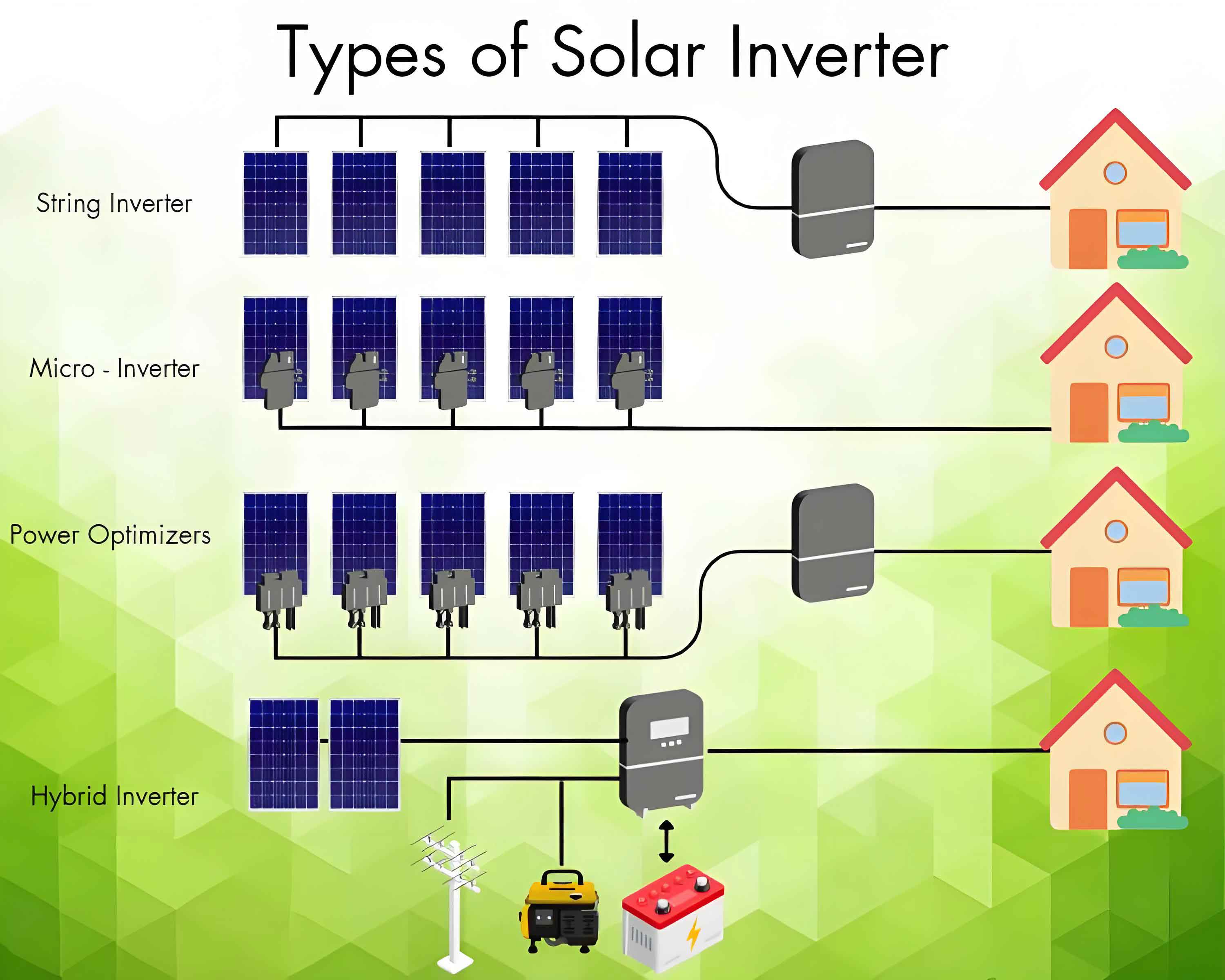
Traditional centralized inverters aggregate power from multiple PV panels connected in series or parallel. While cost-effective for large-scale installations, this architecture suffers from efficiency losses due to mismatched panel performance, shading effects, and single-point failures. In contrast, micro solar inverters are deployed per panel, enabling independent maximum power point tracking (MPPT) and mitigating systemic inefficiencies. Table 1 summarizes their comparative features:
| Feature | Traditional Inverter | Micro Solar Inverter |
|---|---|---|
| MPPT Efficiency | Single MPPT for all panels | Individual MPPT per panel |
| Failure Impact | System-wide downtime | Localized to one panel |
| Energy Yield | Reduced by shading/aging | Up to 25% higher |
| Lifespan | 5–10 years | 15–25 years |
2. Key Technologies in Micro Solar Inverters
2.1 Maximum Power Point Tracking (MPPT)
The I-V characteristics of a PV cell under varying irradiance and temperature conditions are nonlinear. The output current \( I \) and voltage \( V \) of a solar cell can be modeled using the diode equation:
$$
I = I_{ph} – I_0 \left( e^{\frac{q(V + IR_s)}{nkT}} – 1 \right) – \frac{V + IR_s}{R_{sh}}
$$
where \( I_{ph} \) is the photocurrent, \( I_0 \) is the reverse saturation current, \( R_s \) and \( R_{sh} \) are series and shunt resistances, and \( n \) is the ideality factor. The power-voltage (P-V) curve exhibits a unique maximum power point (MPP), which must be tracked dynamically using algorithms such as Perturb and Observe (P&O) or Incremental Conductance (IC).
2.2 Grid Current Control
To ensure sinusoidal current injection into the grid, advanced control strategies are employed. A dual-loop control structure is commonly used, where the outer voltage loop regulates the DC-link voltage, and the inner current loop synchronizes the output with the grid voltage. The grid current \( i_g \) is controlled using proportional-resonant (PR) controllers to minimize steady-state error:
$$
G_{PR}(s) = K_p + \frac{2K_r\omega_c s}{s^2 + 2\omega_c s + \omega_0^2}
$$
where \( \omega_0 \) is the grid frequency and \( \omega_c \) is the cutoff frequency.
2.3 Islanding Detection
Islanding occurs when a solar inverter continues to power a local load after grid disconnection. Passive methods monitor voltage/frequency deviations, while active techniques inject disturbances (e.g., frequency drift or impedance measurement). Table 2 compares these methods:
| Method | Advantages | Disadvantages |
|---|---|---|
| Passive (OV/UF) | No grid disturbance | Large non-detection zone |
| Active Frequency Drift | High accuracy | Grid quality degradation |
| Impedance Measurement | Fast response | Complex implementation |
3. Topology Analysis of Micro Solar Inverters
Micro inverters require high step-up conversion ratios (e.g., 30–60 V DC to 220 V AC). Two-stage topologies (DC-DC + DC-AC) dominate due to design simplicity, though single-stage flyback converters are gaining traction for cost-sensitive applications. The flyback topology, shown below, integrates MPPT and isolation in a single stage:
$$
\frac{V_{out}}{V_{in}} = \frac{N_s}{N_p} \cdot \frac{D}{1 – D}
$$
where \( N_p \) and \( N_s \) are primary/secondary turns, and \( D \) is the duty cycle. Experimental results demonstrate efficiencies exceeding 95% at 250 W output, with total harmonic distortion (THD) below 3%.
4. Experimental Validation
A prototype micro solar inverter was tested under partial shading and varying irradiance conditions. Key results include:
- MPPT efficiency: 99.2% under uniform irradiance
- Conversion efficiency: 94.7% at rated load
- Islanding detection time: < 200 ms
5. Conclusion
Micro solar inverters enhance energy harvest by optimizing individual PV panel performance. Critical advancements in MPPT algorithms, grid synchronization, and topology design have enabled efficiencies comparable to centralized systems while offering superior scalability and fault tolerance. Future work will focus on wide-bandgap semiconductors (e.g., GaN) to further reduce losses and costs.