
In the pursuit of enhancing the efficiency and reliability of solar energy systems, the precise control and positioning of solar panels are paramount. As a researcher and engineer involved in renewable energy component manufacturing, I have focused on the critical subsystem that enables this precision: the tracking system reducer. This article details the design, development, and operational principles of a specialized automated testing apparatus I developed to evaluate the key performance metrics of reducers used in solar panel tracking mechanisms. The need for such a device arose from industry demands for high reliability and the absence of efficient, dedicated test equipment for verifying output torque and reverse self-locking characteristics. The widespread adoption of solar panel arrays hinges on the durability and precision of these mechanical components, making rigorous performance validation not just a quality control step, but a necessity for the overall health of a photovoltaic installation.
The core function of a solar panel tracking system is to orient the solar panel optimally relative to the sun’s position throughout the day. This continuous adjustment maximizes the irradiance capture, significantly boosting the energy yield compared to fixed-tilt systems. The reducer is the workhorse of this system, translating the high-speed, low-torque output of a servo or stepper motor into the low-speed, high-torque motion required to rotate often large and heavy solar panel assemblies. For single-axis or dual-axis trackers, the reducer must not only provide this torque multiplication but also hold position securely when the drive motor is inactive, preventing wind loads or gravitational forces from back-driving the panel. This specific requirement, known as reverse self-locking or backdriving prevention, is a defining feature for reducers in this application, especially those utilizing worm-type designs. The performance of the solar panel tracking system, and consequently the entire power plant’s output, is directly linked to the reducer’s ability to meet precise torque and locking specifications.
The technical requirements for the reducer in a typical solar panel tracking application are stringent and twofold. First, the unit must possess a sufficient reverse self-locking capability. This means that when the input shaft is stationary, a specified constant torque applied to the output shaft must not cause it to rotate. This torque represents the maximum expected external load from wind, snow, or imbalanced weight on the solar panel structure. Second, the reducer must deliver a minimum output torque when driven by its input motor, ensuring it can initiate and maintain movement of the solar panel under all operational conditions, even in scenarios like motor stalling or partial power loss. Based on common industry standards and specific client demands for mid-sized solar panel installations, the following quantitative requirements were established for the worm-and-helical-gear reducer under evaluation.
| Performance Parameter | Symbol | Requirement | Description |
|---|---|---|---|
| Reverse Self-Locking Torque | $T_{lock}$ | ≥ 38 N·m | Constant torque applied to output shaft that must NOT cause rotation when input is locked. |
| Holding Time at Locking Torque | $t_{hold}$ | ≥ 30 seconds | Duration for which the $T_{lock}$ must be sustained without movement. |
| Minimum Output Drive Torque | $T_{out}$ | ≥ 21 N·m | Torque available at the output shaft when the reducer is actively driven by its input motor. |
| Output Speed under Drive | $N_{out}$ | ≈ 0.2 rpm | Typical operational speed for fine adjustment of the solar panel angle. |
The primary challenge in testing these parameters lies in generating a stable, measurable reverse torque for the self-locking test and automating the entire sequence to improve efficiency and data accuracy. Traditional methods involved manual torque wrenches and separate test benches, which were time-consuming and prone to human error. The designed apparatus integrates both tests into a single, automated cycle with precise digital control and data acquisition. The complete test device can be broken down into several key mechanical and electronic subsystems, as summarized below.
| Component No. | Component Name | Primary Function | Key Specifications/Notes |
|---|---|---|---|
| 1 | Base Plate & Frame | Provides rigid foundation and alignment for all components. | Manufactured from high-stiffness steel to minimize deflection under load. |
| 2 | Quick-Clamping Mechanism | Secures the unit under test (UUT – the reducer) rapidly and precisely. | Enables fast loading/unloading, crucial for high-volume testing in solar panel component production. |
| 3 | Unit Under Test (UUT) | The solar panel tracking reducer being evaluated. | Worm drive with helical plastic gear; input from stepper motor (not part of fixture). |
| 4 | Torque-Speed Sensor | Measures output torque ($T$) and rotational speed ($\omega$) from the UUT. | High-accuracy, non-contact type. Key for data acquisition. Output: $T_{measured}$, $\omega_{measured}$. |
| 5 | Modified Magnetic Particle Brake (MPB) | Acts as a programmable, electronically controlled load. Applies reverse torque for self-lock test and load for output torque test. | Core innovation: Modified so its outer casing can be rotated. Braking torque is proportional to excitation current $I$: $T_{brake} = k \cdot I$. |
| 6 | Primary Gear Drive | Connects the drive reducer to the MPB casing. | Simple spur gear set to transfer rotation from Component 7 to Component 5’s casing. |
| 7 | Drive Reducer | A self-locking worm gear reducer used to rotate the MPB casing. | Used to quickly eliminate system backlash. Has its own input motor. Speed: ~30 rpm. |
| 8 | Support Brackets & Pillars | Holds sensors, brakes, and drives in precise alignment. | Adjustable to accommodate different reducer sizes for various solar panel tracker models. |
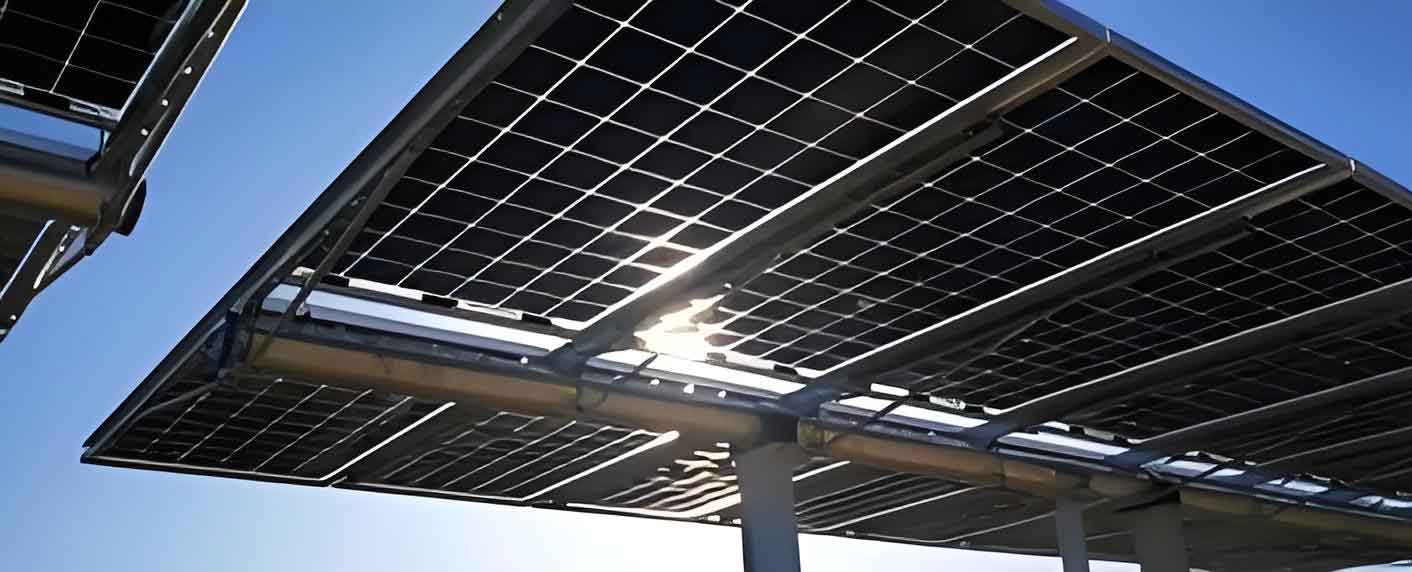
The integration of a bifacial solar panel in the image above underscores the evolving technology in photovoltaic modules. Just as the solar panel itself advances, the supporting mechanisms like trackers and their drives must also evolve and be rigorously validated. Higher efficiency panels place greater importance on precise tracking, which in turn demands more reliable reducers. The testing apparatus described here is a tool to ensure that the mechanical heart of the tracking system meets the challenge of supporting next-generation solar panel designs.
The working principle of the apparatus is ingeniously designed to tackle the test challenges efficiently. The core innovation lies in the dual-role of the modified magnetic particle brake and the use of a secondary drive reducer to manage backlash. The operational logic for the two main tests is as follows.
Reverse Self-Locking Test: For this test, the input shaft of the UUT (connected to its stepper motor) is held stationary. The drive reducer (7) is activated to rotate the casing of the MPB (5) via the primary gear drive (6). Since the MPB’s inner rotor is connected to the UUT’s output shaft via the torque sensor (4), and the UUT is self-locking, this action applies a torque to the output shaft. The MPB itself is not energized at this stage, allowing its rotor to turn freely relative to the casing. The system essentially “winds up” until all mechanical backlash in the UUT and the test fixture is taken up. Once taut, the drive reducer (7) stops. Now, the MPB is energized with a current corresponding to the required reverse locking torque ($I_{lock} = T_{lock}/k$). Since the MPB casing is now held fixed by the self-locking drive reducer (7), the brake exerts a static torque $T_{brake}$ on the UUT’s output shaft. The torque sensor monitors if any rotation occurs. If the measured torque equals the applied torque and the angular displacement $\theta$ remains zero (within a tolerance) for the required $t_{hold}$, the reducer passes the self-lock test. The relationship is checked: $$ |T_{sensor}| \geq T_{lock} \quad \text{and} \quad \Delta \theta \approx 0 \quad \text{for} \quad t \geq t_{hold}. $$
Output Torque Test: Here, the UUT’s input motor is activated to drive its output shaft. The MPB is energized from the beginning with a current $I_{test}$ set to provide a load close to the expected pass torque (e.g., 0.9 * 21 Nm = 18.9 Nm). The drive reducer (7) is also activated briefly in the opposite direction to its use in the lock test. This rapid relative rotation ensures the MPB’s casing is held stationary against the gear drive (6), making the MPB function as a fixed brake. As the UUT tries to turn, it works against this brake load. The torque sensor measures the sustained output torque $T_{out}$. If $T_{out} \geq 21$ Nm under the driven condition, the test is passed. The power involved, though small, relates to the solar panel’s movement: $$ P_{out} = T_{out} \cdot \omega_{out} $$ where $\omega_{out}$ is the output angular velocity (~0.021 rad/s for 0.2 rpm).
The automated control system is the brain of the operation, seamlessly orchestrating the mechanical components and processing data. It eliminates manual intervention, ensuring test consistency—a critical factor when qualifying components for large-scale solar panel farms where thousands of identical reducers may be deployed. The system architecture is hierarchical and networked.
| System Layer | Components | Function | Communication/Interface |
|---|---|---|---|
| Supervisory Layer | PC with Custom Software | Provides user interface (HMI), sends test sequences, logs data, performs final pass/fail judgment. | Ethernet/TCP-IP to Controller; SQL to Database. |
| Database Server | Stores all test results (torque curves, timestamps, serial numbers) for traceability and analysis. | Networked with PC. | |
| Control & Acquisition Layer | Programmable Logic Controller (PLC) / Microcontroller | Executes the precise test sequence: controls motors, energizes MPB, reads digital I/O. | Digital/Analog I/O to drives and brakes; Serial/Ethernet to sensors and PC. |
| Torque-Speed Signal Conditioner / Meter | Acquires analog signals from the sensor, converts to digital torque ($T$) and speed ($\omega$) values. | RS-485 or Ethernet to PC/Controller. | |
| Programmable DC Current Source | Provides the precise excitation current $I$ to the MPB coil based on setpoints from the controller. | Analog input (0-10V or 4-20mA) from controller. | |
| Field Layer | Actuators (Motors for UUT input & Drive Reducer), MPB, Clamp Solenoid, QR Code Scanner | Physical devices executing actions and providing identification input. | Connected to controller I/O modules or drive modules. |
The test methodology is encapsulated in a robust software algorithm that guides the apparatus through a complete evaluation cycle. The process is linear and deterministic, ensuring every solar panel tracker reducer is tested under identical conditions. The high-level flowchart is implemented in the control software with the following sequence.
Step 1: Initialization and Identification. The operator clamps the UUT into the fixture. A QR code or barcode on the reducer housing is scanned, linking its unique serial number to the upcoming test data in the database. This traceability is vital for quality assurance in solar panel component supply chains.
Step 2: Backlash Elimination (Pre-test). The system automatically runs the drive reducer to take up all mechanical slack in the connection between the MPB casing and the UUT output shaft, preparing for a precise torque application.
Step 3: Reverse Self-Locking Test Execution.
a. The UUT’s input motor is commanded to a zero-speed/hold state.
b. The drive reducer is run to apply a pre-tension.
c. The DC current source is ramped to deliver $I_{lock}$ to the MPB, applying $T_{lock}$.
d. The torque and angular position are sampled at a high frequency (e.g., 1 kHz) for the duration $t_{hold}$.
e. The software checks the criteria: $$ \text{Pass if: } \overline{T_{measured}} \geq T_{lock} – \delta_T \quad \text{and} \quad \sigma_{\theta} < \theta_{max} $$ where $\overline{T_{measured}}$ is the mean measured torque, $\delta_T$ is a calibration tolerance, $\sigma_{\theta}$ is the standard deviation of angular position (indicating stability), and $\theta_{max}$ is a tiny allowable angle threshold.
f. The MPB current is ramped down, and the drive reducer reverses to release tension.
Step 4: Output Torque Test Execution.
a. The MPB is pre-energized with a current $I_{test}$ corresponding to a load near the minimum required torque.
b. The drive reducer is briefly activated to lock the MPB casing.
c. The UUT’s input motor is energized and runs at its nominal input speed.
d. The system monitors the torque sensor until a stable reading is achieved (typically after a few seconds to overcome static friction). The steady-state torque $T_{out, steady}$ is recorded.
e. The pass criterion is: $$ T_{out, steady} \geq T_{out, min} \quad \text{(e.g., 21 Nm)}. $$
Step 5: Data Logging and Result Declaration. All time-series data, final values, and the pass/fail status for each test are packaged and sent to the database server under the UUT’s serial number. The PC software updates the operator interface, often with a clear visual indicator (e.g., green light for pass). The apparatus then automatically returns to a neutral state, ready for the next unit.
The integration of formulas within the control logic is essential. For instance, the calibration constant $k$ for the magnetic particle brake is determined empirically and stored in the system. The braking torque is therefore not an open-loop guess but a calculated setpoint: $$ I_{set} = \frac{T_{desired}}{k}. $$ Furthermore, the system can calculate dynamic parameters if needed, such as the approximate efficiency during the output torque test by comparing input electrical power to the motor (estimated) with mechanical output power $P_{out} = T_{out}\omega_{out}$. While not a primary test, this data can be useful for characterizing different batches of reducers destined for solar panel fields in varying climatic conditions.
The design also considers the inherent challenges in testing low-speed, high-ratio reducers. The output speed of a solar panel tracker reducer is exceptionally low—often in the range of 0.1 to 0.5 rpm. Manually observing movement or using simple timers for such speeds is impractical. The automated sensor-based system detects micron-level angular displacements, making the self-locking test genuinely quantitative. The use of the secondary drive reducer to rapidly eliminate backlash addresses the problem of “lost motion” that could lead to false negatives or elongated test cycles. This is summarized in the following equation for the total angular backlash $\beta_{total}$ that must be taken up: $$ \beta_{total} = \beta_{UUT} + \beta_{fixture} + \beta_{couplings} $$ where each $\beta$ represents the angular free play in different parts of the chain. The drive reducer rotates the MPB casing at 30 rpm, taking up this play in seconds rather than the minutes it would take at the UUT’s 0.2 rpm output speed.
In conclusion, the development of this automated performance testing apparatus represents a significant step forward in quality assurance for solar energy infrastructure components. By enabling rapid, precise, and repeatable measurement of both critical torque parameters in a single fixture, it directly addresses a bottleneck in the manufacturing and validation of solar panel tracking drives. The system’s architecture, combining a mechanically innovative fixture with a layered control and data acquisition network, ensures reliability and traceability. As solar panel technologies continue to advance, requiring ever more precise and reliable tracking to squeeze out maximum efficiency gains, the role of validated, high-performance mechanical drives becomes increasingly central. This testing apparatus provides the necessary toolset to ensure that the reducers at the heart of these tracking systems are not the weak link but a guarantor of performance and longevity. Future work may involve adapting the core principles to test other types of actuators or integrating more advanced diagnostics, such as vibration analysis for wear prediction, further solidifying the reliability foundation for large-scale solar power generation.