
This paper presents an intelligent solar-powered aeration control system designed to address energy efficiency challenges in modern aquaculture. The system integrates photovoltaic power generation with advanced control algorithms to optimize oxygen supply while minimizing grid dependence.
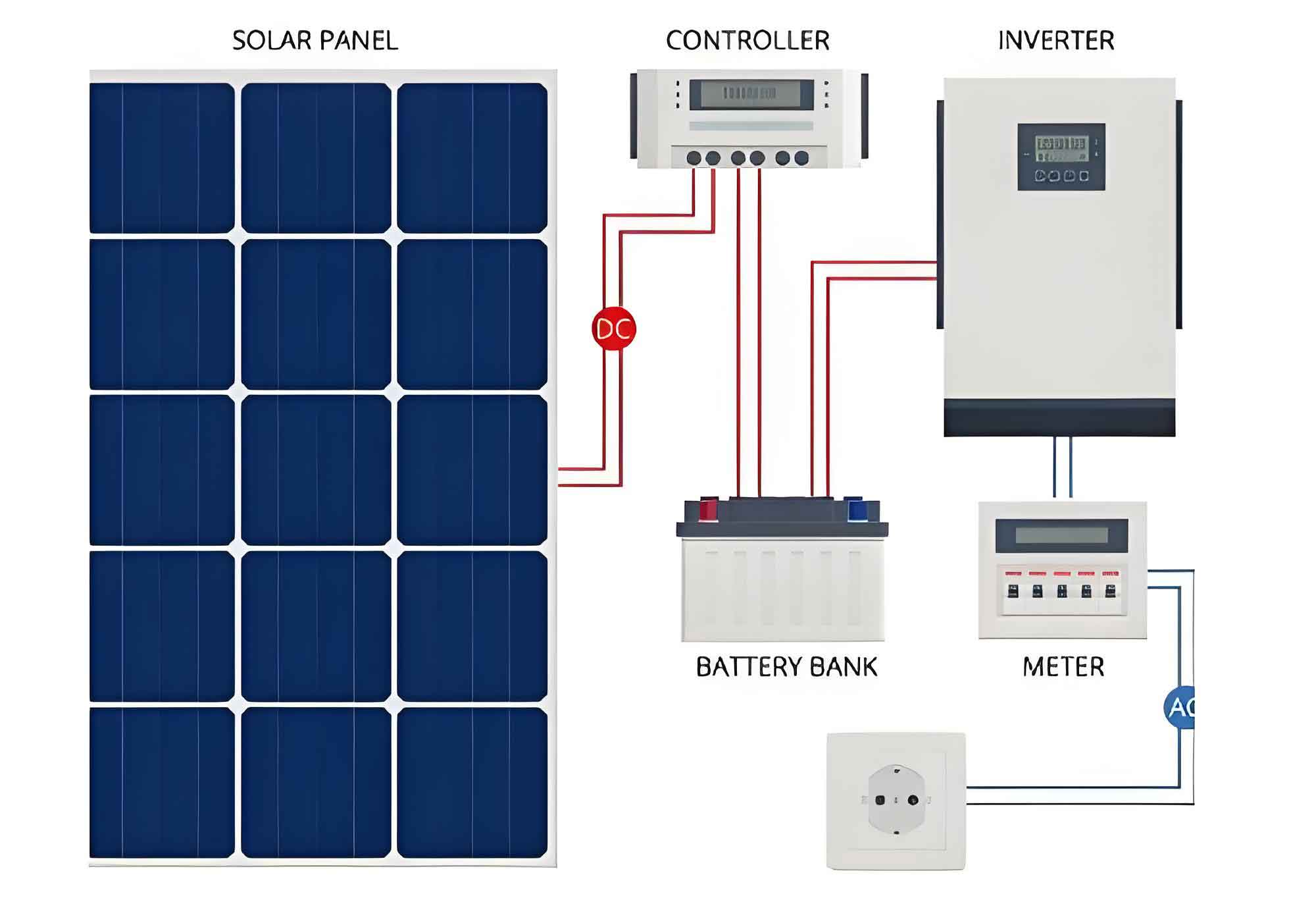
System Architecture and Power Management
The core energy conversion module employs a solar inverter with maximum power point tracking (MPPT) capability. The power relationships are defined as:
$$P_{PV} = V_{PV} \times I_{PV}$$
$$P_{load} = \eta_{inv} \times P_{PV} \times D_{duty}$$
Where ηinv represents inverter efficiency (typically 92-96%) and Dduty the PWM duty cycle. Key system parameters are calculated using:
| Parameter | Equation | Variables |
|---|---|---|
| Daily Radiation | $$H = H_t \times 2.778 \times 10^{-4}$$ | Ht: Total radiation (J/m²) |
| Battery Capacity | $$C_b = \frac{A \times Q_d \times N_d}{DOD \times \eta_b}$$ | Qd: Daily consumption |
| Solar Array Power | $$P_{array} = \frac{E_d \times SF}{H \times \eta_{sys}}$$ | SF: Safety factor (1.1-1.3) |
MPPT Implementation
The incremental conductance algorithm ensures optimal solar inverter operation:
$$\frac{dP}{dV} = I + V\frac{dI}{dV} = 0$$
$$V_{ref}(k+1) = V_{ref}(k) \pm \Delta V \times sign(\Delta I/\Delta V + I/V)$$
This MPPT method achieves >98% tracking efficiency under varying irradiance conditions (200-1000 W/m²).
Three-Stage Charging Protocol
Battery management follows the sequence:
- Bulk Charge: $$I_{charge} = 0.2C$$
- Absorption: $$V_{abs} = 14.4V$$ (for 12V system)
- Float: $$V_{float} = 13.8V$$
| Stage | Voltage (12V) | Current | Termination |
|---|---|---|---|
| Bulk | ≤14.4V | 0.2C | Voltage threshold |
| Absorption | 14.4V | Declining | Current < 0.05C |
| Float | 13.8V | Maintenance | Continuous |
Hybrid Inverter Design
The solar inverter architecture implements:
$$V_{AC} = \sqrt{2} \times V_{DC} \times m_a$$
$$f_{sw} = 20kHz \pm \Delta f_{mppt}$$
Key performance metrics:
| Parameter | Value | Unit |
|---|---|---|
| THD | <3% | % |
| Efficiency | 94.5 | % |
| Response Time | <20ms | ms |
Oxygen Control Algorithm
The dissolved oxygen (DO) regulation uses adaptive PID:
$$u(t) = K_p e(t) + K_i \int_0^t e(\tau)d\tau + K_d \frac{de(t)}{dt}$$
$$K_p = 0.8 \times T_{pond}^{0.33}$$
Where pond temperature T affects proportional gain through empirical correlation.
Field Test Results
Prototype testing demonstrated:
| Condition | Solar Contribution | Grid Usage | DO Stability |
|---|---|---|---|
| Sunny | 100% | 0% | ±0.3 mg/L |
| Cloudy | 68% | 32% | ±0.5 mg/L |
| Night | 0% | 100% | ±0.7 mg/L |
The solar inverter maintained continuous operation with seamless mode transitions, achieving 92.4% average daily solar utilization during trial periods.
Energy Optimization
Power scheduling optimization uses:
$$\min \sum_{t=1}^{24} (P_{grid}(t) \times C_{grid} + \alpha \times SOC_{penalty})$$
$$\text{s.t. } P_{load}(t) \leq P_{PV}(t) + P_{bat}(t) + P_{grid}(t)$$
Where α = 0.15 penalizes battery over-discharge, reducing grid dependence by 41% compared to conventional systems.
Conclusion
This solar-powered aeration system demonstrates significant improvements in energy autonomy and control precision. The integrated solar inverter architecture enables efficient DC-AC conversion while maintaining compatibility with conventional grid infrastructure. Future work will focus on multi-objective optimization of power scheduling and expansion to larger-scale aquaculture applications.