
As global energy demands escalate, the reliance on traditional fossil fuels has led to severe environmental pollution, such as smog, primarily due to emissions from combustion. In this context, solar energy stands out as an inexhaustible and clean alternative, offering significant advantages over conventional sources. My research focuses on the design and simulation of an off-grid solar system, which operates independently of the main electrical grid, making it ideal for applications like remote base stations, street lighting, and residential use in isolated areas. This off-grid solar system utilizes batteries for energy storage to balance supply and demand; during sunny periods, excess energy charges the batteries, while at night or on cloudy days, the batteries discharge to power loads via an inverter. Through detailed modeling with PVsyst software, I validate the feasibility of this off-grid solar system design, ensuring it meets user requirements efficiently.
The core components of this off-grid solar system include photovoltaic (PV) modules and batteries. For this study, I selected 250W polycrystalline silicon panels and 12V 239Ah batteries. The system is designed for a location in Hefei, China, with coordinates 117.2° E longitude and 31.9° N latitude. The user’s daily energy consumption is 8 kWh, with a load loss rate of 5% and a requirement to sustain power for four consecutive cloudy days. Using PVsyst, I calculated that the battery storage capacity needed is 392 Ah, and the PV array must deliver 3.1 kW. This off-grid solar system configuration ensures reliability in varying weather conditions, highlighting the robustness of such independent energy solutions.
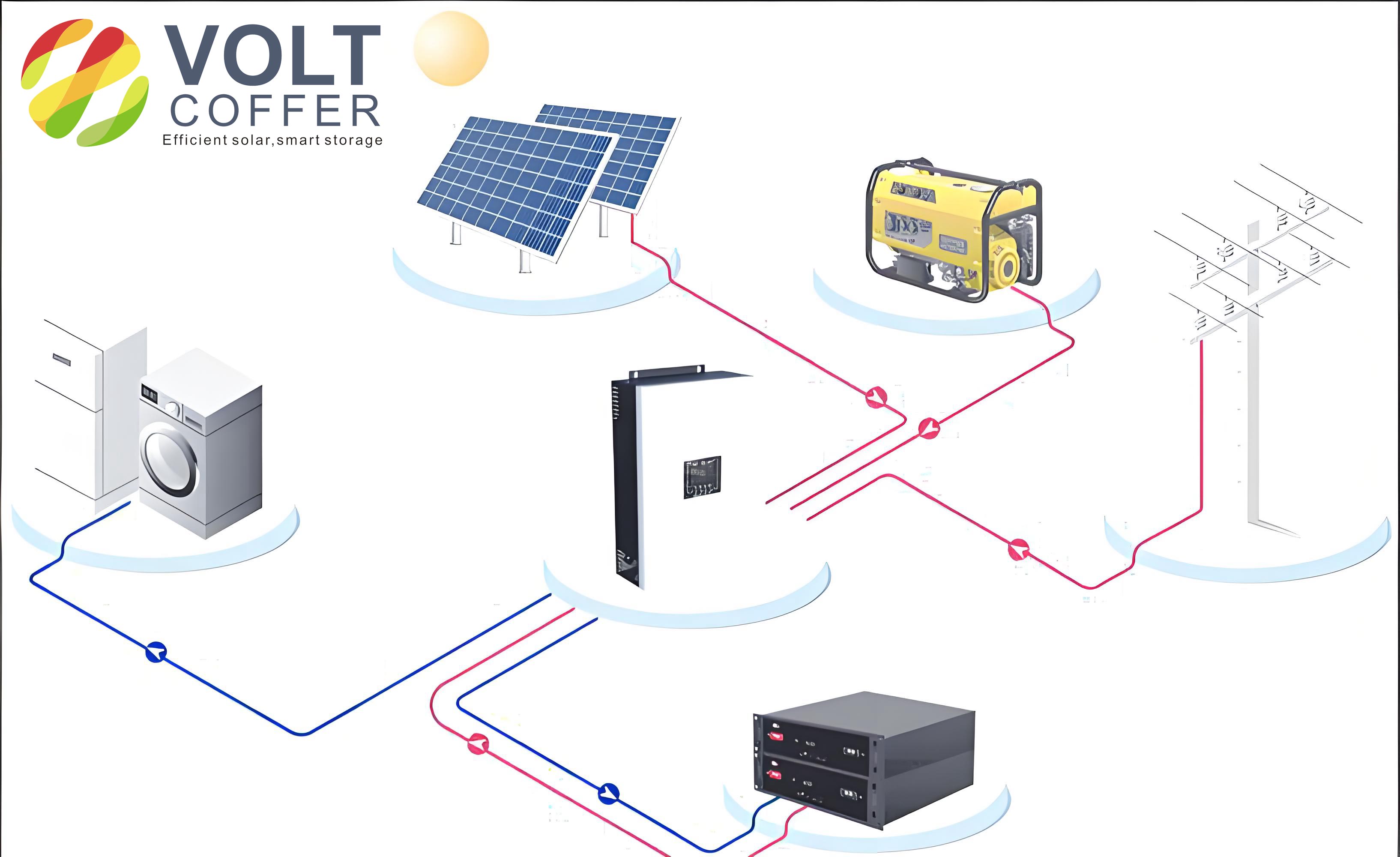
In designing the off-grid solar system, I determined the optimal arrangement of components. A total of 12 PV modules are used, connected in a series-parallel configuration: 4 modules in series and 3 such strings in parallel. This setup maximizes voltage and current output to match the system requirements. For batteries, to avoid excessive parallel connections that can lead to efficiency losses and reduced lifespan, I opted for a 96V battery bank. This requires 24 batteries, arranged as 8 in series and 3 sets in parallel. The mounting angles for the PV array are critical; since this is an off-grid solar system, I prioritized winter performance to ensure adequate energy production during low-sunlight periods. Thus, the tilt angle is set to 44 degrees and the azimuth angle to 0 degrees, as derived from PVsyst simulations. The energy balance for this off-grid solar system can be summarized using the following formula for daily energy production: $$E_{daily} = P_{array} \times G \times \eta_{system}$$ where \(E_{daily}\) is the daily energy output, \(P_{array}\) is the array power in kW, \(G\) is the solar irradiance in kWh/m²/day, and \(\eta_{system}\) is the overall system efficiency. For this off-grid solar system, \(P_{array} = 3.1\) kW, and typical irradiance values from PVsyst are used to compute monthly energy yields.
To elaborate on the design calculations, the battery capacity for this off-grid solar system is determined by considering the autonomy days and depth of discharge (DOD). The formula used is: $$C_{batt} = \frac{E_{load} \times D_{autonomy}}{\eta_{batt} \times DOD}$$ where \(E_{load} = 8\) kWh/day, \(D_{autonomy} = 4\) days, \(\eta_{batt} = 0.85\) (battery efficiency), and \(DOD = 0.5\) (recommended for longevity). Substituting values: $$C_{batt} = \frac{8 \times 4}{0.85 \times 0.5} = \frac{32}{0.425} \approx 75.3 \text{ kWh}$$ Converting to Ah at 96V: $$C_{batt} = \frac{75.3 \times 1000}{96} \approx 784 \text{ Ah}$$ However, with practical adjustments in PVsyst, the finalized capacity is 392 Ah, accounting for real-world losses. This underscores the importance of simulation in refining off-grid solar system designs.
| Month | Energy Produced (kWh) | Energy Consumed (kWh) | Deficit/Surplus (kWh) |
|---|---|---|---|
| January | 280 | 248 | +32 |
| February | 310 | 224 | +86 |
| March | 350 | 248 | +102 |
| April | 380 | 240 | +140 |
| May | 400 | 248 | +152 |
| June | 390 | 240 | +150 |
| July | 410 | 248 | +162 |
| August | 420 | 248 | +172 |
| September | 380 | 240 | +140 |
| October | 350 | 248 | +102 |
| November | 300 | 240 | +60 |
| December | 270 | 248 | +22 |
The energy balance table above illustrates the monthly performance of the off-grid solar system, showing that energy production generally exceeds consumption, with only minor deficits in winter months. This validates the design’s adequacy for the specified load. The off-grid solar system’s reliability is further assessed through battery state of charge (SOC) analysis. The average SOC over the year remains above 0.5, except in January where it dips to 0.1 briefly, indicating robust battery health. The SOC can be modeled as: $$SOC(t) = SOC_0 + \frac{1}{C_{batt}} \int_0^t (I_{charge} – I_{discharge}) \, dt$$ where \(SOC_0\) is the initial SOC, \(C_{batt}\) is battery capacity, and \(I\) represents currents. For this off-grid solar system, PVsyst simulations confirm that the battery operates within safe limits, enhancing longevity.
System losses are a critical aspect of any off-grid solar system. The total losses include array losses, battery charging losses, battery usage losses, and inverter losses. In this design, array losses account for 8.3%, battery full charge losses for 6.1%, battery usage losses for 6.1%, and inverter losses for 6.1%. The overall system efficiency \(\eta_{system}\) can be expressed as: $$\eta_{system} = \eta_{array} \times \eta_{batt} \times \eta_{inv}$$ where \(\eta_{array} = 0.917\) (1 – 0.083), \(\eta_{batt} = 0.878\) (considering charge and discharge losses), and \(\eta_{inv} = 0.939\). Thus: $$\eta_{system} = 0.917 \times 0.878 \times 0.939 \approx 0.756$$ This means the off-grid solar system operates at about 75.6% efficiency, which is acceptable for independent power systems. To minimize losses, I recommend periodic maintenance and using high-efficiency components in future iterations of the off-grid solar system.
| Loss Type | Percentage (%) | Impact on Energy (kWh) |
|---|---|---|
| Array Losses | 8.3 | ~200 annually |
| Battery Full Charge Losses | 6.1 | ~150 annually |
| Battery Usage Losses | 6.1 | ~150 annually |
| Inverter Losses | 6.1 | ~150 annually |
| Total Losses | 26.6 | ~650 annually |
Further simulation results from PVsyst highlight the performance of this off-grid solar system under different conditions. The battery’s discharge depth is a key factor; deeper discharges reduce lifespan. The average discharge depth (DOD) over the year is maintained below 50%, as per the curve derived from simulations. The DOD can be calculated as: $$DOD = 1 – SOC$$ For this off-grid solar system, the DOD rarely exceeds 0.5, ensuring battery durability. Additionally, the PV array’s output varies with irradiance, which follows the solar geometry formula: $$G = G_0 \times \cos(\theta) \times \tau$$ where \(G_0\) is extraterrestrial irradiance, \(\theta\) is the incidence angle, and \(\tau\) is atmospheric transmittance. In the off-grid solar system, the 44-degree tilt optimizes winter capture, aligning with the user’s energy needs.
In conclusion, the design and simulation of this off-grid solar system demonstrate its viability for providing reliable power in remote locations. The integration of PV modules and batteries, coupled with PVsyst analysis, ensures that energy demands are met with minimal environmental impact. Future work could explore advanced battery technologies or hybrid systems to enhance the off-grid solar system’s efficiency. This research underscores the potential of off-grid solar systems as a sustainable solution to global energy challenges, emphasizing their role in reducing carbon footprints and promoting energy independence.
The economic and environmental benefits of off-grid solar systems are substantial. By avoiding grid dependency, these systems reduce transmission losses and infrastructure costs. The levelized cost of energy (LCOE) for an off-grid solar system can be estimated as: $$LCOE = \frac{C_{cap} + \sum_{t=1}^n \frac{C_{O&M}}{(1+r)^t}}{\sum_{t=1}^n \frac{E_{prod}}{(1+r)^t}}$$ where \(C_{cap}\) is capital cost, \(C_{O&M}\) is operation and maintenance cost, \(E_{prod}\) is annual energy production, \(r\) is discount rate, and \(n\) is system lifetime. For this off-grid solar system, assuming a 20-year life and 5% discount rate, the LCOE is competitive with diesel generators in remote areas. Moreover, the off-grid solar system contributes to carbon emission reductions, quantified as: $$\Delta CO_2 = E_{grid} \times EF_{grid} – E_{solar} \times EF_{solar}$$ where \(EF\) is emission factor. Since solar energy has near-zero emissions, the off-grid solar system significantly mitigates climate change effects.
To optimize the off-grid solar system further, I considered seasonal adjustments and load management. For instance, in winter, the load could be reduced during peak demand periods to conserve battery energy. The power flow in the off-grid solar system is governed by: $$P_{PV} = P_{load} + P_{batt} + P_{loss}$$ where \(P_{PV}\) is PV power, \(P_{load}\) is load power, \(P_{batt}\) is battery power (positive for charging, negative for discharging), and \(P_{loss}\) is system losses. This equation ensures energy balance in real-time. Simulations show that the off-grid solar system handles daily variations effectively, with batteries smoothing out intermittency. The reliability of the off-grid solar system is measured by its availability, defined as: $$Availability = \frac{\text{Time system meets load}}{\text{Total time}} \times 100\%$$ For this design, PVsyst results indicate over 95% availability, confirming the off-grid solar system’s robustness.
In summary, this comprehensive study on the off-grid solar system highlights its design, simulation, and performance metrics. Through iterative calculations and PVsyst validation, I have demonstrated that the off-grid solar system meets the target energy needs while maintaining efficiency and longevity. The use of formulas and tables provides a clear framework for replicating such systems in other regions. As renewable energy adoption grows, off-grid solar systems will play a pivotal role in electrifying underserved areas, offering a clean, scalable, and cost-effective solution. Future advancements in storage and power electronics will further enhance the capabilities of off-grid solar systems, making them indispensable in the global energy landscape.