
Off-grid solar power systems represent a self-sufficient energy solution that operates independently from national grids. This technical analysis explores system architecture, component selection, and operational optimization through mathematical modeling and empirical validation.
Core System Architecture
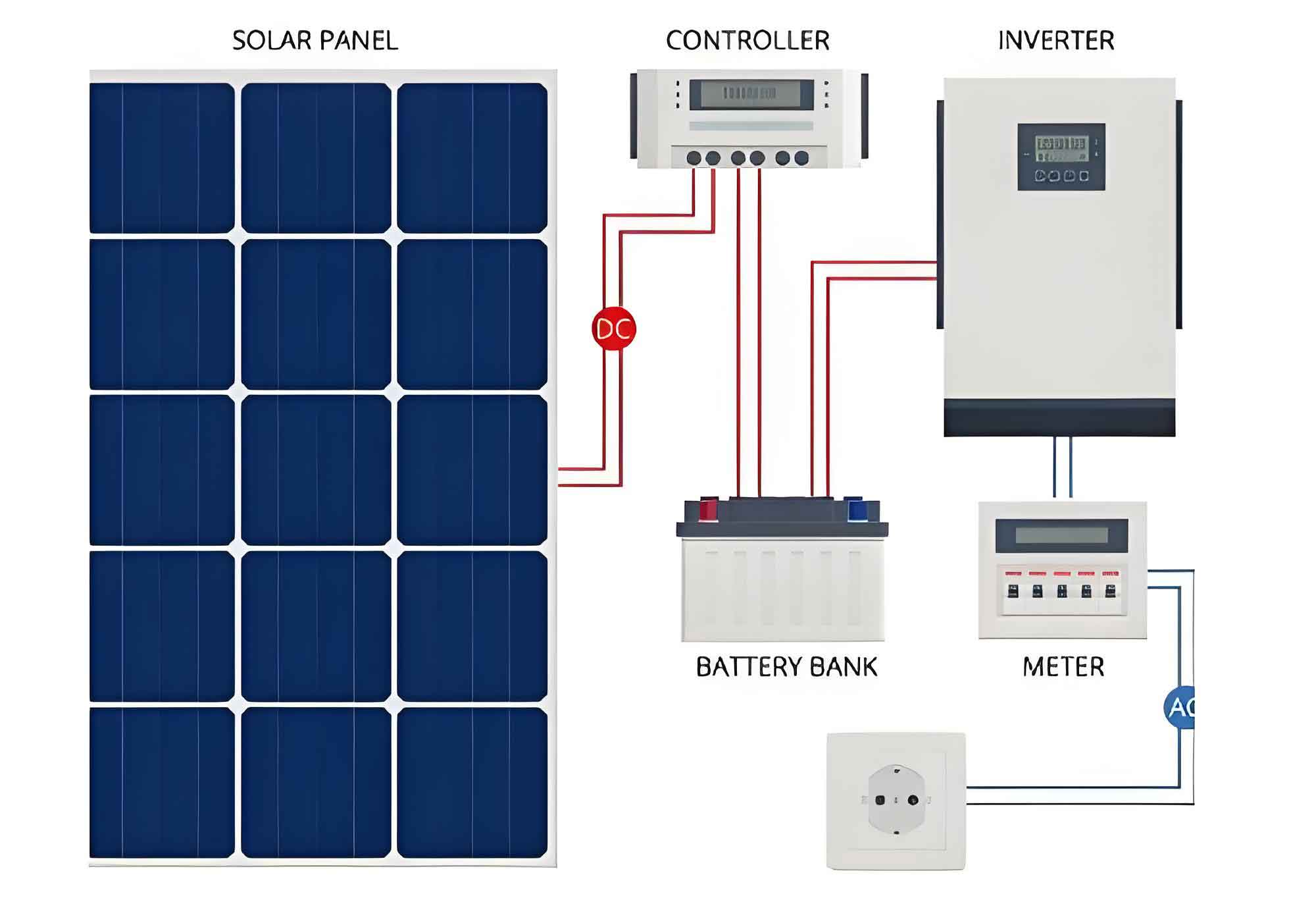
The system comprises five critical components:
| Component | Function | Key Parameters |
|---|---|---|
| PV Modules | Photon-electron conversion | Pmax, Voc, Isc |
| Charge Controller | Power regulation | MPPT efficiency ≥97% |
| Solar Inverter | DC-AC conversion | THD ≤3%, η ≥95% |
| Battery Bank | Energy storage | DoD, Crate, cycles |
| Monitoring System | Performance tracking | RS485/CAN communication |
Photovoltaic Array Sizing
The PV array capacity is calculated considering peak sun hours (PSH) and system losses:
$$
P_{PV} = \frac{E_{load} \times 1.3}{\eta_{sys} \times PSH}
$$
Where:
- Eload: Daily energy consumption (kWh)
- ηsys: System efficiency (0.65-0.75)
- 1.3: Safety factor for autonomy days
Battery Bank Optimization
Deep-cycle battery capacity calculation:
$$
C_{bat} = \frac{E_{load} \times N_{aut}}{V_{sys} \times DoD \times \eta_{inv}}
$$
| Parameter | Value Range |
|---|---|
| DoD (Lead-acid) | 50-80% |
| Naut | 3-5 days |
| ηinv | 92-97% |
Solar Inverter Selection
The solar inverter’s capacity must satisfy:
$$
P_{inv} \geq 1.25 \times \left( \sum P_{ac} + \sum P_{dc} \times \eta_{conv} \right)
$$
Critical performance metrics for solar inverters:
- Waveform purity: THD < 5%
- Conversion efficiency: >94% at nominal load
- Surge capacity: 200% for 3 seconds
System Loss Analysis
| Loss Type | Typical Value |
|---|---|
| PV mismatch | 2-5% |
| Dust accumulation | 3-6% |
| Temperature | 0.5%/°C >25°C |
| Solar inverter | 4-6% |
Maintenance Protocol
Critical maintenance intervals for solar inverters:
- Monthly: Visual inspection of cooling fans
- Quarterly: Torque check on DC terminals
- Biannual: Insulation resistance test
- Annual: Full efficiency calibration
Modern solar inverters incorporate advanced features enhancing system reliability:
$$
\eta_{inv} = \frac{P_{out}}{P_{in}} \times 100\% = \frac{P_{ac}}{P_{dc}} \times 100\%
$$
Where Pac represents AC output power and Pdc the DC input power to the solar inverter.
Performance Monitoring
Key performance indicators for solar inverters:
| Parameter | Measurement |
|---|---|
| MPPT efficiency | ≥98.5% |
| Standby consumption | <10W |
| Response time | <100ms |
This comprehensive design methodology ensures optimal solar inverter utilization and maximum energy harvest in off-grid applications, particularly benefiting remote electrification projects and mobile power systems requiring high reliability.