
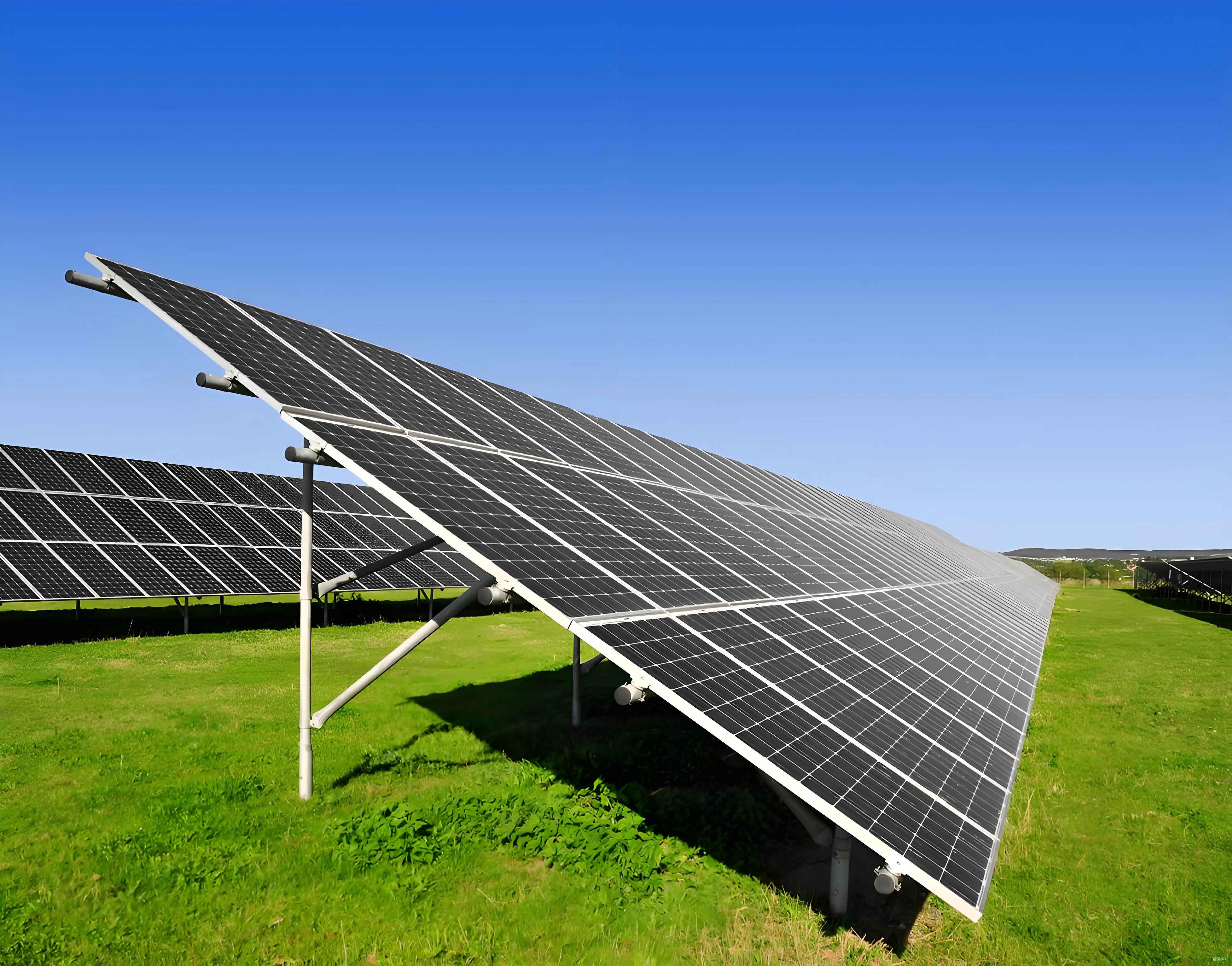
With the increasing adoption of renewable energy systems in forestry environments, solar panels have become a critical component for providing sustainable power in remote wooded areas. However, the efficiency of photovoltaic systems is significantly compromised during winter months due to snow accumulation on panel surfaces. This issue is particularly pronounced in forest settings where manual cleaning is impractical. To address this challenge, I have designed a rolling snow brush-based removal device specifically tailored for photovoltaic panels in forest applications. This article details the material selection, structural design, adhesion force analysis, and dynamic simulation of the brush mechanism, emphasizing its effectiveness in maintaining optimal performance of solar panels under snowy conditions.
The selection of appropriate materials for the snow brush is crucial to ensure durability, flexibility, and non-abrasive contact with photovoltaic surfaces. After evaluating various options, including polypropylene, steel wire, and carbon fiber, I chose Nylon 66 for the brush filaments due to its superior properties in low-temperature environments. Nylon 66 offers high tensile strength, excellent wear resistance, and maintained elasticity at temperatures as low as -40°C, which is essential for forest applications where conditions can be harsh. Additionally, its UV resistance prevents degradation from prolonged sun exposure, common in photovoltaic installations. The material properties are summarized in Table 1.
| Property | Value |
|---|---|
| Density (g/cm³) | 1.14 |
| Elastic Modulus (MPa) | 3200 |
| Tensile Strength (MPa) | 100 |
| Low-Temperature Resistance (°C) | -40 |
| UV Resistance | Excellent |
The structural design of the rolling snow brush incorporates a double-layer configuration to balance weight, strength, and functionality. The inner core is made of PPR plastic with an outer diameter of 50 mm, while the outer layer consists of a hollow aluminum alloy tube with a wall thickness of 10 mm. This combination reduces overall weight while providing sufficient rigidity for effective snow removal. The total brush diameter is 180 mm, with a length of 2000 mm to cover standard photovoltaic panel widths. The brush filaments, arranged in a five-column single-helix pattern, have a diameter of 10 mm and an extension length of 80 mm. This helical arrangement ensures comprehensive coverage and prevents cleaning blind spots, which is critical for maintaining the efficiency of solar panels. A 3 mm gap between the brush ends and filaments minimizes edge damage risks.
To evaluate the cleaning efficiency, I analyzed the adhesive forces between snow particles and photovoltaic surfaces. The primary forces include van der Waals forces, ice bridge forces, and mechanical interlocking forces. The total adhesion force per snow particle is given by:
$$F_a = F_{vdw} + F_{ice} + F_{mech}$$
where \(F_{vdw}\) is the van der Waals force, \(F_{ice}\) is the ice bridge force, and \(F_{mech}\) is the mechanical interlocking force. The van der Waals force comprises two components: the ideal force and the deformation-induced force. The ideal van der Waals force is calculated as:
$$F_{vdw1} = \frac{A_H \cdot R}{6 \cdot h^2}$$
where \(A_H\) is the Hamaker constant (5 × 10⁻²⁰ J for ice and glass), \(R\) is the equivalent particle radius (0.34 × 10⁻⁹ m), and \(h\) is the average distance (1 × 10⁻⁹ m). Substituting the values:
$$F_{vdw1} = \frac{5 \times 10^{-20} \cdot 0.34 \times 10^{-9}}{6 \cdot (1 \times 10^{-9})^2} \approx 2.83 \times 10^{-12} \, \text{N}$$
The deformation-induced van der Waals force is expressed as:
$$F_{vdw2} = \pi \gamma r_c^2 / d$$
where \(\gamma\) is the surface adhesion energy (0.15 J/m²), \(r_c\) is the contact radius (50 × 10⁻⁶ m), and \(d\) is the separation distance. This simplifies to:
$$F_{vdw2} = \gamma \cdot A_{contact} = 1.177 \times 10^{-9} \, \text{N}$$
Thus, the total van der Waals force is:
$$F_{vdw} = F_{vdw1} + F_{vdw2} \approx 1.177 \times 10^{-9} \, \text{N}$$
The ice bridge force, resulting from frozen moisture between particles, is given by:
$$F_{ice} = 2\pi \gamma r$$
where \(\gamma\) is the surface tension of ice (0.2 N/m), and \(r\) is the ice bridge radius (10 × 10⁻⁶ m). Calculating this:
$$F_{ice} = 2\pi \cdot 0.2 \cdot 10 \times 10^{-6} = 1.2566 \times 10^{-5} \, \text{N}$$
The mechanical interlocking force, due to surface roughness, is computed as:
$$F_{mech} = \mu \cdot A_c \cdot P$$
where \(\mu\) is the static friction coefficient (0.1), \(A_c\) is the contact area (1 × 10⁻⁸ m²), and \(P\) is the compressive pressure (100 Pa). Thus:
$$F_{mech} = 0.1 \cdot 100 \cdot 1 \times 10^{-8} = 1 \times 10^{-7} \, \text{N}$$
Summing these forces, the total adhesion force per snow particle is approximately \(1.2566 \times 10^{-5}\) N. However, in practical scenarios, the cumulative force on multiple particles is complex, necessitating dynamic simulation to assess the brush’s cleaning capability.
I conducted dynamic simulations using ANSYS to analyze the mechanical response of the brush filaments during snow removal. The simulations focused on both single and multiple filament configurations to evaluate stress distribution and cleaning effectiveness. The brush rotational speed was set to 120 RPM, and the total simulation time was 8 ms. The photovoltaic panel was fixed, and transient structural analysis was performed to determine equivalent stress over time.
For the single filament simulation, the model was simplified and meshed into 19,175 elements. The equivalent stress at various time intervals is shown in Table 2, with the stress increasing as the filament engages with the panel surface, peaking at 22.397 MPa before stabilizing. This indicates that the brush can generate sufficient force to overcome snow adhesion, which typically requires stresses above 0.1 MPa for effective removal.
| Time (ms) | Equivalent Stress (MPa) |
|---|---|
| 3 | 12.039 |
| 4 | 11.991 |
| 5 | 15.035 |
| 6 | 22.397 |
| 7 | 10.740 |
| 8 | 10.984 |
In the multiple filament simulation, four filaments were modeled to represent a more realistic scenario. The stress distribution was more uniform due to increased contact area, with peak stress reaching 14.971 MPa at 5 ms and stabilizing around 7.999 MPa by 8 ms, as detailed in Table 3. The reduced stress values compared to the single filament case highlight the load-sharing effect among filaments, which enhances cleaning efficiency without compromising the photovoltaic panel integrity. The stresses observed far exceed the adhesion forces of snow, confirming the design’s adequacy for forest photovoltaic applications.
| Time (ms) | Equivalent Stress (MPa) |
|---|---|
| 3 | 9.737 |
| 4 | 12.214 |
| 5 | 14.971 |
| 6 | 14.761 |
| 7 | 10.865 |
| 8 | 7.999 |
The design and simulation results demonstrate that the rolling snow brush effectively addresses snow accumulation on photovoltaic panels in forest environments. The use of Nylon 66 ensures durability and flexibility, while the helical filament arrangement provides comprehensive coverage. The adhesion force analysis and dynamic simulations validate that the brush generates sufficient cleaning force to maintain optimal performance of solar panels. Future work could focus on optimizing brush parameters for different snow conditions and integrating automated control systems for enhanced efficiency in photovoltaic energy generation.