
This paper presents the design and implementation of a 1 kW single-phase high-frequency off-grid solar inverter, optimized for renewable energy applications. The system architecture employs a three-stage topology: DC/DC push-pull conversion, full-bridge DC/AC inversion, and EMI filtering. The controller utilizes Freescale’s MC56F8023 DSC to achieve precise PWM control and soft-start functionality.
1. Working Principle
The solar inverter converts unstable DC input (20-28V) to stable 220V AC through three critical stages:
$$V_o = \frac{2}{T} \int_0^{T} V_i \left( \frac{N_s}{N_p} \right) dt$$
Where \( N_p \) and \( N_s \) represent primary/secondary turns of the push-pull transformer. The voltage conversion ratio is determined by:
$$D = \frac{V_o N_p}{2 V_i N_s}$$
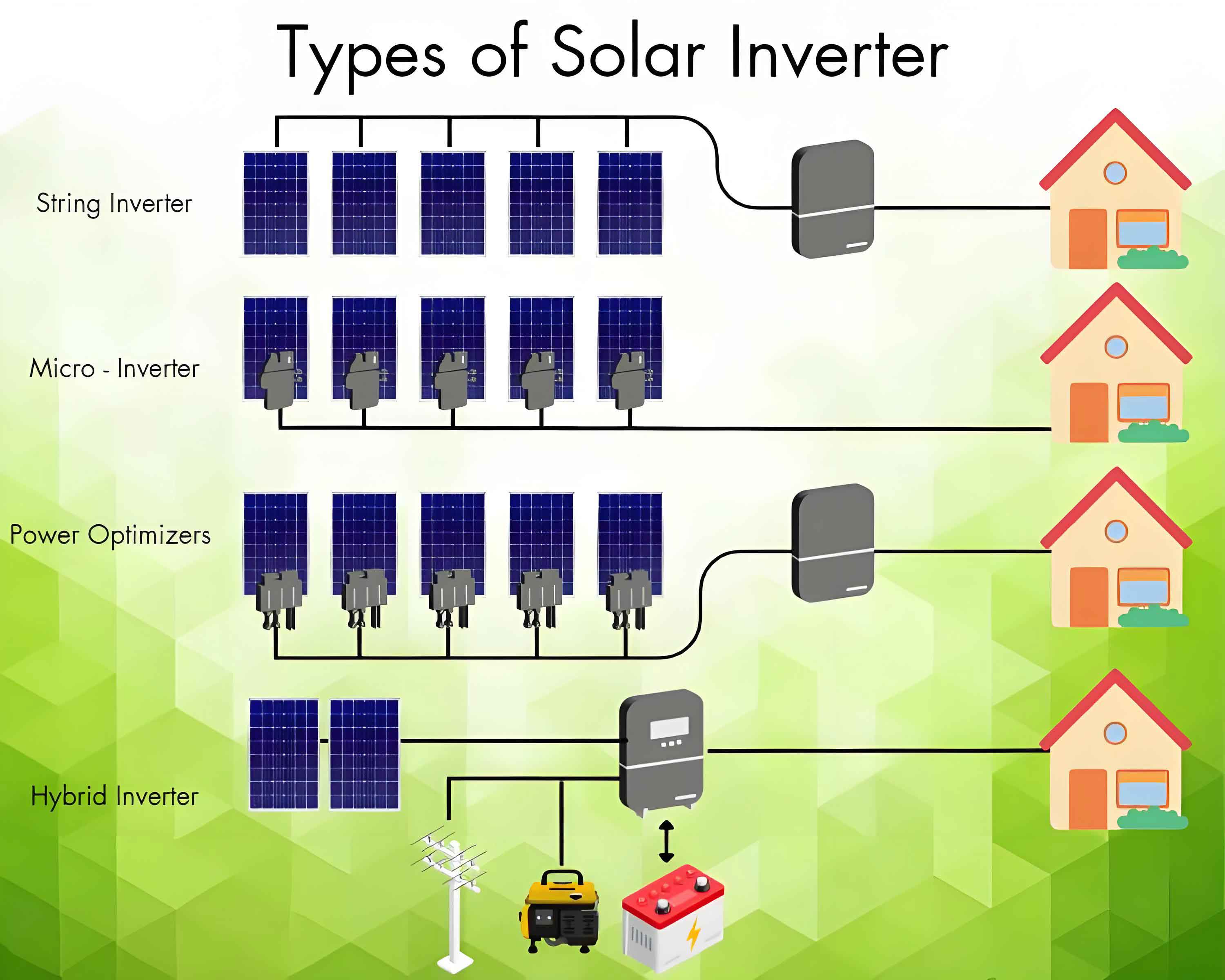
2. High-Frequency Push-Pull Transformer Design
The ETD49 core transformer enables efficient energy transfer with these key parameters:
| Parameter | Value |
|---|---|
| Input Voltage (Vi) | 24V |
| Output Voltage (Vo) | 400V |
| Frequency (f) | 15kHz |
| Primary Turns (Np) | 8 |
| Secondary Turns (Ns) | 134 |
The winding configuration follows:
$$N_p = \frac{V_i \times 10^4}{K_f B_{ac} f A_c}$$
$$N_s = \frac{N_p V_o}{V_i}(1+\alpha)$$
3. EMI Filter Optimization
The solar inverter incorporates dual-stage filtering:
| Component | Specification |
|---|---|
| Common Mode Choke | 1.5mH @ 1GHz |
| X-Capacitors | 0.1μF/275V |
| Y-Capacitors | 2200pF/250V |
Insertion loss meets CISPR22 Class B requirements with 40dB attenuation at 150kHz-30MHz.
4. Digital Control Implementation
The MC56F8023-based control system generates complementary PWM signals with 4μs dead-time:
$$f_{sw} = \frac{1}{T_{period}} = 15kHz$$
$$D_{max} = 48\% \pm 2\%$$
Phase-shifted gate drives ensure push-pull converter stability:
$$T_{delay} = \frac{T_{period}}{2} = 33.3μs$$
5. Experimental Verification
Testing results confirm the solar inverter’s performance:
| Parameter | Measurement |
|---|---|
| Output Voltage THD | <3% @ full load |
| Peak Efficiency | 92.4% |
| Standby Consumption | <1W |
| Transient Response | <100ms |
The output waveform maintains sinusoidal purity with voltage regulation within ±2% across 20-28V DC input variations.
6. Advanced Topology Comparison
Modern solar inverter architectures demonstrate distinct characteristics:
| Topology | Efficiency | Component Count |
|---|---|---|
| Push-Pull + H-Bridge | 90-93% | 38 |
| Full-Bridge LLC | 94-96% | 45 |
| Interleaved Boost | 88-91% | 52 |
7. Thermal Management Strategy
Power loss distribution in the solar inverter follows:
$$P_{loss} = P_{sw} + P_{cond} + P_{core}$$
Where switching losses dominate at high frequency:
$$P_{sw} = \frac{1}{2} V_{ds} I_d (t_r + t_f) f_{sw}$$
Experimental thermal measurements show:
$$T_{jmax} = 78°C @ 45°C \text{ ambient}$$
8. Conclusion
This 1kW solar inverter design demonstrates excellent performance in off-grid applications, achieving 92.4% peak efficiency with compact dimensions (220×150×80mm). The hybrid push-pull/full-bridge topology provides reliable 220V/50Hz output from variable DC sources, making it ideal for solar energy systems, mobile power stations, and rural electrification projects.