
As the global demand for renewable energy continues to rise, solar power has emerged as a key solution due to its safety, reliability, and environmental benefits. Among the critical components in solar energy systems, inverters play a pivotal role by converting direct current (DC) from photovoltaic (PV) arrays or batteries into alternating current (AC) for practical use. In this article, I will delve into the design and analysis of solar inverters, with a particular emphasis on off-grid systems. I will explore various types of solar inverters, including off-grid, grid-tied, and hybrid models, and provide a comprehensive examination of their topologies, control strategies, and performance. Understanding the different types of solar inverter is essential for optimizing energy efficiency and reliability in diverse applications, from remote standalone setups to integrated grid systems.
The core of any solar power system lies in its inverter, which dictates the quality and stability of the output power. In off-grid systems, the inverter must operate independently, often relying on battery storage to ensure continuous power supply. This contrasts with grid-tied inverters, which synchronize with the utility grid, and hybrid inverters that combine both functionalities. Throughout this discussion, I will focus on the design principles of small-scale off-grid inverters, incorporating mathematical models, control algorithms, and simulation results to illustrate their performance. By comparing different types of solar inverter, we can better appreciate their unique advantages and limitations, as summarized in the following table.
| Type of Solar Inverter | Primary Application | Key Features | Efficiency Range | Common Topologies |
|---|---|---|---|---|
| Off-grid Inverter | Standalone systems without grid connection | Battery storage, independent operation, voltage regulation | 85-95% | Full-bridge, push-pull, half-bridge |
| Grid-tied Inverter | Systems connected to the utility grid | Grid synchronization, no battery, anti-islanding protection | 90-98% | H-bridge, multilevel inverters |
| Hybrid Inverter | Combined off-grid and grid-tied functionality | Battery integration, bidirectional power flow, smart energy management | 88-96% | Dual-stage with DC-DC converter |
In off-grid systems, the inverter structure typically includes input circuits, an inversion stage, output filters, control circuits, protection mechanisms, and auxiliary power supplies. The input circuit filters and conditions the DC input from PV arrays or batteries, while the inversion stage—often based on a single-phase topology—converts DC to AC. For small-scale applications, I prefer using a transformerless design to minimize losses and improve efficiency. The main circuit comprises a DC-DC boost converter followed by a single-phase full-bridge inverter. The boost stage elevates the DC voltage from sources like batteries, and the full-bridge inverter then produces AC output. This topology is chosen over push-pull or half-bridge configurations due to its lower switch current requirements and better voltage utilization. The mathematical representation of the boost converter can be expressed using the following differential equations, which describe the inductor current and capacitor voltage dynamics:
$$ \frac{di_L}{dt} = \frac{V_{in} – (1 – d) V_{out}}{L} $$
$$ \frac{dV_{out}}{dt} = \frac{(1 – d) i_L – \frac{V_{out}}{R}}{C} $$
where \( i_L \) is the inductor current, \( V_{in} \) is the input voltage, \( V_{out} \) is the output voltage, \( d \) is the duty cycle, \( L \) is the inductance, \( C \) is the capacitance, and \( R \) is the load resistance. These equations are fundamental in designing the DC-DC stage for optimal performance across different types of solar inverter.
Control strategies are crucial for maintaining output voltage quality and stability. In my design, I employ a voltage feedback closed-loop control system using a TMS320LF2812 DSP. The output voltage is sampled via a Hall voltage sensor (CHV-50P) and conditioned to fit the DSP’s input range (0-3.3V). The control algorithm combines proportional-integral (PI) and repetitive control techniques to enhance dynamic response and eliminate steady-state errors. The PI controller compensates for instantaneous errors, while the repetitive controller addresses periodic disturbances caused by nonlinear loads or switching harmonics. The composite control law can be represented as:
$$ u[k] = K_p e[k] + K_i \sum_{j=0}^{k} e[j] + \sum_{m=0}^{N-1} r[k-m] $$
where \( u[k] \) is the control signal, \( e[k] \) is the error between the reference and output voltages, \( K_p \) and \( K_i \) are the PI gains, and \( r[k] \) is the repetitive control component based on previous periods. This approach ensures robust performance in various operating conditions, which is a key consideration when comparing types of solar inverter. The PWM signals generated by the DSP are isolated and amplified using HCPL3120 optocouplers to drive the power switches safely.
To validate the design, I developed a simulation model in MATLAB/SIMULINK using the Power Electronics toolbox. The model parameters include a DC input voltage of 220V, output frequency of 50Hz, filter inductance of 1.36mH with a series resistance of 0.6Ω, filter capacitance of 18.8μF, and a switching frequency of 10kHz. The simulation results demonstrate that the output voltage closely tracks the sinusoidal reference with a total harmonic distortion (THD) of 2.7%, indicating high waveform quality. The dynamic response is rapid, with minimal overshoot during load transitions. These findings highlight the effectiveness of the PI+repetitive control strategy in off-grid inverters, one of the most common types of solar inverter used in remote applications.
In broader contexts, the evolution of solar inverter technology has led to diverse types of solar inverter, each tailored to specific needs. For instance, hybrid inverters integrate battery storage with grid interaction, offering flexibility and backup power capabilities. These systems often incorporate advanced features like maximum power point tracking (MPPT) and bidirectional power flow. The following table provides a comparative analysis of control techniques used in different types of solar inverter, emphasizing their impact on performance metrics such as efficiency, THD, and cost.
| Control Technique | Applicable Inverter Types | Advantages | Disadvantages | Typical THD |
|---|---|---|---|---|
| PI Control | Off-grid, grid-tied | Simple implementation, good stability | Poor disturbance rejection | 3-5% |
| Repetitive Control | Off-grid, hybrid | Excellent periodic error elimination | Slow response to non-periodic changes | 1-3% |
| MPPT with PWM | All types | Maximizes energy harvest from PV | Increased complexity | 2-4% |
| Sliding Mode Control | Hybrid, grid-tied | Robust to parameter variations | Chattering issues | 1-2% |
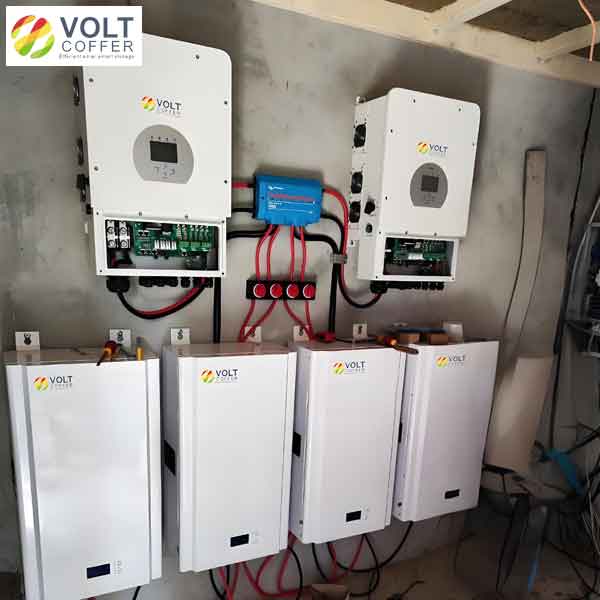
The design and simulation of off-grid inverters underscore the importance of selecting appropriate topologies and control methods. As solar energy systems become more pervasive, understanding the nuances between different types of solar inverter is vital for engineers and researchers. For example, hybrid inverters represent a growing segment due to their ability to manage multiple energy sources. Below is an example of a modern hybrid inverter system, which combines solar input, battery storage, and grid connectivity to provide reliable power.
In conclusion, the design of solar inverters involves a meticulous integration of power electronics, control theory, and simulation tools. Through this analysis, I have highlighted the key aspects of off-grid inverter design, including topology selection, mathematical modeling, and advanced control algorithms. The simulation results confirm that the proposed PI+repetitive control approach achieves low THD and fast dynamic response, making it suitable for various applications. As the renewable energy landscape evolves, continued innovation in the types of solar inverter will drive improvements in efficiency, reliability, and affordability. Future work could focus on optimizing these designs for larger scales or integrating artificial intelligence for adaptive control, further expanding the capabilities of different types of solar inverter.