
In recent years, the demand for renewable energy has driven significant research into solar cell technologies. Among these, perovskite solar cells have emerged as a promising candidate due to their high power conversion efficiency, low manufacturing cost, and scalability. In particular, inverted perovskite solar cells, with their p-i-n structure, offer advantages such as reduced hysteresis, enhanced stability, and compatibility with flexible and tandem applications. The hole transport layer (HTL) is a critical component in these devices, facilitating efficient hole extraction and transport, passivating interfaces, and influencing perovskite crystallization. This article explores the current state of inorganic and organic hole transport materials used in inverted perovskite solar cells, highlighting their properties, preparation methods, and performance enhancements through doping and interface engineering.
The operation of an inverted perovskite solar cell involves several layers: a transparent electrode (e.g., FTO or ITO), a hole transport layer, a perovskite active layer, an electron transport layer (e.g., C60 or PCBM), and a metal counter electrode (e.g., Cu or Ag). Under illumination, the perovskite layer absorbs photons, generating electron-hole pairs that dissociate at the interfaces. Holes are transported through the HTL to the anode, while electrons move via the electron transport layer to the cathode, producing a photocurrent. Key performance parameters include the open-circuit voltage ($V_{oc}$), short-circuit current density ($J_{sc}$), fill factor (FF), and overall power conversion efficiency (PCE), which can be expressed as:
$$ \eta = \frac{J_{sc} \times V_{oc} \times FF}{P_{in}} $$
where $P_{in}$ is the incident light power. The HTL plays a vital role in minimizing non-radiative recombination and optimizing these parameters.
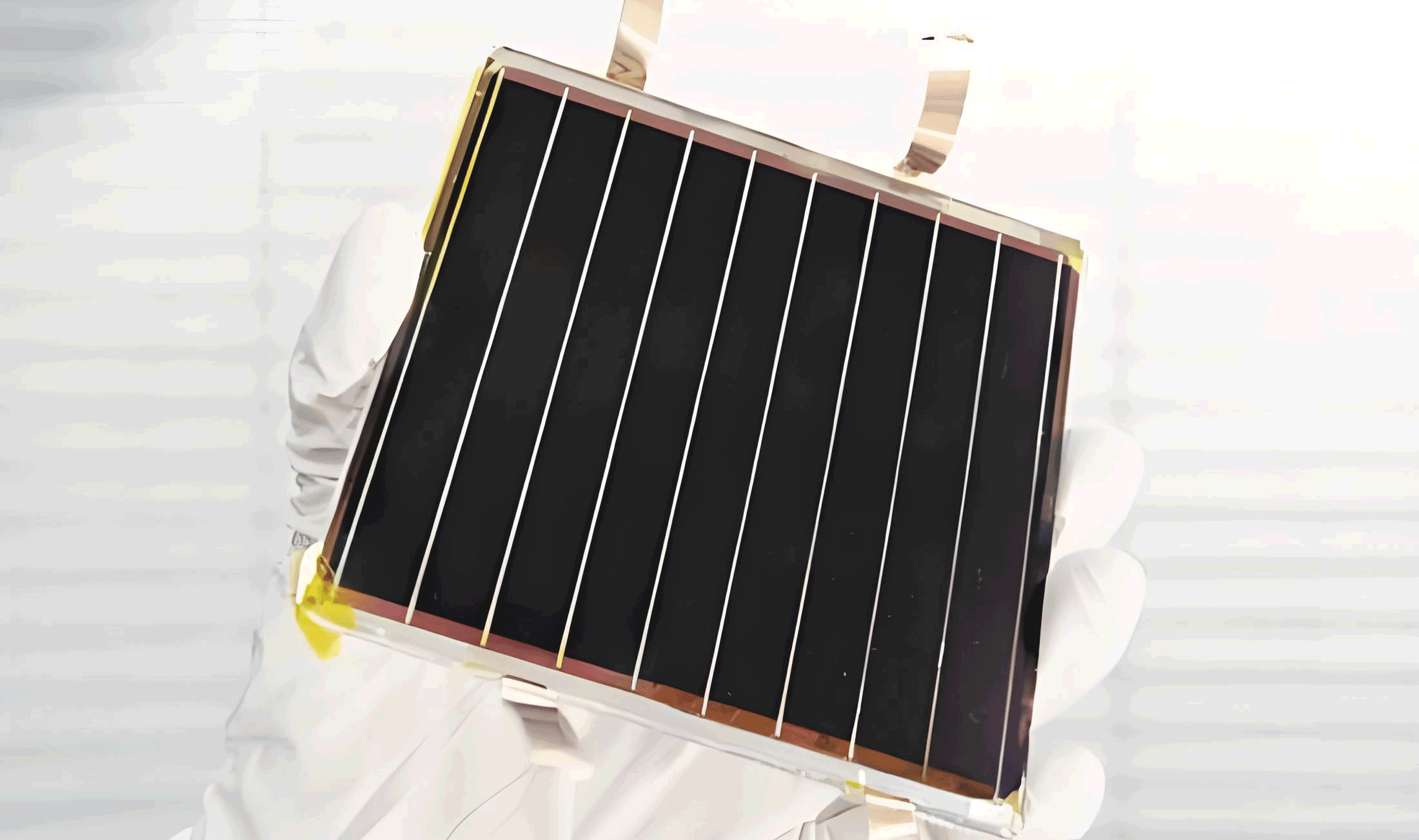
Inorganic hole transport materials, such as NiOx, Cu2O, CuI, CuSCN, and V2O5, are widely used in inverted perovskite solar cells due to their excellent stability, high transparency, and cost-effectiveness. These materials typically exhibit p-type semiconductor behavior, with bandgaps that allow for efficient hole extraction while minimizing optical losses. For instance, NiOx has a cubic structure and a wide bandgap (~3.6 eV), making it suitable for visible light transmission. However, intrinsic defects, such as nickel vacancies, can limit conductivity, necessitating doping strategies. Common preparation methods include physical vapor deposition (PVD), chemical deposition, atomic layer deposition (ALD), spin-coating, and electrochemical deposition.
Physical vapor deposition involves evaporating material in a vacuum to form thin films, as described by:
$$ \text{Deposition rate} = k \cdot P \cdot A $$
where $k$ is a constant, $P$ is the vapor pressure, and $A$ is the surface area. This method produces dense, uniform layers but may require high temperatures. In contrast, chemical deposition, such as sol-gel or spray pyrolysis, offers low-temperature processing. For example, sol-gel-derived NiO nanocrystals have achieved PCEs of around 9.1% in early studies. ALD enables precise thickness control through self-limiting surface reactions, often using precursors like nickel dimethylcyclopentadienyl. Plasma-assisted ALD has further improved hole mobility to $6.0 \times 10^{-3} \, \text{cm}^2/(\text{V} \cdot \text{s})$, leading to PCEs exceeding 17%.
Doping inorganic materials enhances their electrical properties. For NiOx, lithium and magnesium co-doping increases conductivity by compensating for lattice distortions. The resulting Li0.05Mg0.15Ni0.8O films exhibit a conductivity of $2.32 \times 10^{-3} \, \text{S/cm}$, significantly higher than undoped samples. Similarly, copper-based compounds like CuSCN and CuI offer high hole mobility but suffer from lower $V_{oc}$ due to interface recombination. Electrochemical deposition of CuSCN has yielded PCEs up to 16.6%, while thermal evaporation of CuI has achieved 14.7%. The narrow bandgaps of these materials (e.g., ~2.2 eV for Cu2O) can reduce transparency, but optimization of film thickness mitigates this issue.
The table below summarizes key inorganic hole transport materials, their preparation methods, and performance metrics in inverted perovskite solar cells:
| Material | Preparation Method | Hole Mobility (cm²/(V·s)) | Bandgap (eV) | PCE (%) |
|---|---|---|---|---|
| NiOx | Sol-gel, ALD, PVD | ~10-3 to 10-2 | ~3.6 | 9.1–19.1 |
| Cu2O | Thermal oxidation, Spin-coating | ~10-2 | ~2.2 | 11.0–17.4 |
| CuI | Thermal evaporation | ~10-1 | ~3.1 | 14.7 |
| CuSCN | Electrochemical deposition | ~10-1 | ~3.6 | 3.8–16.6 |
| V2O5 | Spin-coating | ~10-3 | ~2.0 | <1 |
Organic hole transport materials, including conductive polymers like PEDOT:PSS and PTAA, offer advantages such as solution processability, high hole mobility, and good flexibility. PEDOT:PSS, a blend of poly(3,4-ethylenedioxythiophene) and polystyrene sulfonate, has high transparency and a work function of around -5.0 eV, enabling efficient hole extraction. Early devices with PEDOT:PSS HTLs achieved PCEs of 3.9%, but improvements in film quality and interface engineering have pushed efficiencies beyond 19%. For instance, urea treatment of PEDOT:PSS enhances morphology and conductivity, leading to a PCE of 18.8%. Copper doping (Cu:PSS) reduces acidity and improves stability, with reported PCEs of 19.44%.
PTAA (poly[bis(4-phenyl)(2,4,6-trimethylphenyl)amine]) exhibits superior hydrophobicity, which promotes better perovskite crystallization and reduces non-radiative recombination. Its amorphous structure ensures isotropic charge transport, and the low surface energy minimizes traps. Devices with PTAA HTLs have achieved PCEs up to 21.1% through additive engineering, such as sulfonic zwitterions that passivate defects. Further advancements, including cross-linking strategies and cation homogenization, have enabled PCEs of 23.9% and recently 26.1% in inverted perovskite solar cells. The fill factor in these devices often exceeds 80%, attributed to reduced interface resistance.
The performance of organic HTLs can be modeled using the diode equation, where the current density ($J$) is given by:
$$ J = J_0 \left( \exp\left(\frac{qV}{nkT}\right) – 1 \right) – J_{ph} $$
where $J_0$ is the reverse saturation current, $q$ is the electron charge, $V$ is the voltage, $n$ is the ideality factor, $k$ is Boltzmann’s constant, $T$ is temperature, and $J_{ph}$ is the photocurrent density. Optimizing the HTL/perovskite interface minimizes $J_0$ and enhances $V_{oc}$.
The table below compares organic hole transport materials based on their properties and performance:
| Material | Hole Mobility (cm²/(V·s)) | Work Function (eV) | Advantages | PCE (%) |
|---|---|---|---|---|
| PEDOT:PSS | ~10-3 to 10-2 | -5.0 | High transparency, solution processable | 3.9–19.44 |
| PTAA | ~10-2 to 10-1 | -5.2 | Hydrophobic, low recombination | 18.1–26.1 |
| Other Polymers | ~10-3 | -5.0 to -5.5 | Flexibility, tunable properties | 12–21 |
Despite progress, challenges remain in developing ideal hole transport layers for inverted perovskite solar cells. An optimal HTL should exhibit high hole mobility, wide bandgap, good energy level alignment with the perovskite, excellent film-forming ability, and stability against environmental factors. For inorganic materials, strategies like doping and surface passivation address conductivity and defect issues. Organic materials benefit from chemical modifications and interface layers that enhance wetting and reduce recombination. Future research should focus on scalable deposition techniques, such as slot-die coating and inkjet printing, to enable large-area and flexible perovskite solar cells. Additionally, the integration of HTLs in tandem structures and semi-transparent devices could broaden applications in building-integrated photovoltaics.
In conclusion, hole transport layers are pivotal in advancing inverted perovskite solar cells toward commercialization. Both inorganic and organic materials have demonstrated remarkable efficiencies, with ongoing innovations in material design and processing. As we continue to explore novel compounds and engineering approaches, the goal of achieving high-performance, stable, and low-cost perovskite solar cells becomes increasingly attainable. The synergy between experimental optimization and theoretical modeling will further elucidate the role of HTLs in charge dynamics, paving the way for next-generation photovoltaic technologies.