
As the penetration of renewable energy sources continues to increase, the stable operation of isolated DC microgrids requires the support of more flexible and reliable energy storage systems. The Hybrid Energy Storage System (HESS), which combines battery storage units (BSU) and hydrogen storage units (HSU), offers the dual advantages of rapid response and high energy density. This system can effectively address power disturbances and voltage fluctuations in isolated microgrids, thereby improving the utilization of renewable energy. This paper presents our work on a hierarchical coordinated control strategy for an electro-hydrogen HESS, designed to achieve coordinated operation among multiple HESS units while considering the practical impact of communication delays.
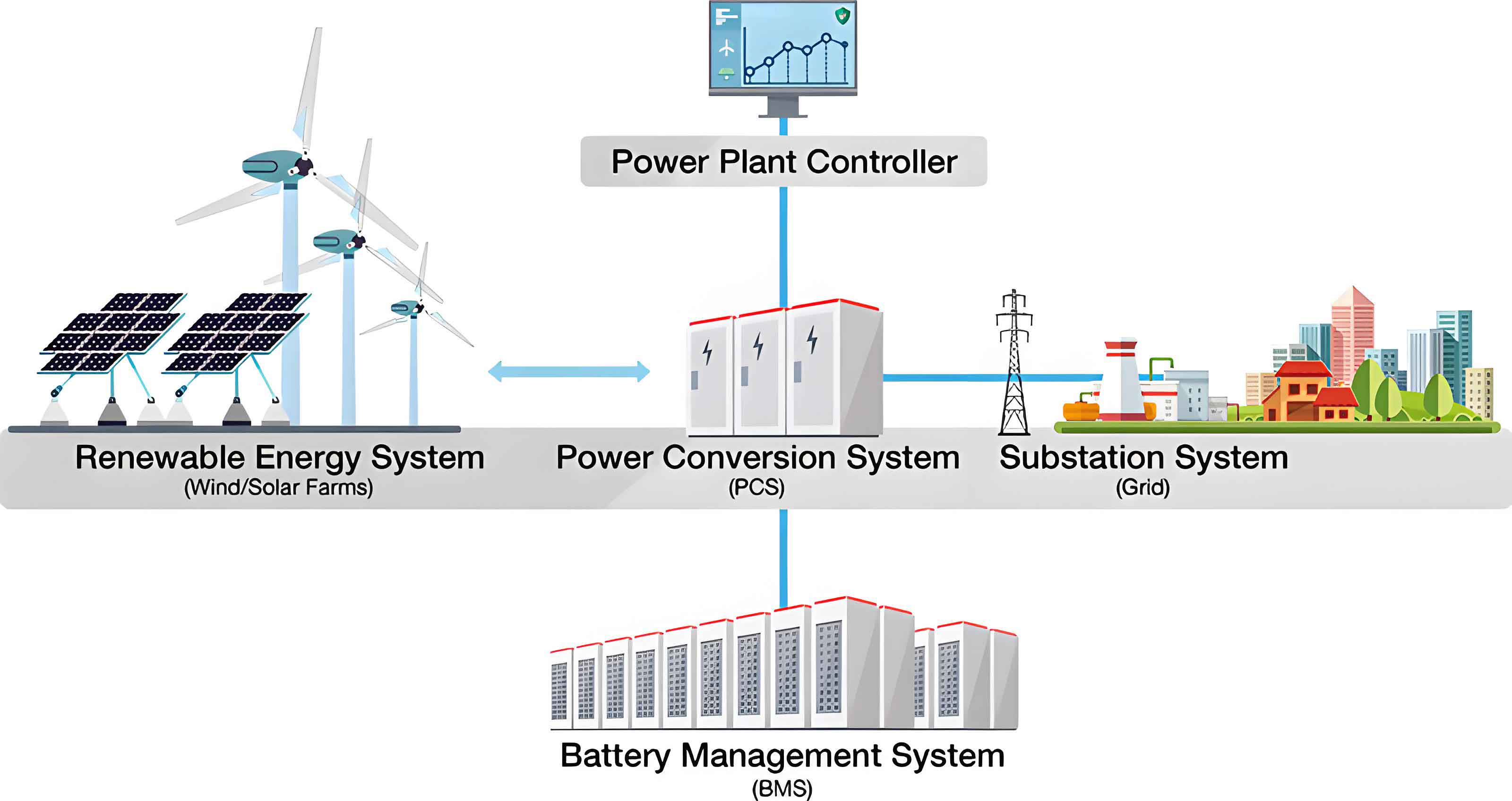
Our proposed strategy is based on a frequency-division and variable compensation consensus algorithm. The structure is composed of a primary control layer and a secondary control layer. The primary layer utilizes an improved droop control method to manage the dynamic power sharing between the BSU and HSU within a single energy storage system. The secondary layer employs a consensus-based distributed controller to restore the average bus voltage and balance the energy distribution among multiple distributed energy storage systems, even under conditions of time-varying communication delays.
1. System Architecture
We consider an islanded DC microgrid with multiple distributed electro-hydrogen energy storage systems. In this structure, each HESS consists of a battery unit and a hydrogen unit (comprising an electrolyzer, fuel cell, and hydrogen storage tank) and is connected to its local DC bus. A distributed communication network connects the various HESS agents, facilitating information exchange for the secondary controller. The primary control objective is to maintain system power balance and a stable DC bus voltage, while the secondary control aims for voltage restoration and SoC/SoH balancing.
2. Primary Control with Improved Frequency-Division Droop Control
To leverage the high energy density of the HSU and the fast response of the BSU, we first propose an improved frequency-division droop control. The conventional method often leaves the BSU with a near-zero steady-state output, which can cause a delay before it can provide support, subjecting the HSU to power shocks. Our method resolves this by modifying the droop equations.
The control equations for the BSU and HSU are given by:
$$
v_{bat,i} = v_{ref} – \frac{1}{sC_{h,i} + 1/R_{b,i}} \cdot i_{bat,i}
$$
$$
v_{el,i} = v_{ref} – R_{h,i} \cdot i_{el,i}
$$
$$
v_{fc,i} = v_{ref} – R_{h,i} \cdot i_{fc,i}
$$
Here, \(v_{ref}\) is the voltage reference, and \(C_{h,i}\) and \(R_{b,i}\) are the virtual capacitance and resistance for the BSU, respectively. By placing a virtual resistance in parallel with the virtual capacitor in the BSU branch, the system allows the BSU to maintain a small steady-state power output while retaining its fast transient response capability. The HSU, governed by a purely resistive droop, handles the majority of the steady-state power. The current sharing relationship between the two units is:
$$
i_{bat,i} = \frac{sR_{h,i} + R_{h,i} / R_{b,i}}{sR_{h,i}C_{h,i} + 1 + R_{h,i}/R_{b,i}} \cdot i_{h,i}
$$
$$
i_{ef,i} = \frac{1}{sR_{h,i}C_{h,i} + 1 + R_{h,i}/R_{b,i}} \cdot i_{h,i}
$$
This creates a natural frequency split, where high-frequency power is directed to the BSU and low-frequency power to the HSU, effectively balancing their response characteristics.
3. Secondary Control with Variable Compensation Consensus
Primary droop control leads to steady-state voltage deviations and prevents perfect power sharing among multiple energy storage systems. To address this, we designed a distributed secondary controller. This controller first defines a global consensus variable to minimize the number of average observers, simplifying the control structure.
The global consensus variable for the BSU and HSU is defined as:
$$
x_{bat,i}(t) = \bar{v}_i(t) – c_i \gamma_{bat,i}(t)
$$
$$
x_{ef,i}(t) = \bar{v}_i(t) – c_i \gamma_{ef,i}(t)
$$
Where \(\bar{v}_i(t)\) is the estimated average voltage, \(\gamma_{bat,i}\) and \(\gamma_{ef,i}\) are the power-sharing state variables for the BSU and HSU, respectively, and \(c_i\) is a bias variable. By ensuring that \(x_{bat,i}(t)\) and \(x_{ef,i}(t)\) converge to a common value, both voltage restoration and energy balancing can be achieved simultaneously.
Recognizing that real communication networks suffer from delays, which can cause conventional consensus algorithms to diverge, we propose a variable-compensation-based average observer:
$$
\bar{x}_i(t) = x_i(t) – \mu \sum_{j=1}^{N} \int_0^t \{ a_{ij}(\bar{x}_i(\tau) – \bar{x}_j(\tau – \tau_{ij})) + \epsilon z_i(\tau) \} d\tau
$$
$$
z_i(t) = \mu \sum_{j=1}^{N} \int_0^t \{ a_{ij}(\bar{x}_i(\tau) – \bar{x}_j(\tau – \tau_{ij})) + \epsilon z_i(\tau) \} d\tau – \epsilon \int_0^t \{ \sum_{j=1}^{N} a_{ij}(z_i(\tau – \tau_{ij}) – z_j(\tau – \tau_{ij})) \} d\tau
$$
In this model, \(z_i(t)\) acts as a bias variable that actively accumulates and offsets the control error induced by the time delay. This method overcomes the divergence problem in conventional consensus algorithms under delayed communication. The final secondary control inputs for the BSU and HSU are:
$$
\dot{u}_{bat,i}(t) = k_{ui}[ (v_{ref} – \bar{v}_i(t)) + c_i(\gamma_i(t) – \bar{\gamma}_{bat,i}(t)) ]
$$
$$
\dot{u}_{ef,i}(t) = k_{ui}[ (v_{ref} – \bar{v}_i(t)) + c_i(\gamma_i(t) – \bar{\gamma}_{ef,i}(t)) ]
$$
Where \(k_{ui}\) is a control gain. This design allows the system to achieve precise voltage recovery and balanced SoC/SoH among distributed energy storage systems.
4. Stability Analysis and Time-Delay Margin
To ensure the practical viability of our control system, we performed a stability analysis using a small-signal model. The linearized model can be expressed as:
$$
\Delta \dot{h}(t) = V_s \Delta h(t) + V_d \Delta h(t – \tau) + V_I \Delta i(t)
$$
Here, \(V_s\) is the system state matrix, \(V_d\) is the matrix affected by the time delay, and \(V_I\) is the input matrix representing the influence of the HESS output current. We derived the characteristic equation for this delay differential equation:
$$
\det(sI – V_s – V_d e^{-s\tau}) = 0
$$
The stability of the system is determined by the roots of this equation. By analyzing the trajectory of the characteristic roots as the delay \(\tau\) increases, we can find the critical delay \(\tau_{lim}\) where the system becomes unstable. Our analysis shows that as the control gains \(k_{ui}\) and \(c_i\) increase, the system’s delay margin decreases. We have summarized the results for different gains in the table below.
| \(\tau_{lim} / ms\) | |||
|---|---|---|---|
| \(k_{ui}\) | \(c_i = 0.01\) | \(c_i = 0.06\) | \(c_i = 0.3\) |
| 1 | 288 | 268 | 185 |
| 2 | 274 | 261 | 177 |
| 3 | 263 | 248 | 164 |
| 4 | 254 | 236 | 148 |
This table demonstrates the robustness of our system, which can tolerate delays in the range of hundreds of milliseconds, a significant improvement over conventional methods.
5. Simulation Verification
We validated our proposed control strategy through extensive Matlab/Simulink simulations on a model with four HESS units. The key parameters are listed below:
| Component | Parameter | Value |
|---|---|---|
| DC Bus | Rated voltage \(v_{dc}\) | 500V |
| Line Impedance | Resistance \(R\) | 0.5 \(\Omega\) |
| Inductance \(L\) | 0.1 mH | |
| PV Source | Rated power \(P_{pv}\) | 50 kW |
| Battery Storage Unit | Capacity \(Q_e\) | 100 Ah |
| Rated voltage \(v_{bat}\) | 200 V | |
| \(SoC_L / SoC_H\) | 0.2 / 0.8 | |
| Virtual capacitance \(C_h\) | 200 | |
| Virtual resistance \(R_b\) | 0.1 | |
| Hydrogen Storage Unit | Tank volume \(V_{sto}\) | 10 \(m^3\) |
| Tank temperature \(T_{sto}\) | 298 K | |
| Max pressure \(P_{sto}\) | 30 MPa | |
| \(SoH_L / SoH_H\) | 0.2 / 0.8 | |
| Virtual resistance \(R_h\) | 0.05 |
5.1 Performance Under Power Disturbances
Our simulations demonstrated that the BSU responds rapidly to high-frequency power changes, while the HSU slowly handles the base load. A key advantage of our method is the reduction in the power ramp rate for the HSU. Compared to a conventional distributed control method, our strategy reduced the HSU’s power ramp rate during load changes by 26.5%, 27.7%, and 29.2% at different disturbance events. This significantly protects the HSU from power shocks and extends its lifespan.
5.2 Performance Under Communication Failures
We tested the system under communication line failures. With a single line fault, the system fully achieved its control objectives. Even with multiple line faults that partitioned the communication topology, each isolated sub-network maintained stability and achieved local secondary control goals. This demonstrates the high reliability and resilience of our distributed control strategy.
5.3 Performance Under Communication Delays
Under a communication delay of 50ms, our control strategy successfully maintained stable operation. The average bus voltage was precisely restored to 500V, and the power output was balanced among the different energy storage systems. A comparison with a leading method showed that while our method had a slightly slower convergence, it provided superior robustness against larger delays. The other method became unstable under a 50ms delay, whereas our system remained stable.
Further testing under various delays showed a gradual degradation in performance. The table below summarizes the voltage overshoot and recovery time under a fixed power disturbance.
| Time Delay | Average Bus Voltage Overshoot | Voltage Recovery Time |
|---|---|---|
| 10 ms | 0.65% | 0.95 s |
| 50 ms | 0.73% | 1.02 s |
| 100 ms | 0.83% | 1.26 s |
As the delay increases, the overshoot increases slightly and the recovery time lengthens, but the system maintains stable operation.
6. Conclusion
In this work, we proposed a hierarchical control strategy for distributed electro-hydrogen energy storage systems in an islanded DC microgrid. Our strategy effectively combines the fast response of BSUs with the high energy density of HSUs. The primary layer uses an improved frequency-division droop control that protects the HSU from power shocks. The secondary layer features a novel distributed controller based on a variable compensation consensus algorithm. This controller is highly robust, achieving zero steady-state error in voltage restoration and energy balancing even under significant communication delays and link failures. Our stability analysis and extensive simulations confirm that the proposed controller outperforms existing methods, providing a more reliable and resilient solution for multi-HESS DC microgrids.