
The proliferation of solar energy integration into the power grid necessitates stringent requirements for the reliability and stability of grid-connected photovoltaic (PV) systems. As stipulated in grid codes such as China’s “Technical Rule for Connecting Photovoltaic Power Station to Power Grid,” PV stations must possess Low Voltage Ride-Through (LVRT) capability, avoiding disconnection during grid voltage anomalies to prevent further loss of generation resources. In practical grid operations, unbalanced faults, characterized by voltage sags with negative-sequence components, occur more frequently than symmetrical faults. These conditions pose significant challenges to the reliable operation of solar inverters, primarily by inducing excessive output peak currents. Such overcurrents can trigger protection devices, damage switching components, and ultimately lead to LVRT failure, severely impacting the stability and reliability of PV generation systems. Therefore, developing effective control strategies to suppress the peak current of solar inverters under unbalanced voltage conditions is of paramount importance. This article analyzes the mechanism behind excessive peak currents and proposes a coordinated active and reactive power control strategy that effectively mitigates this issue while expanding the system’s active power output capability during faults.
Introduction and Problem Background
The increasing penetration of inverter-based resources like solar inverters fundamentally changes grid dynamics. During grid disturbances, these resources must support network stability rather than exacerbate problems. Unbalanced voltage sags, resulting from single-phase or phase-to-phase faults, introduce negative-sequence voltage components at the Point of Common Coupling (PCC). For a grid-connected solar inverter operating with a given active power reference, the presence of negative-sequence voltage and the reduction in positive-sequence voltage magnitude force the inverter to inject larger currents to maintain the power dispatch. This often leads to current magnitudes several times higher than under normal balanced conditions, pushing the inverter beyond its current rating. Furthermore, the negative-sequence components interact with the controlled positive-sequence currents, generating oscillatory components at twice the fundamental frequency (2ω) in both the output active and reactive power. These oscillations can propagate to the DC-link voltage, threatening the stability of the maximum power point tracking (MPPT) algorithm and the lifespan of DC-link capacitors. Consequently, control strategies for solar inverters under unbalanced faults must address three intertwined objectives: limiting the output phase current peak to a safe value (e.g., within 1.2 per unit as a common requirement), minimizing power oscillations to protect DC-side components, and providing necessary reactive current support as mandated by modern grid codes.
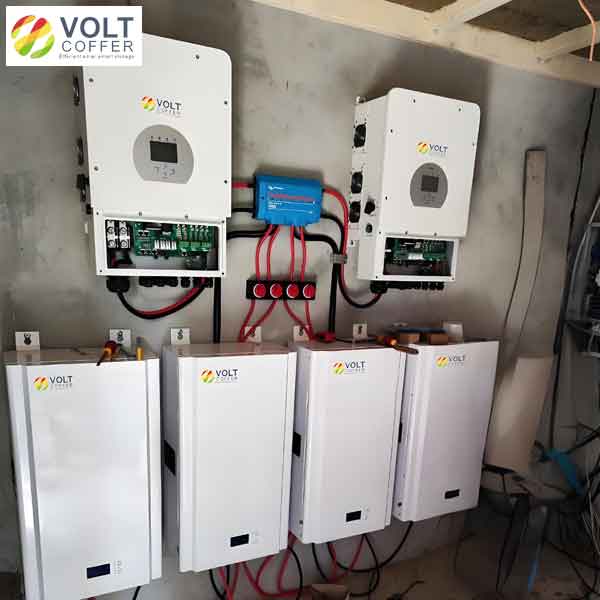
System Topology and Mathematical Model
A standard three-phase, three-wire, two-level voltage source converter (VSC) topology is considered for the grid-connected solar inverter. This topology is ubiquitous in medium- to large-scale PV systems. The inverter is connected to the grid through an L-type filter. The mathematical model in the stationary αβ-reference frame is given by:
$$ u_{\alpha} = Ri_{\alpha} + L\frac{di_{\alpha}}{dt} + e_{\alpha} $$
$$ u_{\beta} = Ri_{\beta} + L\frac{di_{\beta}}{dt} + e_{\beta} $$
where \( u_{\alpha}, u_{\beta} \) and \( i_{\alpha}, i_{\beta} \) are the inverter output voltages and currents, \( e_{\alpha}, e_{\beta} \) are the grid voltages, and \( R, L \) are the resistance and inductance of the filter. The instantaneous active and reactive power are calculated using:
$$ p = 1.5(e_{\alpha}i_{\alpha} + e_{\beta}i_{\beta}) $$
$$ q = 1.5(e_{\beta}i_{\alpha} – e_{\alpha}i_{\beta}) $$
Under unbalanced conditions, the grid voltage contains both positive- and negative-sequence components:
$$ e_{\alpha} = e_{\alpha}^+ + e_{\alpha}^- = U^+\cos(\omega t + \delta^+) + U^-\cos(\omega t + \delta^-) $$
$$ e_{\beta} = e_{\beta}^+ + e_{\beta}^- = U^+\sin(\omega t + \delta^+) – U^-\sin(\omega t + \delta^-) $$
where \( U^+, U^- \) are the magnitudes and \( \delta^+, \delta^- \) are the phase angles of the positive- and negative-sequence voltage components, respectively.
Mechanism of Excessive Peak Current and Traditional Control Targets
Under normal, balanced grid conditions, a solar inverter typically operates at unity power factor. The current reference is derived from the active power reference \( P_{ref} \) and is proportional to the positive-sequence voltage. When an unbalanced sag occurs, the positive-sequence voltage magnitude \( U^+ \) decreases. If the inverter controller stubbornly tries to maintain the pre-fault active power reference \( P_{ref} \), the required current magnitude increases inversely with \( U^+ \), leading to potential overcurrent. Furthermore, the negative-sequence voltage \( U^- \) introduces additional current components.
Traditional control strategies for unbalanced conditions define specific targets by manipulating the positive- and negative-sequence current injections. The primary targets are:
Target I (Balanced Currents): Inject only positive-sequence currents. This produces sinusoidal, balanced output currents but results in large 2ω oscillations in both active and reactive power.
Target II (Constant Reactive Power): Eliminate 2ω oscillations in reactive power. This allows constant reactive power support but causes large oscillations in active power and unbalanced currents.
Target III (Constant Active Power): Eliminate 2ω oscillations in active power. This is often preferred for solar inverters to maintain stable DC-link voltage and MPPT operation. However, it leads to oscillations in reactive power and does not address the peak current issue. The reference currents for Target III in the αβ-frame are:
$$
\begin{bmatrix} i_{\alpha(p)}^{*} \\ i_{\beta(p)}^{*} \end{bmatrix} = \frac{2P_{ref}}{3[(U^+)^2 – (U^-)^2]} \begin{bmatrix} e_{\alpha}^+ – e_{\alpha}^- \\ e_{\beta}^+ – e_{\beta}^- \end{bmatrix}
$$
This formulation clearly shows that as \( U^+ \) decreases and \( U^- \) appears, the denominator shrinks, potentially causing the current references \( i_{\alpha}^{*}, i_{\beta}^{*} \) to become very large, leading to excessive peak phase currents in the solar inverter.
Proposed Reference Current Algorithm with Peak Current Limitation
To address the overcurrent problem, a generalized reference current algorithm is proposed. This algorithm introduces four adjustable parameters (\( m, n, k_1, k_2 \)) within the range [0, 1] into the reference current calculation, providing flexible control over power references, peak current, and power oscillations.
The proposed reference currents for active and reactive power components are:
$$
i_{\alpha(p)}^{*} = \frac{2(e_{\alpha}^+ – k_1 e_{\alpha}^-)}{3[(U^+)^2 – k_1^2 (U^-)^2]} \cdot mP_{ref}
$$
$$
i_{\beta(p)}^{*} = \frac{2(e_{\beta}^+ – k_1 e_{\beta}^-)}{3[(U^+)^2 – k_1^2 (U^-)^2]} \cdot mP_{ref}
$$
$$
i_{\alpha(q)}^{*} = \frac{2(e_{\beta}^+ + k_2 e_{\beta}^-)}{3[(U^+)^2 – k_2^2 (U^-)^2]} \cdot nQ_{ref}
$$
$$
i_{\beta(q)}^{*} = -\frac{2(e_{\alpha}^+ + k_2 e_{\alpha}^-)}{3[(U^+)^2 – k_2^2 (U^-)^2]} \cdot nQ_{ref}
$$
The total reference current is \( i_{\alpha}^{*} = i_{\alpha(p)}^{*} + i_{\alpha(q)}^{*} \) and \( i_{\beta}^{*} = i_{\beta(p)}^{*} + i_{\beta(q)}^{*} \).
Role of the Parameters:
- Parameters \( m \) and \( n \): Directly scale the active and reactive power references. Reducing \( m \) or \( n \) lowers the respective power output, which inherently reduces the peak current.
- Parameters \( k_1 \) and \( k_2 \): Modify the influence of the negative-sequence voltage on the current reference. Adjusting these parameters can reshape the current vector to reduce its peak magnitude without necessarily reducing the average power output. Setting \( k_1 = k_2 = 1 \) recovers the traditional constant active power (Target III) strategy.
The peak value of the phase currents (\( I_{max} \)) when applying this algorithm can be derived analytically. Defining the voltage unbalance factor \( \epsilon = U^- / U^+ \), the maximum phase current is:
$$
I_{max} = \frac{2}{3U^+} \left[ \frac{mP_{ref}}{1 – k_1^2 \epsilon^2} + \frac{nQ_{ref}}{1 – k_2^2 \epsilon^2} + \sqrt{ \left( \frac{mk_1 \epsilon P_{ref}}{1 – k_1^2 \epsilon^2} \right)^2 + \left( \frac{nk_2 \epsilon Q_{ref}}{1 – k_2^2 \epsilon^2} \right)^2 } \right]
$$
This equation is crucial as it explicitly relates the peak current in the solar inverter to the control parameters (\( m, n, k_1, k_2 \)), the power references (\( P_{ref}, Q_{ref} \)), and the grid condition (\( U^+, \epsilon \)). It forms the basis for the coordinated control strategy.
The instantaneous active and reactive powers injected under this strategy contain both constant and oscillatory components. The 2ω oscillatory components are:
$$
\tilde{p} = \frac{(1-k_1)\epsilon U^+}{1 – k_1^2 \epsilon^2} mP_{ref} \cos(2\omega t) – \frac{(1+k_2)\epsilon U^+}{1 – k_2^2 \epsilon^2} nQ_{ref} \sin(2\omega t)
$$
$$
\tilde{q} = -\frac{(1+k_2)\epsilon U^+}{1 – k_2^2 \epsilon^2} nQ_{ref} \cos(2\omega t) – \frac{(1-k_1)\epsilon U^+}{1 – k_1^2 \epsilon^2} mP_{ref} \sin(2\omega t)
$$
These equations show that adjusting \( k_1 \) and \( k_2 \) provides a trade-off between peak current limitation and the magnitude of power oscillations in the solar inverter.
| Parameter | Symbol | Value |
|---|---|---|
| Rated Power | Prated | 0.5 MW |
| DC-link Voltage | Udc | 800 V |
| DC-link Capacitance | C | 5700 μF |
| Grid-side Filter Inductance | L | 1 mH |
| Switching Frequency | fsw | 6 kHz |
| Allowed Peak Current | Imax | 1.2 p.u. |
Coordinated Active and Reactive Power Control Strategy
Based on the proposed algorithm and grid code requirements, a coordinated control strategy for the solar inverter is established. The strategy follows a logical hierarchy to ensure compliance while maximizing performance.
Step 1: Determine Reactive Power Reference \( Q_{ref} \): Following grid code paradigms (e.g., the German BDEW standard), the required reactive current support is determined by the depth of the positive-sequence voltage sag (\( U^+ \)). A typical requirement is:
$$ I_{q,ref} = \begin{cases} 0, & U^+ \ge 0.9 \text{ p.u.} \\ K \cdot (0.9 – U^+), & U^+ < 0.9 \text{ p.u.} \end{cases} $$
where \( K \) is a gain (e.g., 2). The reactive power reference is then \( Q_{ref} = 1.5 \cdot U^+ \cdot I_{q,ref} \).
Step 2: Determine Active Power Reference \( P_{ref} \): The solar inverter operates at its rated apparent power \( S_{rated} \) during faults. Therefore, the active power reference is \( P_{ref} = \sqrt{S_{rated}^2 – Q_{ref}^2} \).
Step 3: Peak Current Limitation Logic:
- Mild Unbalance (High \( U^+ \), Low \( \epsilon \)): If the calculated peak current from Eq. (X) exceeds the limit \( I_{max} \), first adjust parameters \( k_1 \) and \( k_2 \) to minimize power oscillations while bringing \( I_{max} \) to the allowable limit. Set \( m = n = 1 \). This method reduces the peak current without reducing the power output of the solar inverter.
- Severe Unbalance (Low \( U^+ \), High \( \epsilon \)): If adjusting \( k_1, k_2 \) is insufficient (or leads to unacceptable power oscillations), fix \( k_1 = k_2 = 1 \) (prioritize eliminating active power oscillation). Then, adjust parameters \( m \) and/or \( n \) to reduce the power references until the peak current condition \( I_{max} \le I_{limit} \) is satisfied. Priority is given to meeting the reactive power support requirement (\( n \) is adjusted last). The achievable active power is then:
$$ P_{avail} = \frac{ \sqrt{ \left( \frac{3}{2} U^+ I_{limit} \right)^2 – \left( \frac{n Q_{ref}}{1+\epsilon^2} \right)^2 } }{\frac{m}{1-\epsilon^2}} $$
To ensure real-time performance, the optimal parameters \( k_1 \) and \( k_2 \) for a given \( U^+ \), \( \epsilon \), \( P_{ref} \), and \( Q_{ref} \) can be pre-calculated offline using an optimization algorithm (e.g., Improved Particle Swarm Optimization) with the objective of minimizing power oscillation \( \tilde{p} \) subject to \( I_{max} \le I_{limit} \). The results are stored in a lookup table for rapid online application within the solar inverter’s controller.
System Control Implementation
The overall control structure for the solar inverter is implemented in a stationary (αβ) reference frame. A Phase-Locked Loop (PLL) with a decoupled double synchronous reference frame (DDSRF) is used to accurately extract the positive- and negative-sequence components of the grid voltage (\( e_{\alpha}^+, e_{\beta}^+, e_{\alpha}^-, e_{\beta}^- \)). These components, along with the power references and the optimized parameters (\( m, n, k_1, k_2 \)), are fed into the proposed reference current algorithm to generate \( i_{\alpha}^{*} \) and \( i_{\beta}^{*} \).
A Proportional-Resonant (PR) current controller is employed for its ability to track sinusoidal references without steady-state error at the fundamental frequency. The controller outputs the voltage references \( u_{\alpha}^{*} \) and \( u_{\beta}^{*} \), which are then transformed into three-phase modulating signals for Pulse Width Modulation (PWM). The DC-link voltage is regulated by an outer PI controller, the output of which sets the active power reference \( P_{ref} \) during normal operation. During an unbalanced fault, the LVRT strategy overrides this, setting \( P_{ref} \) and \( Q_{ref} \) according to the coordinated control logic described above.
Simulation Verification
A detailed simulation model of a 0.5 MW solar inverter system, with parameters listed in Table 1, was built in PSCAD/EMTDC to validate the proposed strategy. The system operates at unity power factor normally. An unbalanced voltage sag is applied at t = 2.0 s, and the proposed peak current suppression control is activated at t = 2.4 s.
Case 1: Mild Sag (\( U^+ = 0.95 \) p.u., \( \epsilon = 0.18 \)). No reactive support is required. The initial peak current reaches 1.3 p.u., exceeding the 1.2 p.u. limit. With \( m=n=1 \), adjusting parameters to \( k_1=0.645, k_2=0 \) successfully limits the peak current to 1.2 p.u. Active power oscillation increases slightly, while reactive power oscillation decreases.
Case 2: Moderate Sag (\( U^+ = 0.887 \) p.u., \( \epsilon = 0.30 \)). Grid codes require reactive support. With \( Q_{ref} = 0.113 \) Mvar and \( P_{ref} = 0.487 \) MW, the initial peak current is 1.6 p.u. Applying the strategy with \( k_1=0.163, k_2=0.264 \) (and \( m=n=1 \)) brings the peak current down to 1.2 p.u. while maintaining the desired average power output from the solar inverter.
Case 3: Deep Sag (\( U^+ = 0.688 \) p.u., \( \epsilon = 0.60 \)). This is a severe case. The required \( Q_{ref} \) is 0.312 Mvar. The initial peak current is ~3.6 p.u. Adjusting only \( k_1, k_2 \) is insufficient. Therefore, \( k_1=k_2=1 \) is set to prioritize eliminating active power oscillation. Parameters \( m \) and \( n \) are then adjusted. Prioritizing reactive support (\( n \approx 1 \)), the maximum allowable active power is found to be \( P_{avail} = 0.0725 \) MW (with \( m \approx 0.145 \)). The simulation confirms that the peak current is successfully limited to 1.2 p.u., with constant active power and reduced reactive power oscillation.
The simulation results closely match the theoretical calculations from Eq. (X), validating the accuracy of the peak current model and the effectiveness of the proposed control strategy for the solar inverter under all tested unbalanced conditions.
Conclusion
This article has addressed the critical issue of excessive peak currents in grid-connected solar inverters during unbalanced voltage sags. The underlying mechanism was analyzed, revealing how the interaction of reduced positive-sequence voltage, negative-sequence voltage, and constant power control leads to overcurrent conditions. A novel reference current algorithm with four adjustable parameters (\( m, n, k_1, k_2 \)) was proposed, providing a flexible framework to manage the trade-offs between peak current magnitude, power oscillation, and power reference tracking. Building upon this algorithm, a comprehensive coordinated active and reactive power control strategy was developed. This strategy intelligently selects control parameters based on grid code requirements and fault severity, ensuring that the solar inverter remains within its safe current operating limits while providing necessary grid support. The strategy effectively expands the available active power output capability during faults compared to methods that simply derate power. The analytical derivation of the peak current and the simulation results confirm the validity and effectiveness of the proposed approach. This control strategy enhances the reliability and robustness of solar inverters, contributing to the secure integration of large-scale photovoltaic power into modern power systems.