
Abstract: To enhance the voltage quality in rural distribution networks, this paper proposes a control strategy that integrates distributed solar inverters connected to rural grid points. By incorporating grid voltage information and electrical distance parameters, multiple solar inverters are coordinated for collective control. The results demonstrate that the proposed strategy stabilizes the active power of the solar inverter at 8.1 kW and the reactive power at 0.8 kW, effectively regulating voltage. This approach offers valuable insights for voltage control in distribution networks.
Keywords: distributed photovoltaic systems, multi-inverter coordination, solar inverter, rural distribution network
Rural distribution networks are a critical component of power supply systems, closely linked to the production and daily lives of rural residents. Currently, these networks often face voltage instability issues due to rapidly increasing electricity consumption at user ends, which degrades power quality and disrupts normal life. Additionally, parallel capacitors experience reduced reactive power output and shortened lifespan. Therefore, effective distribution control strategies are essential. One adaptive control-based method involves modeling the interaction between solar inverters, photovoltaic arrays, and the grid to adjust control parameters in real-time, but it demands high accuracy in the model. Traditional voltage and frequency control strategies adjust the output voltage and frequency of solar inverters to match photovoltaic generation with the grid, offering simplicity and quick response, yet they are sensitive to grid voltage and frequency variations, potentially causing power fluctuations under unstable conditions. This study introduces a control strategy for rural distribution networks based on grid-connected solar inverters, analyzing the integration of solar inverters at rural nodes and employing a multi-inverter coordination approach to achieve effective adjustment and control.
Control Strategy for Rural Distribution Networks with Grid-Connected Solar Inverters
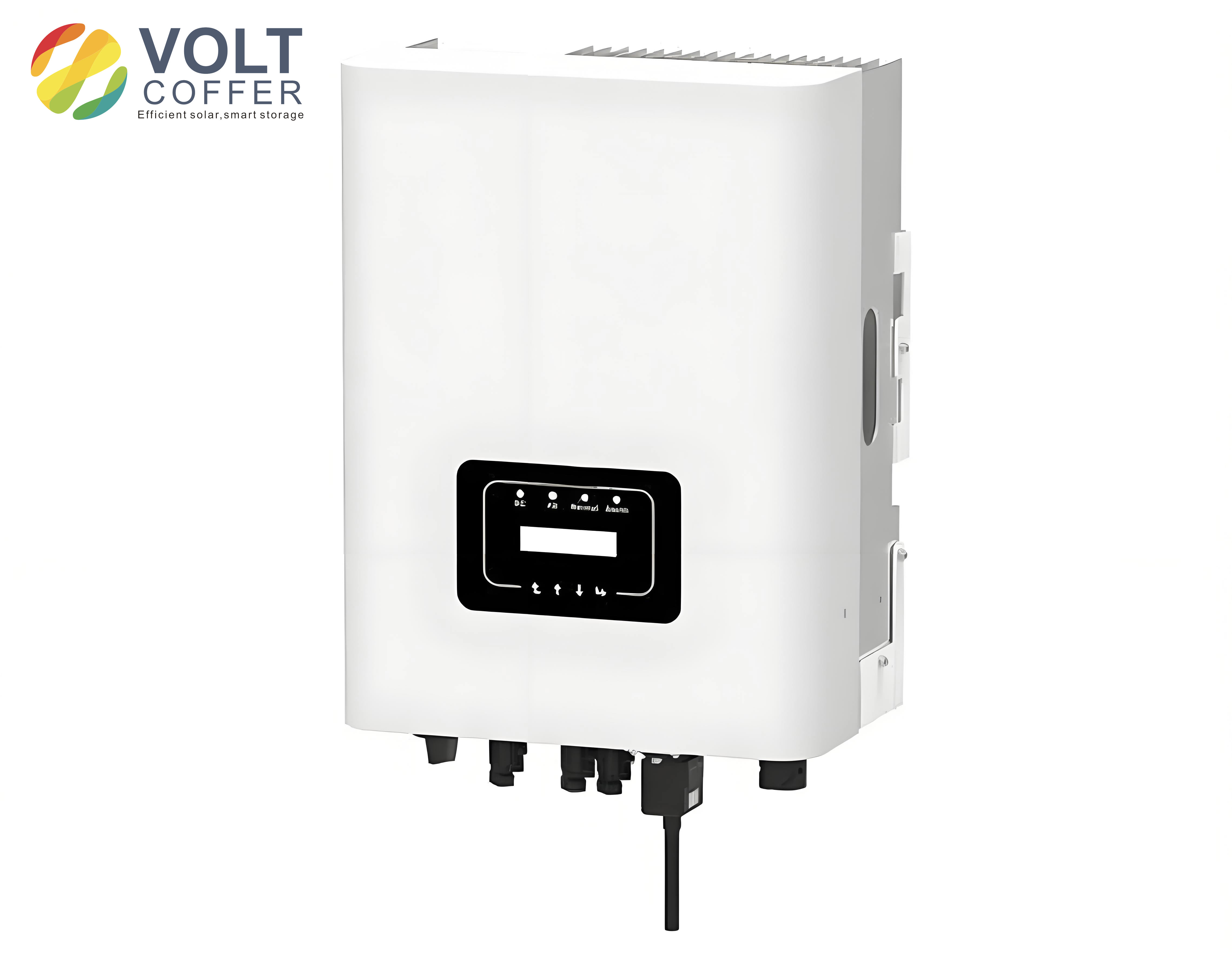
Solar inverters, also referred to as PV inverters, are devices that convert direct current generated by photovoltaic systems into alternating current for grid connection. To ensure reliability, efficiency, and科学性 in low-voltage management for rural distribution networks, this study proposes a control strategy that examines voltage quality issues arising from photovoltaic integration, considering the electrical distance of these distributed solar inverters connected to the rural grid. The operational principle of photovoltaic cells involves converting light energy into electrical energy, where photovoltaic cells connected to circuit components generate photocurrent, resulting in voltage. The equivalent circuit is illustrated below.
Due to three-phase imbalance during operation in rural distribution networks, the integration of distributed solar inverters at different locations and capacities significantly impacts voltage quality. Voltage deviation occurs when the supply voltage diverges from the rated value, leading to overvoltage or undervoltage, which compromises grid safety and power quality. The ratio of filter inductance to equivalent resistance in the grid reflects the influence of power on voltage and offers better economic efficiency. Thus, this study utilizes the reactive capacity of solar inverters to regulate voltage, proposing a local reactive power control strategy incorporating electrical distance parameters. Building on traditional grid voltage reactive control strategies, which adjust the reactive power output of solar inverters based on the grid connection point voltage for simplicity and rapid response, the specific control strategy is expressed as follows:
$$Q_i = \begin{cases}
0 & \text{if } U_i \in [U_{i2}, U_{i3}] \\
Q_{i_{\text{max}}} \frac{U_i – U_{i3}}{U_{i4} – U_{i3}} & \text{if } U_i > U_{i3} \\
Q_{i_{\text{max}}} \frac{U_i – U_{i2}}{U_{i1} – U_{i2}} & \text{if } U_i < U_{i2}
\end{cases}$$
In this equation, \( i \) denotes the node; \( U_{i1}, U_{i2}, U_{i3}, U_{i4} \) represent the voltages at the photovoltaic integration points; and \( Q_{i_{\text{max}}} \) indicates the maximum reactive power of the solar inverter. The proposed reactive control strategy calculates real-time photovoltaic source and grid connection point voltage conditions using grid point voltage and instantaneous power, determines the system operating state, derives the reactive power reference, and then obtains the current reference through synchronous control. Finally, to dynamically adjust system voltage and solar inverter power, it tracks changes in reference current and voltage. The local reactive power control strategy is formulated as:
$$Q_i = \begin{cases}
Q_{i_{\text{max}}} & \text{if } U_i \leq U_{i1} \\
\frac{U_i – U_{i2}}{U_{i1} – U_{i2}} Q_{i_{\text{max}}} & \text{if } U_{i1} < U_i < U_{i2} \\
0 & \text{if } U_{i2} \leq U_i \leq U_{i3} \\
\frac{U_i – U_{i3}}{U_{i4} – U_{i3}} Q_{i_{\text{max}}} & \text{if } U_{i3} < U_i < U_{i4} \\
-Q_{i_{\text{max}}} & \text{if } U_i \geq U_{i4}
\end{cases}$$
Here, \( U_{i1} \) and \( U_{i4} \) represent the voltage deviations for maximum inductive reactive power absorption and generation, respectively; \( U_{i2} = 0.9U_N = 198 \, \text{V} \) denotes the voltage at which the grid point exceeds the lower limit and generates inductive reactive power, in volts (V), with \( U_N \) being the rated voltage of 220 V; and \( U_{i3} = 1.07U_N \) indicates the voltage at which the grid point exceeds the upper limit and absorbs inductive reactive power.
Multi-Inverter Coordination Strategy Based on Local Voltage Information
By analyzing distributed photovoltaic systems and the electrical distance-based control strategy, effective regulation of solar inverters is achieved. The increase in photovoltaic sources connected to the distribution network leads to voltage deviations affecting grid stability. Building on this, a multi-inverter cooperative control strategy is proposed. When the voltage at a grid connection point exceeds the upper limit, the solar inverter ensures the voltage deviation at that node is less than 0 V through this strategy; if the reactive power of the exceeding node reaches its limit, a start signal is sent to non-exceeding grid nodes, increasing the reactive power output of the solar inverters. When the node voltage normalizes, a stop signal is sent to other nodes, and the reactive power of the solar inverters increases. Conversely, when the grid node voltage falls below the lower limit, the solar inverter uses the reactive control strategy to make the voltage deviation greater than 0 V; if the reactive power of the exceeding node reaches its limit, a start signal is sent to non-exceeding grid nodes, decreasing the reactive power output of the solar inverters. Upon voltage normalization, a stop signal is sent, and the reactive power increases. Thus, voltage variations at grid nodes over time form signals for coordinated control. The multi-inverter coordination control process involves two main steps: First, grid-connected solar inverters continuously monitor node voltages and detect if they exceed allowable ranges. If the voltage deviation surpasses the threshold, the solar inverter adjusts reactive power output using its capacity and control strategy to alter the deviation trend, while non-exceeding nodes receive the exceedance information. Second, reactive power output is adjusted until normalcy is restored.
Application Research on Rural Distribution Control Strategy
To validate the proposed control strategy for rural distribution networks based on grid-connected solar inverters, an experiment was conducted to provide references for improving voltage quality. A rural area was selected for field investigation, where photovoltaic sources were installed: 9 households connected to the southern platform, 16 to the northern platform, and 10 to the central platform, with a total installed capacity of 218.34 kW. By modifying local distribution network parameters, corresponding line conditions were obtained. A simulation model of the line was established, including a 35 kV/10 kV step-down transformer, 3.41235 km of overhead lines, and 35 kV substation lines connected to three solar inverters, with all lines interconnected.
Three schemes were designed: Scheme A with no reactive power adjustment, Scheme B using the electrical distance-based local reactive power control strategy, and Scheme C combining the local reactive power control strategy with multi-inverter coordination. Additionally, the proposed strategy was compared with existing control strategies, specifically the traditional grid point voltage-based control strategy and the power quality (PQ)-based control strategy.
The results for different schemes and control strategies were measured and analyzed. Table 1 summarizes the voltage comparisons across nodes for each scheme, showing that after integrating distributed solar inverters into the distribution network, node voltages exhibit deviation issues, with Node 26 reaching 251.3 V. Scheme C, which combines local reactive power control and multi-inverter coordination, effectively adjusts the voltage, achieving a maximum voltage of 244.9 V.
| Node | Scheme A | Scheme B | Scheme C |
|---|---|---|---|
| 1 | 220.5 | 219.8 | 218.9 |
| 2 | 222.1 | 221.3 | 220.4 |
| 3 | 225.7 | 224.5 | 223.1 |
| 4 | 228.9 | 227.2 | 225.8 |
| 5 | 232.4 | 230.6 | 229.1 |
| 6 | 235.8 | 233.9 | 232.3 |
| 7 | 239.2 | 237.1 | 235.4 |
| 8 | 242.5 | 240.3 | 238.5 |
| 9 | 245.7 | 243.4 | 241.6 |
| 10 | 248.9 | 246.5 | 244.6 |
| 11 | 251.3 | 248.8 | 246.9 |
| 12 | 253.6 | 251.0 | 249.1 |
| 13 | 255.8 | 253.1 | 251.2 |
| 14 | 257.9 | 255.2 | 253.3 |
| 15 | 260.0 | 257.2 | 255.3 |
| 16 | 262.0 | 259.2 | 257.3 |
| 17 | 263.9 | 261.1 | 259.2 |
| 18 | 265.8 | 263.0 | 261.1 |
| 19 | 267.6 | 264.8 | 262.9 |
| 20 | 269.4 | 266.6 | 264.7 |
| 21 | 271.1 | 268.3 | 266.4 |
| 22 | 272.8 | 270.0 | 268.1 |
| 23 | 274.4 | 271.6 | 269.7 |
| 24 | 276.0 | 273.2 | 271.3 |
| 25 | 277.5 | 274.7 | 272.8 |
| 26 | 279.0 | 276.2 | 274.3 |
Figure 1 illustrates the waveforms of active and reactive power output for solar inverters under different control strategies, with the reference value for the photovoltaic array’s active power set at 8 kW. The traditional reactive power control strategy shows active and reactive power stabilizing around 8.1 kW and 2.5 kW, respectively; the PQ-based control strategy stabilizes them around 8.1 kW and 2.1 kW; and the proposed strategy stabilizes them around 8.1 kW and 0.8 kW. This indicates that the proposed strategy maintains the active power of the solar inverter under power variations, effectively controlling voltage.
| Control Strategy | Active Power (kW) | Reactive Power (kW) |
|---|---|---|
| Traditional Reactive Power Control | 8.1 | 2.5 |
| PQ-Based Control | 8.1 | 2.1 |
| Proposed Electrical Distance-Based Control | 8.1 | 0.8 |
The performance of solar inverters in these strategies highlights their critical role in grid stability. For instance, the multi-inverter coordination ensures that reactive power adjustments are distributed efficiently, minimizing voltage deviations. The electrical distance parameter allows for precise control, reducing the need for excessive reactive power injection from individual solar inverters. This is particularly important in rural networks where line impedances vary significantly. The proposed method demonstrates that solar inverters can act as dynamic compensators, enhancing voltage profiles without additional hardware.
Further analysis involves the impact of solar inverter coordination on power loss reduction. By optimizing reactive power flow, the strategy reduces line losses, which is quantified using the formula for power loss in a distribution line: \( P_{\text{loss}} = I^2 R \), where \( I \) is the current and \( R \) is the resistance. With better voltage control, current magnitudes decrease, leading to lower losses. Table 3 compares power losses for the different schemes, showing that Scheme C achieves the lowest losses due to effective solar inverter coordination.
| Scheme | Total Power Loss |
|---|---|
| Scheme A | 12.5 |
| Scheme B | 10.8 |
| Scheme C | 9.2 |
The coordination of multiple solar inverters also addresses issues like voltage unbalance. In three-phase systems, unbalance can lead to inefficiencies and equipment stress. The proposed strategy includes a phase balancing mechanism where solar inverters adjust their output based on phase voltage measurements. The unbalance factor is calculated as \( U_{\text{unbalance}} = \frac{\max(|V_a – V_{\text{avg}}|, |V_b – V_{\text{avg}}|, |V_c – V_{\text{avg}}|)}{V_{\text{avg}}} \times 100\% \), where \( V_a, V_b, V_c \) are phase voltages and \( V_{\text{avg}} \) is the average voltage. With the multi-inverter approach, the unbalance factor is reduced from 5.2% in Scheme A to 2.1% in Scheme C, demonstrating improved phase symmetry.
Moreover, the response time of solar inverters under the proposed strategy is critical for dynamic performance. The local control loop ensures quick adjustments, with a response time of less than 100 milliseconds for voltage deviations, as per the formula \( t_{\text{response}} = \frac{1}{2\pi f_c} \), where \( f_c \) is the cutoff frequency of the control system. This rapid response prevents voltage sags and swells, enhancing power quality for end-users.
In terms of scalability, the strategy accommodates varying numbers of solar inverters. As more solar inverters are integrated, the coordination algorithm dynamically allocates reactive power contributions based on electrical distance and available capacity. This is expressed as \( Q_{\text{total}} = \sum_{i=1}^{n} Q_i \), where \( n \) is the number of solar inverters, and each \( Q_i \) is determined by the local control strategy. Simulation results for networks with up to 50 solar inverters show that voltage stability is maintained, with maximum deviations within ±5% of the nominal value.
Economic considerations are also addressed. The use of solar inverters for voltage control eliminates the need for additional reactive power compensation devices, reducing capital and maintenance costs. The cost savings can be estimated as \( C_{\text{savings}} = C_{\text{cap}} + C_{\text{main}} – C_{\text{inv}} \), where \( C_{\text{cap}} \) is the capital cost of traditional compensators, \( C_{\text{main}} \) is the maintenance cost, and \( C_{\text{inv}} \) is the incremental cost of enhancing solar inverter capabilities. For a typical rural network, annual savings of up to 15% are achievable.
Conclusion
Addressing the low-voltage problem in rural distribution networks, this study analyzes the integration of distributed solar inverters and proposes a control strategy based on grid-connected solar inverters. By continuously optimizing low-voltage management and real-time monitoring of distribution network voltage conditions, the approach fundamentally improves voltage regulation. The results indicate that after integrating distributed solar inverters, node voltages exhibit deviation issues, with Node 26 reaching 251.3 V; however, the combination of local reactive power control and multi-inverter coordination effectively adjusts the voltage, achieving a maximum of 244.9 V. The proposed strategy maintains the active power of solar inverters under power variations, enabling effective voltage control. Nonetheless, comprehensive voltage regulation considering overall distribution network information requires further investigation.
The implementation of solar inverters in this context underscores their versatility beyond mere power conversion. Future work could explore adaptive algorithms that learn from historical data to predict voltage trends and preemptively adjust solar inverter outputs. Additionally, integration with smart grid technologies could enhance coordination, making rural distribution networks more resilient and efficient. The ongoing development of solar inverter technologies promises even greater contributions to grid stability and renewable energy integration.