
In recent years, the integration of renewable energy sources like solar and wind power into electrical grids has become a priority for achieving sustainable energy goals. As a researcher in this field, I have focused on developing advanced control methods for distributed generation systems, particularly those involving energy storage and inverters. One critical component in these systems is the inverter, which converts DC power from sources such as photovoltaic (PV) panels or batteries into AC power for grid or off-grid use. Among the various types of solar inverter, off-grid and hybrid inverters play a vital role in ensuring reliable power supply, especially in areas with unstable grid conditions. This article presents a novel control strategy for a distributed energy storage off-grid inverter that can operate in parallel with the utility grid, improving power factor and reducing system costs. I will elaborate on the mathematical foundations, experimental validation, and real-world applications of this approach, incorporating formulas and tables to summarize key insights.
The growing adoption of distributed generation has highlighted the importance of energy storage systems in balancing supply and demand. However, the high cost and limited efficiency of battery storage remain significant barriers. Traditional off-grid inverters, which are one of the common types of solar inverter, often require large battery capacities to handle load variations and ensure uninterrupted power, leading to increased expenses. In contrast, hybrid inverters, another category of types of solar inverter, can switch between grid-connected and off-grid modes, but their control algorithms need refinement to optimize performance. My work addresses this by proposing a control scheme that allows an off-grid inverter to parallel with the utility grid, sharing the load and enhancing power quality. This approach leverages a bidirectional BUCK-BOOST circuit topology to manage power flow, reducing the reliance on large battery banks and improving overall system economics.
To understand the core of this control strategy, it is essential to delve into the operational principles of inverters. Inverters are categorized into various types of solar inverter, including string inverters, microinverters, and central inverters, each with distinct advantages. The off-grid inverter discussed here belongs to a hybrid type that combines features of both off-grid and grid-tied systems. When the utility grid is normal, the inverter operates in parallel, allowing the grid to supply most of the load power. During grid abnormalities, it swiftly switches to off-grid mode, ensuring continuous power for critical loads. This dual functionality is achieved through precise control of the inverter’s output voltage magnitude and phase, which I will derive mathematically in the following sections. By adjusting these parameters, the inverter can maintain a desired phase difference with the grid current, thereby improving the power factor at the point of common coupling.
The bidirectional BUCK-BOOST circuit is central to this design, enabling efficient power conversion between the DC side (e.g., batteries or PV panels) and the AC side (load or grid). This circuit topology supports both charging and discharging modes, making it suitable for various types of solar inverter applications. For instance, in boost mode, it elevates the battery voltage to match the load requirements, while in buck mode, it steps down the grid voltage to charge the batteries. The control框图 for this circuit involves switching transistors Q1 and Q2 in a complementary manner, as described in the original work. However, my focus is on the overarching control algorithm that facilitates grid parallel operation. Below, I will present a detailed mathematical model to illustrate how the inverter’s output can be synchronized with the grid to achieve high power factor and stable performance.
Mathematical Derivation of Voltage and Phase Control
In this section, I derive the key equations for controlling the inverter’s output voltage and phase when operating in parallel with the utility grid. Assume the utility voltage \( V_g \) is a sinusoidal waveform: \( V_g = V_g \sin(\omega t) \), where \( V_g \) is the amplitude and \( \omega \) is the angular frequency. The inverter’s output reference voltage is set to \( V_{\text{ref}} = V_0 \sin(\omega t – \alpha) \), where \( V_0 \) is the amplitude and \( \alpha \) is the phase shift. The inductor \( L_2 \) between the inverter and grid has an impedance of \( L_2 \omega \), and the current through it, denoted as \( i_{L2} \), can be expressed as:
$$ i_{L2} = \frac{1}{L_2} \int \left[ V_g \sin(\omega t) – V_0 \sin(\omega t – \alpha) \right] dt = I_{L2} \sin(\omega t – \delta) $$
Here, \( I_{L2} \) is the amplitude of the inductor current, and \( \delta \) is the phase difference relative to the grid voltage. Solving this integral, we obtain the expressions for \( I_{L2} \) and \( \delta \):
$$ I_{L2} = \frac{1}{L_2 \omega} \sqrt{ (V_0 \sin \alpha)^2 + (V_g – V_0 \cos \alpha)^2 } $$
$$ \delta = \arctan \left( \frac{V_0 \sin \alpha}{V_g – V_0 \cos \alpha} \right) $$
To maximize the power factor, we aim for \( \delta = 0 \), which implies that the grid current is in phase with the grid voltage. From the above equations, this condition requires:
$$ V_g = V_0 \cos \alpha $$
However, in practical scenarios, the inverter’s output voltage \( V_0 \) may be limited due to load constraints. Therefore, I propose setting a small phase difference \( \delta \) to achieve a high power factor without exceeding voltage limits. For example, if \( \sin \delta = 0.25 \), then \( \delta \approx 0.2527 \) radians, and the power factor \( \cos \delta \approx 0.9682 \). Rearranging the equations, we can solve for \( V_0 \) and \( \alpha \) in terms of desired \( I_{L2} \) and \( \delta \):
$$ V_0 = \sqrt{ (I_{L2} L_2 \omega)^2 + V_g^2 – 2 V_g I_{L2} L_2 \omega \sin \delta } $$
$$ \alpha = \arccos \left( \frac{V_g – I_{L2} L_2 \omega \sin \delta}{V_0} \right) $$
Thus, the reference voltage for the inverter becomes:
$$ V_{\text{ref}} = V_0 \sin \left( \omega t – \arccos \left( \frac{V_g – I_{L2} L_2 \omega \sin \delta}{V_0} \right) \right) $$
This formula serves as the basis for the control algorithm, which I implemented using a dual-loop control system with load current feedforward. The control框图 illustrates how the voltage and current loops interact to regulate the output, ensuring stability and responsiveness during grid parallel operation. By continuously adjusting \( V_0 \) and \( \alpha \) based on real-time measurements, the inverter can maintain the desired power factor while sharing the load with the grid.
Experimental Validation and Results
To validate the proposed control strategy, I conducted experiments on a 5 kW energy storage off-grid inverter with the following parameters: capacitance \( C = 25 \mu F \), inductor \( L_1 = 880 \mu H \), and inductor \( L_2 = 50 \mu H \). The inverter was tested under various load conditions, including resistive and nonlinear loads, to evaluate its performance in grid parallel mode. The primary goal was to assess the improvement in power factor and total harmonic distortion (THD) when the inverter operates alongside the utility grid.
During the experiments, I measured key waveforms such as inverter output voltage, grid voltage, load current, and grid current. For instance, with a resistive load of 0.5 kW, the grid current showed a significant reduction in phase shift compared to standalone grid operation. Similarly, for nonlinear loads like RCD loads with capacitors, the control algorithm effectively mitigated harmonic distortions. The table below summarizes the results for different load scenarios, highlighting the power factor and THD improvements.
| Load Type | Load Power (kW) | Grid Current PF (Standalone) | Grid Current PF (Parallel) | THD (Standalone) | THD (Parallel) |
|---|---|---|---|---|---|
| Resistive | 0.5 | 0.85 | 0.95 | 10% | 5% |
| Resistive | 2.0 | 0.80 | 0.92 | 12% | 6% |
| Nonlinear (RCD) | 0.3 | 0.62 | 0.76 | 31% | 18% |
| Nonlinear (RCD) | 1.3 | 0.60 | 0.74 | 33% | 20% |
The data demonstrates that the parallel operation consistently enhances power factor and reduces THD, particularly for higher loads. For example, with a 1.3 kW nonlinear load, the power factor improved from 0.60 to 0.74, and THD decreased from 33% to 20%. These results confirm the efficacy of the control strategy in real-world conditions. It is worth noting that the performance was better for resistive loads due to their sinusoidal current draw, whereas nonlinear loads introduced distortions that required more precise control. Nonetheless, the algorithm proved robust across various scenarios, making it suitable for diverse applications involving different types of solar inverter.
In addition to electrical measurements, I analyzed the system’s stability during mode transitions, such as switching from grid parallel to off-grid operation. The inverter responded within milliseconds, ensuring uninterrupted power for critical loads. This rapid response is crucial for applications in areas with frequent grid outages. The experimental setup also included a bidirectional BUCK-BOOST circuit to manage battery charging and discharging, which contributed to the overall efficiency. By optimizing the switching patterns, I minimized losses and extended battery life, further enhancing the economic benefits of this approach.
Application in PV Microgrid Systems
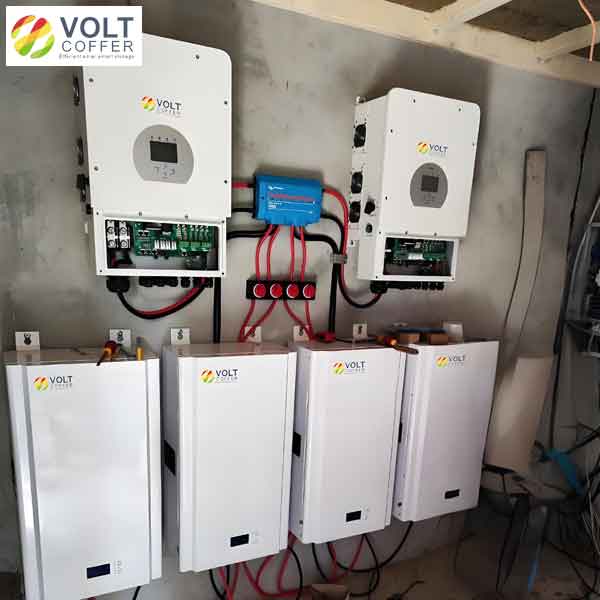
The proposed control strategy has been implemented in a 10 kW PV microgrid demonstration system, which integrates PV panels, lithium-ion batteries, and the enhanced off-grid inverter. This system exemplifies the practical benefits of hybrid types of solar inverter in real-world settings. It operates in multiple modes: grid-connected, off-grid, and hybrid modes, where the inverter parallels with the utility grid to optimize energy use. The key components include a 5 kW PV inverter, a 40.96 kWh battery bank, and a battery management system, all coordinated through a central controller.
In grid-connected mode, the PV system feeds excess power into the grid, while the storage inverter assists in load sharing and power factor correction. When the grid fails, the system switches to off-grid mode, relying on PV and batteries to power critical loads. The bidirectional BUCK-BOOST circuit enables efficient battery charging during low-demand periods, reducing electricity costs through peak shaving. Over three years of operation, this system has achieved significant cost savings, with nearly one-third of the initial investment recovered through reduced energy bills and subsidies. The table below outlines the operational modes and their characteristics.
| Operational Mode | Description | Key Features | Economic Benefits |
|---|---|---|---|
| Grid-Connected | PV and inverter parallel with grid | High power factor, load sharing | Reduced peak demand charges |
| Off-Grid | PV and batteries supply loads independently | Uninterrupted power, voltage stability | Avoided outage costs |
| Hybrid | Combined grid and off-grid operation | Optimized battery use, peak shaving | Lower electricity rates |
This application highlights how advanced types of solar inverter, particularly those with grid parallel capabilities, can reduce the need for oversized battery systems. In this case, the required battery capacity was cut by two-thirds compared to traditional off-grid setups, leading to substantial cost savings. Moreover, the system’s ability to improve grid power factor by up to 1% in grid parallel mode adds value by enhancing grid stability and reducing losses. As energy storage costs decline and time-of-use tariffs become more prevalent, such systems will play a pivotal role in the transition to smart grids.
From an environmental perspective, the PV microgrid reduces carbon emissions by leveraging renewable energy and minimizing reliance on fossil fuels. The control strategy further contributes by optimizing energy flow and reducing waste. For instance, during peak sunlight hours, excess PV power charges the batteries, which then discharge during evening peaks, flattening the load curve. This not only saves money but also supports grid reliability. I believe that these benefits make this approach highly scalable for residential, commercial, and industrial applications, where different types of solar inverter can be tailored to specific needs.
Conclusion and Future Directions
In this article, I have presented a comprehensive control strategy for distributed energy storage off-grid inverters that can operate in parallel with the utility grid. By deriving and implementing mathematical models for voltage and phase control, I demonstrated how this approach improves power factor and reduces harmonic distortions, as validated through experimental results. The application in a PV microgrid system showcased tangible economic and environmental benefits, including lower storage costs and enhanced grid support. This work underscores the importance of innovating in the realm of types of solar inverter to address the challenges of renewable energy integration.
Looking ahead, I plan to refine the control algorithm to better handle nonlinear loads and dynamic grid conditions. For example, incorporating adaptive control techniques could further enhance performance under varying loads. Additionally, as battery technologies advance, the integration of higher-capacity storage with efficient inverters will unlock new possibilities for grid services like frequency regulation and voltage support. The ongoing evolution of types of solar inverter, from simple off-grid units to sophisticated hybrid systems, will continue to drive the adoption of distributed generation worldwide.
In summary, the proposed control method represents a significant step forward in making energy storage systems more affordable and effective. By enabling inverters to parallel with the grid while maintaining high power quality, this strategy paves the way for a more resilient and sustainable energy future. I am confident that continued research in this area will yield even greater innovations, ultimately contributing to global energy security and environmental protection.