
Ensuring the safe operation of lithium-ion batteries under diverse working conditions remains a paramount challenge in their widespread application for energy storage and electric mobility. During charge-discharge cycles, complex electrochemical reactions within the cell generate substantial heat and induce internal mechanical stress. This stress can lead to deformation of the battery casing, and in severe cases, may cause electrolyte leakage, thermal runaway, or even catastrophic failure. Therefore, comprehensively understanding the strain response of the battery casing during operation is critical for developing advanced safety management strategies. This study focuses on constructing a high-fidelity multiphysics model to analyze the deformation behavior of a cylindrical 18650 lithium-ion battery, with the aim of establishing a predictive link between internal states and external mechanical signals.
Traditional battery management systems (BMS) primarily rely on monitoring electrical parameters like voltage and current, and thermal parameters like surface temperature. While effective, these metrics sometimes fail to provide early warning for certain failure modes. Recent research has highlighted the potential of mechanical signals, such as strain and expansion force, as complementary indicators for state-of-health and safety assessment. However, most numerical studies on lithium-ion batteries have concentrated on simulating electrochemical performance and thermal distribution, with less emphasis on accurately predicting the macroscopic strain response of the casing. To bridge this gap, we developed an electrochemical-thermal-mechanical coupled model that integrates the core physicochemical processes.
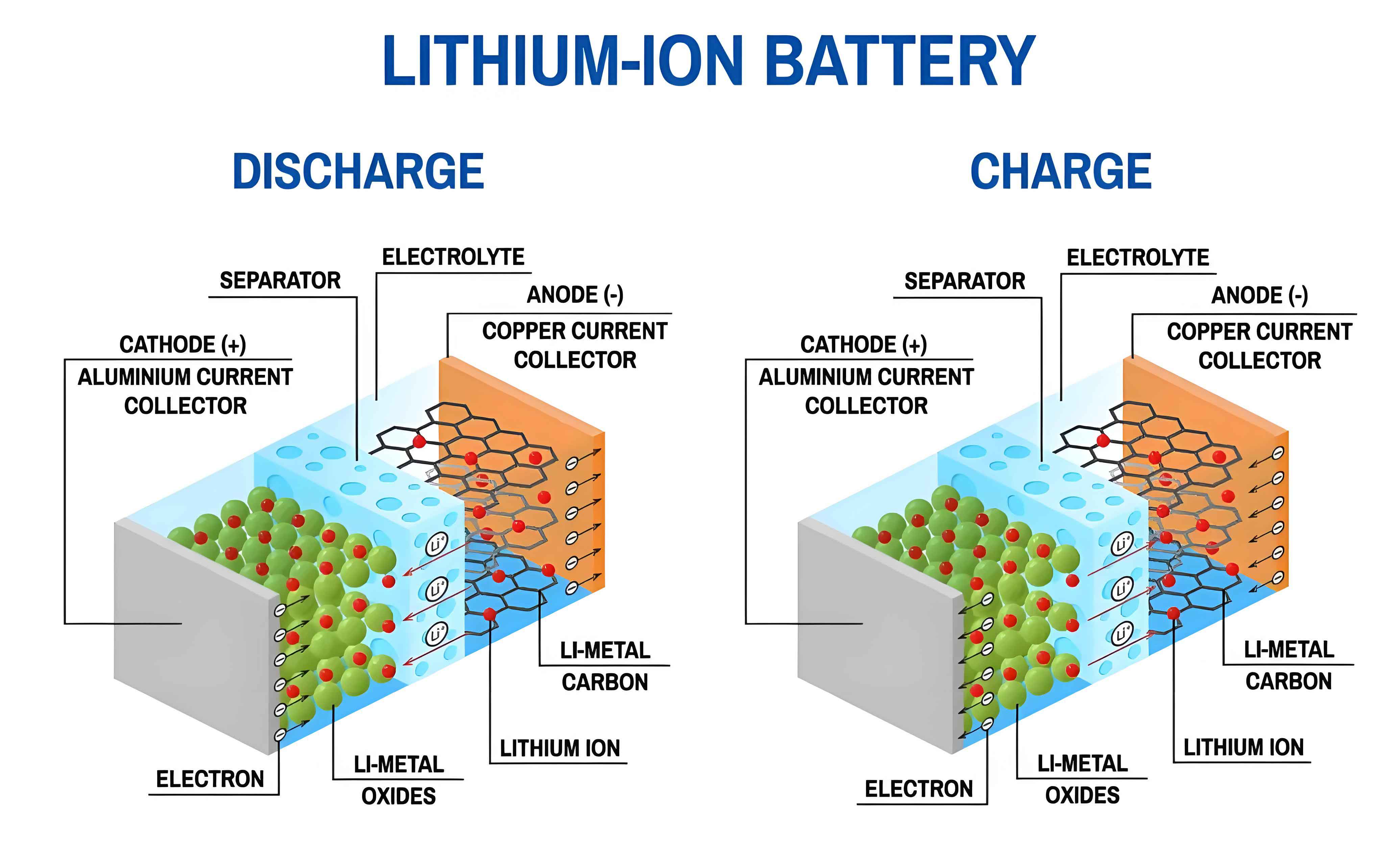
The deformation of a lithium-ion battery casing is not an isolated mechanical event but a consequence of tightly coupled phenomena. The fundamental driver is the intercalation and deintercalation of lithium ions into the active material particles of the electrodes. As ions are inserted (e.g., into graphite anodes during charging), the lattice structure expands, increasing the volume of the electrode. Conversely, during discharge, ions are extracted, leading to contraction. This volume change, often termed intercalation strain, generates significant stress within the tightly wound or stacked cell core. Simultaneously, the electrochemical reactions and ohmic losses produce heat, causing non-uniform temperature fields and subsequent thermal expansion of all battery components. The external casing constrains the combined volume change from both effects, resulting in measurable strain on its surface.
To simulate this complex interplay, we established a two-dimensional axisymmetric model of a commercial 18650 lithium-ion battery. The internal core, comprising the anode, cathode, separator, and current collectors, was homogenized into a single domain with effective anisotropic material properties calculated from the individual components’ volume fractions. The casing was modeled as a separate structural domain. The governing equations for the three coupled physics are detailed below.
Model Formulation and Coupling Strategy
The electrochemical behavior is described using a simplified pseudo-two-dimensional (P2D) framework. Lithium-ion diffusion within the spherical active material particles is governed by Fick’s second law:
$$ \frac{\partial c_s}{\partial t} = \frac{D_s}{X^2} \frac{\partial}{\partial X}\left( X^2 \frac{\partial c_s}{\partial X} \right) $$
where \( c_s \) is the lithium concentration in the solid particle (mol/m³), \( D_s \) is the solid-phase diffusion coefficient (m²/s), \( X \) is the radial coordinate within the particle (m), and \( t \) is time (s). The boundary conditions are: zero flux at the particle center (\( \partial c_s / \partial X |_{X=0} = 0 \)) and a flux at the surface proportional to the local electrochemical reaction current density \( j_n \) (A/m²): \( -D_s \partial c_s / \partial X |_{X=R_s} = j_n / F \), where \( R_s \) is the particle radius and \( F \) is Faraday’s constant.
The thermal field is governed by the energy conservation equation. For the cell core domain, which contains the heat sources, the equation is:
$$ \rho C_p \frac{\partial T}{\partial t} = \nabla \cdot (k \nabla T) + Q_h $$
where \( \rho \) is density (kg/m³), \( C_p \) is specific heat capacity (J/(kg·K)), \( k \) is thermal conductivity (W/(m·K)), \( T \) is temperature (K), and \( Q_h \) is the volumetric heat generation rate (W/m³) from electrochemical processes (irreversible and reversible heat). For the casing domain, \( Q_h = 0 \). The boundary condition accounts for convective cooling with the ambient air: \( -\mathbf{n} \cdot (k \nabla T) = h (T – T_{\text{air}}) \), where \( h \) is the convection coefficient and \( T_{\text{air}} \) is ambient temperature.
The mechanical response is modeled using the theory of linear thermoelasticity. The equilibrium, constitutive, and strain-displacement equations are:
$$ \nabla \cdot \boldsymbol{\sigma} + \mathbf{F}_V = \rho \frac{\partial^2 \mathbf{U}}{\partial t^2} $$
$$ \boldsymbol{\sigma} = \mathbf{C} : \boldsymbol{\epsilon} $$
$$ \boldsymbol{\epsilon} = \frac{1}{2} \left[ \nabla \mathbf{U} + (\nabla \mathbf{U})^T \right] $$
where \( \boldsymbol{\sigma} \) is the stress tensor, \( \mathbf{F}_V \) is the body force, \( \mathbf{U} \) is the displacement vector, \( \mathbf{C} \) is the elasticity tensor, and \( \boldsymbol{\epsilon} \) is the strain tensor. The total strain is considered to have two contributions: the elastic strain and the strain due to thermal expansion/intercalation. The key to coupling lies in defining this non-elastic strain.
The multiphysics coupling was implemented as follows:
- Electrochemical-Thermal Coupling: The heat source \( Q_h \) in the energy equation is calculated from the electrochemical model, which depends on local current density, overpotentials, and entropy change. Conversely, temperature affects the electrochemical model parameters like open-circuit voltage (OCV), kinetics, and diffusion coefficients. This was implemented using temperature-dependent empirical functions for OCV and its temperature derivative, derived from experimental measurements at different states of charge (SOC) and temperatures.
- Thermal-Mechanical Coupling: The temperature field \( T(\mathbf{x}, t) \) induces a thermal strain \( \boldsymbol{\epsilon}_{th} = \alpha (T – T_{\text{ref}}) \mathbf{I} \), where \( \alpha \) is the coefficient of thermal expansion (CTE) and \( T_{\text{ref}} \) is a reference temperature. This strain is added to the elastic strain in the constitutive law.
- Electrochemical-Mechanical Coupling: This is the novel aspect of our model for simulating casing strain. The volume change due to lithium intercalation/deintercalation is directly related to the SOC of the electrode. We introduced a volumetric strain interpolation function \( \epsilon_v(SOC) \) to represent this effect. For a graphite anode paired with an NCM cathode, the overall cell volume changes during discharge. The function was defined based on the maximum reported volume strain \( \theta_{\text{max}} \) for such a system:
$$ \epsilon_v(SOC) = \frac{\Delta V(SOC)}{V_0} = \theta_{\text{max}} (1 – SOC) $$
where \( \theta_{\text{max}} \) was taken as 0.0298. This volumetric strain is applied as an eigenstrain to the homogenized core domain, analogous to thermal expansion but driven by SOC. The structural mechanics module then solves for the resulting displacement and stress fields, including the constraint imposed by the casing.
The homogenized properties for the core and the properties for the casing material are critical inputs. These are summarized in the table below.
| Component / Domain | Thickness (μm) | Thermal Conductivity (W/(m·K)) | Specific Heat (J/(kg·K)) | Density (kg/m³) | CTE (1/K) | Young’s Modulus (GPa) | Poisson’s Ratio |
|---|---|---|---|---|---|---|---|
| Negative Current Collector (Cu) | 7 | 398 | 385 | 8933 | 16.6×10⁻⁶ | 139.2 | 0.34 |
| Negative Electrode (Graphite) | 55 | 1.04 | 1437 | 1347 | 29×10⁻⁶ | 12.0 | 0.30 |
| Separator | 30 | 0.34 | 1978 | 1009 | 100×10⁻⁶ | 0.9 | 0.35 |
| Positive Electrode (NCM) | 55 | 1.58 | 1269 | 2329 | 12×10⁻⁶ | 132.0 | 0.32 |
| Positive Current Collector (Al) | 10 | 170 | 875 | 2770 | 23.2×10⁻⁶ | 76.5 | 0.32 |
| Homogenized Core (Effective) | – | Anisotropic | Calculated | Calculated | 14.28×10⁻⁶ | Anisotropic | 0.32 |
| Steel Casing | 250 | 45 | 500 | 7850 | 12.30×10⁻⁶ | 200 | 0.30 |
Model Validation and Analysis of Transient Responses
The coupled model was solved using finite element analysis software. A mesh independence study confirmed that results for strain stabilized beyond 368 elements. Experimental validation was performed using an 18650 lithium-ion battery (2600 mAh, NCM/Graphite) instrumented with strain gauges and thermocouples on its casing. The battery was discharged at constant currents of 0.5C, 1C, and 2C from a fully charged state (4.2 V) to a cutoff voltage (2.75 V) in a temperature-controlled environment.
The simulation results for voltage, surface temperature, and casing strain showed excellent agreement with experimental data across all discharge rates. The model successfully captured the key trends: faster voltage drop, higher temperature rise, and increased compressive (negative) strain magnitude with increasing C-rate. At the end of discharge, the simulated strain magnitudes were -115, -158, and -175 με for 0.5C, 1C, and 2C, respectively, closely matching the measurements. The small discrepancies were attributed to simplifications such as neglecting side reactions and assuming ideal mechanical constraints.
Analysis of the simulated internal fields during a 1C discharge provides deep insight. The temperature distribution revealed that the core is consistently hotter than the outer casing. The axial temperature gradient was significantly smaller than the radial gradient, with a maximum internal temperature difference of about 1°C, reaching 37.1°C at the end of discharge. The displacement field, which leads to surface strain, exhibited a complex pattern. The overall deformation increased with discharge time, reaching a maximum displacement of 2.35 μm. The displacement was greater on the outer casing than in the inner core due to the cumulative effect of volume change from the center outward. Axially, the casing displacement was largest near the middle section and smaller near the constrained ends. This pattern results from the competition between the contracting core (due to Li+ extraction) and the expanding components (due to heating). Initially, thermal expansion mitigates the core contraction; later, as heating slows, the intercalation strain dominates, leading to the observed compression and deformation pattern.
Parametric Study and Strain Correlation
A parametric study was conducted to evaluate the influence of the effective thermal expansion coefficient (CTE) of the core material on the strain response. Simulations were run with the core CTE (\( \alpha_e \)) varied from one-tenth to ten times its baseline value (14.28×10⁻⁶ 1/K). The results, plotted as strain and displacement profiles, demonstrated a strong dependence. For low \( \alpha_e \) values, the intercalation contraction effect dominated, resulting in compressive strain at the casing center. For high \( \alpha_e \) values, thermal expansion dominated, leading to tensile strain everywhere on the casing. The axial strain profile transitioned from compressive in the middle with tensile ends (low \( \alpha_e \)) to entirely tensile with a maximum at the center (high \( \alpha_e \)). This underscores the dual and competing nature of the strain mechanisms in a lithium-ion battery.
Based on the understanding that the total observed strain \( \epsilon \) is a superposition of the intercalation effect and the thermal effect, we proposed a semi-empirical correlation equation to predict the strain at the casing mid-point as a function of SOC and temperature rise:
$$ \epsilon(SOC, T) = K_1 \cdot \theta_{\text{max}} (1 – SOC) + K_2 \cdot \alpha_e (T – T_0) $$
where \( K_1 \) and \( K_2 \) are dimensionless weighting coefficients that capture the relative influence of each mechanism, which may vary with C-rate, and \( T_0 \) is the initial temperature. Fitting this model to the simulated (and experimental) strain data yielded coefficients of determination (R²) of 0.99, 0.98, and 0.99 for 0.5C, 1C, and 2C discharge, respectively. This high accuracy confirms that the simplified two-mechanism model effectively captures the primary drivers of casing strain in a lithium-ion battery. The values of \( K_1 \) and \( K_2 \) changed with C-rate, reflecting the changing balance between irreversible heat (affecting \( T \)) and the rate of SOC change.
Conclusion
In this work, we successfully developed and validated a comprehensive electrochemical-thermal-mechanical multiphysics model for a cylindrical 18650 lithium-ion battery. The model’s novelty lies in explicitly coupling the electrochemical SOC to a volumetric strain in the mechanical domain via an interpolation function, enabling the prediction of macroscopic casing deformation during operation. The model accurately simulates voltage, temperature, and strain responses under different discharge rates. Analysis reveals that the casing strain is a result of the competition between contraction from lithium-ion deintercalation and expansion from Joule heating. The strain distribution is non-uniform, with the mid-section of the casing experiencing the largest deformation. Furthermore, we derived a concise correlation equation linking the measurable casing strain to the internal states of SOC and temperature, providing a potentially valuable tool for battery management systems. This research establishes a foundational framework for using mechanical strain as a diagnostic and prognostic signal for lithium-ion battery safety, paving the way for more robust and multi-faceted battery management strategies. Future work will focus on extending the model to account for aging effects over multiple cycles and validating it under more complex dynamic loading profiles.