
As the global energy landscape rapidly shifts towards renewable sources, lithium-ion battery technology has emerged as a cornerstone for energy storage solutions. However, the inherent risks associated with these systems, particularly thermal runaway events, pose significant safety challenges. In this article, I will delve into the design, hazards, and mitigation strategies for lithium-ion battery facilities, emphasizing a first-person perspective based on extensive analysis and industry experience. The goal is to provide a detailed framework for risk assessment and safeguarding, ensuring that these systems operate within tolerable risk levels while supporting the renewable energy transition.
The increasing adoption of lithium-ion batteries for grid-scale energy storage, electric vehicles, and portable electronics underscores their critical role. Yet, incidents like the 2019 explosion in a battery energy storage system highlight the potential dangers, including fire, explosion, and toxic gas release. My analysis focuses on understanding the root causes, such as thermal runaway, and developing robust safety protocols. Through this discussion, I aim to reinforce the importance of proactive risk management in lithium-ion battery deployments.
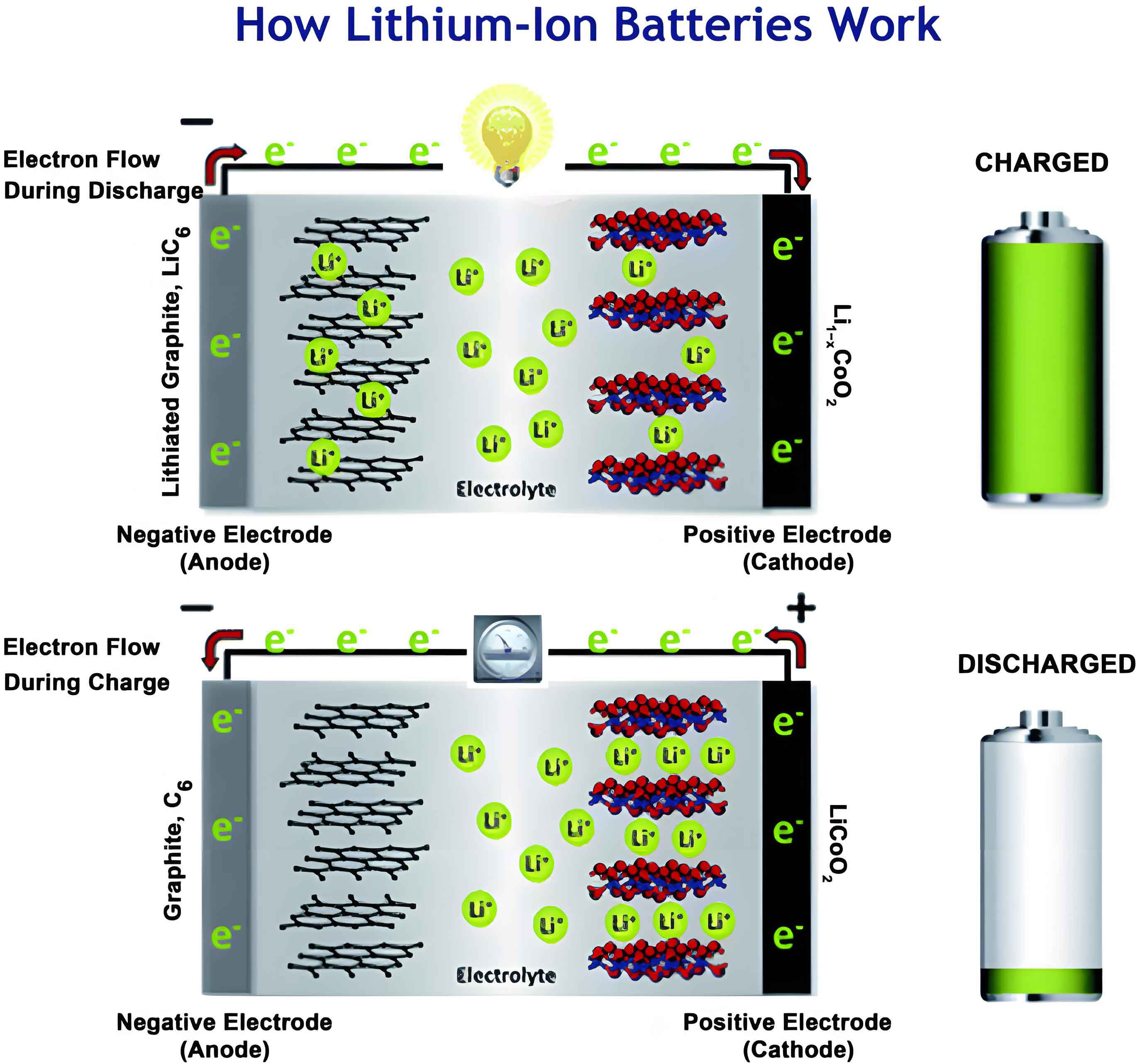
To begin, let’s explore the fundamental design of a lithium-ion battery. A typical lithium-ion battery consists of four key components: the cathode, anode, separator, and electrolyte. Each plays a vital role in energy storage and release, but also contributes to potential failure modes. The cathode, usually a lithium metal oxide like lithium cobalt oxide (LiCoO2) or lithium nickel manganese cobalt oxide (NMC), facilitates lithium-ion intercalation during discharge. The anode, typically graphite, stores lithium ions, while a solid electrolyte interface (SEI) layer forms during initial charging to prevent unwanted reactions. The separator, often made of polyethylene or polypropylene, allows ion transport but prevents internal short circuits; it can act as a thermal fuse by melting at elevated temperatures. The electrolyte, composed of organic carbonates (e.g., dimethyl carbonate, DMC) and lithium salts like lithium hexafluorophosphate (LiPF6), enables ion mobility. This design is efficient but introduces vulnerabilities, as organic solvents are flammable and lithium salts can decompose into toxic compounds.
| Component | Material Examples | Function | Potential Risks |
|---|---|---|---|
| Cathode | LiCoO2, NMC, LiMn2O4 | Provides lithium-ion intercalation sites | Oxygen release during decomposition |
| Anode | Graphite, silicon composites | Stores lithium ions during charging | Lithium plating and dendrite formation |
| Separator | Polyethylene, polypropylene | Prevents internal short circuits | Melting at high temperatures, leading to failure |
| Electrolyte | Organic carbonates, LiPF6 | Facilitates ion transport | Flammability, toxic gas generation (e.g., HF) |
Thermal runaway is the most critical failure mode for a lithium-ion battery. It involves a self-accelerating exothermic reaction chain that can lead to fire, explosion, and gas emissions. The process typically starts with an initiating event, such as internal short circuit, overcharging, mechanical damage, or thermal abuse. As temperature rises, the SEI layer decomposes at around 90–130°C, triggering further reactions. For instance, the electrolyte can react with lithium, and the cathode may decompose, releasing oxygen. This can be represented by simplified chemical equations. For example, the decomposition of LiPF6 in the presence of moisture produces hydrogen fluoride (HF):
$$ \text{LiPF}_6 \rightarrow \text{LiF} + \text{PF}_5 $$
$$ \text{PF}_5 + \text{H}_2\text{O} \rightarrow \text{POF}_3 + 2\text{HF} $$
Overall, the reaction can be summarized as:
$$ \text{LiPF}_6 + \text{H}_2\text{O} \rightarrow \text{LiF} + \text{POF}_3 + 2\text{HF} $$
This HF generation is particularly hazardous due to its toxicity, with an Immediately Dangerous to Life and Health (IDLH) concentration of 30 ppm. Additionally, the organic solvents decompose into flammable gases like carbon monoxide (CO), hydrogen (H2), methane (CH4), and ethylene (C2H4). The rapid gas production increases internal pressure, potentially causing cell venting or rupture, which can ignite the gases and propagate thermal runaway to adjacent cells.
| Gas Type | Examples | Hazards | Estimated Release per kWh (mg) |
|---|---|---|---|
| Flammable Gases | CO, H2, CH4, C2H4 | Fire, explosion risk | Varies (100–500 mg) |
| Toxic Gases | HF, CO, HCN | Acute toxicity, asphyxiation | HF: 20–200 mg/(W·h) |
| Other Products | CO2, aerosol particles | Environmental and health impacts | Depends on battery chemistry |
Assessing the risks associated with lithium-ion battery facilities requires a systematic approach. I recommend using qualitative and quantitative methods, such as Failure Mode and Effects Analysis (FMEA), to evaluate failure frequencies and consequences. Key factors to consider include the robustness of manufacturer-designed safety features, the prevalence of separator defects, and procedural safeguards against thermal or mechanical abuse. For instance, the probability of thermal runaway can be influenced by battery management system (BMS) effectiveness, cell quality, and operating conditions. To model consequences, gas dispersion analysis is crucial, as it helps predict flammable and toxic gas concentrations in enclosed spaces. However, data gaps exist—detailed gas composition profiles during thermal runaway are still evolving, necessitating further research. A risk matrix can be applied to prioritize mitigation measures, focusing on high-likelihood, high-severity scenarios.
The safety of a lithium-ion battery system relies on multiple layers of protection. At the cell level, built-in safety devices include charge interruption devices (CIDs), positive temperature coefficient (PTC) elements, shutdown separators, and venting mechanisms. CIDs disconnect the circuit under overpressure, while PTCs increase resistance at high temperatures to limit current. Shutdown separators lose porosity upon heating, blocking ion flow. Venting devices prevent uncontrolled casing rupture. However, these may not fully prevent thermal runaway, especially under extreme conditions. Therefore, module and system-level protections are essential. A Battery Management System (BMS) monitors state-of-charge, voltage, and temperature, preventing overcharge and over-discharge. A Thermal Management System (TMS) maintains optimal operating temperatures through cooling or heating. For large-scale energy storage, spacing between battery packs is critical to prevent cascading failures; standards like NFPA 855 recommend at least 0.91 m spacing and limit energy per group in non-dedicated buildings.
| Protection Layer | Examples | Function | Limitations |
|---|---|---|---|
| Cell-Level | CID, PTC, venting | Prevents internal failures, relieves pressure | May not stop thermal runaway from external triggers |
| Module-Level | BMS, TMS, spacing | Monitors and controls operational parameters | Requires proper integration and maintenance |
| System-Level | Gas detection, ventilation, fire suppression | Mitigates gas accumulation and fire spread | Effectiveness depends on design and response time |
Gas detection and ventilation are paramount for risk mitigation in lithium-ion battery facilities. Flammable gas sensors should be installed to monitor concentrations below the lower explosive limit (LEL), typically around 1–4% for mixtures like H2 and CO. However, I emphasize that catalytic bead sensors may fail in inert atmospheres created during fire suppression, so alternative technologies like infrared or electrochemical sensors are preferable. Toxic gas detectors for HF and CO should also be deployed, with alarms set at safe thresholds (e.g., STEL of 3 ppm for HF). Ventilation systems must activate automatically upon gas detection to maintain safe levels, as highlighted in NFPA 855 guidelines. The design should consider air exchange rates; for example, in the 2019 incident, inadequate ventilation allowed gas buildup despite灭火剂 discharge. Computational fluid dynamics (CFD) modeling can optimize ventilation layouts, using equations like the advection-diffusion equation for gas dispersion:
$$ \frac{\partial C}{\partial t} + \nabla \cdot (\mathbf{u} C) = \nabla \cdot (D \nabla C) + S $$
where \( C \) is gas concentration, \( \mathbf{u} \) is velocity field, \( D \) is diffusivity, and \( S \) is source term from battery emission.
Fire suppression for lithium-ion batteries presents unique challenges. Traditional agents like water, CO2, or clean agents (e.g., Novec 1230) can extinguish flames but may not cool cells sufficiently to halt thermal runaway. Water is effective for cooling but risks electrical hazards. Therefore, a balanced approach is needed: suppression to control fire, coupled with cooling to prevent reignition. Testing shows that applying water directly to cells can reduce temperatures below critical thresholds, but this requires careful system design. For enclosed spaces, inerting with nitrogen or argon can prevent combustion, but it must be sustained to avoid gas accumulation. Explosion prevention measures, such as deflagration venting or explosion-proof enclosures, should be considered for high-risk areas. I advocate for integrated safety systems that combine detection, ventilation, and suppression, with regular testing and maintenance.
In terms of risk assessment, I propose a holistic framework that incorporates both probabilistic and deterministic analyses. The frequency of thermal runaway can be estimated using reliability data, though this is often limited for emerging technologies. A Bayesian approach can update probabilities based on operational experience. For consequence analysis, gas release models should account for variables like battery state-of-charge, chemistry, and enclosure geometry. Empirical data suggests that a single lithium-ion battery can release energy equivalent to 80% of its stored chemical energy during fire, with gas volumes scaling linearly with capacity. Monte Carlo simulations can propagate uncertainties, providing risk curves for decision-making. Additionally, human factors and emergency response protocols must be included; for instance, first responders should be trained on lithium-ion battery hazards, including HF exposure and re-ignition risks.
| Parameter | Description | Typical Values or Methods |
|---|---|---|
| Thermal Runaway Frequency | Probability per cell-year | 10-6 to 10-4 (based on FMEA) |
| Gas Emission Rate | Mass flow per event | 0.1–1 kg/s for large packs |
| Toxic Gas Concentration | HF ppm in enclosed space | Modeled using CFD or analytical solutions |
| Mitigation Effectiveness | Reduction factor for safeguards | 0.1–0.01 for combined systems |
Looking ahead, advancements in lithium-ion battery technology may reduce risks. Solid-state batteries, which replace liquid electrolytes with solid materials, promise lower flammability and higher thermal stability. However, they are still in development and may introduce new failure modes. In the interim, improving cell design—such as using more stable cathode materials (e.g., lithium iron phosphate, LFP) or non-flammable electrolytes—can enhance safety. Research into real-time monitoring using acoustic or fiber-optic sensors for early fault detection is also promising. From a regulatory perspective, standards like UL 9540 and IEC 62619 provide guidelines, but I urge for harmonized global codes that address gas hazards and cascade failures specifically.
In conclusion, the safe deployment of lithium-ion battery energy storage systems hinges on a thorough understanding of thermal runaway mechanisms and a multi-layered risk mitigation strategy. Through careful design, including robust gas detection, adequate ventilation, and appropriate spacing, the risks can be managed to tolerable levels. As I reflect on industry practices, continuous risk assessment and adaptation are essential, especially as battery capacities scale up. By prioritizing safety in innovation, we can harness the benefits of lithium-ion batteries for a sustainable energy future while minimizing potential harms. This article underscores that proactive measures, grounded in scientific analysis, are key to safeguarding these critical assets.
To encapsulate key principles, I often refer to a risk equation that balances frequency and consequence:
$$ R = F \times C $$
where \( R \) is risk, \( F \) is frequency of thermal runaway, and \( C \) is consequence severity. Mitigation strategies aim to reduce both terms—for example, by improving cell reliability (lowering \( F \)) and implementing gas venting (reducing \( C \)). Iterative refinement based on operational data will drive safer lithium-ion battery implementations across various applications.