
With the rapid advancement of photovoltaic (PV) power generation, solar inverters have become pivotal components in converting DC power from PV panels to AC power for grid integration. As the core power conversion equipment, the performance optimization of solar inverters is critical for enhancing power quality and system reliability. A significant challenge in this domain is the suppression of harmonics, which can distort voltage and current waveforms, increase system losses, and compromise grid stability. This review systematically examines the harmonic generation mechanisms in solar inverters and categorizes suppression techniques into two primary approaches: source-side control to minimize harmonic generation and propagation-blocking methods using filtering technologies. We explore various modulation strategies, such as sinusoidal pulse width modulation (SPWM), space vector pulse width modulation (SVPWM), and selective harmonic elimination PWM (SHEPWM), alongside filtering techniques like LCL filters and active damping. By analyzing the principles, advantages, and limitations of these methods, we aim to provide a comprehensive overview of current research and identify future trends in harmonic suppression for solar inverters.
Harmonics in solar inverters primarily arise from the nonlinear switching behavior of power electronic devices, such as insulated gate bipolar transistors (IGBTs) and metal-oxide-semiconductor field-effect transistors (MOSFETs). During the DC-AC conversion process, the rapid switching actions introduce high-frequency components into the output current and voltage. The fundamental mechanism can be modeled using Fourier analysis, where the output voltage of a PWM-based solar inverter contains harmonics centered around the switching frequency and its multiples. For instance, in a single-phase inverter using SPWM, the output voltage $v_o(t)$ can be expressed as:
$$v_o(t) = \frac{V_{dc}}{2} + \sum_{n=1}^{\infty} \sum_{m=-\infty}^{\infty} \frac{4V_{dc}}{n\pi} J_m\left(\frac{n\pi M}{2}\right) \sin\left((n+m)\frac{\pi}{2}\right) \cos(n\omega_c t + m\omega_s t)$$
where $V_{dc}$ is the DC input voltage, $M$ is the modulation index, $\omega_c$ is the carrier frequency, $\omega_s$ is the signal frequency, and $J_m$ is the Bessel function of the first kind. These harmonics can lead to issues such as increased total harmonic distortion (THD), electromagnetic interference (EMI), and reduced efficiency. In grid-connected systems, harmonics may cause resonance with grid impedance, leading to voltage instability and equipment damage. Therefore, effective harmonic suppression is essential for maintaining power quality and compliance with standards like IEEE 519.
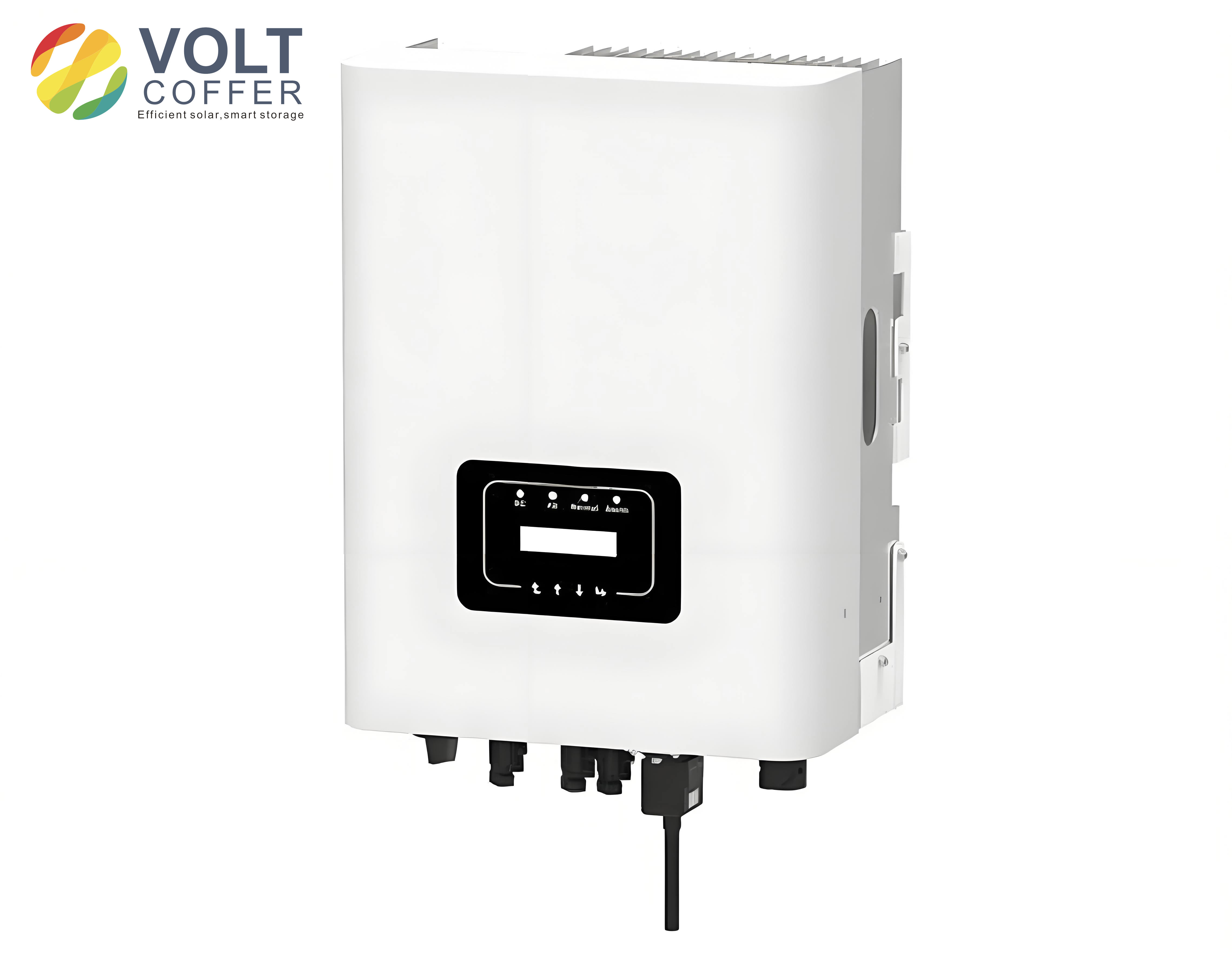
Source-side harmonic suppression focuses on optimizing modulation techniques to reduce harmonic generation at the inverter output. One widely adopted method is SPWM, which generates a sinusoidal output by comparing a triangular carrier wave with a sinusoidal reference. The harmonic spectrum of SPWM is characterized by sidebands around the carrier frequency, and the THD can be minimized by increasing the switching frequency. However, higher switching frequencies elevate switching losses, necessitating a trade-off. For solar inverters, the optimal carrier frequency typically ranges from 3 kHz to 10 kHz, depending on the power rating and thermal constraints. Advanced variants of SPWM, such as carrier phase-shifted PWM (CPS-PWM), employ multiple phase-shifted carriers to cancel specific harmonics. In a system with $K$ carriers, the equivalent switching frequency increases to $K f_c$, reducing low-order harmonics. The output voltage in CPS-PWM can be represented as:
$$v_{o,\text{total}}(t) = \sum_{k=1}^{K} v_{o,k}(t) = K M V_{dc} \sin(\omega_s t) + \sum_{n=1}^{\infty} \sum_{m=-\infty}^{\infty} C_{nm} \cos(nK\omega_c t + m\omega_s t)$$
where $C_{nm}$ are coefficients determined by Bessel functions. While CPS-PWM enhances harmonic performance, it requires precise synchronization and increases control complexity. Another approach, space vector PWM (SVPWM), improves voltage utilization and reduces harmonics by synthesizing the output voltage using space vectors. In three-phase solar inverters, SVPWM achieves a circular flux trajectory, minimizing torque ripple in motor drives and harmonic distortion. The reference voltage vector $\vec{V}_{\text{ref}}$ is generated by combining adjacent active vectors and zero vectors, with duty cycles calculated as:
$$d_1 = \frac{\sqrt{3} T_s}{V_{dc}} |\vec{V}_{\text{ref}}| \sin(60^\circ – \theta), \quad d_2 = \frac{\sqrt{3} T_s}{V_{dc}} |\vec{V}_{\text{ref}}| \sin(\theta), \quad d_0 = 1 – d_1 – d_2$$
where $T_s$ is the sampling period, and $\theta$ is the angle of $\vec{V}_{\text{ref}}$. SVPWM inherently injects a third-harmonic component, which increases the linear modulation range to 90.7%, compared to 78.5% for SPWM. To address computational complexity, simplified SVPWM methods based on 120° coordinate systems have been developed, eliminating sector identification and reducing real-time processing demands. For instance, the transformation from abc to 120° coordinates is given by:
$$\begin{bmatrix} V_\alpha \\ V_\beta \end{bmatrix} = \frac{2}{3} \begin{bmatrix} 1 & -\frac{1}{2} & -\frac{1}{2} \\ 0 & \frac{\sqrt{3}}{2} & -\frac{\sqrt{3}}{2} \end{bmatrix} \begin{bmatrix} V_a \\ V_b \\ V_c \end{bmatrix}$$
Selective harmonic elimination PWM (SHEPWM) is another source-side technique that eliminates specific low-order harmonics by solving nonlinear equations for optimal switching angles. For a three-level inverter with $N$ switching angles per quarter cycle, the Fourier series of the output voltage is:
$$V(\omega t) = \sum_{n=1,3,5,\ldots}^{\infty} \frac{4V_{dc}}{n\pi} \left[ \sum_{k=1}^{N} (-1)^{k+1} \cos(n\alpha_k) \right] \sin(n\omega t)$$
To eliminate the 5th, 7th, and 11th harmonics, the equations $\sum_{k=1}^{N} (-1)^{k+1} \cos(5\alpha_k) = 0$, $\sum_{k=1}^{N} (-1)^{k+1} \cos(7\alpha_k) = 0$, and $\sum_{k=1}^{N} (-1)^{k+1} \cos(11\alpha_k) = 0$ are solved numerically using algorithms like Newton-Raphson or particle swarm optimization (PSO). SHEPWM reduces switching losses but is sensitive to parameter variations and requires offline computation. Soft-switching techniques, such as zero-voltage switching (ZVS) and zero-current switching (ZCS), also minimize harmonics by reducing voltage and current spikes during switching transitions. These methods incorporate resonant circuits to create conditions where switches turn on or off at zero voltage or current, effectively lowering EMI and improving efficiency. For example, in a resonant DC-link inverter, the resonant circuit generates a sinusoidal voltage across the DC bus, enabling soft switching. The resonant frequency $f_r$ is given by:
$$f_r = \frac{1}{2\pi\sqrt{L_r C_r}}$$
where $L_r$ and $C_r$ are the resonant inductor and capacitor, respectively.
Propagation-blocking harmonic suppression employs filtering techniques to attenuate harmonics before they reach the grid. LCL filters are commonly used in solar inverters due to their superior high-frequency attenuation compared to L or LC filters. The transfer function of an LCL filter from inverter output voltage to grid current is:
$$G_{\text{LCL}}(s) = \frac{i_g(s)}{v_i(s)} = \frac{1}{L_1 L_2 C s^3 + (L_1 + L_2) s}$$
where $L_1$ and $L_2$ are the inverter-side and grid-side inductors, and $C$ is the filter capacitor. The resonant frequency of the LCL filter is:
$$f_{\text{res}} = \frac{1}{2\pi} \sqrt{\frac{L_1 + L_2}{L_1 L_2 C}}$$
To prevent resonance, damping methods are essential. Passive damping adds resistors in series or parallel with filter components, but it incurs power losses. For instance, a series resistor $R_d$ with the capacitor reduces the quality factor but dissipates energy. Active damping uses control algorithms to emulate damping resistors, such as capacitor current feedback, where the feedback gain $H(s)$ is designed to stabilize the system. The closed-loop transfer function with active damping becomes:
$$T(s) = \frac{G_{\text{LCL}}(s) G_c(s)}{1 + G_{\text{LCL}}(s) G_c(s) H(s)}$$
where $G_c(s)$ is the controller transfer function. Advanced current tracking techniques, such as proportional-resonant (PR) controllers and repetitive control, enhance harmonic suppression by providing high gain at specific frequencies. A PR controller for the fundamental and harmonics is expressed as:
$$G_{\text{PR}}(s) = K_p + \sum_{h=1,3,5,\ldots} \frac{2K_{r,h} \omega_c s}{s^2 + 2\omega_c s + (h\omega_0)^2}$$
where $K_p$ is the proportional gain, $K_{r,h}$ is the resonant gain for the h-th harmonic, $\omega_c$ is the cutoff frequency, and $\omega_0$ is the fundamental frequency. Repetitive control, based on the internal model principle, uses a delay line to cancel periodic disturbances. The transfer function of a repetitive controller is:
$$G_{\text{RC}}(s) = \frac{k_r e^{-sT}}{1 – Q(s) e^{-sT}}$$
where $k_r$ is the gain, $T$ is the period of the disturbance, and $Q(s)$ is a filter to ensure stability. Deadbeat control offers fast dynamic response by predicting the future output based on the system model. For a discrete-time system, the control law is:
$$u(k) = \frac{1}{b} \left[ y_{\text{ref}}(k+1) – a y(k) \right]$$
where $a$ and $b$ are system parameters, and $y_{\text{ref}}$ is the reference. However, deadbeat control is sensitive to model inaccuracies and delays.
| Technique | Principle | Advantages | Limitations | Typical THD Reduction |
|---|---|---|---|---|
| SPWM | Sine-triangle comparison | Simple implementation, low cost | Low voltage utilization, high switching losses | 5-10% |
| SVPWM | Space vector synthesis | High voltage utilization, low harmonics | Computational complexity, sector identification | 3-8% |
| SHEPWM | Switching angle optimization | Eliminates specific harmonics, low switching frequency | Offline computation, sensitive to parameters | 2-5% |
| LCL Filter | Third-order filtering | High attenuation at high frequencies | Resonance risk, requires damping | 4-7% |
| Active Damping | Control-based resonance suppression | No power loss, adaptable | Complex design, sensitive to delays | 3-6% |
To quantify the performance of harmonic suppression methods, we can analyze the total harmonic distortion (THD) for current, defined as:
$$\text{THD}_i = \frac{\sqrt{\sum_{h=2}^{\infty} I_h^2}}{I_1} \times 100\%$$
where $I_h$ is the RMS value of the h-th harmonic current, and $I_1$ is the fundamental current. For solar inverters, standards such as IEC 61727 require THD below 5% for grid connection. Advanced modulation techniques like SHEPWM can achieve THD as low as 2%, while filtering methods combined with control strategies can further reduce it to 1-3%. The design of LCL filters involves optimizing parameters to balance size, cost, and performance. The inductance ratio $L_2/L_1$ is typically chosen between 0.5 and 1 to minimize current ripple, and the capacitor value $C$ is selected based on the reactive power limit, often set to 5% of the rated power. The resonance frequency should be placed between 10 times the fundamental frequency and half the switching frequency to avoid interaction with control bandwidth.
Future trends in harmonic suppression for solar inverters include the integration of artificial intelligence (AI) and machine learning (ML) for adaptive control. AI algorithms can optimize switching patterns in real-time based on operating conditions, reducing harmonics under varying solar irradiance and grid impedance. For example, deep reinforcement learning can train controllers to minimize THD by adjusting modulation parameters. Additionally, wide-bandgap semiconductors like silicon carbide (SiC) and gallium nitride (GaN) enable higher switching frequencies with lower losses, facilitating more effective harmonic filtering. The development of hybrid filters, combining passive and active components, promises enhanced performance with reduced size. For instance, an LLCL filter adds a small inductor in series with the capacitor to trap specific harmonics, improving attenuation at the switching frequency. The impedance of an LLCL filter is given by:
$$Z_{\text{LLCL}}(s) = s L_1 + \frac{1}{s C} + s L_f + \frac{1}{s C_f}$$
where $L_f$ and $C_f$ form the trap circuit. Moreover, grid-forming inverters with virtual inertia capabilities can contribute to grid stability by providing harmonic damping services. As solar penetration increases, standards for harmonic emission will become stricter, driving innovation in suppression technologies.
In conclusion, harmonic suppression in grid-connected solar inverters is crucial for ensuring power quality and system reliability. Source-side techniques like advanced modulation and soft-switching reduce harmonic generation, while propagation-blocking methods such as LCL filters and active damping attenuate residual harmonics. The choice of technique depends on factors like cost, complexity, and application requirements. Future research should focus on AI-driven adaptive control, wide-bandgap devices, and standardized testing protocols. By addressing these challenges, solar inverters can achieve higher efficiency and smoother integration into modern power systems, supporting the global transition to renewable energy.