
In the context of engineering education accreditation, which emphasizes the cultivation of students’ ability to solve complex engineering problems, there is a growing need to reform and innovate the content and modes of practical courses such as university physics experiments. As an educator involved in curriculum design, I have explored the integration of lithium-ion battery technology into experimental teaching. This technology, representing the forefront of the new energy revolution, exhibits interdisciplinary and comprehensive characteristics that align with multiple features of complex engineering problems. In this article, I will discuss the advantages and feasibility of incorporating lithium-ion battery experiments into university physics courses, present a detailed implementation plan for a comprehensive experimental design, and reflect on how this approach enhances students’ problem-solving skills and fosters innovative thinking.
Engineering education accreditation focuses on outcome-based education, with a core requirement being the ability to address complex engineering problems. These problems are defined by characteristics such as the need for in-depth engineering principles, involvement of multiple conflicting factors, requirement for abstract modeling, and high comprehensiveness. Traditional experimental courses often lack the depth and breadth to fully develop these competencies. Therefore, I propose that lithium-ion battery technology, with its inherent complexity and real-world relevance, serves as an ideal subject for a comprehensive experimental project. The li ion battery, as a key component in electric vehicles and portable electronics, involves physics, chemistry, materials science, and engineering, making it a perfect candidate for interdisciplinary learning.
The advantages of introducing li ion battery experiments into university physics courses are manifold. First, it directs students’ attention to technological frontiers, keeping them abreast of the latest advancements in energy storage and conversion. Second, it promotes the cultivation of compound innovative talents by integrating knowledge from multiple disciplines. Third, it significantly improves students’ engineering practice and innovation capabilities through hands-on activities such as battery design, assembly, testing, and thermal management simulation. These benefits align with the goals of modern engineering education, which aims to produce graduates who can tackle real-world challenges.
To illustrate the experimental design, I have developed a 32-hour course structured around key components of li ion battery technology. The syllabus is summarized in Table 1, which outlines the content, objectives, and allocated time for each module.
| Content | Objectives | Hours |
|---|---|---|
| 1. Introduction to Lithium-Ion Battery Technology | Understand battery working principles and basics | 2 |
| 2. Overall Battery Design | Complete structural and compositional design of the battery | 4 |
| 3. Battery Assembly and Encapsulation | Prepare electrodes, assemble, and encapsulate the battery | 10 |
| 4. Battery Charge-Discharge Performance Testing | Master testing and analysis methods using equipment | 10 |
| 5. Battery Thermal Management System Design | Learn methods for battery thermal safety management | 6 |
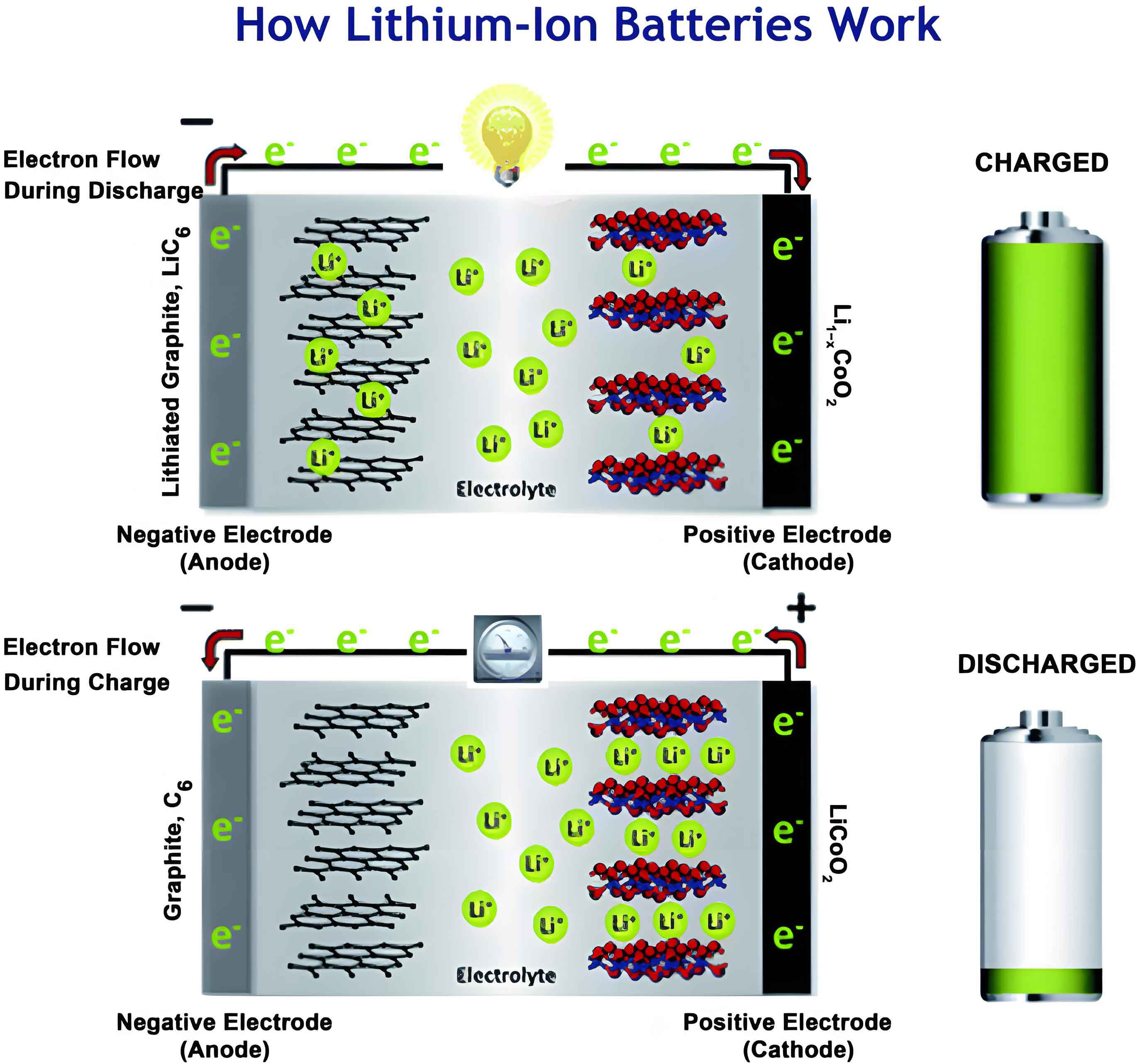
The first module introduces the fundamentals of li ion batteries. I explain the working principle, where lithium ions shuttle between the cathode and anode during charge and discharge, often described as a “rocking-chair” mechanism. The overall reaction can be represented by the following general formula for a lithium-ion cell: $$ \text{Cathode: } \text{Li}_x\text{MO}_2 \rightleftharpoons \text{Li}_{x-1}\text{MO}_2 + \text{Li}^+ + e^- $$ $$ \text{Anode: } \text{C} + \text{Li}^+ + e^- \rightleftharpoons \text{LiC}_6 $$ where M represents a transition metal. This redox process is the cornerstone of li ion battery operation, and understanding it requires knowledge of electrochemistry and solid-state physics.
The second module focuses on overall battery design. Students are tasked with designing a battery based on specific application requirements, such as for smartphones, laptops, or electric vehicles. This involves selecting key materials—cathode, anode, electrolyte, and separator—and determining parameters like voltage, capacity, and current. The choice of materials significantly impacts battery performance, as shown in Table 2, which compares design parameters for different devices.
| Parameter | Smartphone | Laptop | Electric Vehicle |
|---|---|---|---|
| Voltage Range | 2.75–4.2 V | 11–16.8 V | 27.5–42 V |
| Current | 0.1–0.2C rate | 0.5C rate | 0.5C–3C rate |
| Capacity | 2000–5000 mAh | 3000–7000 mAh | 25–300 Ah |
| Cathode Material | Lithium cobalt oxide (LiCoO2) | Lithium iron phosphate (LiFePO4) | Nickel manganese cobalt oxide (NMC) |
| Anode Material | Graphite | Graphite | Graphite or silicon composites |
| Electrolyte | Organic carbonate-based | Organic carbonate-based | High-stability blends |
| Cell Casing | Pouch or aluminum shell | Aluminum shell | Pouch or aluminum shell |
In this design phase, students must apply engineering principles to balance factors like energy density, safety, and cost. For instance, the theoretical capacity of an electrode material can be calculated using the formula: $$ C_{\text{theoretical}} = \frac{nF}{3.6M} $$ where \( n \) is the number of electrons transferred per formula unit, \( F \) is Faraday’s constant (96485 C/mol), and \( M \) is the molar mass of the active material in g/mol. This equation helps students evaluate material choices and predict battery performance.
The third module involves hands-on battery assembly and encapsulation. Students prepare electrode slurries, coat them onto current collectors using a coater, and then dry and compress them into electrodes. The assembly is conducted in an argon-filled glove box to prevent moisture and oxygen contamination. A typical coin cell configuration includes a negative case, spacer, anode, separator soaked with electrolyte, cathode, another spacer, and positive case, all sealed under pressure. This process familiarizes students with manufacturing techniques and safety protocols essential for li ion battery production.
To visualize the components involved, here is an image depicting a li ion battery structure:
The fourth module covers performance testing. Using a battery testing system, students conduct charge-discharge cycles, rate capability tests, and cycle life assessments. Data analysis involves plotting voltage versus capacity curves and calculating metrics like Coulombic efficiency: $$ \eta = \frac{Q_{\text{discharge}}}{Q_{\text{charge}}} \times 100\% $$ where \( Q \) represents capacity. For example, a li ion battery with a lithium cobalt oxide cathode might show a discharge capacity of 153.5 mAh/g after 100 cycles, with a Coulombic efficiency of 96.4%. Students learn to interpret these results to evaluate battery health and degradation.
The fifth module introduces thermal management system design. Since li ion batteries generate heat during operation, especially in high-power applications, thermal safety is critical. Students use simulation software like COMSOL Multiphysics to model heat generation and dissipation. The governing equation for heat transfer in a battery can be expressed as: $$ \rho C_p \frac{\partial T}{\partial t} = \nabla \cdot (k \nabla T) + q $$ where \( \rho \) is density, \( C_p \) is specific heat capacity, \( k \) is thermal conductivity, \( T \) is temperature, and \( q \) is heat generation rate per volume. By simulating scenarios such as air cooling or liquid cooling, students design systems to maintain optimal temperature ranges, thereby addressing a key complex engineering problem in li ion battery applications.
Throughout the experiment, the li ion battery project embodies the features of complex engineering problems. First, it requires the application of deep engineering principles, such as electrochemistry for material selection and thermodynamics for thermal management. Second, it involves multiple conflicting factors—for instance, increasing energy density may compromise safety or cost. Third, it necessitates abstract modeling, as seen in the use of COMSOL for thermal simulations or equivalent circuit models for performance prediction. Fourth, it cannot be solved by routine methods alone; students must innovate in design and troubleshooting. Fifth, it includes factors beyond standard engineering practice, such as environmental regulations and market demands. Sixth, it considers diverse stakeholder interests, from manufacturers to end-users. Seventh, it is highly comprehensive, integrating sub-problems like material synthesis, cell assembly, testing, and system integration.
To further illustrate the interdisciplinary nature, Table 3 summarizes the key disciplines and skills involved in each module of the li ion battery experiment.
| Module | Disciplines Involved | Key Skills Developed |
|---|---|---|
| Introduction | Physics, Chemistry | Understanding redox reactions, energy storage principles |
| Design | Materials Science, Electrical Engineering | Material selection, circuit design, cost analysis |
| Assembly | Mechanical Engineering, Chemical Engineering | Precision handling, slurry preparation, safety procedures |
| Testing | Data Science, Electronics | Instrument operation, data processing, curve fitting |
| Thermal Management | Thermodynamics, Computer Science | Simulation software use, heat transfer modeling |
In terms of assessment, students are evaluated based on theoretical knowledge, practical skills, and experimental reports. The theoretical component tests their grasp of li ion battery fundamentals, such as the Nernst equation for cell voltage: $$ E = E^0 – \frac{RT}{nF} \ln Q $$ where \( E^0 \) is the standard cell potential, \( R \) is the gas constant, \( T \) is temperature, and \( Q \) is the reaction quotient. Practical skills are assessed through their ability to operate equipment and produce functional coin cells. Reports are graded for design innovation, data analysis, and critical reflection.
The implementation of this comprehensive experiment has shown promising results. Students report increased engagement and a better understanding of how theoretical concepts apply to real-world problems. For example, by designing a li ion battery for a specific application, they learn to optimize parameters like specific energy (in Wh/kg) and power density (in W/kg), which are crucial for industries like electric vehicles. Moreover, the hands-on experience with advanced tools—from glove boxes to simulation software—prepares them for careers in research and development.
In conclusion, integrating lithium-ion battery technology into university physics experiments is a powerful way to address the demands of engineering education accreditation. By engaging with complex engineering problems through the lens of li ion batteries, students develop critical thinking, interdisciplinary knowledge, and practical skills. This approach not only enhances their ability to solve multifaceted challenges but also contributes to training the next generation of innovators in the energy sector. As we continue to refine this experimental design, we aim to further align it with evolving technological trends and educational standards, ensuring that graduates are well-equipped to drive progress in fields reliant on advanced energy storage solutions like the li ion battery.
Looking ahead, we plan to expand the experiment to include emerging battery technologies, such as solid-state li ion batteries, which offer higher safety and energy density. This will involve additional modules on material characterization techniques, like X-ray diffraction and scanning electron microscopy, and more complex modeling approaches. By doing so, we keep the curriculum dynamic and responsive to industry needs, reinforcing the role of practical education in fostering engineering excellence.
Ultimately, the success of this initiative hinges on collaboration between educators, researchers, and industry partners. By sharing resources and insights, we can create a robust learning environment that bridges theory and practice. The li ion battery experiment serves as a model for how complex engineering problems can be effectively integrated into undergraduate education, preparing students not just for exams, but for the real-world challenges they will face in their professional lives. Through continuous improvement and innovation, we strive to make such experimental designs a cornerstone of modern engineering training, empowering students to contribute meaningfully to the advancement of technologies like the li ion battery and beyond.