
Perovskite solar cells have emerged as a promising technology for next-generation photovoltaics due to their high power conversion efficiency and low-cost fabrication. Among them, inorganic perovskite solar cells, particularly those based on cesium lead halide compositions, offer superior thermal and light stability compared to their organic-inorganic hybrid counterparts. This makes them ideal candidates for tandem solar cell applications, where they can be combined with silicon bottom cells to exceed the Shockley-Queisser limit. However, the performance of inorganic perovskite solar cells is often limited by high surface defect state densities, which lead to significant non-radiative recombination losses at interfaces, especially between the light-absorbing layer and the electron transport layer. Addressing this issue is crucial for advancing the efficiency and stability of these photovoltaic devices.
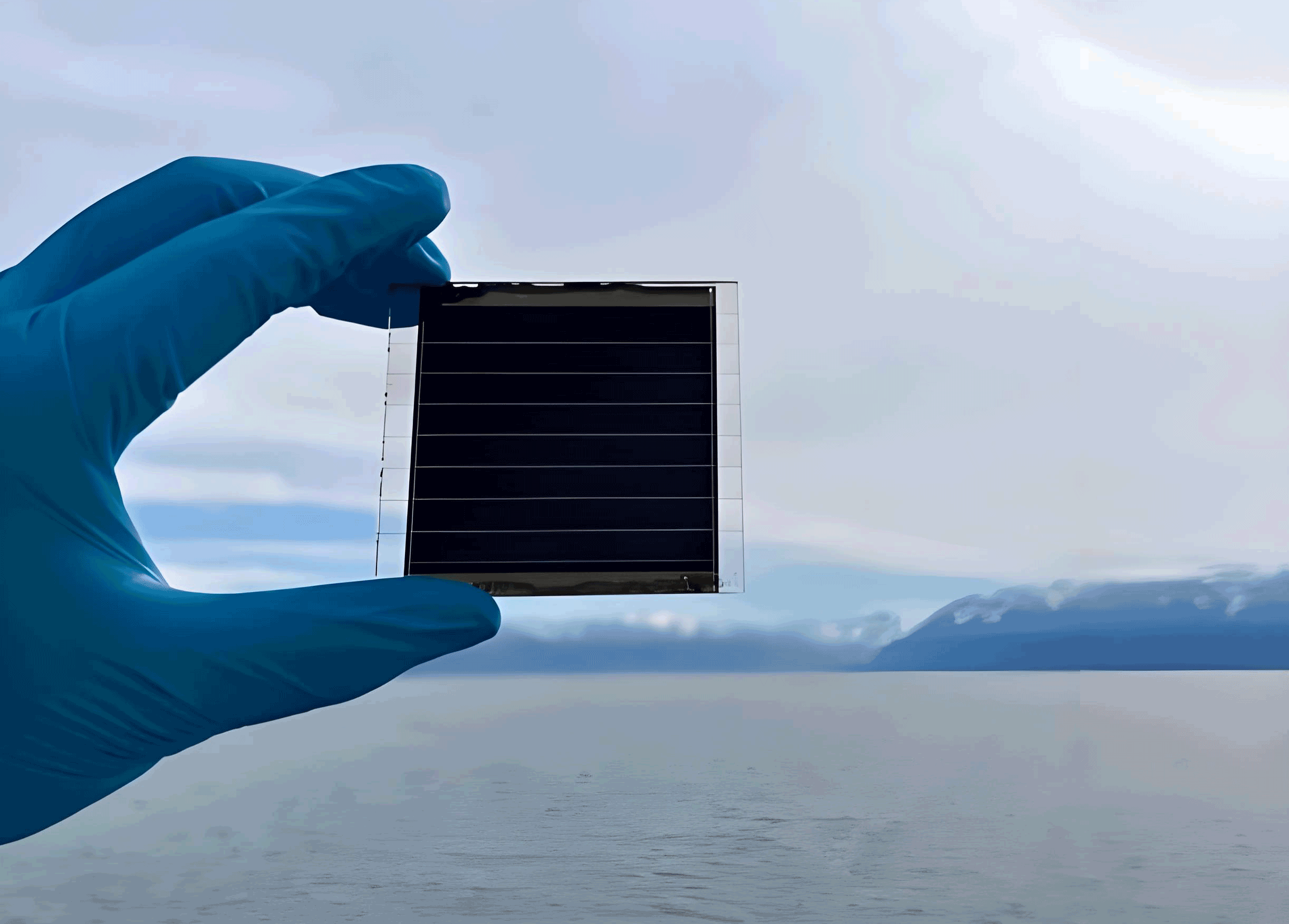
In this study, we explore the use of bis(pentafluorophenyl)zinc (B(PFP)Zn) as a surface modifier to reduce defect state densities in inorganic perovskite films. The unique chemical properties of B(PFP)Zn, including its ability to coordinate with undercoordinated lead ions and the hydrophobic nature of its pentafluorophenyl groups, make it an excellent candidate for interface engineering. We demonstrate that B(PFP)Zn treatment significantly enhances the crystallinity of the perovskite layer, passivates surface defects, and improves the overall photovoltaic performance. The treated perovskite solar cells exhibit a remarkable increase in open-circuit voltage and power conversion efficiency, along with improved humidity and thermal stability. This approach provides a simple and effective strategy for optimizing the interface in inverted perovskite solar cells fabricated in ambient air, paving the way for large-scale production.
The fabrication of inorganic perovskite solar cells typically involves the deposition of a cesium-based perovskite layer, such as CsPbI3 or its mixed-halide variants, onto a substrate coated with charge transport layers. In our work, we focus on the inverted device structure, which offers advantages in terms of stability and compatibility with tandem configurations. The key challenge in these perovskite solar cells is the high density of surface defects, which act as recombination centers and reduce the carrier lifetime. By applying a thin layer of B(PFP)Zn onto the perovskite surface, we aim to passivate these defects and create a more favorable interface for charge extraction. The following sections detail the experimental methods, results, and discussions that underscore the effectiveness of this treatment.
To quantify the impact of B(PFP)Zn on the defect state density, we employed various characterization techniques, including photoluminescence spectroscopy, time-resolved photoluminescence, and space-charge-limited current measurements. The results show a substantial reduction in trap states and non-radiative recombination, leading to enhanced device performance. Additionally, we analyzed the stability of the perovskite solar cells under humid and thermal stress, revealing that the B(PFP)Zn treatment significantly improves the durability of the devices. The insights gained from this study contribute to the ongoing efforts to develop high-efficiency and stable perovskite solar cells for commercial applications.
Experimental Methods
The inorganic perovskite films were prepared using a solution-based method in ambient air with controlled humidity below 20%. The precursor solution consisted of cesium iodide and lead halides in a mixed solvent of dimethylformamide and dimethyl sulfoxide. The solution was spin-coated onto a substrate pre-coated with nickel oxide and a self-assembled monolayer of (2-(9H-carbazol-9-yl)ethyl)phosphonic acid. The films were annealed at elevated temperatures to form the crystalline perovskite phase. Subsequently, the B(PFP)Zn solution in isopropanol was spin-coated onto the perovskite surface in a nitrogen-filled glovebox, followed by a brief annealing step. The electron transport layer, comprising [6,6]-phenyl-C61-butyric acid methyl ester, and a bathocuproine hole-blocking layer were deposited sequentially, and finally, a silver electrode was evaporated to complete the device.
The characterization of the films and devices included X-ray diffraction to assess crystallinity, scanning electron microscopy for surface morphology, and atomic force microscopy for roughness analysis. The photovoltaic performance was evaluated using current-density-voltage measurements under standard illumination conditions. Steady-state and time-resolved photoluminescence spectra were recorded to probe the optical properties and carrier dynamics. Defect state densities were calculated from space-charge-limited current data, and admittance spectroscopy was used to determine the trap density of states. Stability tests were conducted by monitoring the device performance over time under controlled humidity and temperature.
Results and Discussion
The treatment with B(PFP)Zn led to a noticeable improvement in the crystallinity of the inorganic perovskite films. The X-ray diffraction patterns showed enhanced intensity and narrower full-width at half-maximum for the characteristic peaks, indicating larger grain sizes and reduced microstrain. This recrystallization effect is attributed to the interaction between B(PFP)Zn and the perovskite surface during the secondary annealing process. The scanning electron microscopy images revealed a denser film morphology with fewer pinholes, which are known to act as recombination centers in perovskite solar cells. The atomic force microscopy measurements confirmed a reduction in surface roughness, further supporting the formation of a more uniform and defect-free interface.
The photovoltaic parameters of the devices with and without B(PFP)Zn treatment are summarized in Table 1. The champion device exhibited a power conversion efficiency of 18.72%, compared to 16.07% for the reference device. This improvement is primarily due to the increase in open-circuit voltage and fill factor, which we attribute to the reduced non-radiative recombination at the perovskite/electron transport layer interface. The short-circuit current density remained relatively unchanged, indicating that the treatment does not compromise light absorption. The external quantum efficiency spectra showed high values across the visible range, with integrated current densities matching the J-V measurements. The steady-state power output confirmed the stability of the performance under continuous illumination.
| Sample | PCE (%) | VOC (V) | JSC (mA/cm2) | FF (%) |
|---|---|---|---|---|
| Reference | 16.07 | 1.12 | 19.49 | 77 |
| B(PFP)Zn Treated | 18.72 | 1.19 | 19.59 | 81 |
The photoluminescence intensity of the B(PFP)Zn-treated films was significantly higher than that of the reference films, suggesting a lower density of non-radiative recombination centers. The time-resolved photoluminescence decay curves were fitted with a bi-exponential function to extract the carrier lifetimes. The average lifetime increased from τavg,ref to τavg,treat, indicating improved charge carrier management. The defect state density (Nt) was calculated from the space-charge-limited current measurements using the formula:
$$N_t = \frac{2 \epsilon_0 \epsilon_r V_{TFL}}{e L^2}$$
where ε0 is the vacuum permittivity, εr is the relative permittivity of the perovskite, VTFL is the trap-filled limit voltage, e is the elementary charge, and L is the film thickness. The values decreased from 8.63 × 1015 cm−3 to 8.08 × 1015 cm−3 after treatment, confirming the passivation effect. The trap density of states, derived from admittance spectroscopy, also showed a reduction across various energy depths, consistent with the suppression of non-radiative recombination.
The dark J-V characteristics revealed lower leakage current in the treated devices, which is indicative of reduced shunt paths and better diode behavior. The ideality factor (n) was extracted from the dark current using the equation:
$$J = J_0 \left( \exp\left(\frac{eV}{nkT}\right) – 1 \right)$$
where J0 is the reverse saturation current, V is the voltage, k is Boltzmann’s constant, and T is the temperature. The lower ideality factor for the treated devices suggests a decrease in trap-assisted recombination. The enhanced performance is further explained by the coordination between B(PFP)Zn and undercoordinated Pb2+ ions, which reduces the density of deep-level traps. Additionally, the hydrophobic pentafluorophenyl groups form a protective layer that mitigates ion migration and moisture ingress, contributing to the improved stability.
The stability of the perovskite solar cells was evaluated under accelerated aging conditions. The water contact angle increased from 45.48° to 62.82° after B(PFP)Zn treatment, demonstrating enhanced hydrophobicity. This property helps to shield the perovskite layer from ambient humidity, as evidenced by the slower degradation of the device performance in humid environments. The time to 80% of the initial efficiency increased from 115 hours to 300 hours under 20–30% relative humidity. Similarly, the thermal stability at 65°C showed that the treated devices retained 79.83% of their initial efficiency after 500 hours, compared to 59.01% for the reference devices. These results highlight the dual role of B(PFP)Zn in improving both efficiency and durability.
Conclusion
In summary, we have demonstrated that bis(pentafluorophenyl)zinc is an effective surface modifier for inorganic perovskite solar cells. The treatment reduces the defect state density at the perovskite/electron transport layer interface, leading to a significant enhancement in open-circuit voltage and power conversion efficiency. The recrystallization process improves the film quality, while the hydrophobic groups provide a barrier against environmental stressors. This simple and reproducible strategy offers a viable path for advancing the performance and stability of perovskite solar cells, particularly in inverted structures fabricated in ambient air. Future work will focus on optimizing the concentration and application methods of B(PFP)Zn to further push the boundaries of efficiency and scalability in perovskite-based photovoltaics.
The success of this approach underscores the importance of interface engineering in perovskite solar cells. By carefully designing molecular modifiers that target specific defects, we can unlock the full potential of these materials. The insights from this study may also be applicable to other types of perovskite solar cells, including those in tandem configurations. As the field moves toward commercialization, strategies like B(PFP)Zn treatment will play a crucial role in ensuring that perovskite solar cells meet the demands for high efficiency, stability, and cost-effectiveness.