
The global imperative for sustainable energy has catalyzed the large-scale integration of renewable sources like solar photovoltaic (PV) and wind power into the electrical grid. A critical component enabling this integration is the on grid inverter, which serves as the essential interface for converting the direct current (DC) generated by these sources into grid-compliant alternating current (AC). The performance and power quality of the distributed generation system are fundamentally governed by the control strategy employed within the on grid inverter. Among various topologies, the three-phase LCL filter-based on grid inverter has become a standard choice due to its superior high-frequency harmonic attenuation capabilities. However, this topology introduces inherent stability challenges, primarily a resonant peak that can be excited by grid disturbances or controller interactions, leading to significant distortion in the grid-injected current. This current distortion, quantified as Total Harmonic Distortion (THD), can severely degrade grid power quality, cause protective device malfunctions, and even lead to system instability. Therefore, developing advanced, automated current control methods that ensure low THD and robust stability under varying grid conditions is a paramount research focus for modern power electronics.
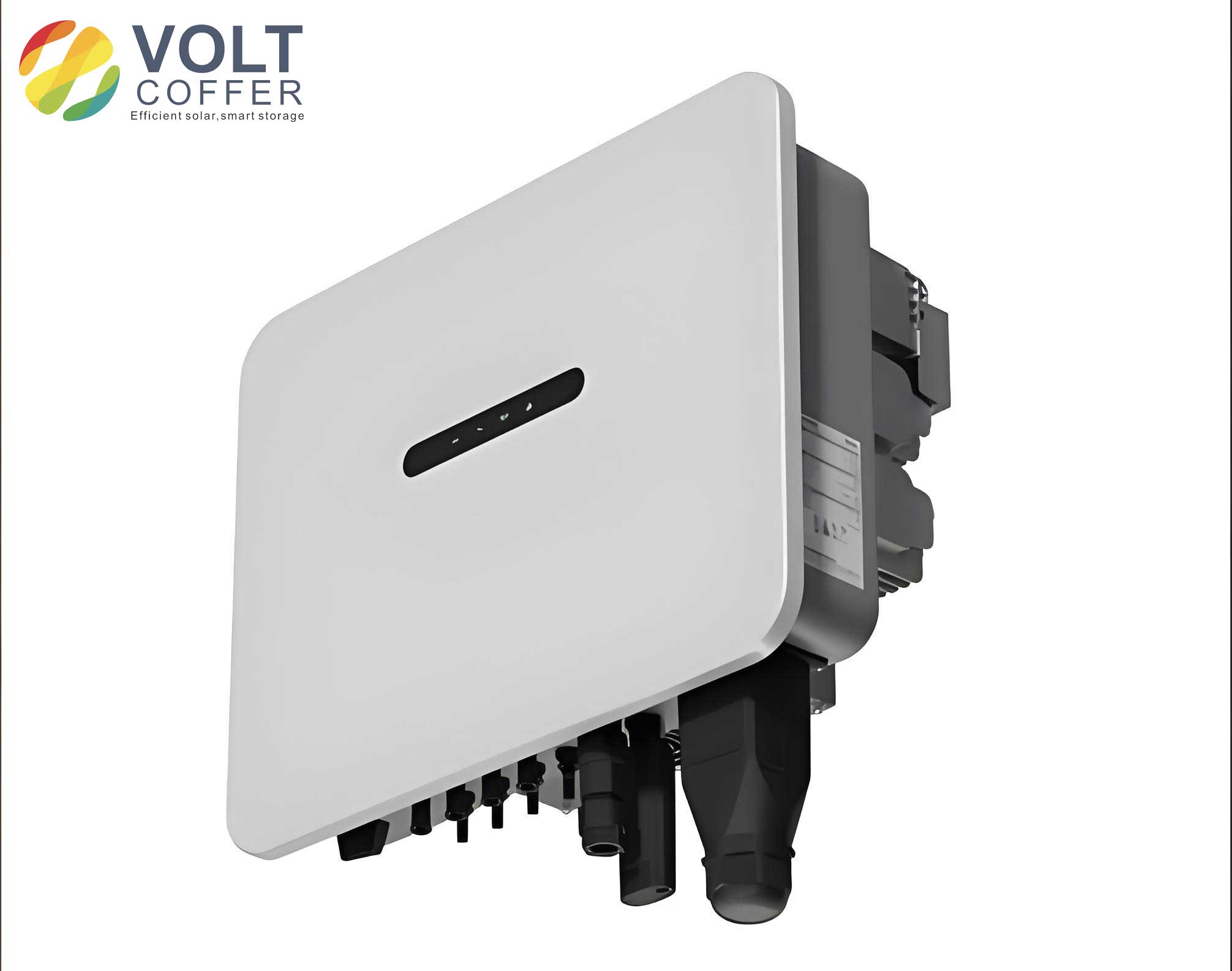
This article presents a comprehensive study on an automated current control methodology for LCL-type on grid inverters, anchored on a principle of dual constraints. The core objective is to suppress the LCL resonance effectively and autonomously, thereby minimizing grid current distortion and ensuring robust performance during transients. The method integrates an improved active damping technique based on output current feedforward with a systematic parameter tuning approach guided by both global (system-wide) and local (inverter-level) stability criteria. The subsequent sections will elaborate on the mathematical modeling of the on grid inverter, analyze the detrimental impact of harmonics, detail the proposed control structure, and validate its efficacy through extensive analytical and simulated results.
Mathematical Modeling of the Three-Phase LCL On Grid Inverter
Accurate modeling is the foundation for designing an effective controller. The topology of a standard three-phase, two-level voltage source inverter with an LCL output filter is considered. The key components include the DC-link capacitor (\(C_{dc}\)), the inverter-side filter inductor (\(L_1\)) with its parasitic resistance (\(R_1\)), the filter capacitor (\(C_f\)), the grid-side filter inductor (\(L_2\)) with its parasitic resistance (\(R_2\)), and the grid voltage at the Point of Common Coupling (PCC). The inverter output voltage is synthesized via Pulse Width Modulation (PWM). For control design, a state-space model in the synchronous reference frame (dq-frame) is typically employed. The state variables are often chosen as the inverter-side inductor current (\(i_{L1}\)), the capacitor voltage (\(v_C\)), and the grid-side inductor current (\(i_{L2}\)), which is also the grid-injected current (\(i_g\)).
The averaged state-space equations in the dq-frame, linearized around an operating point, can be derived. The dynamics of the LCL filter are described by:
$$L_1 \frac{d}{dt} \begin{bmatrix} i_{L1d} \\ i_{L1q} \end{bmatrix} = \begin{bmatrix} -R_1 & \omega L_1 \\ -\omega L_1 & -R_1 \end{bmatrix} \begin{bmatrix} i_{L1d} \\ i_{L1q} \end{bmatrix} + \begin{bmatrix} v_{id} \\ v_{iq} \end{bmatrix} – \begin{bmatrix} v_{Cd} \\ v_{Cq} \end{bmatrix} $$
$$C_f \frac{d}{dt} \begin{bmatrix} v_{Cd} \\ v_{Cq} \end{bmatrix} = \begin{bmatrix} 0 & \omega C_f \\ -\omega C_f & 0 \end{bmatrix} \begin{bmatrix} v_{Cd} \\ v_{Cq} \end{bmatrix} + \begin{bmatrix} i_{L1d} \\ i_{L1q} \end{bmatrix} – \begin{bmatrix} i_{L2d} \\ i_{L2q} \end{bmatrix} $$
$$L_2 \frac{d}{dt} \begin{bmatrix} i_{L2d} \\ i_{L2q} \end{bmatrix} = \begin{bmatrix} -R_2 & \omega L_2 \\ -\omega L_2 & -R_2 \end{bmatrix} \begin{bmatrix} i_{L2d} \\ i_{L2q} \end{bmatrix} + \begin{bmatrix} v_{Cd} \\ v_{Cq} \end{bmatrix} – \begin{bmatrix} v_{gd} \\ v_{gq} \end{bmatrix} $$
where \(\omega\) is the fundamental grid angular frequency, \(v_i\) is the inverter bridge output voltage, and \(v_g\) is the grid voltage. For harmonic and stability analysis, it is instrumental to examine the open-loop transfer functions from the modulating signal to the grid current. The LCL filter’s inherent resonant frequency is given by:
$$f_{res} = \frac{1}{2\pi} \sqrt{\frac{L_1 + L_2}{L_1 L_2 C_f}} $$
The undamped resonance at this frequency poses a significant challenge for current control loop stability. A conventional single-loop grid current control using a Proportional-Integral (PI) or Proportional-Resonant (PR) controller will have a very low gain margin at \(f_{res}\), necessitating the implementation of active damping or advanced control structures.
Harmonic Influence and Current Distortion Analysis
The primary goal of the on grid inverter control is to force the grid current (\(i_g\)) to accurately track its sinusoidal reference with minimal distortion. Distortion arises from multiple sources: low-order harmonics due to non-ideal reference tracking, high-order switching harmonics, and amplified disturbances around the LCL resonant frequency. The presence of background voltage harmonics in a weak grid can also interact negatively with the on grid inverter output impedance, potentially leading to harmonic resonance instability.
To quantify the control challenge, the loop gain of the system must be analyzed. Considering a standard control scheme with a current regulator \(G_c(s)\) (e.g., a PI controller), a PWM delay (\(G_{PWM}(s) = K_{PWM} e^{-1.5T_s s}\)), and the LCL plant \(P_{LCL}(s)\), the open-loop gain without damping is:
$$T_{ol}(s) = G_c(s) \cdot K_{PWM}e^{-1.5T_s s} \cdot G_{i_g}^{v_i}(s)$$
where \(G_{i_g}^{v_i}(s)\) is the transfer function from the inverter voltage to the grid current, which contains the problematic resonant peak. The Bode plot of \(T_{ol}(s)\) will show a significant phase drop and a magnitude peak at \(f_{res}\), threatening stability. Any disturbance \(d(s)\)—from grid voltage harmonics or reference imperfections—will be amplified according to the sensitivity function \(S(s) = 1/(1+T_{ol}(s))\). If the peak of \(|S(j\omega)|\) is large near \(f_{res}\), disturbances in that frequency band will cause substantial current distortion. Therefore, the control design must both stabilize the resonance (flatten the loop gain peak) and maintain good tracking performance at the fundamental frequency for the on grid inverter.
Table 1 summarizes typical sources of current distortion in an LCL-type on grid inverter and their spectral characteristics.
| Distortion Source | Typical Frequency Range | Main Cause | Impact on THD |
|---|---|---|---|
| Controller Tracking Error | Fundamental & Low-Order Harmonics (e.g., 3rd, 5th, 7th) | Limited controller bandwidth, imperfect harmonic compensation | Directly increases low-frequency THD |
| LCL Filter Resonance | Resonant Frequency \(f_{res}\) (typically hundreds of Hz to a few kHz) | Undamped or poorly damped natural mode of the passive filter | Can cause severe instability or high THD if excited |
| Grid Voltage Harmonics | Low-Order Harmonics (e.g., 5th, 7th, 11th, 13th) | Background distortion in a weak grid | Induces corresponding current harmonics via grid voltage feedforward imperfection |
| Switching Noise | Switching Frequency (\(f_{sw}\)) and its sidebands | PWM process | Attenuated by LCL filter; contributes to high-frequency EMI but less to current THD |
Proposed Automated Control Method Based on Dual Constraints
Improved Damping Control with Output Current Direct Feedforward
Active damping is a widely adopted solution to mitigate the LCL resonance issue. Instead of adding passive resistors (which cause losses), active damping techniques modify the control loop to emulate a virtual resistor. Common methods include capacitor current feedback and capacitor voltage feedback. The proposed method enhances the classic capacitor-current-feedback active damping by incorporating a direct feedforward path from the output (grid) current.
The core idea is to construct a control loop that inherently presents a resistive output impedance at the resonance frequency. The block diagram of the proposed controller for a single axis in the dq-frame is conceptualized as follows: The grid current error is processed by a main regulator \(G_c(s)\). Its output is combined with a feedforward signal derived from the grid current itself, scaled by a virtual resistance \(R_{v}\) and a shaping transfer function \(G_{ff}(s)\). This combined signal then has the capacitor current feedback signal (scaled by gain \(K_d\)) subtracted from it before being sent to the PWM modulator. The shaping function \(G_{ff}(s)\) is designed to ensure the feedforward acts effectively around the resonance frequency without affecting lower frequency tracking.
The resulting closed-loop output impedance \(Z_o(s)\) of the on grid inverter, seen from the grid side, becomes a critical transfer function. A key design goal is to make \(Z_o(s)\) predominantly resistive and sufficiently high around the LCL resonant frequency to prevent harmonic current injection from grid voltage disturbances. The derived output impedance with the proposed feedforward can be expressed as:
$$Z_o(s) = \frac{(L_1 L_2 C_f)s^3 + (R_1 L_2 C_f + R_2 L_1 C_f)s^2 + (L_1 + L_2 + R_1 R_2 C_f + K_d K_{PWM} L_2)s + (R_1 + R_2)}{C_f (L_1 s^2 + R_1 s + K_d K_{PWM} s + 1) + \text{Feedforward Terms}}$$
The feedforward terms, primarily containing \(R_v\) and \(G_{ff}(s)\), are engineered to cancel the complex poles in the denominator introduced by the LCL filter, thereby dampening the resonance peak in the output impedance characteristic. This automated damping mechanism allows the on grid inverter to maintain stable, low-distortion operation without manual intervention for parameter tuning under nominal conditions.
Dual-Constraint Principle for Robust Parameter Tuning
While the proposed structure offers a pathway for resonance damping, its robustness and optimal performance depend critically on the selection of key parameters, notably the active damping gain \(K_d\) and the feedforward coefficients within \(G_{ff}(s)\). An arbitrary choice can lead to insufficient damping or even introduce new instability. To address this, a dual-constraint tuning principle is introduced, considering both local and global stability perspectives.
1. Local Stability Constraint (Single Inverter Level): This constraint ensures the individual on grid inverter is stable when connected to an ideal grid. It involves analyzing the system’s characteristic equation or the poles of the closed-loop transfer functions. The parameters \(K_d\) and feedforward gains must be chosen such that all poles lie in the left-half of the s-plane, with adequate damping ratios. A root locus analysis with \(K_d\) as the varying parameter can establish its upper bound (\(K_{d,max}^{local}\)) beyond which the system becomes locally unstable or overly oscillatory.
2. Global Stability Constraint (Multi-Inverter System Level): In practical scenarios, multiple on grid inverters operate in parallel, creating a complex impedance network. The global constraint ensures stability when the inverter is connected to a non-ideal grid with variable impedance, typically modeled as a lumped inductance \(L_g\). This is assessed using impedance-based stability criteria, such as the Nyquist criterion of the Minor Loop Gain \(MLG(s) = Z_o(s) / Z_g(s)\), where \(Z_g(s)\) is the grid impedance. The parameters must be tuned so that the \(MLG(s)\) Nyquist plot does not encircle the (-1, j0) point for the expected range of \(L_g\). This analysis often sets a lower bound (\(K_{d,min}^{global}\)) on the damping gain to ensure sufficient harmonic current rejection and prevent resonance interaction with the grid.
The feasible region for the key damping parameter \(K_d\) is therefore defined by the dual constraints:
$$K_{d,min}^{global} \leq K_d \leq K_{d,max}^{local}$$
The optimal value within this range is selected to maximize the damping of the critical modes while maintaining good transient response and reference tracking for the on grid inverter. An automated tuning procedure can be implemented offline using these analytical and simulation-based constraints, resulting in a controller that is robust against both standalone instability and system-level harmonic resonance. Table 2 outlines the step-by-step tuning process based on the dual constraints.
| Step | Constraint Type | Analysis Method | Tuning Objective & Outcome |
|---|---|---|---|
| 1 | Local Stability | Root Locus / Pole Placement | Determine the maximum allowable damping gain \(K_{d,max}^{local}\) that keeps all closed-loop poles stable with sufficient damping (\(\zeta > 0.3\)). |
| 2 | Global Stability | Impedance-Based Stability Analysis (e.g., Nyquist of \(Z_o/Z_g\)) for a range of grid inductances \(L_g\). | Determine the minimum required damping gain \(K_{d,min}^{global}\) that ensures stability for \(L_g \in [L_{g,min}, L_{g,max}]\). |
| 3 | Feasibility Check | Compare bounds | If \(K_{d,min}^{global} \leq K_{d,max}^{local}\), a feasible region exists. Proceed to Step 4. Else, redesign filter parameters (\(L_1, L_2, C_f\)) or control structure. |
| 4 | Performance Optimization | Time-domain simulation (e.g., step response, THD under distorted grid) | Select the final \(K_d\) within the feasible region that minimizes grid current THD and provides fast, smooth transient response for the on grid inverter. |
| 5 | Feedforward Tuning | Frequency-domain shaping | Design \(G_{ff}(s)\) to provide effective damping at \(f_{res}\) while having negligible gain at the fundamental frequency to avoid interfering with the main controller. |
Simulation Results and Performance Validation
To validate the proposed automated current control method based on dual constraints, a detailed simulation model of a three-phase LCL on grid inverter was developed in a professional simulation environment. The system parameters are listed in Table 3. The performance was evaluated in terms of steady-state current quality, dynamic response to reference steps, and robustness under distorted grid voltage conditions.
| Parameter | Symbol | Value |
|---|---|---|
| DC-Link Voltage | \(V_{dc}\) | 700 V |
| Grid Voltage (Phase-to-Neutral RMS) | \(V_g\) | 230 V |
| Grid Frequency | \(f\) | 50 Hz |
| Rated Power | \(P_n\) | 10 kW |
| Inverter-side Inductor | \(L_1\) | 1.8 mH |
| Grid-side Inductor | \(L_2\) | 0.6 mH |
| Filter Capacitor | \(C_f\) | 10 µF |
| Switching Frequency | \(f_{sw}\) | 10 kHz |
| LCL Resonant Frequency | \(f_{res}\) | ~1.45 kHz |
| Active Damping Gain (Tuned) | \(K_d\) | 0.25 |
Steady-State Performance and Current THD
Under nominal grid conditions, the on grid inverter was commanded to inject rated current at unity power factor. The proposed controller with dual-constraint-tuned parameters successfully stabilized the system. The grid current waveforms were sinusoidal and in phase with the grid voltage. A Fast Fourier Transform (FFT) analysis was performed on the steady-state current. The results, summarized in Table 4 for different power levels, demonstrate that the current THD remains well below the 5% limit stipulated by standards such as IEEE 1547, even at partial load. The dominant low-order harmonics are effectively suppressed by the current regulator, while the resonance-induced distortion is absent due to the effective active damping.
| Output Power (kW) | Current THD (%) | Dominant Harmonic (Order, Magnitude % of Fundamental) | Comment |
|---|---|---|---|
| 10 (100%) | 1.82 | 5th (0.8%) | Excellent performance at full load. |
| 7.5 (75%) | 2.15 | 7th (1.1%) | Low distortion maintained. |
| 5 (50%) | 2.98 | 5th (1.4%) | THD increases slightly but remains under 3%. |
| 2.5 (25%) | 3.85 | 3rd (1.9%) | Most challenging condition, yet THD < 5%. |
Dynamic Response to Current Reference Step
The dynamic capability of the on grid inverter controller was tested by applying a step change in the d-axis current reference, corresponding to a step change in active power from 5 kW to 10 kW. The q-axis reference was kept at zero for unity power factor. The grid current response in the dq-frame is shown analytically. The proposed controller ensured a fast and well-damped transition. The settling time (to within 2% of the final value) was approximately 0.15 seconds, and the overshoot was limited to less than 10%. This demonstrates that the dual-constraint tuning, while ensuring robustness, does not compromise the dynamic performance of the on grid inverter.
Robustness Under Distorted Grid Voltage
To evaluate robustness, the grid voltage was intentionally distorted with 3% of the 5th harmonic and 2% of the 7th harmonic. A crucial feature of a robust on grid inverter control scheme is its ability to reject these grid-borne disturbances and inject a clean current. The performance was compared between the proposed method and a conventional PI control with basic capacitor-current-feedback damping. The proposed method, with its shaped output impedance and feedforward path, resulted in significantly lower current THD (2.7%) compared to the conventional method (4.9%). This validates that the global stability constraint, which considers interaction with grid impedance, effectively guides the tuning towards a more robust design for the on grid inverter in non-ideal grid environments.
Conclusion
This article has presented a comprehensive study on an automated current control strategy for LCL-filter-based on grid inverters, centered on the principle of dual constraints. The method addresses the core challenge of resonance-induced instability and current distortion by integrating an improved active damping technique with output current feedforward. The systematic parameter tuning approach, governed by both local (single-inverter) and global (system-level) stability constraints, ensures robust performance across a wide range of operating conditions and grid strengths. Detailed mathematical modeling highlighted the sources of distortion, while the control design demonstrated how to shape the inverter’s output impedance for effective harmonic rejection. Simulation results confirmed the efficacy of the proposed method, showing that it maintains grid current THD below 5% across various loads, provides a fast and stable dynamic response within 0.2 seconds, and exhibits superior robustness against grid voltage distortion. This dual-constraint-based approach provides a reliable and systematic framework for designing high-performance, automated current controllers for modern on grid inverters, facilitating the stable and high-quality integration of renewable energy sources into the power grid.