
In the context of continuously deepening “dual carbon” goals and the accelerated development of distributed renewable energy, the penetration rate of photovoltaic power generation in distribution networks is steadily increasing. This shift in operational characteristics imposes higher demands on grid loss reduction and power quality. As core devices for power conversion and intelligent control, solar inverters have evolved from traditional grid-connected equipment into multifunctional smart terminals capable of reactive power regulation, harmonic suppression, and voltage control. In this paper, we explore the application of solar inverters in intelligent loss reduction and power quality optimization for distribution networks. We systematically analyze the technical pathways and practical outcomes of solar inverters in reactive power optimization, voltage support, power factor adjustment, and harmonic mitigation. Through comparative data analysis and case validations, we demonstrate their comprehensive performance, offering theoretical foundations and engineering insights for efficient, secure, and stable operation of distribution systems under high-proportion renewable energy integration.
Solar inverters serve as the critical interface between distributed generation and the distribution network, with their advantages extending beyond mere energy conversion to encompass multidimensional system support. These solar inverters exhibit significant benefits in intelligent loss reduction and power quality management. For instance, solar inverters possess dynamic reactive power regulation capabilities, enabling stable bus voltage control through low-voltage ride-through and reactive voltage strategies, thereby enhancing voltage quality and mitigating voltage sags during peak load periods.
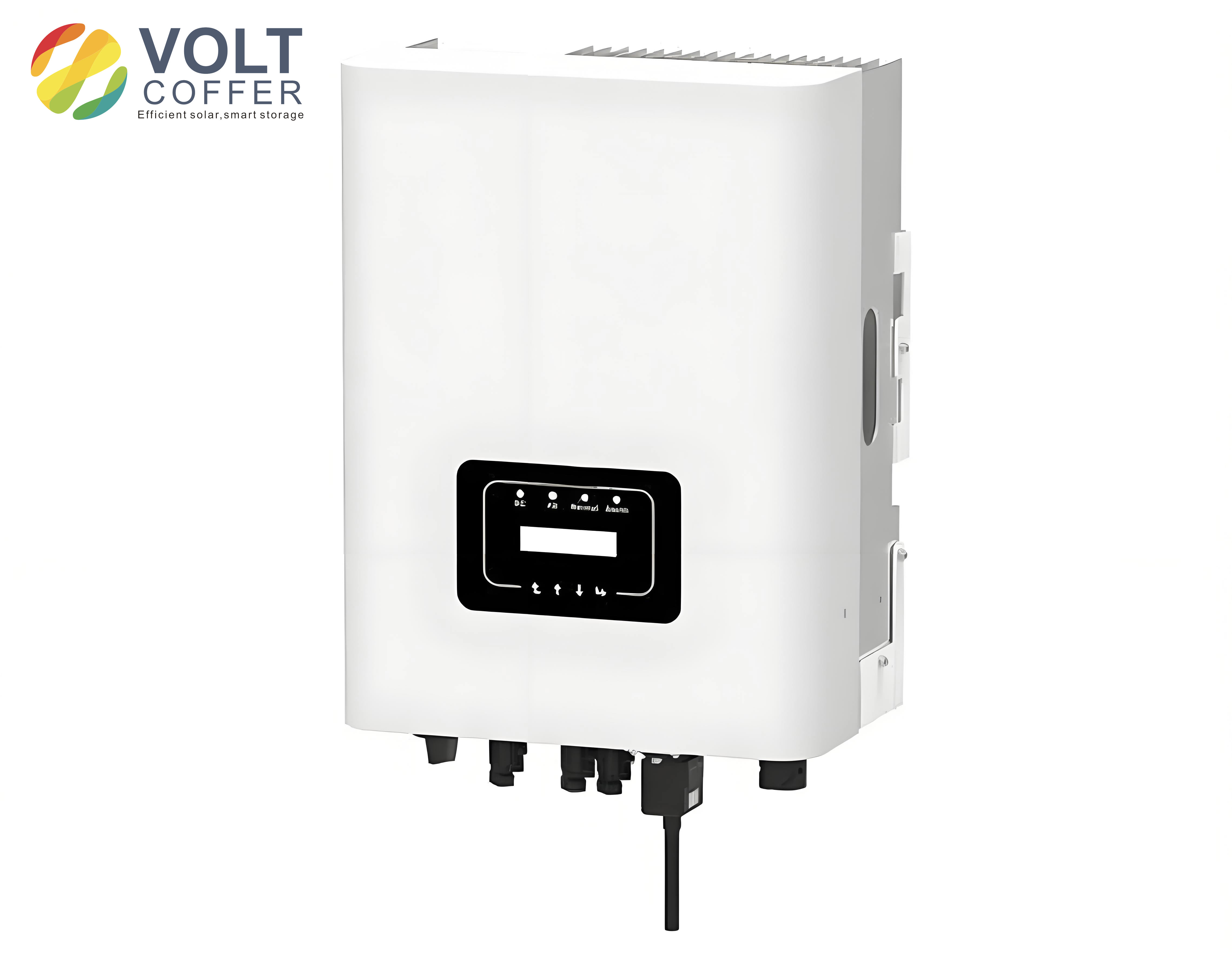
The advanced power conversion functionalities of solar inverters empower them with perception, decision-making, and execution roles in smart distribution networks. Their rapid response characteristics allow solar inverters to adjust active and reactive power outputs within milliseconds, adapting to instantaneous load variations and improving system flexibility and dynamic stability. Certain advanced solar inverters integrate harmonic suppression algorithms and passive filters, enabling real-time identification and filtering of typical harmonics such as the 3rd and 5th orders, which optimizes local power quality indices and reduces interference risks to sensitive equipment. By deploying solar inverters locally and implementing predictive active power control, they facilitate source-grid collaborative loss reduction operations, effectively addressing feeder power flow imbalances and terminal voltage fluctuations, thus enhancing the overall economic efficiency and safety margin of the distribution network.
The integration of solar inverters into distribution networks alters power flow patterns and significantly improves operational metrics through active control mechanisms. For example, in a typical 10 kV distribution network, key parameters before and after solar inverter integration are compared in Table 1, covering aspects like voltage, power factor, line losses, and harmonic characteristics.
| Key Operational Parameter | Value Before Integration | Value After Integration | Trend of Change |
|---|---|---|---|
| Node Voltage Deviation Range /% | -6.2 to +4.8 | -2.1 to +1.9 | Voltage fluctuation significantly reduced |
| System Power Factor | 0.91 | 0.98 | Reactive power compensation capability enhanced |
| Branch Line Loss Rate /% | 7.4 | 4.1 | Line energy loss reduced |
| 3rd Harmonic Voltage Content /% | 2.8 | 1.2 | Harmonic level effectively decreased |
| Voltage Fluctuation Standard Deviation /V | 16.7 | 7.9 | Voltage stability improved |
| Reactive Power Flow Maximum Fluctuation /kVar | ±240 | ±85 | Reactive power fluctuation significantly reduced |
As shown in Table 1, solar inverters achieve real-time regulation of bus voltage, markedly narrowing the node voltage deviation range and boosting power supply reliability. In reactive power management, the power factor increases from 0.91 to 0.98, as solar inverters utilize their dynamic reactive power adjustment to alleviate the reactive burden on traditional transformers. The branch line loss rate drops by 3.3%, indicating that the localized power supply特性 of solar inverters reduces long-distance transmission losses and optimizes energy efficiency. The 3rd harmonic voltage content decreases from 2.8% to 1.2%, demonstrating the effective harmonic suppression capabilities of built-in filters and control algorithms in solar inverters. The halving of voltage fluctuation standard deviation highlights significant improvements in steady-state performance, while the reduction in maximum reactive power flow fluctuations reflects the responsive nature of solar inverters in mitigating voltage swings and system disturbances. Overall, solar inverters enhance voltage stability, improve power factor, reduce network losses, and suppress harmonics, serving as pivotal technical supports for safe, economical, and high-quality operation of distribution networks with high penetration of distributed energy resources.
In the realm of intelligent loss reduction for distribution networks, solar inverters play a crucial role through various applications, including reactive power control, voltage regulation, and loss minimization. Reactive power control in solar inverters involves local measurements of voltage and power factor, dynamically adjusting reactive power output to achieve voltage stability and loss minimization. Solar inverters can operate in constant voltage control, constant power factor control, or volt-var curve control modes, leveraging embedded strategies to synchronize with grid conditions. During light-load periods when terminal voltage rises, solar inverters absorb reactive power to suppress voltage increases; conversely, during high-load periods, they inject reactive power to support voltage, maintaining it within target ranges and preventing violations.
Moreover, solar inverters can participate in regional reactive power optimization dispatch, forming a two-layer control structure with local response and system coordination through commands from distribution automation systems or master stations. In typical low-voltage PV integration scenarios, distributed deployment of solar inverters creates a fine-grained reactive power regulation network, effectively addressing transformer overload and feeder voltage deviations, significantly reducing branch losses, and enhancing power transmission efficiency. Compared to conventional reactive compensation devices, solar inverters offer faster response times, higher regulation accuracy, and real-time optimization of reactive power distribution, making them indispensable for intelligent loss reduction in distribution networks.
Voltage regulation via solar inverters entails real-time collection and analysis of point-of-common-coupling voltage data, employing localized or coordinated control for precise voltage adjustment and improved supply stability. In practice, solar inverters commonly use volt-var characteristic curve control strategies, automatically adjusting reactive output based on bus voltage deviations to provide dynamic voltage support. When grid voltage exceeds the set upper limit, solar inverters absorb reactive power to lower local voltage, and when voltage falls below 0.95 per unit, they inject reactive power for support, thus keeping voltage within permissible bounds.
In scenarios with multiple parallel solar inverters, coordinated voltage control strategies can be applied, where a master unit issues unified voltage adjustment commands, and inverters respond hierarchically by region, achieving wide-area voltage distribution optimization—particularly beneficial for long feeder end voltage regulation. Some advanced systems incorporate temporal voltage regulation mechanisms, combining load forecasting and irradiance trends to pre-adjust output power and reactive margins, enabling “feed-forward” voltage management and reducing fluctuations caused by power transients. In summary, solar inverters demonstrate remarkable capabilities in dynamic voltage support, feeder voltage difference equalization, and terminal voltage limit prevention, effectively ensuring low-loss operation in distribution networks.
Loss reduction in distribution networks through solar inverters relies on their localized generation, dynamic reactive power regulation, and intelligent power management abilities, enabling refined restructuring and optimization of active and reactive power flows. Compared to traditional centralized supply models, distributed deployment of solar inverters near load nodes shortens power transmission paths, reduces main line currents, and minimizes losses due to conductor resistance.
In practical applications, solar inverters dynamically adjust output power by monitoring feeder node voltages, currents, and load states, forming an energy supply模式 prioritizing local consumption and balance. In multi-node distributed PV integration, solar inverters can adopt “partitioned autonomy + local coordination” control strategies, prioritizing response to local loads and only feeding excess power to the upper grid when local generation exceeds demand, significantly shortening reverse power flow paths and reducing feeder power density and total system losses.
The reactive power compensation capability of solar inverters provides key support for reducing additional system losses. Traditional distribution networks operating at low power factors require long-distance reactive power transmission to maintain voltage levels, leading to voltage drops and transmission losses. Solar inverters precisely supply the required reactive power, meeting node voltage regulation and power factor correction needs, enhancing local reactive power generation and consumption, and avoiding secondary losses from long-distance transmission.
Some smart distribution systems integrate energy flow optimization scheduling algorithms, coordinating inverter output power and branch operating states based on predictive models that account for load dynamics and irradiance fluctuations. During high-load periods such as sunrise and sunset, solar inverters proactively adjust output strategies according to forecast data, prioritizing power release at loss-sensitive nodes to balance power flows and shave peaks, effectively mitigating loss increases from concentrated loads. By integrating smart solar inverters and implementing energy optimization control, distribution networks can achieve higher renewable energy utilization efficiency through distributed, fast-response, and precise control features.
To validate the practical effectiveness of solar inverters in intelligent loss reduction for distribution networks, we examine a case study from a typical 10 kV rural distribution network retrofit project in a southern region. The original system suffered from large feeder voltage differences and high branch losses. The project involved integrating 980 kW of distributed PV systems across four typical transformer areas, all equipped with smart solar inverters featuring dynamic reactive power regulation and voltage response functions, complemented by regional coordination strategies. A comparison of operational indicators before and after solar inverter integration is presented in Table 2.
| Transformer Area ID | Peak Line Loss Rate /% | Power Factor | Node Voltage Deviation /% | Terminal Current /A | Peak Load Loss /kW |
|---|---|---|---|---|---|
| TQ-01 | 8.4 | 0.91 | -6.1 to +4.7 | 112 | 14.3 |
| TQ-02 | 7.8 | 0.89 | -5.8 to +4.3 | 98 | 12.6 |
| TQ-03 | 6.9 | 0.93 | -4.9 to +3.9 | 87 | 11.1 |
| TQ-04 | 6.4 | 0.92 | -4.5 to +3.7 | 82 | 10.5 |
After integrating solar inverters and implementing coordinated control, line loss rates decreased across all transformer areas, terminal currents reduced, load losses dropped, and node voltage deviations converged noticeably, effectively alleviating terminal overvoltage issues. The overall power factor increased, indicating that solar inverters actively provided sufficient reactive support, reducing long-distance transmission losses. This case demonstrates that smart solar inverters, through precise output regulation and optimized power flow paths, significantly enhance operational efficiency and reduce system losses in distributed distribution scenarios, positioning them as core equipment for advancing intelligent loss reduction technologies.
In power quality optimization, solar inverters are instrumental in harmonic suppression, voltage fluctuation control, and power factor improvement. Harmonic pollution in distribution networks has become increasingly severe due to nonlinear loads and distributed generation. Solar inverters address this through internal control loops and filtering mechanisms. By employing current loop designs based on repetitive control and feedforward filtering, combined with LCL filter structures, solar inverters create high-impedance frequency bands at the point of common coupling, selectively suppressing specific harmonic currents. In typical three-phase grid-connected applications, solar inverters sample output currents, compare them with reference currents, and generate modulation signals via controllers to compensate for harmonic currents injected by loads, achieving nearly sinusoidal source-side currents.
The performance of this control strategy can be evaluated using the total harmonic distortion (THD) index for current, calculated as:
$$ D_{TH} = \frac{\sqrt{\sum_{n=2}^{\infty} I_n^2}}{I_1} \times 100\% $$
where \( D_{TH} \) is the current total harmonic distortion rate, \( I_1 \) is the fundamental current RMS value, and \( I_n \) is the RMS value of the nth harmonic current. Solar inverters dynamically identify and filter major harmonic components, maintaining grid-connected point THD below 3%, well under the national standard limit of 5%. In multi-inverter parallel operation scenarios, distributed harmonic control algorithms协同抑制 multiple injection point superposition effects, enabling wide-area harmonic治理 in medium- and low-voltage distribution networks and significantly improving power quality.
Voltage fluctuation control with solar inverters relies on their high-responsiveness dynamic reactive power regulation and intelligent algorithms to rapidly suppress short-term voltage disturbances. In practice, solar inverters often use dynamic voltage restore control strategies, monitoring bus voltage values in real-time against set reference limits. When voltage deviates, solar inverters instantly inject or absorb reactive power to stabilize the point-of-common-coupling voltage. During rapid irradiance changes or load surges causing voltage dips, solar inverters can complete reactive support responses within 20–50 ms, effectively mitigating voltage sags and ensuring normal operation of sensitive loads.
Advanced solar inverter systems deploy virtual impedance control mechanisms, dynamically adjusting output impedance to increase sensitivity to local voltage changes and provide “soft buffering” for fluctuations. In distributed systems with multiple parallel solar inverters, distributed coordinated voltage control algorithms prevent control conflicts among inverters, achieving collaborative voltage fluctuation suppression across regions.
Power factor optimization in distribution networks via solar inverters involves built-in reactive power adjustment functions to dynamically balance active and reactive outputs, maintaining high power factor levels and reducing additional losses from reactive power flow. In engineering applications, solar inverters operate in constant power factor control mode, precisely regulating output based on preset targets to automatically compensate for user-side low power factor operation, avoiding penalties and capacity wastage.
Solar inverters feature programmable reactive response curves, allowing autonomous power factor adjustments according to load fluctuations. When sudden load increases raise local reactive demand, solar inverters automatically inject reactive power into the system, achieving real-time power factor correction. In typical distributed PV integration scenarios, solar inverters interact with distribution automation systems to participate in regional reactive dispatch and power factor coordination, ensuring the entire feeder operates within an optimal power factor range.
In conclusion, solar inverters, as key equipment integrating energy conversion and multidimensional control in smart distribution networks, have demonstrated exceptional technical value in reactive power optimization, voltage regulation, harmonic suppression, and power factor improvement. Their rapid responsiveness, local autonomy, and distributed control advantages provide solid support for high-penetration renewable energy integration. Future efforts should further investigate solar inverters in wide-area coordination, adaptive scheduling strategies, and multi-energy complementary systems, continuously enhancing their adaptability and compatibility under complex conditions to achieve high-quality, low-loss, and resilient distribution network operation amidst high PV penetration.