
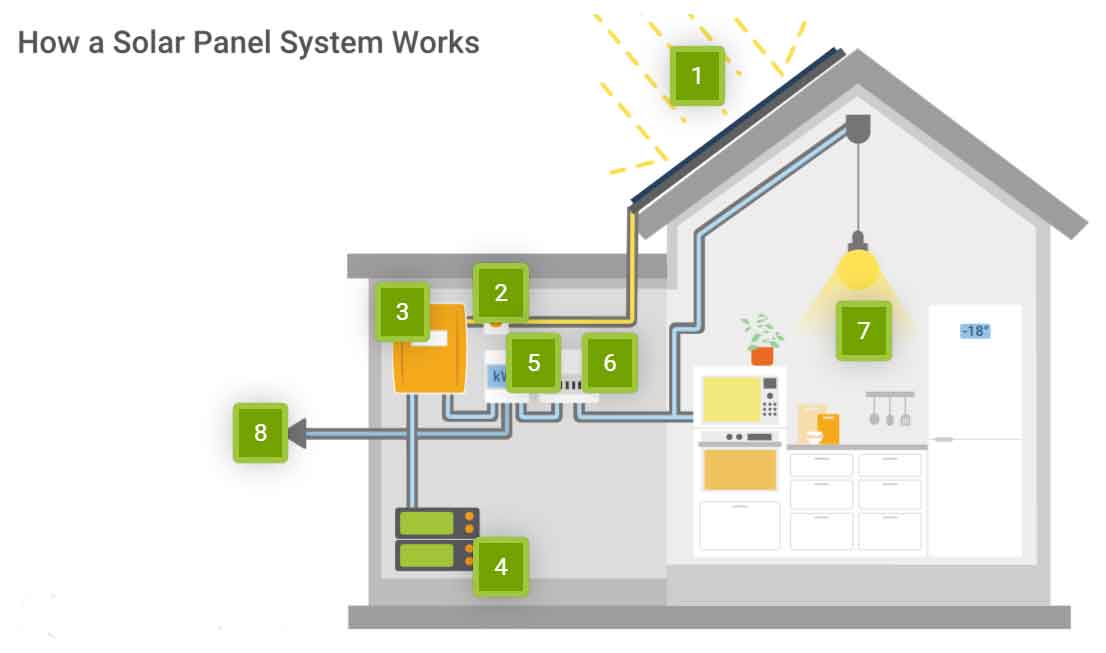
In terms of power generation methods, photovoltaic power generation systems can be mainly divided into two types: centralized and distributed. The distribution of solar energy in China is vast, and it is not suitable for centralized power generation. Therefore, in terms of photovoltaic power generation, distributed power generation is the main method. Strengthening research on distributed photovoltaic systems is of great value in promoting the development of China’s photovoltaic power generation industry.
1. Control objectives of photovoltaic grid connected power plants
The goal of photovoltaic grid connection design is to control the output current of the grid connected inverter, so that it can synchronize with the grid voltage frequency, maintain high-quality sine wave output, and convert the output of the inverter into a unit power factor to minimize the harmonic impact on the output current as much as possible. The output voltage of the inverter is also controlled to ensure that the voltage can achieve the same amplitude, phase, and frequency as the grid voltage, avoiding the occurrence of circulating currents, In the design of photovoltaic grid connected power plants, there are many differences between the control of inverters and that of ordinary inverters, which enable the grid and inverters to smoothly enter a parallel operation state. These differences are mainly manifested in the following aspects: firstly, in photovoltaic grid connected power plants, the output end of inverters is connected to the grid, which can have a significant impact on the operation of inverters; The second is that the grid connected current must achieve the same frequency and phase as the grid voltage. Therefore, in terms of system design, technicians need to control the size of the grid connected current and give the corresponding current size based on the benchmark. On the other hand, track the phase of the mains supply, and then determine the grid connection current based on the situation and benchmark of the power grid.
2. Design of solar grid connected inverter system
There are many classification methods for inverters in photovoltaic power grids, including voltage source inverters and current source inverters. The current source inverter requires a stable current input to be connected in series on the DC side, which increases system instability. Therefore, voltage source inverters are generally used in photovoltaic grid connection design. In terms of output control methods, two main methods can be used: current control and voltage control. In the grid connection design, the power grid serves as a customized AC voltage source in the system. If voltage control is used to output the inverter, the entire system will become a parallel connection between the voltage source and voltage source. In order to maintain the operational stability of the photovoltaic power plant system, phase-locked control technology needs to be adopted to control the system to ensure synchronization between the power plant system and the municipal power supply. Technicians can control the output mode of the power plant system by adjusting the output voltage of the inverter. Combined with phase shift adjustment, the conversion between active and reactive output can be achieved. However, in this control method, the response to the phase-locked loop is relatively slow, and it is difficult for technicians to grasp the specific and accurate voltage value when adjusting the output voltage of the inverter, which can easily lead to circulation problems, Affects the operational performance of photovoltaic power plant systems.
Therefore, current control can be used in the output mode of the inverter. As long as the output current of the inverter is controlled and the phase of the mains voltage is tracked by the current, the goal of parallel stable operation can be achieved. Moreover, the control method is relatively simple and has been widely used in the design of photovoltaic grid connected power station systems. Therefore, the above two points are comprehensively integrated, In the design of photovoltaic power plant systems, voltage source can be used as the input, while current source can be used as the output. In this way, the control variables in the entire system can control two, one is the output voltage of the inverter, and the other is the output current of the inverter. By controlling these two variables well, the stability of grid connected operation of the photovoltaic power plant system can be achieved, ensuring the stability of voltage output and the stability of current following phase, Therefore, in terms of control structure, it can be summarized as a dual loop control structure.
3. Design of solar cell tracking control
In the design of distributed solar photovoltaic power plant systems, maximum power tracking control technology is generally used for the control of solar cells. In the photovoltaic power plant system, power generation mainly comes from the conversion of solar energy, so the photovoltaic array of solar energy is the key to maintaining the operation of the power plant. However, due to the sensitivity of solar cells to changes in factors such as sunlight intensity and panel temperature, the power supply of the solar array is not stable. Therefore, in order to maintain the optimal stable state of solar energy, Measures need to be taken to synchronize the power output of the power station with changes in external light intensity, and to implement automatic tracking of it. This tracking control technology is the main control technology for solar cells in the design of photovoltaic power station systems. When the output voltage of the photovoltaic array is low, the change in output current will also decrease. At this point, the photovoltaic array tends to approach a constant current source. When the voltage rises to a certain critical value, the current will continue to decrease. At this point, the solar array will tend to approach a constant voltage source, and the output power of the solar photovoltaic array will fluctuate with the change of voltage, During this process, a point with the highest output power will naturally appear. By tracking this point, the system can be adjusted based on changes in solar cell power. In the control of solar cells, attention should be paid to controlling the following technical parameters: first, short-circuit current, which is the maximum output current under a given sunlight intensity and temperature. The value of short-circuit current is related to the area of the solar cell, and the larger the area, the greater the value of short-circuit current; The second is the open circuit voltage, which is the maximum output voltage under a given sunlight intensity and temperature. The magnitude of the open circuit voltage is directly proportional to the logarithm of the incident spectral irradiance, and is independent of the battery area. As the junction temperature increases, the open circuit voltage value also decreases; The third is the maximum power point current, which corresponds to the maximum power point current under a given sunlight intensity and temperature; The fourth is the maximum power point voltage, which corresponds to the maximum power point voltage under a given sunlight intensity and temperature; The fifth is the maximum power point power, which is the maximum power that a solar cell array may output under a given sunlight and temperature. By controlling these parameters well, the solar cell can be controlled to ensure the stability of the photovoltaic power plant system operation.
4. Conclusion
The increasingly severe environmental and energy issues have driven the development of photovoltaic power generation around the world. For regions with vast solar energy distribution and long sunshine periods, using photovoltaic power generation is an important means to solve the demand for electricity. As an energy country, strengthening research on photovoltaic power generation and promoting the development of photovoltaic industry are the main means to solve China’s energy problems. This article mainly analyzes and explores the design of photovoltaic power station systems under distributed solar energy mode, hoping to promote the development of China’s photovoltaic industry.