
In recent years, I have observed a significant shift towards renewable energy sources, driven by global initiatives such as carbon peak and neutrality goals. Among these, solar energy stands out due to its abundance and sustainability. The utilization of solar resources has evolved from simple thermal applications to advanced photovoltaic (PV) technologies, with distributed solar systems gaining prominence in building integration. In this article, I will delve into the development, advantages, challenges, and future prospects of distributed solar photovoltaics in buildings, emphasizing the role of solar systems in our energy transition.
Solar energy resources are vast, with many regions receiving ample sunlight annually. For instance, statistical data indicates that over two-thirds of areas experience more than 2,000 hours of sunshine per year, with solar irradiation exceeding 5×10^6 kJ/(m²·a). This abundance makes solar energy a viable alternative to fossil fuels. Currently, solar energy is harnessed through three primary methods: solar thermal conversion, solar photovoltaic power generation, and solar chemical energy conversion. Solar thermal technology, such as solar water heaters and greenhouses, is mature and widely adopted. However, with advancements in PV and energy storage technologies, solar photovoltaic power generation has become one of the fastest-growing applications, particularly under the push for carbon reduction. Additionally, emerging technologies like solar hydrogen production are beginning to showcase the potential of solar chemical conversion. The adoption of solar systems addresses issues associated with traditional fossil fuels, aligning with sustainable development goals.
The development of solar photovoltaic power generation technology has a rich history. It all began in 1839 when the photovoltaic effect was accidentally discovered, paving the way for PV research. In 1954, the first practical silicon solar cell was developed, laying the foundation for large-scale applications. By 1958, solar cells were used in space satellites, and by 1960, the first grid-connected solar power station was established. In my country, research on solar cells started in 1958, with practical applications emerging in the 1970s. Since the 21st century, PV technology has advanced rapidly, with global solar cell production growing at an average annual rate of 33% over the past decade and 43% over the past five years. In 2006, worldwide solar cell production reached 2,500 MWp, and cumulative shipments hit 8,500 MWp, marking a new phase in PV development. The solar system industry has expanded significantly, driven by government policies and technological innovations.
Solar cells can be classified based on materials used. The main types include silicon-based solar cells, compound thin-film solar cells, organic solar cells, nanocrystalline solar cells, and polymer-modified electrode solar cells. Silicon-based cells dominate the market, accounting for over 95% of production due to their maturity and efficiency. To summarize, I present a table comparing different solar cell types:
| Type of Solar Cell | Efficiency Range (%) | Advantages | Disadvantages |
|---|---|---|---|
| Silicon-based | 15-22 | High stability, mature technology | High manufacturing cost |
| Compound Thin-film | 10-18 | Flexible, lightweight | Lower efficiency than silicon |
| Organic | 5-12 | Low-cost, printable | Short lifespan |
| Nanocrystalline | 8-15 | Potential for high efficiency | Experimental stage |
Solar photovoltaic power generation has distinct characteristics compared to traditional methods. The advantages include low pollution, wide applicability, relative safety, good stability, and efficient land use. However, drawbacks such as dependence on weather conditions, low photoelectric conversion efficiency, and high initial investment with slow returns exist. As technology progresses, these issues are being mitigated. For example, the efficiency of a solar system can be modeled using the formula: $$ P_{output} = \eta \cdot A \cdot G \cdot (1 – \alpha) $$ where \( P_{output} \) is the power output in watts, \( \eta \) is the conversion efficiency, \( A \) is the area of the solar panels in square meters, \( G \) is the solar irradiance in W/m², and \( \alpha \) represents losses due to factors like shading or temperature. This formula highlights how optimizing parameters can enhance solar system performance.
The future of solar photovoltaic power generation is promising. PV technology has proven to be technically mature, economically viable, and environmentally friendly. Many countries, including the United States, Germany, Japan, and India, have implemented large-scale projects like “Million Roofs” plans. According to a 2021 report, global new PV installations reached 138.2 GW in 2020, and annual additions are projected to increase to 266 GW by 2025. The levelized cost of electricity from solar systems is now lower than that of fossil fuels and nuclear power in many regions, indicating substantial growth potential. I believe that distributed solar systems will play a crucial role in this expansion, especially in building applications.
A photovoltaic power generation system converts solar radiation into electricity using PV arrays. It typically consists of PV panels, controllers, and energy storage or conversion units. Solar systems are categorized into independent and grid-connected systems. Independent systems, often used in remote areas, include standalone power supplies for villages, solar home systems, and solar streetlights with batteries. Grid-connected systems, which feed electricity into the grid, can be further divided into those with or without energy storage. Based on scale, grid-connected systems are classified as centralized or distributed. Centralized solar systems are large-scale installations in deserts or wastelands, while distributed solar systems are smaller units installed on rooftops, building facades, or industrial sheds, making them ideal for urban environments. The distributed solar system is particularly relevant for building integration due to its proximity to load centers.
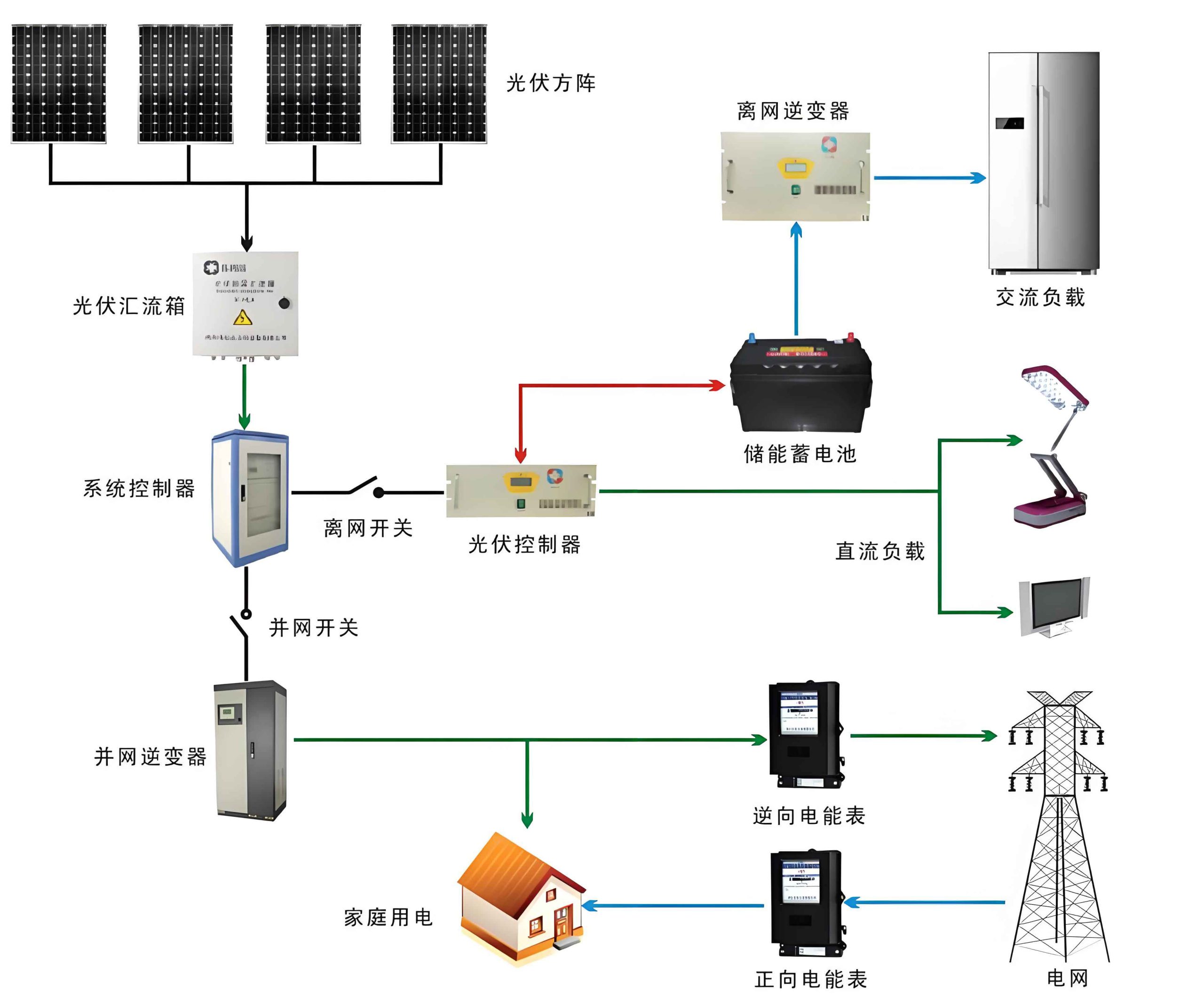
Distributed solar power stations refer to small-scale generation systems that utilize dispersed resources and are located near users, typically connected to low-voltage grids below 35 kV. These stations employ PV modules to directly convert sunlight into electricity. The key features include localized generation, grid connection, conversion, and consumption. This approach not only increases the effective power output of同等规模的光伏电站 but also reduces losses associated with long-distance transmission. The advantages of distributed solar systems are multifaceted. First, their output power is relatively small, ranging from a few kilowatts to several megawatts. Second, they are green and eco-friendly, producing no emissions, waste, or noise during operation, making them suitable for residential areas. Third, they integrate generation and consumption, enabling on-site power usage. Fourth, by being close to load centers, they eliminate the need for expensive step-up equipment and minimize transmission losses. Fifth, they are safe and reliable, with minimal grid impact. Sixth, they save land resources and development costs by utilizing existing structures like roofs and facades. Seventh, the scale of these solar systems is flexible, adjustable based on available space. Eighth, installation is simple and maintenance straightforward, allowing for decentralized deployment in energy-intensive areas.
In my analysis, the application of distributed solar systems in existing buildings holds immense potential. According to development targets, urban building photovoltaics are expected to reach 1 million kW by 2020, surpassing traditional power station construction. Currently, the total built-up area in my country is approximately 80 billion square meters, with urban public buildings accounting for at least 14.5 billion square meters. This provides a substantial base for retrofitting distributed solar systems. Assuming an average building height of 7 stories, roof area typically constitutes about 15% of the total floor area. Thus, urban public building roofs offer at least 2.175 billion square meters for solar system installation. If we consider a practical installation ratio of 40% and a power density of 120 W/m², the potential installed capacity of distributed solar systems is at least 104.4 GW, equivalent to five Three Gorges Dam power stations. The annual electricity generation could exceed 100 billion kWh, supplying about 1.3% of the national electricity consumption based on 2019 data. With additional potential from building south-facing facades and new construction projects, the growth prospects are even greater. Since 2013, supportive policies have been introduced, including subsidies of 0.42 yuan/kWh for distributed PV projects, which has sparked investor interest. However, the full potential of solar systems in buildings remains untapped.
Despite policy support, several challenges hinder the widespread adoption of distributed solar systems in existing buildings. First, investment profitability is a concern. Although distributed solar stations have many benefits, the per-watt investment cost is high, with long payback periods and low returns. Even with subsidies, the price advantage of solar power is not significant, and project ROI remains modest, especially for smaller systems with higher unit costs. Second, securing installation sites is difficult. Building ownership in my country is complex, with roofs often divided among multiple entities, making coordination challenging. Renting large, contiguous roof spaces involves negotiating with numerous stakeholders, leading to delays. Third, policy misalignment between central and local governments hampers implementation. While national policies provide guidelines, local配套 policies are lacking, resulting in inconsistent approval processes and poor operability, which discourages investors. Fourth, project financing is difficult due to low returns and long cycles, causing financial institutions to be cautious. Fifth, promotion of distributed solar systems faces obstacles like varying levels of awareness and local protectionism. These issues must be addressed to accelerate solar system deployment.
To overcome these challenges, I propose the following recommendations for developing distributed solar systems. First, governments at all levels should take proactive roles, formulating and完善配套 policies, opening markets, and facilitating roof access. Second, investment enterprises should innovate in business models and technologies to enhance efficiency and reduce costs. Third, financial institutions should design special loan schemes to support solar system projects. Fourth, grid companies must collaborate closely to streamline grid connection and settlement services. Fifth, urban planning should incorporate distributed solar systems into new building designs. Sixth, increased R&D in key technologies, such as energy storage and smart grids, is essential to improve solar system performance. By addressing these areas, we can unlock the full potential of solar systems in buildings.
In terms of technical aspects, the efficiency of a solar system can be optimized through various means. For instance, the overall system efficiency \( \eta_{system} \) can be expressed as: $$ \eta_{system} = \eta_{PV} \cdot \eta_{inverter} \cdot \eta_{storage} \cdot (1 – \beta) $$ where \( \eta_{PV} \) is the PV panel efficiency, \( \eta_{inverter} \) is the inverter efficiency, \( \eta_{storage} \) is the storage efficiency (if applicable), and \( \beta \) represents system losses such as wiring or soiling. Typical values range from 10% to 20% for overall solar system efficiency. Additionally, the economic viability can be assessed using the levelized cost of electricity (LCOE) formula: $$ LCOE = \frac{\sum_{t=1}^{n} \frac{I_t + M_t}{(1+r)^t}}{\sum_{t=1}^{n} \frac{E_t}{(1+r)^t}} $$ where \( I_t \) is the investment cost in year \( t \), \( M_t \) is the maintenance cost, \( E_t \) is the electricity generated, \( r \) is the discount rate, and \( n \) is the system lifetime. For distributed solar systems, LCOE has decreased significantly, making them competitive. I have compiled a table summarizing key parameters for distributed solar system evaluation:
| Parameter | Typical Value | Impact on Solar System |
|---|---|---|
| PV Efficiency (η_PV) | 15-20% | Higher efficiency increases power output per area |
| System Lifetime (n) | 25-30 years | Longer lifetime improves ROI |
| Initial Investment (I_0) | $1,000-$2,000 per kW | Lower cost accelerates adoption |
| Annual Maintenance Cost (M_t) | 1-2% of I_0 | Reduces net benefits |
| Solar Irradiance (G) | 800-1200 W/m² peak | Higher irradiance boosts generation |
The integration of solar systems into buildings also involves architectural considerations. Building-integrated photovoltaics (BIPV) replace conventional building materials with PV elements, such as solar shingles or facades. This approach enhances aesthetics and functionality. The energy yield of a BIPV solar system can be estimated using: $$ E_{annual} = A \cdot G_{annual} \cdot \eta_{system} \cdot PR $$ where \( E_{annual} \) is the annual energy output in kWh, \( A \) is the installed area in m², \( G_{annual} \) is the annual solar irradiance in kWh/m², \( \eta_{system} \) is the system efficiency, and \( PR \) is the performance ratio (typically 0.75-0.85). For example, a 100 m² solar system with 15% efficiency and 1,200 kWh/m² annual irradiance can generate approximately 13,500 kWh per year, assuming a PR of 0.8. This demonstrates how solar systems can contribute significantly to building energy needs.
Looking ahead, the role of distributed solar systems in achieving carbon neutrality is paramount. With continued technological advancements, costs are expected to decline further. Innovations like perovskite solar cells promise higher efficiencies at lower costs, potentially revolutionizing the solar system market. Moreover, the integration of solar systems with smart grids and Internet of Things (IoT) technologies will enable better energy management and grid stability. In my view, the future of solar systems lies in their ability to form interconnected microgrids that enhance resilience and sustainability. Policies should encourage such integrations through incentives and standards.
In conclusion, as we progress towards carbon peak and neutrality goals, the deployment of distributed solar systems in buildings represents a critical pathway for renewable energy adoption. By leveraging existing structures, we can tap into vast solar resources without additional land use. Despite challenges, with coordinated efforts from governments, businesses, and financial institutions, distributed solar photovoltaics will become a mainstream energy solution. The solar system is not merely a supplement to traditional energy but a transformative force driving us towards a greener future. I am optimistic that through innovation and collaboration, solar systems will illuminate our path to sustainability.