
The operational performance, cycle life, and safety of a lithium-ion battery are profoundly influenced by its operating temperature. Therefore, a rational design of the Battery Thermal Management System (BTMS) cooling system is crucial for ensuring the battery pack operates within its optimal temperature range. Efficient heat dissipation becomes particularly critical when numerous cells are assembled into modules or packs. Among various cooling methods, liquid cooling is recognized for its high cooling efficiency and uniformity, making it the preferred choice for large-capacity lithium-ion battery modules. This article, based on a numerical model validated against experimental data, systematically investigates the impact of several key structural and operational parameters of an S-shaped liquid cooling channel on the thermal performance of a battery module.
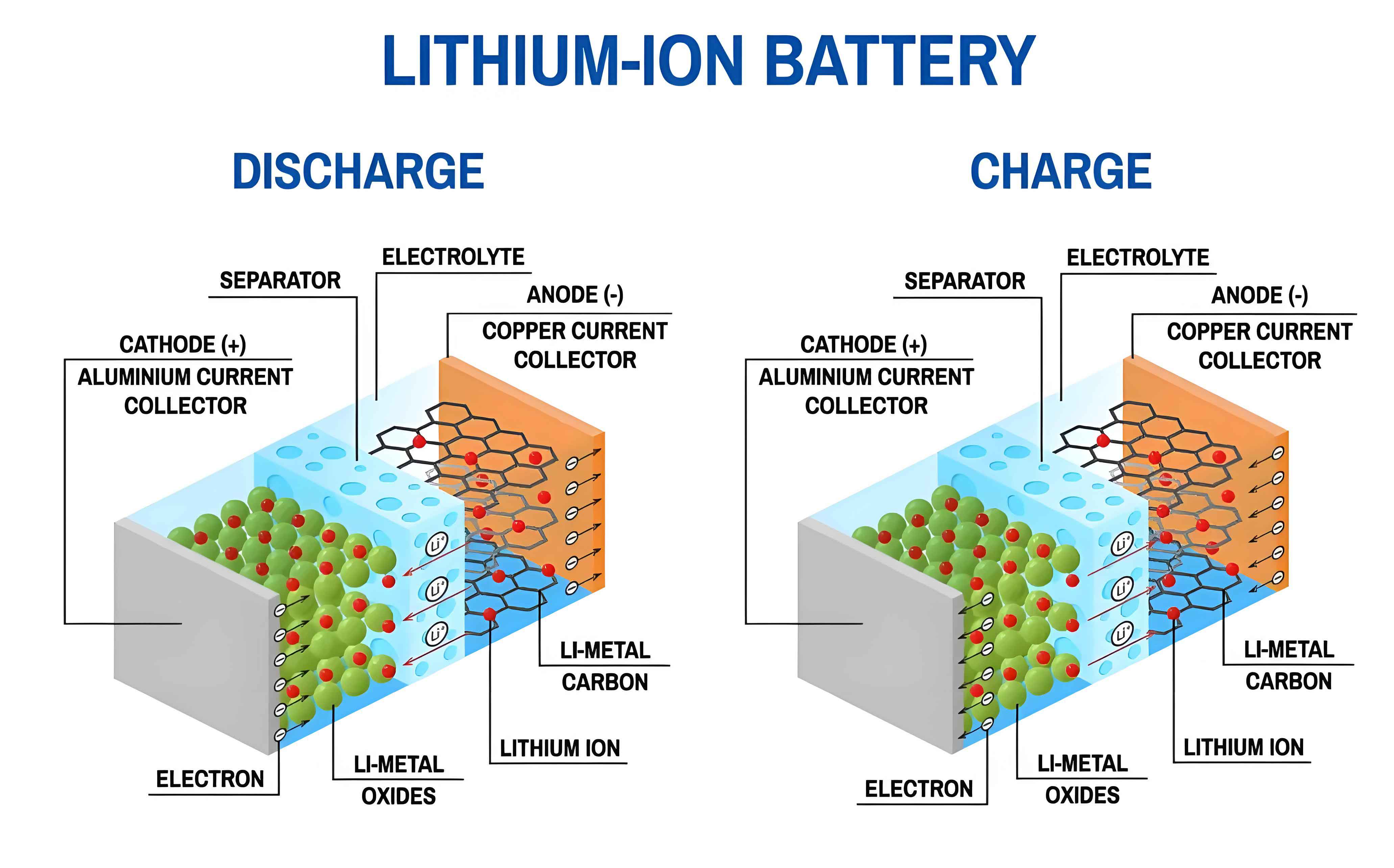
The thermal behavior of a lithium-ion battery cell can be described by the three-dimensional heat conduction equation. Assuming uniform internal heat generation and constant material properties, the governing equation is:
$$
\rho_{cell} C_p \frac{\partial T_{cell}}{\partial t} = \lambda_x \frac{\partial^2 T_{cell}}{\partial x^2} + \lambda_y \frac{\partial^2 T_{cell}}{\partial y^2} + \lambda_z \frac{\partial^2 T_{cell}}{\partial z^2} + q
$$
Here, \( \rho_{cell} \) is the density, \( C_p \) is the specific heat capacity, \( \lambda_x, \lambda_y, \lambda_z \) are the thermal conductivities in different directions, \( T_{cell} \) is the temperature, and \( q \) is the volumetric heat generation rate. The heat generation within the lithium-ion battery during operation is calculated using the Bernardi model:
$$
q = \frac{I}{V} \left[ I(R_j + R_o) + T \frac{dE_{OC}}{dT} \right]
$$
where \( I \) is the current, \( V \) is the volume, \( R_j \) and \( R_o \) are the polarization and ohmic resistances, respectively, and \( \frac{dE_{OC}}{dT} \) is the entropy coefficient. The internal resistance of the lithium-ion battery varies with its State of Charge (SOC), a relationship that must be characterized experimentally and fitted for accurate simulation.
The cooling performance is evaluated using three key metrics: the maximum temperature of the module (\( T_{max} \)), the maximum temperature difference within the module (\( \Delta T_{max} \)), and the pressure drop across the cooling channel (\( \Delta P \)). The primary goal is to minimize \( T_{max} \) and \( \Delta T_{max} \) while maintaining a manageable \( \Delta P \).
Key Factors Influencing Liquid Cooling Performance
The study focuses on an S-shaped channel design cooling a module of 15 cylindrical 18650 lithium-ion batteries. The analysis reveals that five parameters significantly affect the heat dissipation performance. Their individual and combined effects are summarized below.
| Factor | Symbol | Definition / Variation | Primary Impact on Performance |
|---|---|---|---|
| Channel Height Ratio | β | β = H₂/H₄ (0.1 to 0.9) | Non-linear; optimal at high β; low β benefits from high velocity. |
| Coolant Mass Flow Rate | \( \dot{m}_a \) | 0.01 to 0.80 kg/s | Strong initial improvement; diminishing returns beyond ~0.10 kg/s with drastic pump power increase. |
| Channel Width | \( H_6 \) | 1 to 4 mm | Minor effect on \( T_{max} \); significant reduction in \( \Delta P \) as width increases. |
| Wrapping Angle | θ | 60° to 105° | Linear improvement in cooling with increased angle; accompanied by increased flow resistance. |
| Number of Channels | N | 1 to 4 | Highly effective for low β designs; marginal benefit for high β designs. |
1. Channel Height Ratio (β)
The channel height ratio β defines the proportion of the cooling plate’s height occupied by the fluid channel. It directly influences the contact area between the coolant and the battery wall, as well as the flow velocity for a given mass flow rate. The relationship is complex and non-linear.
At a low mass flow rate (e.g., 0.01 kg/s), increasing β from 0.1 to 0.3 surprisingly leads to an increase in \( T_{max} \) from 33.05°C to 34.16°C. This is because the low-β (0.1) channel has a very small cross-sectional area, resulting in a high coolant velocity (~0.61 m/s). Although the contact area is small, the enhanced convective heat transfer due to high velocity compensates effectively. The medium-β (0.3) channel has a larger area and lower velocity (~0.20 m/s), leading to poorer immediate performance.
For β > 0.3, further increasing the ratio improves performance monotonically, as the benefit of increased contact area dominates. At β = 0.9, \( T_{max} \) drops to 31.54°C, the lowest in this series. This demonstrates that for standard operating conditions, maximizing the thermal interface area is beneficial, but the design must also consider the associated flow mechanics.
2. Coolant Mass Flow Rate (\( \dot{m}_a \))
The coolant mass flow rate is a critical operational parameter for any lithium-ion battery liquid cooling system. The convective heat transfer coefficient \( h \) is related to flow velocity, which is proportional to \( \dot{m}_a \) for a fixed channel geometry. A higher flow rate removes heat more effectively but requires more pump power, quantified by the pressure drop \( \Delta P \).
The analysis shows a strong initial benefit. Increasing \( \dot{m}_a \) from 0.01 kg/s to 0.05 kg/s reduces \( T_{max} \) by approximately 2.00°C. A further increase to 0.10 kg/s yields an additional reduction of 0.29°C. However, beyond this point, the law of diminishing returns applies starkly. Increasing the flow rate to 0.80 kg/s only lowers \( T_{max} \) by an extra 0.40°C compared to the 0.10 kg/s case. Meanwhile, the pressure drop escalates non-linearly, from about 568 Pa at 0.10 kg/s to nearly 33,000 Pa at 0.80 kg/s, as described by the relation:
$$
\Delta P \propto f \frac{L}{D_h} \frac{\rho u^2}{2}
$$
where \( f \) is the friction factor, \( L \) is the channel length, \( D_h \) is the hydraulic diameter, \( \rho \) is density, and \( u \) is velocity. This highlights the critical need for system-level optimization: selecting a flow rate that provides adequate cooling without imposing excessive parasitic energy consumption on the pump.
3. Channel Width (\( H_6 \)) and Wrapping Angle (θ)
These are primary geometric parameters of the S-channel. The channel width \( H_6 \) has a relatively minor impact on the peak temperature of the lithium-ion battery module. Varying the width from 2 mm to 4 mm causes a negligible increase in \( T_{max} \) of only 0.20°C. Its main effect is on flow resistance. A wider channel significantly reduces the pressure drop \( \Delta P \), offering a way to lower pump power for a given flow rate.
In contrast, the wrapping angle θ has a pronounced linear effect. This angle determines the arc of the battery surface in direct contact with the cooling plate. A larger θ increases the thermal contact area. Increasing θ from 60° to 105° reduces \( T_{max} \) by 2.03°C, a significant improvement for thermal management of the lithium-ion battery pack. This enhancement comes at the cost of increased flow resistance (ΔP rose by 57%), as the longer, more conforming channel path increases friction losses. The trade-off between improved heat transfer and increased pumping power must be evaluated.
4. Number of Parallel Channels (N)
Implementing multiple parallel channels within the same cooling plate footprint is a common strategy to enhance performance. The effect of channel multiplicity is, however, deeply intertwined with the channel height ratio β. When the total cross-sectional area for coolant flow is held constant, increasing N decreases the individual channel’s height and increases the total perimeter (contact area) per unit width.
The performance gain from multi-channel design is most dramatic for modules with a low overall β. For a design with β=0.1, switching from a single channel (N=1) to four channels (N=4) reduces \( T_{max} \) by 2.02°C. This is because the multi-channel design brings the coolant flow much closer to the battery’s top and bottom regions (near the terminals), which are often hotspots, improving heat extraction from these critical areas.
Conversely, for a design with a very high β (e.g., 0.9), where the single channel already covers most of the battery height, adding more channels provides minimal benefit. In this case, increasing N from 1 to 4 only reduced \( T_{max} \) by 0.27°C. This indicates that for a well-designed, high-β single channel, the marginal improvement from flow subdivision is not justified by the increased manufacturing complexity. The table below summarizes the effect for different β values.
| Channel Height Ratio (β) | \( T_{max} \) for N=1 (°C) | \( T_{max} \) for N=4 (°C) | Reduction in \( T_{max} \) (°C) |
|---|---|---|---|
| 0.1 | 33.05 | 31.03 | 2.02 |
| 0.3 | 34.16 | 31.47 | 2.69 |
| 0.5 | 34.10 | 31.36 | 2.74 |
| 0.7 | 32.97 | 31.31 | 1.66 |
| 0.9 | 31.54 | 31.27 | 0.27 |
Synthesis and Design Implications for Lithium-Ion Battery Packs
The analysis underscores that optimizing a liquid cooling system for a lithium-ion battery module is a multi-dimensional challenge. No single parameter operates in isolation. A systems engineering approach is required to balance thermal performance against hydraulic pumping power and manufacturability.
For the S-channel design studied, a high channel height ratio (β > 0.7) is generally favorable for achieving a low maximum temperature and good temperature uniformity. A coolant mass flow rate should be chosen in the range where the cooling benefit per unit increase in flow rate is still significant, typically before the curve flattens—around 0.05 to 0.10 kg/s in this specific case. Exceeding this point leads to wasteful energy consumption.
The wrapping angle should be maximized within mechanical design constraints to improve heat transfer, accepting the moderate increase in flow resistance. The channel width can be tuned primarily to manage pressure drop rather than to significantly influence peak temperature. The decision to use multiple channels is highly effective for compact, low-profile cooling plates (low β) but offers diminishing returns for taller, single-channel designs that already provide extensive coverage.
These principles, derived from the simulation of a specific module, can be generalized. The governing energy equation for the coolant flow, coupled with the heat conduction in the lithium-ion battery, always presents this trade-off:
$$
\dot{m}_a C_{p,c} (T_{out} – T_{in}) = \int_{A_{contact}} h(T_{wall} – T_{fluid}) \, dA
$$
where the left side represents the total heat absorbed by the coolant, and the right side represents the integrated convective heat transfer from the battery wall. The parameters β, θ, and N directly influence the contact area \( A_{contact} \). The parameters \( \dot{m}_a \) and \( H_6 \) influence the velocity profile and thus the convective heat transfer coefficient \( h \) and the pressure drop. An optimal design finds the best compromise between maximizing the right-hand side of this equation and minimizing the pump power required to sustain the flow.
Conclusion and Future Perspectives
Effective thermal management is paramount for the safety, longevity, and performance of lithium-ion battery systems in electric vehicles and energy storage. Liquid cooling with optimized channel design remains a leading solution. This investigation into an S-shaped channel design reveals the complex interplay between geometric parameters (β, \( H_6 \), θ, N) and operational parameters (\( \dot{m}_a \)) on the cooling performance of a lithium-ion battery module.
Key takeaways are that maximizing thermal contact area (through high β and large θ) is fundamentally important, while flow rate must be optimized to avoid prohibitive pumping losses. Multi-channel designs are particularly powerful for space-constrained, low-profile cooling systems. The robustness of this thermal management strategy for the lithium-ion battery must also be evaluated under dynamic loads, variable ambient conditions, and during fast-charging scenarios where heat generation rates are extreme.
Future work will involve multi-objective optimization algorithms to automatically balance \( T_{max} \), \( \Delta T_{max} \), and \( \Delta P \) across these parameters. Furthermore, integrating advanced materials or hybrid cooling techniques (e.g., coupling phase change materials with liquid cooling) could be explored to push the limits of thermal management for next-generation, high-energy-density lithium-ion batteries.