
As a professional deeply involved in the renewable energy sector, I have observed the transformative impact of solar photovoltaic (PV) technology on our energy landscape. The construction of grid-connected solar system installations represents a critical intersection of engineering precision, electrical expertise, and project management. This article delves into the comprehensive technical workflow, key construction methodologies, and the underlying principles of building effective and reliable grid-connected PV power plants. The successful deployment of a solar system hinges on meticulous planning and execution across all phases, from initial site assessment to final grid synchronization.
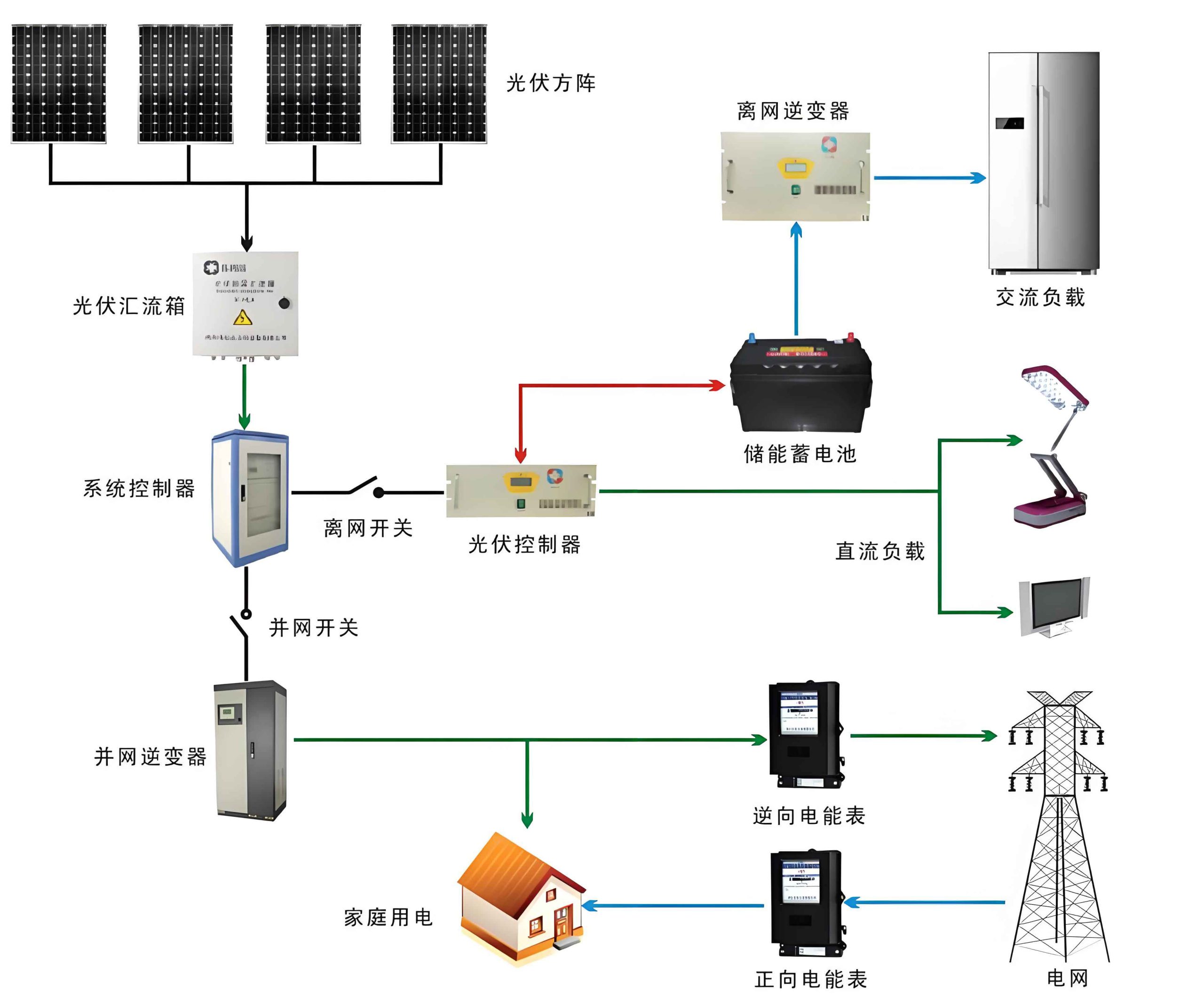
The core principle of a grid-connected solar system is the direct conversion of sunlight into electricity using PV modules, followed by the conditioning and synchronization of this DC power with the utility AC grid. Unlike off-grid systems, these installations do not require large-scale battery storage for primary operation, thereby enhancing overall efficiency and reducing capital costs. The fundamental power generation equation for a PV cell is described by the diode equation:
$$I = I_{ph} – I_0 \left[ \exp\left(\frac{q(V + IR_s)}{nkT}\right) – 1 \right] – \frac{V + IR_s}{R_{sh}}$$
where \(I\) is the output current, \(I_{ph}\) is the photogenerated current, \(I_0\) is the diode saturation current, \(q\) is the electron charge, \(V\) is the output voltage, \(R_s\) is the series resistance, \(n\) is the diode ideality factor, \(k\) is Boltzmann’s constant, \(T\) is the cell temperature, and \(R_{sh}\) is the shunt resistance. For a complete solar system array, the total DC power (\(P_{dc}\)) available before inversion can be approximated by:
$$P_{dc} = N_m \times P_{mpp(STC)} \times \frac{G}{G_{STC}} \times [1 – \gamma (T_c – T_{STC})]$$
where \(N_m\) is the number of modules, \(P_{mpp(STC)}\) is the module power at Standard Test Conditions (STC: 1000 W/m², 25°C cell temperature, AM1.5 spectrum), \(G\) is the actual irradiance, \(G_{STC}\) is the STC irradiance (1000 W/m²), \(\gamma\) is the power temperature coefficient, \(T_c\) is the actual cell temperature, and \(T_{STC}\) is 25°C. The final AC output power fed to the grid is then:
$$P_{ac} = P_{dc} \times \eta_{inv} \times \eta_{other}$$
where \(\eta_{inv}\) is the inverter efficiency and \(\eta_{other}\) accounts for losses in cables, transformers, etc.
The construction of a grid-tied solar system offers distinct advantages: significant reduction in greenhouse gas emissions and operational noise, optimal utilization of space (often on building rooftops), and distributed generation that feeds surplus power directly into the grid, enhancing local energy security and reducing transmission losses.
Pre-Construction Phase: Planning and Preparation
Before any physical work begins, a thorough preparatory phase is paramount for the success of the solar system project. This involves comprehensive site assessment, system design, and logistical planning.
| Activity | Key Tasks and Considerations | Tools/Outcome |
|---|---|---|
| Site Survey & Assessment | Evaluate shading (using sun path tools), structural integrity of the mounting surface (roof or ground), azimuth and tilt potential, soil conditions (for ground mounts), and accessibility. Measure available area precisely. | Solar pathfinder, 3D modeling software, structural analysis reports, topographic surveys. |
| System Design & Engineering | Perform energy yield simulation. Determine optimal string configuration based on inverter MPPT voltage/current windows. Design electrical single-line diagrams (SLD), including protection schemes (DC/AC breakers, surge protection). Plan cable routing and equipment layout. | PVsyst, HelioScope, AutoCAD. Finalized SLDs, bill of materials (BOM), layout drawings. |
| Material Procurement & Inspection | Source certified PV modules, inverters, mounting structures, and electrical components. Upon delivery, inspect all items for transport damage, verify model numbers and ratings against the BOM, and perform random electrical tests on modules (open-circuit voltage \(V_{oc}\), short-circuit current \(I_{sc}\)). | Checklists, IV curve tracers, multimeters. Approved materials ready for installation. |
| Safety & Logistics Setup | Establish site safety protocols (fall arrest systems for roofs, trenching safety for grounds). Set up temporary power and material storage areas. Conduct detailed technical briefings for all crews. | Job hazard analysis (JHA), safety harnesses, fencing, material laydown areas. |
Construction Phase: Technical Workflow and Key Methodologies
The physical construction follows a sequential workflow where precision at each stage ensures the integrity and performance of the entire solar system.
1. Mounting Structure Installation
The mounting system forms the skeleton of the solar system. Its primary role is to provide secure, durable, and correctly oriented support for the PV modules for decades.
a. Layout and Marking: Using the engineered layout drawings, the installation area is marked. For roof-mounted systems, rafters or primary structural members are located. The key reference axes are established using precision tools like total stations or laser levels to ensure perfect alignment. The tilt angle (\(\beta\)) is set according to the design, often optimized using the latitude (\(\phi\)) of the site. A common rule-of-thumb for annual maximum yield is: \(\beta_{opt} \approx \phi\).
b. Structure Assembly and Fixing: For metallic structures (typically aluminum or galvanized steel), components are assembled on the ground where possible. Common connection methods include:
- Bolting: Preferred for its strength and ease of inspection. Torque wrenches must be used to achieve specified values.
- Clamping: Used for attaching rails to standing seams on metal roofs without penetration.
- Welding (for heavy-duty ground mounts): Requires skilled welders and subsequent anti-corrosion treatment (e.g., hot-dip galvanizing or painting) of the welds.
The structure must be meticulously leveled and aligned. Critical tolerances are summarized below:
| Parameter | Typical Tolerance | Measurement Tool |
|---|---|---|
| Rail Alignment (deviation from straight line) | ± 2 mm per 2 m length | String line, Laser level |
| Overall Plane Levelness | ± 3 mm per 10 m length | Spirit level, Laser scanner |
| Post/Vertical Support Plumb | ± 1.5° from vertical | Plumb bob, Digital level |
2. PV Module Installation
This is the core activity where the energy-capturing elements of the solar system are mounted. Extreme care is needed to prevent mechanical stress, micro-cracks, and electrical damage.
a. Handling and Pre-installation Check: Modules should always be carried by the frame, never by the junction box or cables. Before installation, each module’s \(V_{oc}\) and \(I_{sc}\) should be logged and compared to the datasheet to identify any significant deviations or potential mismatch within a string. The formula for calculating the maximum system voltage at lowest expected temperature is crucial for insulation checks:
$$V_{max(open-circuit)} = N_s \times V_{oc(STC)} \times [1 + (T_{min} – T_{STC}) \times \beta_{V_{oc}}]$$
where \(N_s\) is the number of modules in series, \(T_{min}\) is the historical minimum ambient temperature, and \(\beta_{V_{oc}}\) is the \(V_{oc}\) temperature coefficient (typically a negative %/°C).
b. Mounting and Securing: Modules are placed onto the mounting rails starting from the bottom row to provide a stable working platform. They are secured using specialized clamps – mid-clamps between modules and end-clamps at the row ends. The clamping force must be within the manufacturer’s specified range to avoid glass stress. A minimum air gap (usually 10-20 mm) between modules is maintained for thermal expansion and contraction.
c. Stringing: After a row of modules is mechanically fixed, they are electrically connected in series to form a string. Watertight MC4 (or similar) connectors are used. It is critical to follow the planned stringing layout to balance voltages across different MPPT inputs of the inverter. The voltage of a string under STC is:
$$V_{string(STC)} = N_s \times V_{mpp(STC)}$$
This must fall within the inverter’s MPPT voltage range, considering both the high-voltage limit at low temperatures and the minimum startup voltage at high temperatures.
3. Electrical System Integration
This phase involves integrating all DC and AC components into a safe, code-compliant, and efficient solar system.
a. DC Wiring: Combiner Boxes and Conduits: Strings are routed to combiner boxes. Each string input is protected by a fuse or a DC circuit breaker. The combined current from multiple parallel strings (\(I_{total-dc}\)) is:
$$I_{total-dc} = N_p \times I_{sc(STC)} \times 1.25 \text{ (for overcurrent protection sizing)}$$
where \(N_p\) is the number of parallel strings. All DC wiring must be in conduits or use sunlight-resistant, UV-stable cables (e.g., USE-2 or PV wire). Proper cable management with segregation between DC and AC cables is mandatory to prevent EMI.
b. Inverter Installation: Inverters are mounted in well-ventilated locations, as per clearance requirements specified by the manufacturer. They convert the variable DC power to grid-synchronized AC power. Key inverter parameters include maximum DC input power, MPPT voltage/current range, nominal AC output power, and grid specifications (voltage, frequency, power factor). The conversion efficiency (\(\eta_{inv}\)) is a critical metric, often represented by a weighted efficiency (Euro or CEC).
c. AC Wiring and Grid Connection Point: The AC output from the inverter(s) is connected to a dedicated AC distribution board, which includes an isolation switch and overcurrent protection. For larger systems, a step-up transformer may be used. The final grid connection is made at the point of common coupling (PCC), which must be equipped with a utility-approved revenue meter and protective relays for anti-islanding, over/under voltage, and over/under frequency.
d. Grounding and Lightning Protection: A comprehensive grounding system is non-negotiable. All module frames, mounting structures, inverter enclosures, and combiner boxes must be bonded to a low-resistance earth ground. A separate lightning protection system (LPS) with air terminals and down conductors may be required for large, exposed installations. The system’s surge protective devices (SPDs) on both DC and AC sides are vital for protecting electronics from transient voltages.
4. Commissioning, Testing, and Grid Synchronization
Before energizing the solar system, a rigorous series of tests is conducted.
| Test Phase | Procedures and Measurements | Acceptance Criteria / Formula |
|---|---|---|
| Visual Inspection | Check all mechanical connections, cable management, labeling, and cleanliness. | Compliance with construction drawings and electrical codes (NEC, IEC). |
| Insulation Resistance Test | Apply a high DC voltage (e.g., 1000V) between live conductors and earth. | Resistance > 1 MΩ (typical minimum for DC side). |
| Continuity & Grounding Test | Measure resistance of all equipotential bonding connections. | Resistance < 0.1 Ω for critical bonds. |
| Open-Circuit Voltage Check | Measure \(V_{oc}\) of each string at the inverter terminals. | Values match expected range (within ~5% of calculated \(V_{string}\)). |
| Short-Circuit Current Check | Measure \(I_{sc}\) of each string using a clamp meter (briefly, under sun). | Values proportional to irradiance and match design expectations. |
| Polarity Verification | Confirm correct positive and negative polarity for all strings. | Correct polarity at inverter DC inputs. |
| Functional Test | Energize the system in sequence. Verify inverter startup, MPPT tracking, and communication. | Stable grid connection, no error codes, data reporting functional. |
| Performance Ratio (PR) Baseline | Measure initial energy yield over a defined period (e.g., 1 week of clear weather). | $$PR = \frac{Y_f}{Y_r} = \frac{\text{Measured AC output (kWh)} / P_{rated (STC) (kW)}}{\text{In-plane Irradiance (kWh/m²)} / G_{STC (1 kW/m²)}}$$ Target PR > 80%. |
Advanced Considerations for Optimizing the Solar System
Beyond basic installation, several advanced techniques can enhance the yield and reliability of a grid-connected solar system.
1. Bifacial Module Installation: When using bifacial modules, the mounting structure and ground surface (albedo, \(\rho\)) become active components. The total energy gain can be modeled as:
$$P_{bifacial} \approx P_{monofacial} \times (1 + BF \times \rho \times f)$$
where \(BF\) is the bifaciality factor of the module, and \(f\) is a geometric factor dependent on mounting height, row spacing, and tilt angle. Special care in wiring and grounding is needed to avoid shading the rear side.
2. Dynamic String Sizing for Partial Shading Mitigation: In sites with unavoidable shading, using module-level power electronics (MLPEs) like DC optimizers or microinverters can drastically reduce losses. For a string inverter system, careful string design—such as grouping modules with similar shading profiles on separate MPPT inputs—is crucial. The mismatch loss (\(L_{mm}\)) can be approximated by analyzing the IV curves of shaded and unshaded modules in series.
3. Thermal Management: High operating temperatures reduce module voltage and efficiency. Ensuring adequate ventilation behind modules (especially for rooftop systems) is critical. The operating cell temperature (\(T_c\)) can be estimated using the Ross model:
$$T_c = T_a + \frac{NOCT – 20}{800} \times G$$
where \(T_a\) is ambient temperature, \(NOCT\) is the Nominal Operating Cell Temperature (typically 42-48°C), and \(G\) is irradiance in W/m². Choosing light-colored mounting surfaces and elevated mounting can help lower \(T_c\).
Conclusion
The construction of a grid-connected solar photovoltaic power plant is a sophisticated engineering endeavor that integrates civil, mechanical, and electrical disciplines. Each step, from the precision layout of the mounting structure to the meticulous commissioning of the electrical solar system, directly impacts the long-term performance, safety, and financial return of the investment. Adherence to international standards, rigorous testing protocols, and the application of optimized design principles are non-negotiable for ensuring that the solar system operates reliably at its peak potential for its entire 25+ year lifespan. As technology evolves, embracing advancements in module design, power electronics, and digital monitoring will continue to push the boundaries of efficiency and integration, solidifying solar PV’s role as a cornerstone of the global clean energy transition.