
In recent years, the integration of photovoltaic (PV) systems into the power grid has gained significant attention due to the global push for renewable energy. As a core component in these systems, the three-phase inverter plays a crucial role in converting direct current (DC) from PV arrays into alternating current (AC) suitable for grid connection. However, the long-term operation of three-phase inverters faces challenges such as DC voltage fluctuations, grid disturbances, and load variations, which can compromise system stability and power quality. In this paper, I analyze a robust control strategy for three-phase inverters that combines proportional-integral-derivative (PID) control with feedforward techniques to enhance performance in grid-connected PV applications. The focus is on improving the dynamic response, harmonic suppression, and overall robustness of the three-phase inverter under varying operating conditions.
The three-phase inverter topology typically includes a DC bus capacitor, an inverter bridge composed of insulated gate bipolar transistors (IGBTs), and an LC or LCL filter to smooth the output waveform. The mathematical model of the three-phase inverter can be derived using state-space equations in the dq rotating coordinate system to simplify control design. For instance, the voltage and current relationships in a balanced three-phase system are expressed as follows:
$$ u_k(t) = R_1 i_{k1}(t) + L_1 \frac{di_{k1}(t)}{dt} + u_{kc}(t) $$
$$ i_{k1}(t) = i_{k2}(t) + C \frac{du_{kc}(t)}{dt} $$
$$ u_{kc}(t) = R_2 i_{k2}(t) + L_2 \frac{di_{k2}(t)}{dt} + u_{ks}(t) $$
where \( k \) represents phases a, b, or c, \( R_1 \) and \( R_2 \) are equivalent resistances, \( L_1 \) and \( L_2 \) are inductances, \( C \) is the capacitance, and \( u_{ks} \) is the grid voltage. The transformation from the ABC stationary frame to the dq rotating frame is given by:
$$ \begin{bmatrix} u_d \\ u_q \\ u_0 \end{bmatrix} = \frac{2}{3} \begin{bmatrix} \sin(\omega_s t) & \sin(\omega_s t – \frac{2\pi}{3}) & \sin(\omega_s t + \frac{2\pi}{3}) \\ \cos(\omega_s t) & \cos(\omega_s t – \frac{2\pi}{3}) & \cos(\omega_s t + \frac{2\pi}{3}) \\ \frac{1}{2} & \frac{1}{2} & \frac{1}{2} \end{bmatrix} \begin{bmatrix} u_a \\ u_b \\ u_c \end{bmatrix} $$
Here, \( \omega_s \) is the grid angular frequency, typically 120π rad/s for a 60 Hz system. This transformation facilitates decoupling control in the dq axes, which is essential for designing effective control strategies for the three-phase inverter.
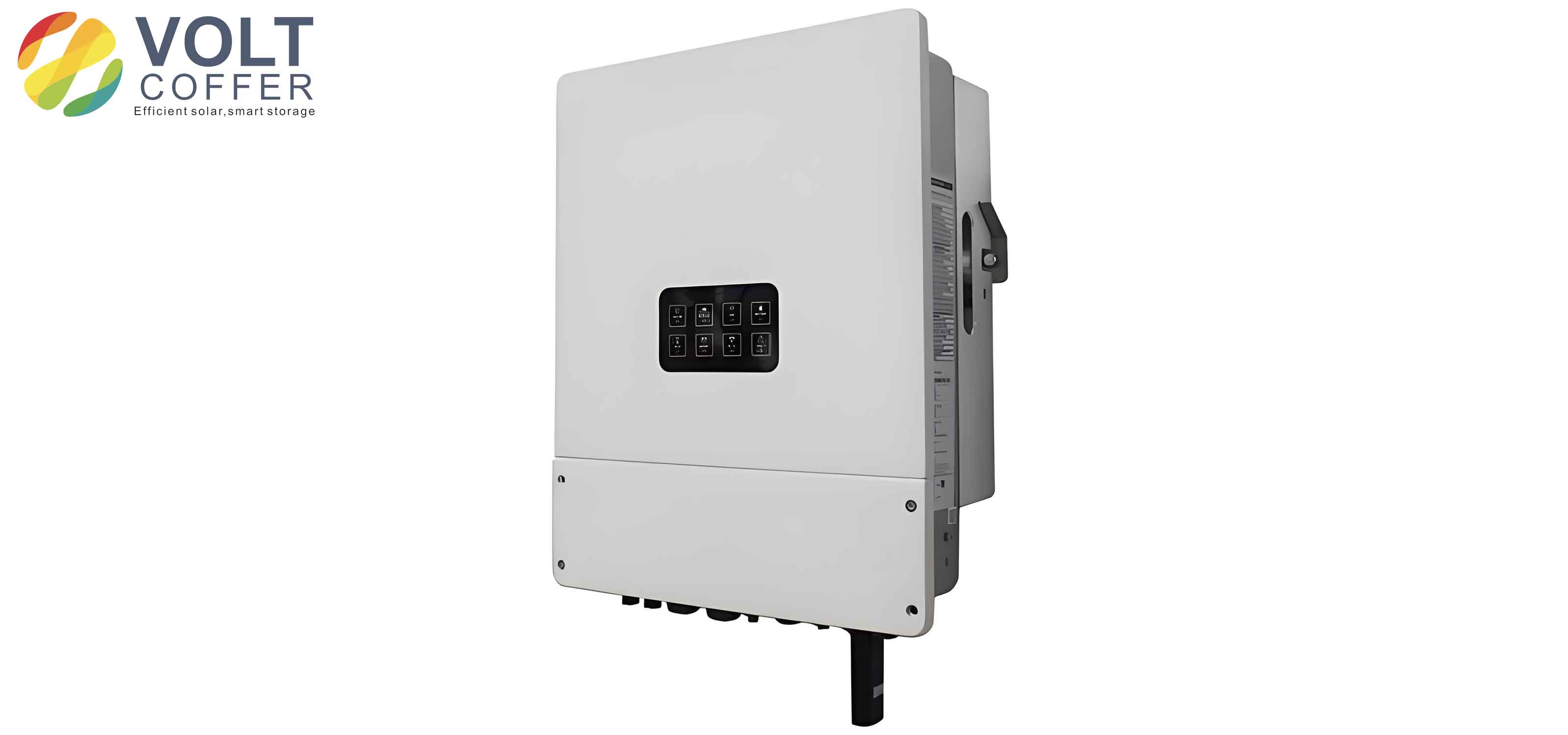
The operating modes of a three-phase inverter depend on the switching states of the IGBTs, which determine the output phase voltages. For a resistive load, the switching states and corresponding output voltages are summarized in Table 1. Each switching state corresponds to specific conduction patterns of the upper and lower switches in the inverter bridge, resulting in discrete voltage levels. In inductive load conditions, the switching states become more complex due to the freewheeling diodes, leading to additional modes as shown in Table 2. The switching sequence ensures that three switches are conducting at any given time, with a 120-degree phase shift between phases, producing a three-phase voltage waveform with reduced harmonic content.
| Switching Mode | VT1-VT6 States | \( u_a \) | \( u_b \) | \( u_c \) |
|---|---|---|---|---|
| t0 | 000000 | 0 | 0 | 0 |
| t1 | 100110 | 1/3 | -2/3 | 1/3 |
| t2 | 100101 | 2/3 | -1/3 | -1/3 |
| t3 | 101001 | 1/3 | 1/3 | -2/3 |
| t4 | 011001 | -1/3 | 2/3 | -1/3 |
| t5 | 011010 | -2/3 | 1/3 | 1/3 |
| t6 | 010110 | -1/3 | -1/3 | 2/3 |
| Switching Mode | VT1-VT6 States | D1-D6 States | \( u_a \) | \( u_b \) | \( u_c \) |
|---|---|---|---|---|---|
| t0 | 000010 | 100100 | -2/3 | 1/3 | 1/3 |
| t1 | 000110 | 100000 | -1/3 | -1/3 | 2/3 |
| t2 | 000100 | 100001 | -1/3 | -1/3 | 2/3 |
| t3 | 100100 | 000001 | 1/3 | -2/3 | 1/3 |
| t4 | 100000 | 001001 | 1/3 | -2/3 | 1/3 |
| t5 | 100001 | 001000 | 2/3 | -1/3 | -1/3 |
| t6 | 000001 | 011000 | 2/3 | -1/3 | -1/3 |
| t7 | 001001 | 010000 | 1/3 | 1/3 | -2/3 |
| t8 | 001000 | 010010 | 1/3 | 1/3 | -2/3 |
| t9 | 011000 | 000010 | -1/3 | 2/3 | -1/3 |
| t10 | 010000 | 000110 | -1/3 | 2/3 | -1/3 |
| t11 | 010010 | 000100 | -2/3 | 1/3 | 1/3 |
Filter design is critical for attenuating harmonics in the output of the three-phase inverter. The LCL filter is preferred over the L-type due to its superior high-frequency attenuation. The transfer functions for the L-type and LCL-type filters are given by:
$$ G_k(s) = \frac{i_{k2}(s)}{u_{k2}(s)} = \frac{1}{(L_1 + L_2)s} $$
$$ G_{kT}(s) = \frac{i_{k2}(s)}{u_{k2}(s)} = \frac{1}{L_1 L_2 C s^3 + (L_1 + L_2)s} $$
To design the filter parameters, the total inductance \( L = L_1 + L_2 \) must satisfy the following inequality to ensure proper operation and current ripple limitation:
$$ \frac{V_{dc}}{4\sqrt{3} \Delta I_{ripple} f_s} < L < \frac{\sqrt{\frac{V_{dc}^2}{3} – U_{Smax}^2}}{\omega I_{kmax}} $$
where \( V_{dc} \) is the DC input voltage, \( \Delta I_{ripple} \) is the maximum current ripple, \( f_s \) is the grid frequency, \( U_{Smax} \) is the peak grid phase voltage, and \( I_{kmax} \) is the peak inverter output current. The capacitance \( C \) is designed to limit reactive power to within 5% of the rated power:
$$ C = \frac{\lambda P}{3 \times 2\pi f_s U_{Smax}^2} $$
where \( \lambda \) is a proportionality factor (typically 0.05) and \( P \) is the rated power of the three-phase inverter.
For closed-loop control, the three-phase inverter employs a dual-loop strategy with voltage and current feedback. The state-space model in the dq frame reveals coupling between the d and q axes, which can be decoupled using feedforward terms. The decoupled outputs are:
$$ u_d = u_{1d} – \omega_s L_1 i_{1q} – (L_1 s + R_1) \omega_s C u_{cq} – (L_1 s^2 + R_1 s) \omega_s L_2 C i_{2q} $$
$$ u_q = u_{1q} + \omega_s L_1 i_{1d} + (L_1 s + R_1) \omega_s C u_{cd} + (L_1 s^2 + R_1 s) \omega_s L_2 C i_{2d} $$
Sine pulse width modulation (SPWM) is used to generate the switching signals for the three-phase inverter. In SPWM, a sinusoidal reference wave is compared with a triangular carrier wave to produce PWM pulses. The modulation index \( \delta = V_{dc}/2 \) determines the output voltage magnitude. For a three-phase inverter, SPWM can be implemented using unipolar or bipolar modulation, with unipolar offering better waveform symmetry.
The proposed PID plus feedforward control strategy enhances the robustness of the three-phase inverter by combining the dynamic regulation of PID with the predictive capability of feedforward control. The PID controller’s transfer function is:
$$ G_{PID}(s) = K_P + \frac{K_P}{T_I} \frac{1}{s} + K_P \tau s $$
where \( K_P \) is the proportional gain, \( T_I \) is the integral time constant, and \( \tau \) is the derivative time constant. The output of the PID controller in the time domain is:
$$ y(t) = K_P \sigma(t) + \frac{K_P}{T_I} \int_0^t \sigma(t) dt + K_P \tau \frac{d\sigma(t)}{dt} $$
In the dq frame, the PID gain at the grid frequency \( \omega_s \) is:
$$ K_{PID} = \sqrt{K_P^2 + \left( \frac{K_I}{\omega_s} \right)^2 + (K_D \omega_s)^2} $$
where \( K_I = K_P / T_I \) and \( K_D = K_P \tau \). The feedforward control introduces grid voltage and DC bus voltage disturbances into the control loop, allowing the system to anticipate and compensate for changes before they affect the output. This is particularly important for maintaining stability in the three-phase inverter under varying PV generation and grid conditions.
Parameter tuning for the PID controller is based on the linearized model of the three-phase inverter system. The overall closed-loop transfer function includes the PWM gain \( K_{PWM} = V_{dc}/2 \). The current loop ensures fast tracking of reference currents, while the voltage loop regulates the DC bus voltage. The control structure minimizes steady-state error and improves disturbance rejection.
To validate the control strategy, I conducted simulations using MATLAB Simulink for a 50 kW three-phase inverter system with parameters listed in Table 3. The system includes a PV array, DC bus capacitor, inverter bridge, LCL filter, and grid connection. The simulation model incorporates the PID plus feedforward control in the dq frame, with SPWM modulation at a switching frequency of 15 kHz.
| Parameter | Value |
|---|---|
| Rated Power \( P \) (kW) | 50 |
| Grid Phase Voltage \( U_S \) (V) | 480 |
| Grid Phase Current \( I_S \) (A) | 35 |
| Grid Frequency \( f_s \) (Hz) | 60 |
| PV Array Output Voltage \( V_{dc} \) (V) | 900 |
| Switching Frequency \( f_{sw} \) (kHz) | 15 |
| Sampling Frequency \( f_c \) (kHz) | 15 |
| Inverter Side Inductance \( L_1 \) (μH) | 800 |
| Grid Side Inductance \( L_2 \) (μH) | 800 |
| Filter Capacitance \( C \) (μF) | 30 |
| Transformer Turns Ratio \( N_1/N_2 \) | 4/5 |
In the simulation, a disturbance was applied at 0.1 s by increasing the DC bus voltage, lasting for 0.02 s. The response of the three-phase inverter showed that the control strategy achieved disturbance rejection within 0.04 s, with the DC voltage and output power returning to steady state quickly. The output phase voltage and current remained synchronized, demonstrating the effectiveness of the PID plus feedforward approach. The modulation index adjusted promptly to compensate for the disturbance, as seen in the simulation results.
Harmonic analysis was performed on the inverter output voltage and current. The total harmonic distortion (THD) of the inverter bridge output voltage was initially high at 83.26%, but after filtering, the THD of the inverter output voltage reduced to 0.86%. The three-phase voltages and currents exhibited low distortion, meeting grid standards. Additionally, the impact of dead time on THD was investigated, as summarized in Table 4. Reducing dead time below 1 μs resulted in THD below 1%, but practical considerations such as switch protection must be balanced.
| Dead Time (μs) | THD (%) | 5th Harmonic (%) | 7th Harmonic (%) | 11th Harmonic (%) | 15 kHz ± 60e Hz (%) | Modulation Index |
|---|---|---|---|---|---|---|
| 0 | 0.75 | 0.03 | 0.03 | 0.02 | 0.42 | 0.87 |
| 1 | 0.85 | 0.29 | 0.20 | 0.10 | 0.44 | 0.91 |
| 2 | 1.09 | 0.57 | 0.37 | 0.23 | 0.45 | 0.95 |
| 3 | 1.41 | 0.86 | 0.55 | 0.36 | 0.47 | 0.98 |
In conclusion, the PID plus feedforward control strategy significantly enhances the robustness and performance of the three-phase inverter in grid-connected PV systems. The combination of PID control for dynamic regulation and feedforward control for disturbance prediction ensures fast response and stability under various operating conditions. The design of the LCL filter and careful parameter tuning further improve harmonic suppression. Simulation results confirm that this approach achieves low THD, rapid disturbance rejection, and synchronized output, making it suitable for practical applications. Future work could focus on optimizing the control parameters for larger-scale systems and integrating advanced monitoring techniques for real-time adaptation.