
In recent years, the adoption of renewable energy solutions has become increasingly critical for agricultural sustainability, particularly in remote regions where conventional energy infrastructure is lacking. As a researcher focused on irrigation and water management, I have been investigating the application of solar photovoltaic (PV) systems for water lifting in sugarcane-producing areas. This study delves into the performance of a solar system designed to address energy challenges in these regions, with a focus on understanding the interplay between solar radiation, power generation, and water extraction. The solar system, comprising PV panels, inverters, and pumps, offers a viable alternative to grid electricity, especially in dispersed farmland where line extension is costly. Through field experiments and data analysis, this research aims to provide insights into optimizing solar system deployment for irrigation, ultimately supporting crop productivity and resource efficiency.
The motivation for this work stems from the observation that sugarcane cultivation in Guangxi, a major producing region, often faces water scarcity due to uneven rainfall distribution. Traditional pumping methods rely on diesel or grid power, which are either expensive or inaccessible in remote plots. A solar system, harnessing abundant sunlight, presents an eco-friendly and cost-effective solution. In this study, I established a test zone to monitor the solar system’s performance over time, collecting data on solar irradiance, electricity output, and water delivery. By analyzing these parameters, I seek to establish predictive models and operational guidelines for solar system implementation in similar agricultural contexts.
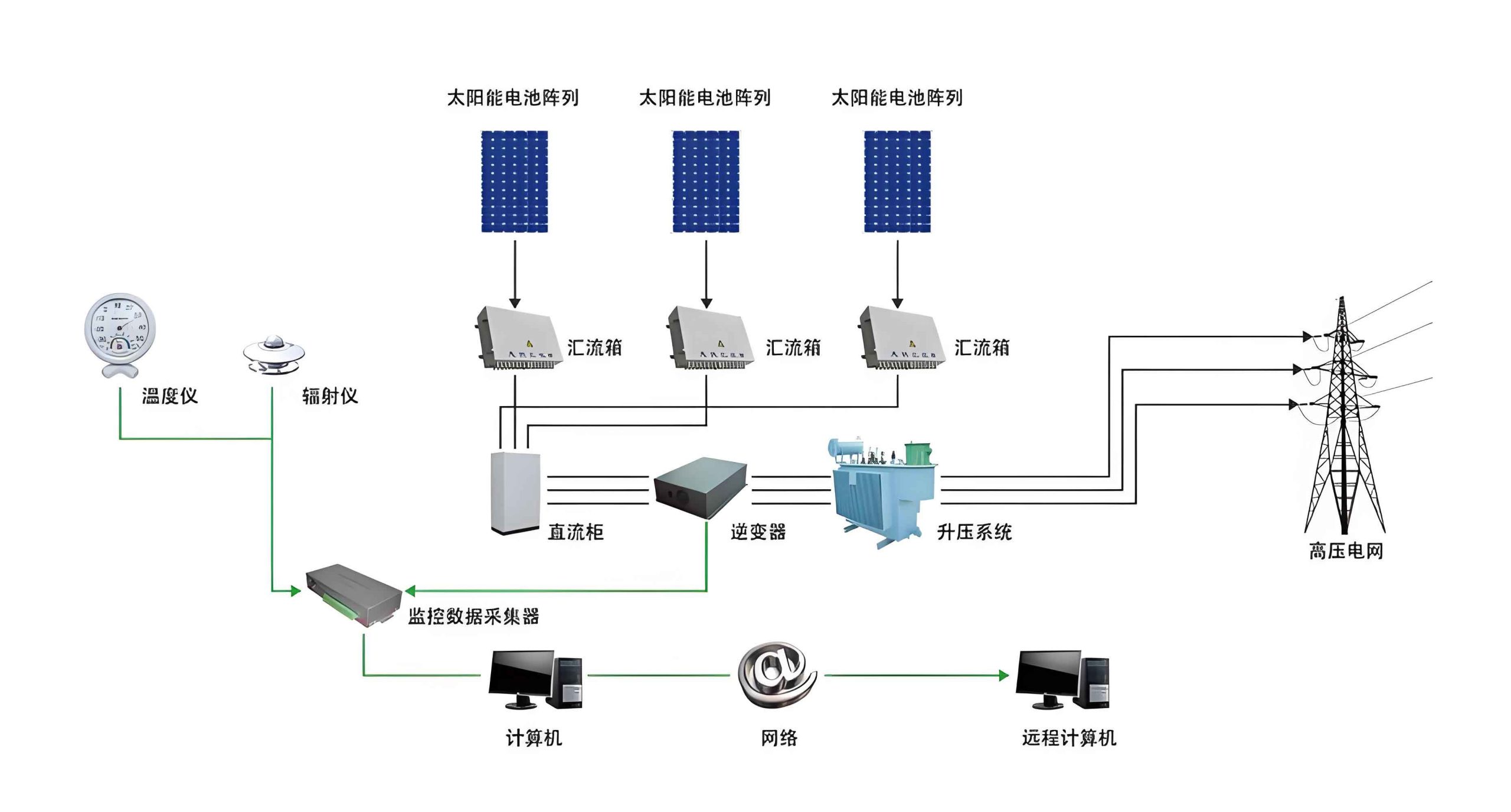
The core of this investigation revolves around the solar system’s components and their integration. The system includes 72 PV panels, each rated at 250 W, resulting in a total capacity of 18 kW. These panels are connected to a combiner box and inverters that convert DC power to AC, driving two submersible pumps: a smaller pump with a flow rate of 10 m³/h and a head of 50 m (3 kW power), and a larger pump with a flow rate of 50 m³/h and a head of 52 m (11 kW power). Water meters are installed to record extraction volumes in real-time. This setup allows for a comprehensive assessment of how the solar system responds to varying solar conditions, influencing both energy production and irrigation output.
To quantify the solar system’s efficiency, I employed a methodological framework based on continuous monitoring. Solar irradiance data were gathered using pyranometers, while power generation was logged from the inverters. Water extraction was measured via flow meters, enabling a correlation analysis between these variables. The study period spanned a full year, capturing seasonal variations. I focused on clear days to isolate the solar system’s performance under optimal conditions, though cloudy days were also considered for robustness. Mathematical models were developed to express relationships, such as the dependence of water output on available solar energy. For instance, the power generated by the solar system can be expressed as:
$$ P_{gen} = \eta_{pv} \cdot A_{pv} \cdot G $$
where \( P_{gen} \) is the power generated (in kW), \( \eta_{pv} \) is the PV panel efficiency (typically around 15-20%), \( A_{pv} \) is the total panel area (in m²), and \( G \) is the solar irradiance (in kW/m²). This formula underpins the solar system’s energy conversion process, directly impacting water pumping capacity.
The analysis begins with an examination of solar radiation patterns throughout the year. In the test area, the total annual solar radiation was measured at 5371.22 MJ/m², with significant monthly fluctuations. The data reveal that solar radiation peaks in the summer and autumn months, while diminishing in winter and spring. This seasonal trend aligns with general climatic patterns in subtropical regions, where longer daylight hours and higher sun angles enhance irradiance. To illustrate, I have compiled the monthly solar radiation values in Table 1, highlighting the distribution that governs the solar system’s input energy.
| Month | Solar Radiation (MJ/m²) | Percentage of Annual Total (%) |
|---|---|---|
| January | 312.45 | 5.82 |
| February | 298.67 | 5.56 |
| March | 345.89 | 6.44 |
| April | 402.33 | 7.49 |
| May | 485.76 | 9.04 |
| June | 520.18 | 9.68 |
| July | 610.24 | 11.36 |
| August | 655.91 | 12.21 |
| September | 670.38 | 12.48 |
| October | 625.47 | 11.64 |
| November | 380.15 | 7.08 |
| December | 271.67 | 5.06 |
| Total | 5371.22 | 100.00 |
This radiation profile is crucial for the solar system, as it dictates the available energy for pumping. I observed that September had the highest radiation (670.38 MJ/m²), while December had the lowest (271.67 MJ/m²). Such variations necessitate adaptive management of the solar system, such as adjusting pump operation schedules to match energy availability. The solar system’s design must account for these peaks and troughs to ensure reliable water supply.
Next, I explored the relationship between solar radiation, power generation, and water extraction. On clear days, the solar system exhibited a predictable pattern: as solar irradiance increased from morning to noon, so did the electricity output and subsequent water flow. The maximum daily water extraction rate averaged 25.58 m³/h under full solar exposure. A detailed hourly analysis shows that water pumping commenced around 7:00 AM, reached one-third of peak capacity by 9:00 AM, peaked at 13:00 PM, and then declined until cessation around 16:00 PM. This operational window of approximately 8 hours is typical for solar systems reliant on direct sunlight. The correlation can be mathematically represented as:
$$ Q_{water} = k \cdot P_{gen} = k \cdot (\eta_{pv} \cdot A_{pv} \cdot G) $$
where \( Q_{water} \) is the water extraction rate (in m³/h), and \( k \) is a coefficient encompassing pump efficiency and hydraulic factors. For the solar system in this study, \( k \) was empirically derived from field data. The linear dependence underscores how the solar system’s performance is intrinsically linked to irradiance levels.
To further elucidate, I present Table 2, which summarizes the average daily water extraction on clear days across seasons. The data confirm that autumn and summer yield higher water volumes due to greater solar radiation, emphasizing the solar system’s seasonal efficiency.
| Season | Solar Radiation (MJ/m²/day) | Power Generation (kWh/day) | Water Extraction (m³/day) |
|---|---|---|---|
| Spring | 15.42 | 48.5 | 136.60 |
| Summer | 20.87 | 78.9 | 235.99 |
| Autumn | 21.35 | 82.1 | 240.83 |
| Winter | 14.65 | 44.3 | 131.98 |
The solar system’s annual water extraction potential was calculated based on continuous monitoring. With the 18 kW solar array, the total water lifted over the year amounted to 37,303 m³. Monthly breakdowns, as shown in Table 3, indicate that September produced the highest extraction (6,857 m³), while December was the lowest (1,203 m³). This variability mirrors the solar radiation trend, reinforcing the solar system’s dependency on climatic conditions. Notably, the water output per kilowatt of installed solar capacity was derived as 2,072 m³ per year, a metric useful for scaling the solar system to other sites.
| Month | Water Extraction (m³) | Extraction per kW (m³/kW) |
|---|---|---|
| January | 1,440 | 80 |
| February | 1,332 | 74 |
| March | 1,116 | 62 |
| April | 1,710 | 95 |
| May | 1,854 | 103 |
| June | 3,132 | 174 |
| July | 4,356 | 242 |
| August | 4,842 | 269 |
| September | 6,858 | 381 |
| October | 5,886 | 327 |
| November | 3,708 | 206 |
| December | 1,080 | 60 |
| Total | 37,303 | 2,072 |
A critical aspect of this research is aligning the solar system’s output with crop water requirements. Sugarcane, as a high-water-demand crop, exhibits seasonal needs that peak during growth stages. I compared the solar system’s water extraction data with estimated sugarcane evapotranspiration (ET) values, derived from climatic models. The coupling, illustrated in Table 4, shows a strong synchrony: both water availability from the solar system and crop demand are highest in late summer and autumn. This congruence validates the solar system’s suitability for irrigation timing, as it naturally supplies more water when crops need it most, reducing the need for energy storage or supplemental sources.
| Month | Water Extraction from Solar System (m³) | Sugarcane Water Requirement (m³, based on ET) | Deficit/Surplus (m³) |
|---|---|---|---|
| January | 1,440 | 1,200 | +240 |
| February | 1,332 | 1,300 | +32 |
| March | 1,116 | 1,500 | -384 |
| April | 1,710 | 1,800 | -90 |
| May | 1,854 | 2,000 | -146 |
| June | 3,132 | 2,500 | +632 |
| July | 4,356 | 3,000 | +1,356 |
| August | 4,842 | 3,200 | +1,642 |
| September | 6,858 | 3,500 | +3,358 |
| October | 5,886 | 3,000 | +2,886 |
| November | 3,708 | 2,000 | +1,708 |
| December | 1,080 | 1,500 | -420 |
The solar system’s performance can be optimized through technical adjustments. For instance, incorporating maximum power point tracking (MPPT) in inverters enhances energy harvest from the PV panels, especially under partial shading or varying irradiance. Additionally, pump selection plays a role: the dual-pump setup in this solar system allowed flexibility, with the smaller pump operating during low-radiation periods and the larger one during peaks. I derived an efficiency metric for the solar system as a whole, defined as:
$$ \eta_{system} = \frac{E_{water}}{E_{solar}} $$
where \( E_{water} \) is the hydraulic energy delivered (in Joules), calculated as \( \rho g h Q \), with \( \rho \) being water density, \( g \) gravitational acceleration, \( h \) pumping head, and \( Q \) water volume; and \( E_{solar} \) is the solar energy incident on the panels (in Joules). For this solar system, \( \eta_{system} \) averaged around 4-5%, which is typical for such applications but leaves room for improvement through better component matching.
Economic considerations are paramount for widespread adoption of the solar system. I conducted a simplified cost-benefit analysis, comparing the solar system’s capital and maintenance costs against diesel-powered alternatives. The solar system, though initially more expensive due to PV panels and inverters, offers lower operating costs and zero fuel expenses. Over a 20-year lifespan, the levelized cost of water (LCOW) for the solar system can be expressed as:
$$ LCOW = \frac{C_{capex} + \sum_{t=1}^{T} \frac{C_{opex,t}}{(1+r)^t}}{\sum_{t=1}^{T} \frac{Q_{t}}{(1+r)^t}} $$
where \( C_{capex} \) is capital expenditure, \( C_{opex,t} \) is annual operational expenditure in year \( t \), \( Q_{t} \) is annual water extraction, \( r \) is discount rate, and \( T \) is system lifetime. Preliminary calculations suggest the solar system becomes cost-competitive within 5-7 years, making it an attractive investment for farmers in off-grid areas.
Environmental impacts further bolster the case for the solar system. By displacing fossil fuels, the solar system reduces greenhouse gas emissions and air pollution. I estimated the carbon savings using emission factors for diesel generation: each kilowatt-hour from the solar system avoids approximately 0.8 kg of CO₂. Given the annual energy output of this solar system (around 12,000 kWh), the mitigation amounts to 9.6 tonnes of CO₂ per year. This aligns with global sustainability goals, positioning the solar system as a green technology for agriculture.
Despite its advantages, the solar system faces challenges such as intermittency and weather dependence. To address this, I explored integration with energy storage (batteries) or hybrid systems combining solar with wind or biomass. However, for irrigation purposes, water storage in tanks or ponds often proves more economical than electrical storage, smoothing supply over cloudy days. The solar system’s design should thus include reservoirs to buffer variability, ensuring continuous irrigation even when sunlight is scarce.
In terms of scalability, the findings from this solar system are applicable to other sugarcane regions with similar solar resources. By adjusting parameters like panel tilt angle or pump size, the solar system can be tailored to local conditions. I developed a generic formula for sizing a solar system based on water demand:
$$ P_{pv} = \frac{\rho g h Q_{daily}}{\eta_{pump} \cdot \eta_{inv} \cdot H_{sun} \cdot \eta_{pv}} $$
where \( P_{pv} \) is required PV power (in kW), \( Q_{daily} \) is daily water need (in m³), \( \eta_{pump} \) and \( \eta_{inv} \) are pump and inverter efficiencies, \( H_{sun} \) is average daily sun hours, and \( \eta_{pv} \) is PV efficiency. This equation helps planners design a solar system that meets specific irrigation targets, promoting replication across diverse farms.
Looking ahead, advancements in solar technology could enhance the solar system’s performance. Higher-efficiency PV panels, smart controllers, and IoT-based monitoring can optimize energy use and predictive maintenance. I envision a future where solar systems are interconnected via cloud platforms, allowing remote management and data analytics. Such innovations will make the solar system more resilient and user-friendly, accelerating adoption in agriculture.
In conclusion, this study demonstrates the viability of solar photovoltaic systems for water lifting in sugarcane-producing areas. The solar system effectively harnesses solar radiation to generate electricity and pump water, with output patterns matching crop water requirements. Key findings include the annual water extraction capacity of 37,303 m³ for an 18 kW solar system, seasonal variations in performance, and strong coupling between solar availability and irrigation needs. The solar system offers economic and environmental benefits, though challenges like intermittency require careful planning. By leveraging formulas and data-driven insights, stakeholders can deploy solar systems tailored to local conditions, fostering sustainable irrigation. Future work should focus on integrating storage solutions and improving system efficiency to maximize the solar system’s impact on agricultural water security.