
As an engineer specializing in renewable energy systems, I have spent considerable time exploring the intricacies of photovoltaic (PV) inverters, particularly those used in off-grid applications. The growing demand for clean and sustainable energy sources has made solar power an attractive option, and inverters play a pivotal role in converting the direct current (DC) generated by solar panels into alternating current (AC) for everyday use. In this article, I will delve into the analysis, design, and considerations for off-grid photovoltaic inverters, emphasizing the various types of solar inverter configurations that enhance system efficiency. My goal is to provide a comprehensive guide that incorporates practical insights, mathematical models, and comparative tables to aid in understanding these complex systems. Throughout, I will reference key concepts such as the types of solar inverter topologies, including off-grid, on-grid, and hybrid systems, to highlight their distinct advantages and applications.
Off-grid photovoltaic systems are essential for remote locations or areas without reliable grid access, and they typically consist of solar panels, batteries, inverters, and controllers. The heart of these systems is the inverter, which must efficiently manage energy conversion while ensuring reliability. I will start by examining the fundamental structure of off-grid PV systems and then move on to the detailed design of inverter circuits, including DC/DC and DC/AC stages. Along the way, I will incorporate formulas to explain voltage transformations and control strategies, as well as tables to summarize component selections and performance metrics. By sharing my experiences and research, I aim to offer valuable insights for designing robust and efficient off-grid inverters.
To begin, let’s consider the basic architecture of an off-grid PV system. It comprises a solar array that captures sunlight and converts it to DC electricity, a battery bank for energy storage, an inverter to convert DC to AC, and a controller to regulate the entire process. Unlike grid-tied systems, off-grid setups operate independently, making the inverter’s role even more critical. In my work, I have found that understanding the types of solar inverter topologies—such as transformerless, low-frequency transformer, and high-frequency transformer designs—is crucial for optimizing performance. For instance, transformerless inverters are compact and lightweight, ideal for small-scale applications, while those with transformers offer better isolation and efficiency in larger systems. The following table summarizes the key characteristics of these types of solar inverter configurations:
| Inverter Type | Advantages | Disadvantages | Typical Applications |
|---|---|---|---|
| Transformerless | Lightweight, high efficiency, compact size | Limited isolation, potential for DC injection | Residential rooftops, portable systems |
| Low-Frequency Transformer | Robust isolation, reliable operation | Bulky, lower efficiency, higher cost | Industrial setups, off-grid cabins |
| High-Frequency Transformer | Balanced efficiency and size, good isolation | Complex design, more components | Hybrid systems, medium-power applications |
In my designs, I often opt for a two-stage inverter topology for off-grid systems, as it allows for precise control over both voltage boosting and inversion. The first stage involves a DC/DC converter that steps up the battery voltage (e.g., from 12V or 24V) to a higher DC level, typically around 320V, using a push-pull configuration. This is followed by a DC/AC inverter stage that produces a 220V/50Hz AC output. The efficiency of this process can be modeled using power conversion formulas. For example, the output voltage of a boost converter in the DC/DC stage can be expressed as:
$$ V_{out} = \frac{V_{in}}{1 – D} $$
where \( D \) is the duty cycle of the pulse-width modulation (PWM) signal. By adjusting \( D \), I can implement maximum power point tracking (MPPT) to optimize the solar array’s output. This is particularly important in off-grid systems, where energy harvest must be maximized. The relationship between input and output power can be further analyzed using efficiency equations, such as:
$$ \eta = \frac{P_{out}}{P_{in}} \times 100\% $$
where \( \eta \) represents the efficiency, \( P_{out} \) is the output power, and \( P_{in} \) is the input power. In practice, I aim for efficiencies above 85% to minimize energy losses.
Moving to the DC/AC inversion stage, I prefer a full-bridge topology driven by sinusoidal PWM (SPWM) signals. This approach generates a quasi-sine wave that is suitable for most household loads. The SPWM generation involves comparing a high-frequency carrier wave with a low-frequency sinusoidal reference, and the modulation index \( m_a \) can be defined as:
$$ m_a = \frac{A_m}{A_c} $$
where \( A_m \) is the amplitude of the modulating signal and \( A_c \) is the amplitude of the carrier signal. To filter out high-frequency components and produce a clean AC waveform, I use an LC filter with inductance \( L \) and capacitance \( C \). The cutoff frequency \( f_c \) of this filter is given by:
$$ f_c = \frac{1}{2\pi\sqrt{LC}} $$
For a standard 50Hz output, I typically design the filter to have a cutoff frequency around 100-200Hz to attenuate harmonics effectively. The values of \( L \) and \( C \) can be derived from the load impedance \( R_L \) using empirical formulas:
$$ L = \frac{R}{2\pi f_0} $$
$$ C = \frac{1}{2\pi f_0 R} $$
where \( R \approx 0.5 R_L \) and \( f_0 \) is the desired cutoff frequency. In my projects, I often select \( L \) around 0.7mH and \( C \) around 5μF for a 500W system, which I will discuss later.
Battery management is another critical aspect of off-grid inverters, as it directly impacts system longevity and reliability. I implement a multi-stage charging strategy using a microcontroller, such as an STC series chip, which monitors voltage, current, and temperature. The charging process includes constant current, constant voltage, and float stages to prevent overcharging and extend battery life. The control algorithm can be summarized in a flowchart-like table for clarity:
| Charging Stage | Action | Parameters Monitored |
|---|---|---|
| Constant Current | Charge at fixed current until voltage threshold | Battery voltage, current |
| Constant Voltage | Maintain voltage until current drops | Voltage, current drop |
| Float | Apply trickle charge to compensate for self-discharge | Voltage, temperature |
In terms of hardware design, I focus on selecting components that balance cost, efficiency, and durability. For the DC/DC stage, I use MOSFETs in a push-pull arrangement driven by a PWM controller like TL494. This setup allows for high-frequency operation, reducing transformer size and improving efficiency. The transformer turns ratio is calculated based on the input and output voltages. For example, if the input is 24V and the desired output is 320V, the turns ratio \( n \) can be estimated as:
$$ n = \frac{V_{out}}{V_{in}} \times \frac{1}{D_{max}} $$
where \( D_{max} \) is the maximum duty cycle, typically around 0.9 to avoid saturation. After rectification and filtering, the high-voltage DC is fed to the DC/AC stage, which employs an H-bridge of IGBTs or MOSFETs driven by SPWM signals from the microcontroller. The driver circuit, often based on IR2110 chips, ensures proper switching and isolation.
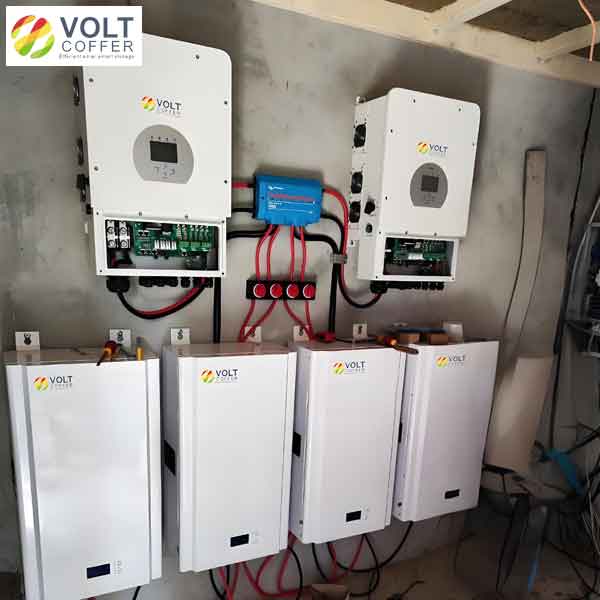
In one of my recent projects, I developed a 500W off-grid inverter prototype based on the STC15W4K32S4 microcontroller. This device features enhanced PWM capabilities and ADC channels, making it ideal for real-time control and monitoring. The inverter achieved an efficiency of over 87.5% under full load, with a total harmonic distortion (THD) below 3.24%. The output voltage remained stable at 220V ±2.6%, and the frequency error was within ±0.5Hz. These results demonstrate the effectiveness of the two-stage design and careful component selection. To further illustrate the performance, I have compiled a table of key metrics from laboratory tests:
| Parameter | Measured Value | Standard Requirement |
|---|---|---|
| Output Power | 500W | Rated power |
| Efficiency | 87.5% – 90% | >85% |
| THD | <3.24% | <5% |
| Output Voltage | 220V ±2.6% | 220V ±5% |
| Output Frequency | 50Hz ±0.5Hz | 50Hz ±1Hz |
When considering the broader landscape of solar energy systems, it is essential to recognize the diversity in types of solar inverter technologies. Off-grid inverters, as I have described, are just one category; on-grid inverters synchronize with the utility grid and often require anti-islanding protection, while hybrid inverters combine features of both, allowing for battery backup and grid interaction. Each of these types of solar inverter serves specific needs, and selecting the right one depends on factors like location, load requirements, and regulatory constraints. In my experience, off-grid inverters are particularly valuable for rural electrification, emergency power, and mobile applications, where reliability and simplicity are paramount.
To enhance the design process, I often use simulation tools to model inverter behavior before hardware implementation. For instance, the dynamics of the DC/DC boost stage can be analyzed using state-space averaging techniques. The average output voltage in continuous conduction mode is given by the earlier formula, but accounting for losses, the actual efficiency can be modeled as:
$$ \eta_{boost} = \frac{V_{out} I_{out}}{V_{in} I_{in}} $$
where \( I_{in} \) and \( I_{out} \) are the input and output currents, respectively. Similarly, for the DC/AC stage, the output voltage waveform can be expressed in terms of Fourier series to analyze harmonic content:
$$ v_{ac}(t) = \sum_{n=1}^{\infty} V_n \sin(n\omega t + \phi_n) $$
where \( V_n \) is the amplitude of the nth harmonic, \( \omega \) is the angular frequency, and \( \phi_n \) is the phase angle. By minimizing higher-order harmonics through proper filtering, I can achieve a cleaner output that meets international standards.
In conclusion, designing off-grid photovoltaic inverters requires a deep understanding of power electronics, control systems, and energy storage. Through my work, I have found that a two-stage topology with meticulous component selection and microcontroller-based control yields excellent results. The various types of solar inverter designs each have their place, but for off-grid applications, simplicity and efficiency are key. As solar technology advances, I believe that innovations in semiconductor devices and digital control will further improve inverter performance, making renewable energy more accessible. I hope this detailed analysis and design approach provides a useful reference for engineers and enthusiasts alike, encouraging the adoption of sustainable energy solutions worldwide.