
In the realm of renewable energy systems, photovoltaic (PV) power generation has emerged as a pivotal technology due to its sustainability and minimal environmental impact. As a researcher focused on power electronics, I have dedicated efforts to enhancing the efficiency and reliability of solar inverters, which are crucial components in converting DC power from PV panels to AC power for grid integration. Traditional single-stage inverters often require multiple PV panels connected in series to achieve sufficient DC input voltage for standard AC output, but this approach leads to issues like shading effects and reduced power generation efficiency. Moreover, conventional non-isolated full-bridge solar inverters are prone to leakage currents, compromising system safety. To address these challenges, I propose an integrated single-phase single-stage boost solar inverter topology that not only elevates AC output voltage above DC input but also effectively suppresses leakage currents. This design avoids bridge-arm shoot-through problems, thereby improving system reliability. In this article, I will delve into the working principles, modulation strategies, steady-state characteristics, and parameter design of this innovative solar inverter, supported by analytical formulas and comparative tables.
The proliferation of solar energy systems has necessitated advancements in inverter technology, particularly for low-voltage applications. Solar inverters must efficiently convert DC power from PV sources to AC power while maintaining high gain, low leakage current, and compact design. Non-isolated solar inverters are favored for their cost-effectiveness and high efficiency, but they often struggle with leakage currents due to varying common-mode voltages. My research focuses on developing a topology that integrates boost and inversion functions into a single stage, reducing component count and enhancing performance. The proposed solar inverter utilizes a symmetric structure with inductors, diodes, and switches to achieve voltage step-up and inversion simultaneously. This approach minimizes the need for series-connected PV panels, mitigating shading issues and improving overall system robustness. Throughout this discussion, I will emphasize the role of solar inverters in modern energy systems and how my design contributes to their evolution.
The core of my proposed solar inverter topology is illustrated in the following description. It consists of a PV input source, four inductors (Lb1, Lb2, L1, L2), four diodes (Db1, Db2, D1, D2), four power switches (S1, S2, S3, S4), a storage capacitor C, and a filter network connected to the load. The inductors Lb1 and Lb2 serve as boost inductors, transferring energy from the PV source to the capacitor C, which then supplies the load. Inductors L1 and L2 function as clamping and filtering components, reducing the size and cost of additional filter elements. All components are assumed ideal for analytical simplicity, neglecting losses and parasitic parameters. This configuration enables the solar inverter to achieve a higher AC output voltage than the DC input, addressing the limitations of traditional designs. The topology’s symmetry simplifies control and enhances reliability, making it suitable for various solar applications.
To understand the operation of this solar inverter, I developed a hybrid modulation strategy based on unipolar sinusoidal pulse width modulation (SPWM). In this strategy, switches S2 and S3 operate during the positive half-cycle of the output, while S1 and S4 operate during the negative half-cycle. Specifically, during the positive half-cycle, S3 remains continuously on, and S2 switches at high frequency; during the negative half-cycle, S4 remains on, and S1 switches at high frequency. This approach reduces switching losses compared to uniform SPWM, improving the efficiency of the solar inverter. The modulation waveforms involve a triangular carrier wave at 20 kHz and a sinusoidal reference wave at 50 Hz, ensuring precise control over the output. The working modes can be categorized into discontinuous conduction mode (DCM) and a mixed mode (DCD), each affecting the inductor currents and voltage gain. For instance, in DCM, the boost inductors experience current zero-crossings, while in DCD, they operate in a combination of discontinuous and continuous conduction, optimizing performance for different load conditions.
The mathematical analysis of the solar inverter’s voltage gain is crucial for design. In DCM, the voltage gain GDCM is derived from the inductor current dynamics and power balance. Assuming ideal components, the input power equals the output power: UinILb2 = Uo2/R, where Uin is the DC input voltage, Uo is the AC output voltage, and R is the load resistance. Using volt-second balance on the boost inductor Lb2, the gain can be expressed as:
$$G_{\text{DCM}} = \frac{U_o}{U_{\text{in}}} = \sqrt{1 + \sqrt{1 + \frac{m^2 R}{4 L_{\text{b2}} f_s}}}$$
Here, m is the modulation index, Lb2 is the inductance, and fs is the switching frequency. For the DCD mode, the gain simplifies to:
$$G_{\text{DCD}} = \frac{m}{1 – m}$$
This indicates that the solar inverter can achieve a gain greater than 1 for m > 0.5, with typical values ranging from 1.5 to 4 for m between 0.6 and 0.8. These formulas guide the selection of parameters to meet specific voltage requirements in solar applications. To illustrate the relationship between gain, load, and modulation, I present a summary table and a 3D surface plot in textual form, emphasizing how variations impact performance.
| Parameter | DCM Mode Gain | DCD Mode Gain |
|---|---|---|
| Modulation Index (m) | Non-linear increase with m | Linear increase with m |
| Load Resistance (R) | Increases with R | Independent of R |
| Inductance (Lb) | Decreases with Lb | Independent of Lb |
The design of boost inductors is critical for optimizing the solar inverter’s performance. Based on the boundary condition between DCM and DCD modes, the maximum inductance Lb_max to ensure proper operation is given by:
$$L_{\text{b_max}} = \frac{m U_{\text{in}}^2}{2 P_o f_s}$$
where Po is the output power. Selecting inductors below this value ensures adequate voltage gain and fast dynamic response, though smaller inductances may increase voltage ripple on the capacitor. For the proposed solar inverter, typical values are in the range of 0.08 mH to 0.15 mH for a 250 W system with 20 kHz switching. Additionally, the voltage and current stresses on components must be considered to ensure reliability. The maximum voltage stresses are:
$$U_{\text{S1_max}} = U_{\text{S2_max}} = U_C, \quad U_{\text{S3_max}} = U_{\text{S4_max}} = U_g, \quad U_{\text{D1_max}} = U_{\text{D2_max}} = U_C, \quad U_{\text{Db1_max}} = U_{\text{Db2_max}} = U_C – U_{\text{in}}$$
where UC is the capacitor voltage and Ug is the grid voltage. Current stresses relate to the inductor and output currents, with peak values dependent on the operating mode. These calculations aid in selecting appropriate semiconductor devices for the solar inverter.
Loss analysis is essential for evaluating the efficiency of solar inverters. The total losses comprise switching losses, conduction losses, diode losses, and inductor losses. For switches, the losses include turn-on, turn-off, and on-state components. For example, the switching loss per cycle for a switch can be approximated as:
$$P_{\text{sw}} = \frac{1}{2} U_{\text{in}} I_{\text{peak}} (t_{\text{on}} + t_{\text{off}}) f_s$$
where Ipeak is the peak current, and ton and toff are the switching times. Diode losses account for forward voltage drop and reverse recovery. Inductor losses include copper losses from winding resistance and core losses from hysteresis and eddy currents. The efficiency η of the solar inverter is calculated as:
$$\eta = \frac{P_o}{P_o + P_{\text{loss}}} \times 100\%$$
In my experiments, the proposed solar inverter achieved efficiencies up to 96.1% in DCD mode, demonstrating its suitability for practical applications. The table below compares loss distributions for different operating modes.
| Loss Component | DCM Mode (250 W) | DCD Mode (250 W) |
|---|---|---|
| Switch Losses | Approx. 8 W | Approx. 6 W |
| Diode Losses | Approx. 5 W | Approx. 4 W |
| Inductor Losses | Approx. 3 W | Approx. 2 W |
| Capacitor Losses | Approx. 1 W | Approx. 1 W |
Leakage current suppression is a vital feature for non-isolated solar inverters, as it enhances safety by reducing ground currents. In my design, the common-mode voltage UCM is stabilized through the symmetric structure and modulation strategy. For the positive half-cycle, the common-mode voltage is expressed as:
$$U_{\text{CM}} = \frac{U_{AN} + U_{BN}}{2} = U_C – \frac{U_{\text{CS4}}}{2}$$
where UAN and UBN are node voltages, and UCS4 is the voltage across switch S4‘s parasitic capacitance. Since S3 and S4 operate at line frequency, their parasitic capacitances do not experience high-frequency variations, effectively limiting leakage current to below 30 mA, as per safety standards. This makes the solar inverter compliant with grid-connection requirements and reliable for long-term use.
To contextualize my proposed solar inverter, I compare it with existing topologies in the literature. The table below highlights key parameters such as component count, leakage current performance, voltage gain, and efficiency. This comparison underscores the advantages of my design in terms of simplicity, gain capability, and safety.
| Inverter Type | Switches | Diodes | Leakage Current | Gain | Efficiency |
|---|---|---|---|---|---|
| H5 Topology | 5 | 0 | Small | <1 | 98.0% |
| H6 Topology | 6 | 0 | Small | <1 | 96.7% |
| HERIC Topology | 6 | 1 | Small | <1 | 97.2% |
| Proposed Solar Inverter | 4 | 4 | Small | >1 | 96.1% |
My solar inverter uses fewer switches while providing boost functionality, which reduces cost and control complexity. Unlike traditional full-bridge solar inverters, it avoids shoot-through risks, eliminating the need for dead-time insertion and improving output waveform quality. These features make it competitive for low-voltage PV systems, where efficiency and reliability are paramount.
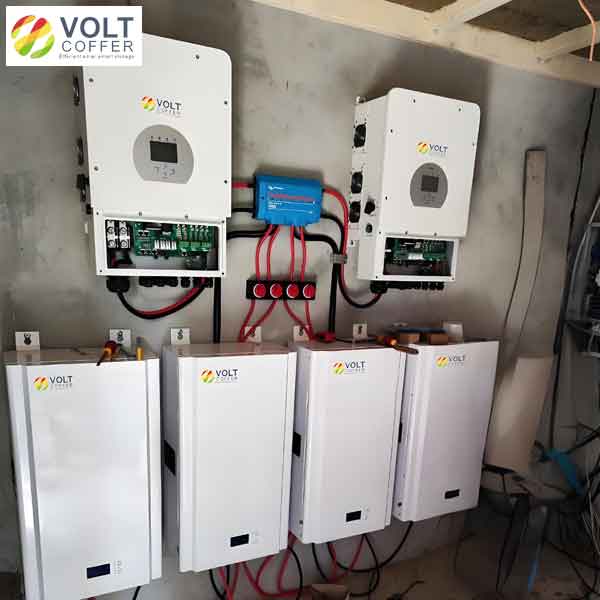
Experimental validation was conducted on a 250 W prototype to verify the theoretical analysis. The solar inverter was tested with an input voltage range of 40–60 V DC and an output of 155 V AC at 50 Hz. Key components included boost inductors of 0.15 mH for DCD mode and 0.08 mH for DCM mode, a 220 μF storage capacitor, and an LC filter. The results showed stable operation with a voltage gain consistent with calculations. In DCD mode, the capacitor voltage reached 190 V, and the output current was 3.2 A, yielding 250 W of power. The leakage current remained below 25 mA, meeting safety standards. Dynamic tests under load changes demonstrated fast response and stable output, confirming the robustness of the solar inverter. Efficiency curves plotted against output power indicated higher efficiency in DCD mode, peaking at 96.1%, compared to DCM mode at lower power levels. These findings validate the practical applicability of my design for solar energy systems.
In conclusion, the integrated single-phase boost solar inverter I proposed offers a compelling solution for low-voltage photovoltaic applications. By combining voltage step-up and inversion in a single stage, it reduces the need for series-connected PV panels, mitigating shading issues and enhancing system flexibility. The hybrid modulation strategy optimizes switching losses, while the symmetric structure suppresses leakage currents and eliminates shoot-through risks. Analytical formulas for voltage gain, inductor design, and loss estimation provide a framework for customizing the solar inverter to specific requirements. Comparative analysis with other topologies highlights its advantages in component count and performance. Experimental results confirm its efficacy, with high efficiency and reliable operation under varying conditions. Future work could explore soft-switching techniques or coupled inductors to further improve efficiency and power density. This solar inverter represents a step forward in the evolution of renewable energy technology, contributing to more efficient and safer solar power systems.
The development of advanced solar inverters is crucial for the widespread adoption of solar energy. My research underscores the importance of innovation in power electronics to address real-world challenges. As solar inverters evolve, they will play an increasingly vital role in grid stability and energy sustainability. I encourage further exploration into integrated topologies that balance performance, cost, and reliability, paving the way for next-generation solar solutions.