
The global shift towards renewable energy has placed solar power at the forefront of sustainable electricity generation. The efficiency of this conversion process is directly and significantly impacted by the cleanliness of the solar panels. Accumulated dust, sand, and other particulates not only reduce the amount of incident light but can also create localized hot spots, known as the “hot-spot effect,” which can permanently damage photovoltaic cells and even pose fire risks. This problem is particularly acute in arid and desert regions, such as those in Northwestern China, the Middle East, and North Africa, which are ideally suited for large-scale solar farms due to high solar insolation but are plagued by frequent dust storms and scarce water resources.
Traditional cleaning methods, primarily manual washing or truck-mounted high-pressure water systems, are labor-intensive, costly, and environmentally unsustainable due to their high water consumption. Alternative solutions, like rail-mounted cleaning robots, introduce additional infrastructure costs, complexity, and maintenance issues, as rails are prone to jamming with sand. To address these challenges, I present the design and implementation of an adaptive control system for a trackless, dry-cleaning robot. This robot utilizes a negative-pressure adhesion principle to navigate and clean inclined solar panels autonomously, specifically engineered for the harsh, windy, and dusty conditions of desert solar farms.
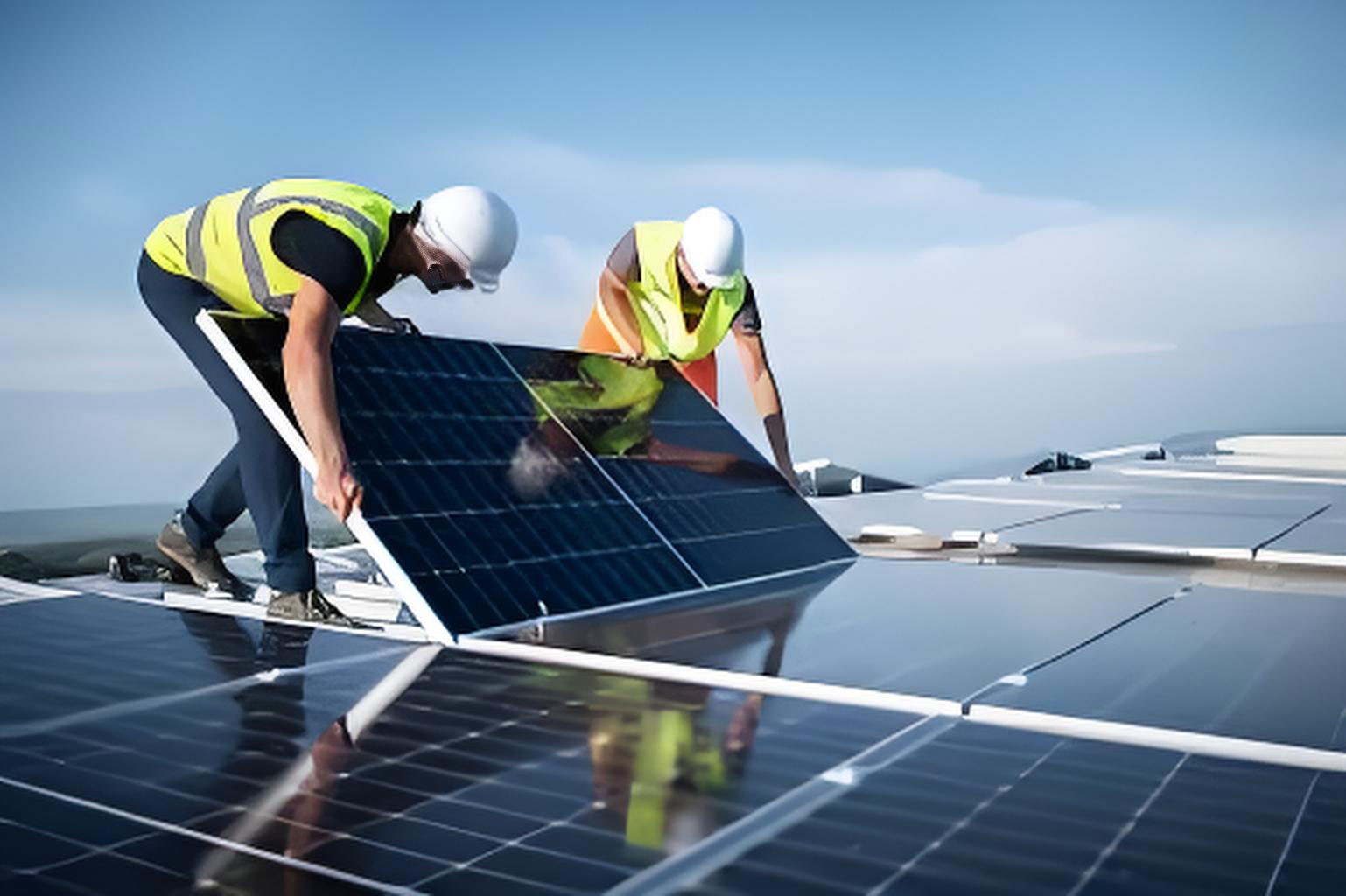
The operational environment for this robot is characterized by extensive arrays of solar panels. A typical array consists of multiple rows and columns. For the scope of this robot, a single column is targeted. Each column is often composed of multiple individual panels arranged vertically. The key environmental and structural parameters are summarized below:
| Parameter | Typical Value / Description |
|---|---|
| Panel Array Layout | Grid of rows and columns (e.g., 20×20 to 200×200 panels) |
| Inter-Column Spacing | ~500 mm |
| Inter-Row Spacing | ~3500 mm |
| Individual Panel Dimensions | ~1960 mm (L) x ~990 mm (W) |
| Panel Tilt Angle (θ) | 20° to 45° from horizontal |
| Panel Mounting Frame Height | ~10 mm above the cell surface |
| Gap Between Adjacent Panels | ~5 mm (for thermal expansion) |
| Array Base Height | ~600 mm from ground |
The robot’s chassis is a transformative wheeled design featuring four sets of dual cleaning rollers (eight total). These rollers serve multiple functions: they are the primary cleaning elements, they can be oriented to form part of a sealed chamber for negative pressure, and they provide traction or braking force. The core locomotion is powered by stepper motors, while adhesion is generated by eight high-flow ducted fans. The system is equipped with a suite of sensors: an electronic gyroscope for attitude feedback, laser distance sensors on a protective bumper for edge and obstacle detection, force sensors on the roller axles, and ambient light sensors to assess cleaning efficacy by measuring the reflectivity of the solar panels before and after cleaning.
The robot’s workflow is fully autonomous after initial placement on the lower corner of a solar panel column. The adaptive operational cycle is as follows:
- Initialization & Orientation: The robot determines the climb direction, reorients its front and rear cleaning rollers, and deploys the side rollers to engage with the panel edges, forming the initial sealed chamber for negative pressure.
- Calibration & Origin Fixing: Using laser sensors and the gyroscope, the robot aligns itself parallel to the panel’s edge and establishes a local coordinate origin (0,0).
- Climb and Traverse: The robot climbs vertically along the column until its top sensors detect the upper frame edge.
- Lateral Shift and Descent: At the top, it executes a controlled lateral shift (along the X-axis), moves down one cleaning swath width, and then begins a descending cleaning pass.
- Iterative Coverage: Steps 3 and 4 repeat until the entire column surface area is covered, following a precise boustrophedon (back-and-forth) path plan.
The desired, adaptively planned trajectory on a coordinate plane defined by the panel surface can be visualized as a series of parallel lines connected by semicircular turns at the edges, ensuring complete coverage.
Control System Hardware Architecture
The control system is built around a central STM32 microcontroller, chosen for its computational power, rich peripheral set, and real-time capabilities. A Controller Area Network (CAN) bus forms the communication backbone, linking all critical subsystems. This architecture offers excellent noise immunity, modularity, and simplicity in wiring. The major hardware units are:
| System Unit | Key Components | Primary Function |
|---|---|---|
| Control Unit | STM32 Microcontroller | Central processor for sensor fusion, path planning algorithm execution, and generating control signals for all actuators. |
| Data Acquisition Unit | Gyroscope, Laser Sensors, Force Sensors, Ambient Light Sensors | Provides real-time state feedback: tilt, yaw, distance to edges/obstacles, roller contact force, and panel reflectivity. |
| Drive Unit | 24V DC Stepper Motors, Motor Drivers, PID Controllers | Provides precise locomotion control for climbing, descending, and lateral movement. |
| Negative Pressure Unit | 8x Ducted Fans, PWM Controllers | Generates adjustable adhesive force and provides suction to evacuate dislodged dust into collection bags. |
| Power Unit | 18650 Lithium-ion Battery Pack, Power Management Circuit | Supplies stable power for all subsystems, designed for >2 hours of continuous operation. |
The system flowchart, executed by the microcontroller, begins with sensor initialization and self-check, proceeds to the origin-finding and alignment routine, and then enters the main adaptive cleaning loop, which includes continuous monitoring for obstacles, battery level, and cleaning performance.
Mathematical Modeling and Key Functional Algorithms
The core intelligence of the system lies in its software algorithms that solve the key challenges of operating on an inclined, large-area surface like a solar panel. These are grounded in physical models and control theory.
1. Adhesion Force and Traction Control Model
The fundamental requirement is to prevent the robot from sliding down the inclined solar panels. The adhesive force (Fadhesion) generated by the ducted fans must counteract the downhill component of gravity and provide a normal force for traction.
The force balance parallel to the panel surface during a steady climb is:
$$ \sum F_x = F_{traction} – mg\sin\theta – F_{friction\_drag} = 0 $$
where $F_{traction}$ is the combined force from the driving rollers, $m$ is the robot mass, $g$ is gravity, $\theta$ is the panel tilt angle, and $F_{friction\_drag}$ is the rolling friction.
The adhesion force required to prevent slip is governed by:
$$ F_{adhesion} \cdot \mu_{static} \geq mg\sin\theta + F_{traction\_required} $$
where $\mu_{static}$ is the coefficient of static friction between the sealing rollers and the panel surface. The adhesion force is proportional to the pressure differential (∆P) created by the fans and the effective seal area (Aseal):
$$ F_{adhesion} = \Delta P \cdot A_{seal} $$
The seal area is dynamically adjusted by changing the deployment angle (α) of the side rollers. Therefore, the fan speed (and thus ∆P) and the roller angle (α) are control variables used to maintain a safe adhesion margin:
$$ \Delta P(\alpha) = \frac{mg\sin\theta + \zeta}{ \mu_{static} \cdot A_{seal}(\alpha) } $$
where $\zeta$ is a safety margin factor. This relationship is implemented in a lookup table or a real-time calculated control law within the microcontroller.
2. Adaptive Path Planning and Edge Detection
The robot does not rely on a pre-programmed map. Instead, it uses its laser distance sensors to continuously scan the area just ahead and to its sides. The key to the boustrophedon path is reliable detection of the panel’s leading (top/bottom) and lateral edges. The laser sensors measure the distance to the surface. A sudden increase in measured distance indicates an edge or the mounting frame.
Let $d_{measured}(t)$ be the real-time distance reading. An edge is detected when:
$$ \frac{d}{dt}d_{measured}(t) > \delta_{threshold} $$
where $\delta_{threshold}$ is a calibrated value corresponding to the height of the panel frame (~10mm). Upon detection, the robot decelerates, stops precisely at the edge, and executes a turn sequence. The lateral shift (∆Y) during the turn is exactly equal to the effective cleaning width (Wclean) of the robot to ensure adjacent cleaning paths overlap slightly for complete coverage:
$$ \Delta Y = W_{clean} $$
This simple reactive strategy, combined with dead reckoning from wheel encoders and gyroscope data for straight-line correction, forms a robust adaptive path planner for the uniform geometry of solar panel arrays.
3. Yaw Correction and Dynamic Attitude Control
Maintaining a straight path parallel to the panel’s edge is critical. Deviations, or yaw errors (ψ), can occur due to uneven friction or forces. The gyroscope provides the yaw rate ($\dot{\psi}$). The control system implements a Proportional-Integral-Derivative (PID) controller to correct this error.
The yaw error is calculated from the desired heading (typically along the Y-axis of the panel) and the current heading from sensor fusion. The corrective differential drive signal for the left and right side motors is:
$$ \Delta V_{LR} = K_p \cdot \psi + K_i \cdot \int \psi \, dt + K_d \cdot \dot{\psi} $$
A more sophisticated method, as hinted in the original concept, uses differential adhesion force. If the robot yaws to the right (positive ψ), the control system increases the speed/power of the ducted fans on the right side relative to the left. This creates a differential adhesive force ($\Delta F_{adhesion}^{RL}$) which, due to the offset (L) from the center of mass, generates a corrective torque (τ):
$$ \tau = \Delta F_{adhesion}^{RL} \cdot L $$
This torque helps rotate the robot back to the correct heading. This method can be combined with differential drive for rapid and stable orientation control, crucial on slippery or dusty solar panels.
4. Obstacle (Inter-Panel Gap) Negotiation
The small (~5mm) gaps between adjacent solar panels are treated as minor obstacles. As the roller approaches the gap, the seal is momentarily broken, causing a drop in adhesion. The control system anticipates this from the laser sensor reading and executes a pre-programmed sequence:
- Power Boost: Briefly increases fan power to maximum to maximize adhesion from the rollers still in contact.
- Coast: Maintains drive motor momentum to carry the robot smoothly across the gap.
- Reseal: Once the laser confirms surface contact on the other side, fan power is returned to the nominal level for the current tilt angle.
The dynamics can be modeled by considering the transient loss of seal area $A_{seal}(t)$ as a function of the robot’s position over the gap. The controller must ensure:
$$ \min(\Delta P(t) \cdot A_{seal}(t)) \cdot \mu_{static} > mg\sin\theta \quad \text{for all } t \text{ during traversal} $$
This is achieved by the proactive fan power boost.
5. Cleaning Efficacy Feedback Loop
An innovative aspect is the use of ambient light sensors to indirectly assess cleaning performance. Clean solar panels have a different reflectivity (lower, more light is absorbed) compared to dusty ones. By measuring the reflected light intensity (Irefl) before a cleaning pass and immediately after, a cleaning factor (Cf) can be estimated:
$$ C_f = 1 – \frac{I_{refl}^{after}}{I_{refl}^{before}} $$
A higher Cf indicates better dust removal. This data can be logged. Furthermore, if Cf falls below a certain threshold over several passes, it could indicate worn cleaning rollers or a full dust collection bag, triggering a maintenance alert. While not a primary navigation sensor, it adds a layer of performance monitoring and system intelligence.
System Integration and Validation
The integration of the mechanical design, sensor suite, and the adaptive control algorithms results in a robust autonomous system. The CAN bus allows modular communication. The control algorithm’s state machine manages transitions between operational modes: IDLE, ALIGN, CLIMB, TURN, DESCEND, and FAULT.
A summary of the core control algorithms and their mathematical basis is presented below:
| Control Function | Key Sensors | Control Actuators | Mathematical / Algorithmic Basis |
|---|---|---|---|
| Adhesion & Traction | Gyro (θ), Force Sensors | Ducted Fans (PWM), Roller Angle Servos | $$ F_{adhesion} \geq \frac{mg\sin\theta}{\mu_{static}} $$, Dynamic fan power vs. tilt angle table. |
| Straight-Line Navigation | Gyro (ψ, $\dot{\psi}$), Encoders | Differential Drive Motors | PID Control: $$ \Delta V = K_p \psi + K_i \int \psi dt + K_d \dot{\psi} $$ |
| Edge Detection & Turn | Laser Distance Sensors | All Motors | Threshold-based detection: $$ \Delta d > \delta_{threshold} $$; Execute turn sequence with fixed lateral shift ∆Y. |
| Obstacle/Gap Crossing | Laser Distance Sensors | Ducted Fans, Drive Motors | Transient adhesion model; pre-emptive fan power boost protocol. |
| Performance Monitoring | Ambient Light Sensors | Logging System / Alert | $$ C_f = 1 – I_{after}/I_{before} $$ |
Validation tests were performed on solar panels tilted at 30° in a simulated desert dust environment. The robot successfully demonstrated all key functionalities: autonomous origin finding, stable climbing and descending with automatic yaw correction, seamless traversal over panel gaps, and complete coverage of a multi-panel column. The dry-cleaning mechanism, combining brushing and immediate suction, proved effective in removing adhered dust without water. The energy system supported over two hours of operation, sufficient for cleaning approximately 150 m² of panel surface.
Conclusion and Future Perspectives
The adaptive path planning and control system presented here successfully enables a trackless, negative-pressure robot to perform autonomous dry cleaning on inclined solar panels. By solving the core challenges of adhesion control, precise navigation, edge detection, and obstacle negotiation through integrated sensor feedback and robust algorithms, the system achieves reliable and efficient operation in conditions representative of large-scale desert-based solar farms. The use of a modular CAN bus architecture centered on an STM32 microcontroller provides a flexible platform for future enhancements.
Potential future developments include: integrating machine vision for more sophisticated soiling assessment and panel condition inspection; implementing wireless charging for fully continuous operation; employing more advanced predictive control models to optimize energy consumption of the ducted fans; and developing swarm coordination algorithms for multiple robots to clean entire solar panel arrays simultaneously. This work contributes a practical and sustainable technological solution for maintaining the efficiency and longevity of photovoltaic installations in arid regions, thereby supporting the global growth of solar energy.