
As a researcher deeply immersed in the fields of sustainable construction and renewable energy, I have witnessed a remarkable surge in innovations aimed at reducing environmental impact and enhancing energy efficiency. In this comprehensive analysis, I will explore recent developments in building materials, standards, and technologies, with a particular emphasis on thin film solar panels. These panels represent a transformative approach to integrating solar energy into our built environment, offering flexibility, efficiency, and aesthetic appeal. Throughout this discussion, I will incorporate tables and formulas to summarize key data and principles, ensuring a thorough understanding of these advancements. The integration of thin film solar panels into various applications, from building facades to windows, is paving the way for a greener future.
Let me begin by addressing the evolution of construction materials. The development of industry standards for high-performance concrete aggregates and recycled micro-powders is crucial for advancing sustainable building practices. High-performance concrete relies on superior aggregates that enhance durability and strength. The new standard aims to establish parameters for such aggregates, including particle size distribution, density, and chemical composition. For instance, the optimal gradation can be expressed using the Fuller curve formula: $$ P = 100 \times \left( \frac{d}{D} \right)^n $$ where \( P \) is the percentage passing a sieve of size \( d \), \( D \) is the maximum particle size, and \( n \) is an exponent typically around 0.5. This ensures a dense packing structure, improving concrete performance. Similarly, the use of recycled micro-powders from construction waste in concrete and mortar reduces landfill burden and conserves natural resources. The chemical composition of these micro-powders, such as silica content, affects pozzolanic activity, which can be modeled by the reaction equation: $$ \text{Ca(OH)}_2 + \text{SiO}_2 \rightarrow \text{C-S-H} $$ where C-S-H denotes calcium silicate hydrate, the primary binder in concrete. Tables 1 and 2 summarize the key requirements for these materials.
| Property | High-Performance Aggregate Standard | Typical Value Range |
|---|---|---|
| Particle Density (kg/m³) | Minimum 2500 | 2500-3000 |
| Water Absorption (%) | Maximum 2.0 | 0.5-2.0 |
| Crushing Value (%) | Maximum 20 | 10-20 |
| Chloride Content (%) | Maximum 0.01 | 0.001-0.01 |
| Parameter | Recycled Micro-Powder Standard | Impact on Concrete |
|---|---|---|
| Fineness (m²/kg) | Minimum 400 | Enhances workability |
| SiO₂ Content (%) | Minimum 35 | Improves strength |
| Loss on Ignition (%) | Maximum 5.0 | Reduces carbon footprint |
| Activity Index (%) | Minimum 75 at 28 days | Ensures durability |
Moving to building fixtures, the new national standard for smart toilets highlights the push for energy and water efficiency in residential and commercial structures. These devices incorporate sensors and controllers that optimize flushing and heating, with energy consumption modeled by: $$ E = \sum_{i=1}^{n} P_i \times t_i $$ where \( E \) is total energy use, \( P_i \) is power of component \( i \), and \( t_i \) is operating time. This standard sets benchmarks for performance, safety, and reliability, contributing to overall building sustainability. However, my focus remains on energy generation, where thin film solar panels are making significant strides. The recent production of copper indium gallium selenide (CIGS) thin film solar modules in China marks a milestone in photovoltaic technology. These thin film solar panels are characterized by their lightweight, flexible nature and high efficiency under diverse conditions. The efficiency of a thin film solar panel can be calculated using: $$ \eta = \frac{V_{oc} \times I_{sc} \times FF}{P_{in}} $$ where \( \eta \) is efficiency, \( V_{oc} \) is open-circuit voltage, \( I_{sc} \) is short-circuit current, \( FF \) is fill factor, and \( P_{in} \) is incident solar power. For CIGS thin film solar panels, typical efficiency ranges from 15% to 22%, competing favorably with traditional silicon panels. Moreover, their low temperature coefficient, expressed as: $$ \beta = \frac{\Delta \eta}{\eta_0 \times \Delta T} $$ where \( \beta \) is the coefficient, \( \Delta \eta \) is efficiency change, \( \eta_0 \) is initial efficiency, and \( \Delta T \) is temperature change, makes them less susceptible to performance degradation in hot climates. This is crucial for building-integrated photovoltaics (BIPV), where thin film solar panels are directly incorporated into roofs, walls, or windows.
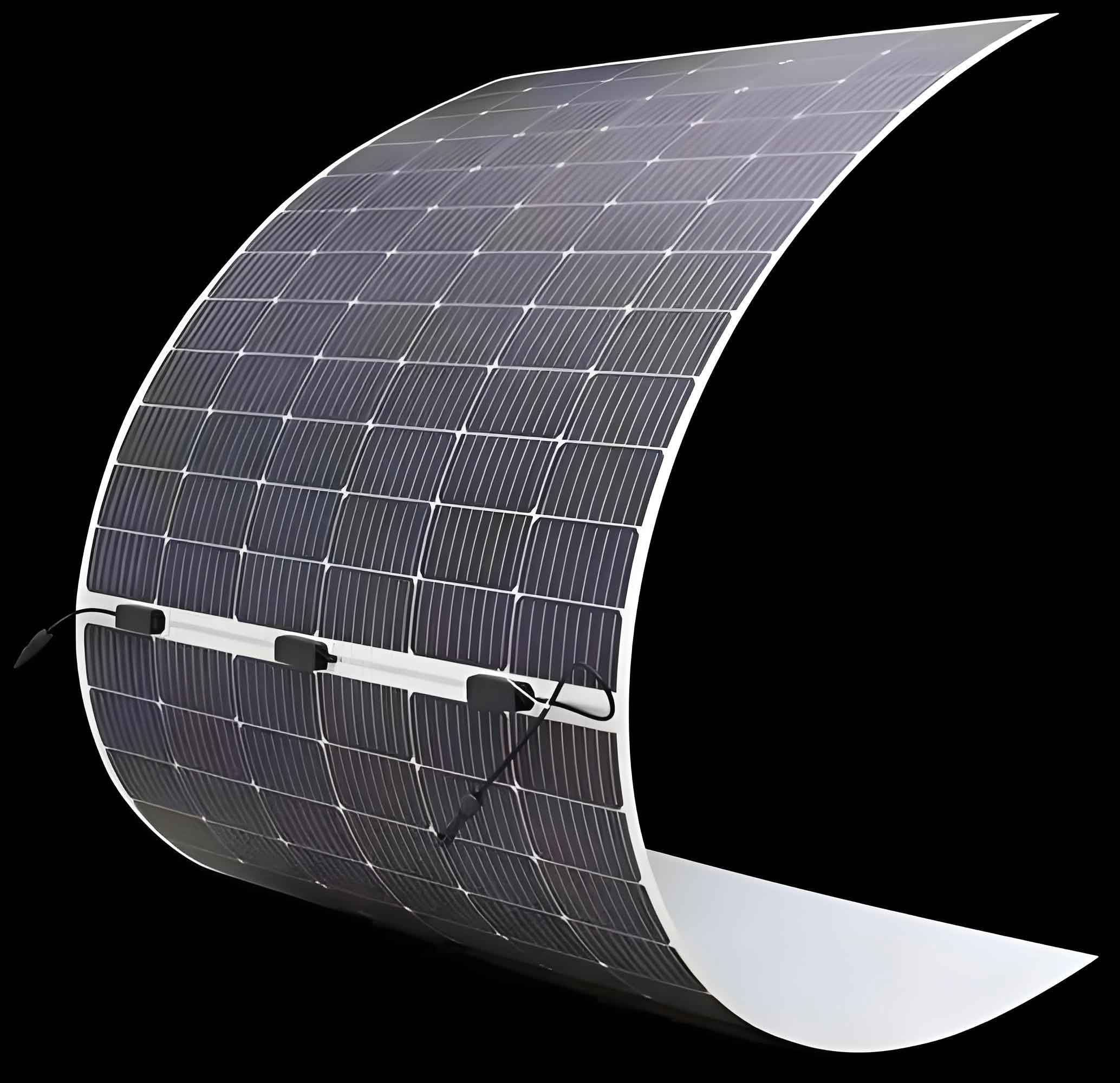
The image above illustrates the sleek design of thin film solar panels, which can be seamlessly integrated into architectural elements. In my analysis, thin film solar panels offer distinct advantages for BIPV due to their adaptability and aesthetic versatility. The production line for these thin film solar panels leverages German Industrial 4.0 technology, ensuring high precision and scalability. For example, the annual capacity of 1.5 GW translates to significant energy output, calculated as: $$ E_{annual} = \eta \times A \times G \times 365 $$ where \( E_{annual} \) is annual energy generation in kWh, \( \eta \) is panel efficiency, \( A \) is area in m², and \( G \) is average daily solar irradiance in kWh/m²/day. Assuming an efficiency of 18% and irradiance of 4 kWh/m²/day, a 1.5 GW plant can produce approximately 3.9 TWh annually, powering thousands of homes. The economic impact is substantial, with projected revenues exceeding 1.2 billion USD and tax contributions over 300 million USD. This underscores the growing importance of thin film solar panels in the global renewable energy market.
In parallel, passive low-energy buildings are gaining traction, particularly in regions like Shandong, where several projects have received Sino-German quality certification. These buildings minimize energy use through superior insulation, airtightness, and heat recovery. The thermal performance can be evaluated using the heat loss formula: $$ Q = U \times A \times \Delta T $$ where \( Q \) is heat loss in watts, \( U \) is thermal transmittance in W/m²K, \( A \) is surface area in m², and \( \Delta T \) is temperature difference in Kelvin. Passive buildings often achieve U-values below 0.15 W/m²K, drastically reducing heating demands. The integration of thin film solar panels into such buildings enhances their energy autonomy. For instance, thin film solar panels can be installed on roofs or facades to generate electricity for ventilation systems or lighting, aligning with the passive house philosophy. Table 3 compares key metrics for passive buildings and conventional structures.
| Metric | Passive Low-Energy Building | Conventional Building |
|---|---|---|
| Heating Demand (kWh/m²/year) | ≤ 15 | 50-150 |
| Primary Energy Demand (kWh/m²/year) | ≤ 120 | 200-300 |
| Airtightness (ACH at 50 Pa) | ≤ 0.6 | 3-5 |
| Renewable Energy Integration | High (e.g., thin film solar panels) | Low to Moderate |
Another critical area is construction waste management, as seen in legislative efforts to promote recycling. The resource utilization rate for construction waste can be expressed as: $$ R = \frac{M_{recycled}}{M_{total}} \times 100\% $$ where \( R \) is the rate, \( M_{recycled} \) is mass of recycled materials, and \( M_{total} \) is total waste mass. By implementing standards for recycled micro-powders, this rate can exceed 50%, reducing environmental strain. Furthermore, the use of recycled materials in concrete production lowers the embodied carbon, calculated via: $$ CE = \sum (m_i \times CF_i) $$ where \( CE \) is carbon emissions, \( m_i \) is mass of material \( i \), and \( CF_i \) is its carbon factor. This complements the adoption of thin film solar panels, which reduce operational carbon by generating clean energy. In my view, a holistic approach combining waste reduction and renewable energy integration is essential for sustainable urban development.
Innovations in glazing technologies also contribute to energy efficiency. The collaboration on solar-powered windows involves embedding thin film solar panels into glass panels, allowing for simultaneous daylighting and electricity generation. The power output of such windows depends on factors like transparency and orientation, modeled by: $$ P = \eta_{window} \times I \times A \times \cos(\theta) $$ where \( \eta_{window} \) is the efficiency of the solar window, \( I \) is solar irradiance, \( A \) is window area, and \( \theta \) is angle of incidence. Typical efficiencies for these thin film solar panels range from 5% to 10%, balancing transparency and energy yield. This technology is particularly promising for skyscrapers, where large glass surfaces can be transformed into power generators. As thin film solar panels become more efficient and affordable, their adoption in windows and facades will accelerate, supporting net-zero energy buildings.
To delve deeper into the technical aspects of thin film solar panels, let’s consider their material science. CIGS thin film solar panels consist of multiple layers deposited on substrates like glass or flexible polymers. The bandgap energy of CIGS, which determines light absorption, is given by: $$ E_g = 1.0 + 0.24x + 0.27x^2 $$ eV, where \( x \) is the gallium fraction. This tunable bandgap allows optimization for different light spectra, enhancing performance in varied climates. The manufacturing process involves techniques such as sputtering or evaporation, with thicknesses typically under 3 micrometers, making thin film solar panels resource-efficient compared to bulk silicon panels. The cost per watt for thin film solar panels has been decreasing, following the learning curve formula: $$ C = C_0 \times (Q)^{-\alpha} $$ where \( C \) is current cost, \( C_0 \) is initial cost, \( Q \) is cumulative production, and \( \alpha \) is the learning rate (often around 0.2). This trend makes thin film solar panels increasingly competitive.
Moreover, the application of thin film solar panels extends beyond buildings to areas like smart agriculture and electric vehicles. In agriculture, thin film solar panels can be integrated into greenhouse roofs, providing shade while generating power for irrigation systems. The energy balance in such systems can be expressed as: $$ E_{gen} = E_{crop} + E_{aux} $$ where \( E_{gen} \) is energy from thin film solar panels, \( E_{crop} \) is energy for crop growth, and \( E_{aux} \) is for auxiliary equipment. For electric vehicles, thin film solar panels on car roofs can extend driving range by charging batteries, with incremental range calculated as: $$ \Delta D = \frac{E_{solar} \times \epsilon}{E_{mile}} $$ where \( \Delta D \) is additional distance in miles, \( E_{solar} \) is solar energy harvested in kWh, \( \epsilon \) is charging efficiency, and \( E_{mile} \) is energy consumption per mile in kWh/mile. These diverse applications highlight the versatility of thin film solar panels.
In conclusion, the convergence of advanced materials, stringent standards, and innovative technologies is driving sustainable construction forward. Thin film solar panels stand out as a key enabler, offering efficient, adaptable, and aesthetically pleasing solutions for energy generation. From high-performance concrete to passive buildings and solar windows, the integration of thin film solar panels is transforming our built environment. As research progresses, we can expect further improvements in efficiency and cost, solidifying the role of thin film solar panels in a low-carbon future. My ongoing work in this field reinforces the importance of cross-disciplinary collaboration to achieve global sustainability goals. Through continuous innovation and adoption, thin film solar panels will undoubtedly play a pivotal role in shaping resilient and energy-efficient communities.
To summarize the quantitative benefits, Table 4 provides a comparison of different solar panel technologies, emphasizing thin film solar panels.
| Technology | Average Efficiency (%) | Temperature Coefficient (%/°C) | Typical Thickness (μm) | Application Flexibility |
|---|---|---|---|---|
| Monocrystalline Silicon | 20-25 | -0.3 to -0.5 | 150-200 | Moderate |
| Polycrystalline Silicon | 15-20 | -0.4 to -0.5 | 180-220 | Moderate |
| CIGS Thin Film Solar Panels | 15-22 | -0.2 to -0.3 | 1-3 | High |
| CdTe Thin Film Solar Panels | 10-18 | -0.25 to -0.35 | 2-4 | High |
| Amorphous Silicon Thin Film | 6-10 | -0.1 to -0.3 | 0.5-1 | Very High |
Additionally, the lifecycle energy payback time for thin film solar panels can be estimated using: $$ T_{payback} = \frac{E_{manufacturing}}{E_{annual}} $$ years, where \( E_{manufacturing} \) is energy used in production, and \( E_{annual} \) is annual energy generation. For CIGS thin film solar panels, this time is typically 1-2 years, significantly shorter than their lifespan of 20-30 years, underscoring their sustainability. As we move forward, continued investment in research and development will enhance the performance and reduce the costs of thin film solar panels, making them accessible worldwide. In my perspective, the widespread deployment of thin film solar panels, coupled with supportive policies and standards, is essential for mitigating climate change and achieving energy independence. Let’s embrace these technologies to build a brighter, cleaner future.