
In the pursuit of sustainable energy solutions, the development of high-performance energy storage systems is paramount. Among these, lithium-ion batteries (li-ion batteries) have emerged as a cornerstone technology due to their high energy density, lightweight nature, and widespread applicability in portable electronics, electric vehicles, and grid-scale storage. However, the ever-growing demand for higher energy densities drives the search for advanced anode materials beyond conventional graphite. Silicon (Si) stands out as a promising alternative due to its exceptionally high theoretical specific capacity of approximately 3579 mAh/g, which is nearly ten times that of graphite. Despite this advantage, the practical implementation of Si anodes in li-ion batteries is hampered by significant challenges, primarily stemming from the substantial volume expansion (up to ~300%) during lithiation and delithiation cycles. This volumetric fluctuation induces mechanical stress, leading to particle pulverization, loss of electrical contact, and, critically, the continuous breakdown and reformation of the solid electrolyte interphase (SEI) film. The SEI film is a passivation layer that forms on the anode surface during the initial cycles of a li-ion battery. It is electronically insulating but ionically conductive, serving to prevent further electrolyte decomposition while facilitating Li+ transport. A stable and robust SEI is vital for the long-term cyclability, Coulombic efficiency, and safety of li-ion batteries. In this comprehensive review, I will delve into the formation mechanisms, influencing factors, failure modes, and recent advancements in stabilizing the SEI on Si anodes, emphasizing strategies that enhance the performance of li-ion batteries.
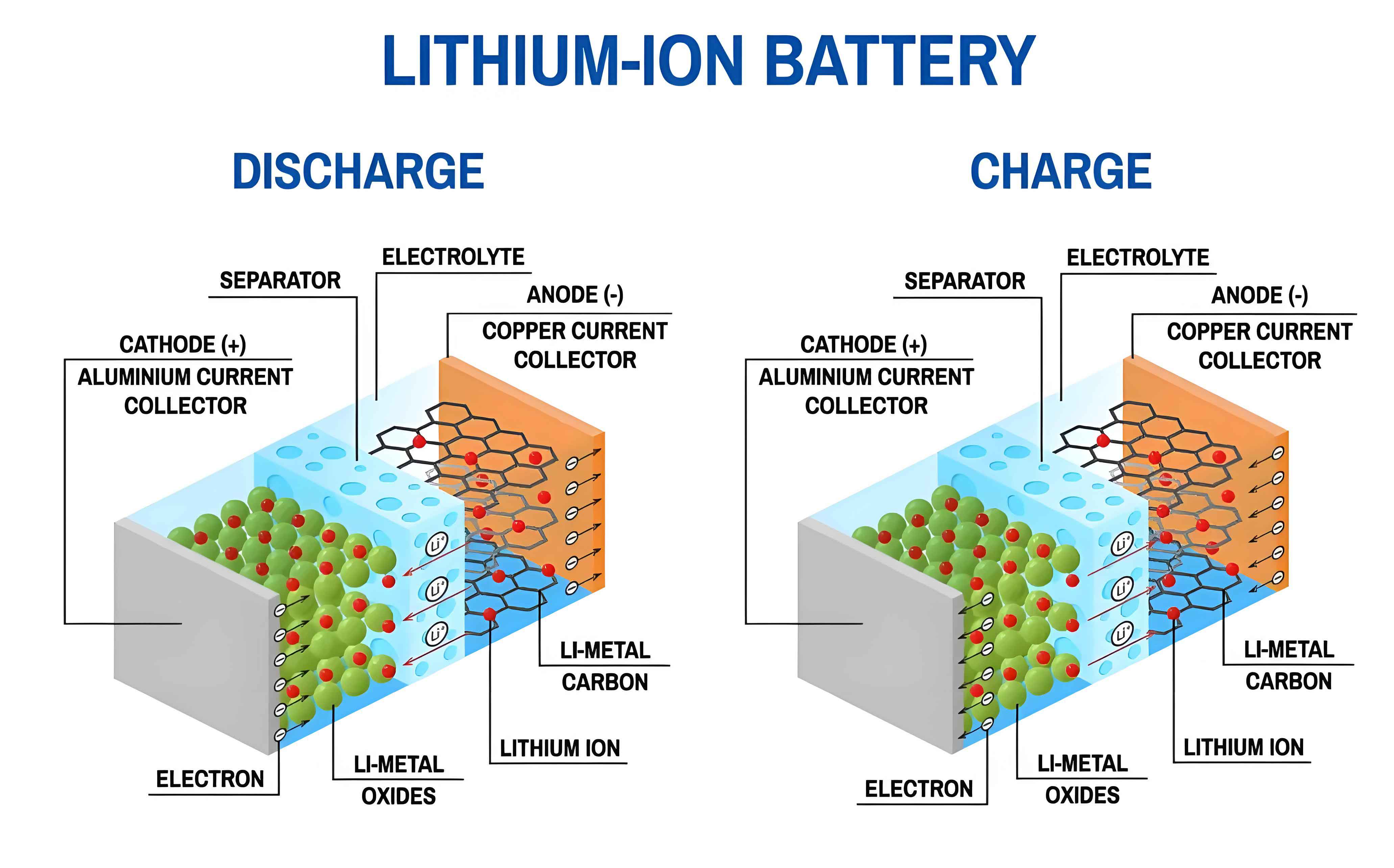
The formation of the SEI film is an electrochemical process that occurs when the electrode potential drops below the reduction threshold of the electrolyte components. In a typical li-ion battery employing a Si anode, during the first charge (lithiation) cycle, the electrolyte undergoes reductive decomposition at the anode surface. This process involves the transfer of electrons from the anode to the electrolyte species, resulting in the precipitation of insoluble reduction products that constitute the SEI layer. The formation can be conceptually described by a simplified reaction: $$ \text{Electrolyte} + e^- \rightarrow \text{SEI components (inorganic/organic)} $$ The kinetics of SEI growth can often be modeled using an Arrhenius-type equation, where the growth rate depends on temperature and activation energy: $$ \frac{d\delta}{dt} = k_0 \exp\left(-\frac{E_a}{RT}\right) $$ Here, $\delta$ represents the SEI film thickness, $k_0$ is a pre-exponential factor, $E_a$ is the activation energy for SEI formation, $R$ is the universal gas constant, and $T$ is the absolute temperature. The SEI on Si anodes typically exhibits a dual-layer structure. The inner layer is compact and primarily composed of inorganic compounds such as Li2CO3, LiF, Li2O, and LiOH. This layer is thin, dense, and relatively stable. The outer layer is more porous and heterogeneous, consisting mainly of organic species like lithium alkyl carbonates (ROCO2Li) and lithium alkoxides (ROLi). The composition and morphology of this SEI are dictated by the specific electrolyte chemistry, electrode potential, and operating conditions of the li-ion battery.
Several critical factors govern the formation, structure, and stability of the SEI film on Si anodes in li-ion batteries. Understanding these factors is essential for designing strategies to engineer a more resilient interface. I have summarized the key influences in the table below.
| Influencing Factor | Impact on SEI Film | Underlying Mechanism | Implication for Li-ion Battery Performance |
|---|---|---|---|
| Ambient Temperature | Alters thickness, uniformity, and inorganic/organic ratio. | Higher temperatures accelerate reaction kinetics and organic salt dissolution, leading to a more inorganic-rich, continuous SEI. Lower temperatures reduce ion mobility, favoring a denser, organics-dominated SEI. | High temperature can promote stable SEI growth but risks thermal runaway. Low temperature increases impedance and reduces charge transfer. |
| Electrolyte Composition (Lithium Salts & Solvents) | Determines the chemical identity of SEI components (e.g., LiF from fluorinated salts, alkyl carbonates from carbonate solvents). | Reduction potentials of salt anions and solvent molecules dictate the sequence and products of decomposition reactions at the anode surface. | Choice of electrolyte directly affects SEI stability, Coulombic efficiency, and cycle life of the li-ion battery. |
| Electrode Potential | Controls the thermodynamic driving force for electrolyte reduction, affecting SEI structure (graded vs. mosaic). | Very low potentials (vs. Li/Li+) favor the formation of a distinct bilayer (inorganic inner, organic outer). Higher potentials lead to a mixed, mosaic structure. | Operating voltage window of the anode material is crucial for SEI formation pathways in a li-ion battery. |
| Anode Material Morphology & Composition | Influences SEI thickness, adhesion, and homogeneity. | Surface chemistry and topology affect electrolyte adsorption and reduction kinetics. Nanostructured materials provide more sites but can lead to excessive SEI growth. | Material design is key to managing volume change and achieving a conformal, stable SEI in high-capacity li-ion batteries. |
The failure of the SEI film on Si anodes is a multifaceted problem that ultimately limits the lifespan of li-ion batteries. The primary failure mechanisms are intrinsically linked to the massive volume changes of Si. During lithiation, Si undergoes alloying with lithium, which can be represented as: $$ \text{Si} + x\text{Li}^+ + x e^- \leftrightarrow \text{Li}_x\text{Si} $$ where $x$ can reach up to ~4.4, corresponding to the Li22Si5 phase. This reaction induces a volumetric strain $\epsilon_v$: $$ \epsilon_v = \frac{\Delta V}{V_0} \approx 3.0 \quad \text{(or 300\%)} $$ where $V_0$ is the initial volume and $\Delta V$ is the volume change. This strain imposes significant mechanical stress on the SEI film, leading to cracking and delamination—a physical failure mode. Concurrently, the exposed fresh Si surface reacts with the electrolyte, triggering further decomposition and the formation of a new, often thicker and more resistive, SEI layer. This constitutes a chemical failure mode. The repetitive breakdown and reformation consume active lithium and electrolyte, increasing the interfacial impedance $R_{sei}$ and causing rapid capacity fade. The total cell impedance $Z_{cell}$ can be modeled as a sum of contributions, where the SEI resistance plays a critical role: $$ Z_{cell} = R_\Omega + R_{ct} + Z_{W} + R_{sei} $$ Here, $R_\Omega$ is the ohmic resistance, $R_{ct}$ is the charge transfer resistance, $Z_{W}$ is the Warburg diffusion impedance, and $R_{sei}$ is the resistance associated with Li+ transport through the SEI. An unstable SEI leads to a continuous increase in $R_{sei}$, degrading the power performance of the li-ion battery.
To combat SEI instability on Si anodes, extensive research has focused on material engineering, interface modification, and electrolyte formulation for li-ion batteries. These strategies aim to accommodate volume change, promote the formation of a flexible and ionically conductive SEI, and minimize irreversible side reactions. The following sections detail these approaches, supplemented with comparative tables.
Nanostructural Design of Si-based Anodes: Confining Si to nanoscale dimensions can effectively mitigate pulverization by reducing the absolute strain and providing void space for expansion. Common architectures include nanoparticles, nanowires, nanotubes, and porous structures. The effective stress $\sigma$ experienced by a nanoparticle of radius $r$ can be related to the strain and material properties: $$ \sigma \propto E \cdot \epsilon_v \cdot f(r) $$ where $E$ is the Young’s modulus and $f(r)$ is a size-dependent function indicating lower stress for smaller particles. Moreover, compositing Si with carbon matrices (e.g., graphene, carbon nanotubes) enhances electronic conductivity and buffers volume change. The performance of various nanostructures is summarized below.
| Nanostructure Type | Key Feature | Advantage for SEI/Performance | Typical Capacity Retention (after n cycles) |
|---|---|---|---|
| Si Nanoparticles (SiNPs) | Reduced diffusion length, high surface area. | Better strain tolerance, but may form excessive SEI due to high surface area. Often requires carbon coating. | ~80% after 100 cycles (with carbon coating). |
| Si Nanowires (SiNWs) | Direct electrical pathways, free space between wires. | Accommodates axial expansion, maintains electrical contact, promotes more stable SEI formation. | ~85% after 200 cycles. |
| Porous Si/C Composites | Internal pores buffer expansion, carbon provides conductivity. | Minimizes particle fracture, limits SEI growth to outer surface, enhances cyclability. | >90% after 300 cycles. |
| Core-Shell Structures (e.g., Si@C) | Carbon shell constrains expansion and protects core. | Carbon shell acts as a stable artificial SEI precursor, reduces direct electrolyte contact. | ~88% after 500 cycles. |
Artificial SEI/Coating Design: Applying a conformal, mechanically robust coating on Si particles prior to cell assembly can serve as an artificial SEI or a protective layer that guides the formation of a native, more stable SEI. These coatings are designed to be elastic or to have high fracture toughness to withstand stress. The effectiveness of a coating can be evaluated by its modulus and adhesion energy. Common coating materials include carbon, polymers, metal oxides, and fluorides. For instance, an Al2O3 or AlF3 coating deposited via atomic layer deposition (ALD) can significantly improve interfacial stability. The improvement in cycle life $\Delta N$ due to a coating can be empirically related to its properties: $$ \Delta N \propto \frac{\Gamma_c}{E_c \cdot \epsilon_c} $$ where $\Gamma_c$ is the coating adhesion energy, $E_c$ is its elastic modulus, and $\epsilon_c$ is its fracture strain. A comparison of coating strategies is provided.
| Coating Material | Deposition Method | Proposed Function | Impact on SEI in Li-ion Battery |
|---|---|---|---|
| Carbon (Amorphous, Graphene) | Chemical Vapor Deposition (CVD), Pyrolysis | Enhances conductivity, physically confines Si, reduces direct electrolyte reduction. | Promotes thinner, more uniform SEI; improves initial Coulombic efficiency. |
| Conductive Polymers (e.g., Polyaniline, PEDOT:PSS) | Electropolymerization, Solution Casting | Provides elasticity, integrates with native SEI, stores electrolyte in layered structures. | Leads to a hybrid, flexible SEI with uniform ion transport, excellent cycling stability. |
| Metal Oxides (e.g., Al2O3, TiO2) | Atomic Layer Deposition (ALD), Sol-Gel | Acts as a barrier layer, scavenges HF, provides mechanical strength. | Initiates formation of a dense, inorganic-rich inner SEI layer, suppresses continuous decomposition. |
| Metal Fluorides (e.g., AlF3, LiF) | ALD, Chemical Reaction | High Li+ conductivity, excellent chemical stability, high surface potential reduces electron transfer. | Fosters a LiF-rich SEI with high interfacial energy, dramatically enhancing cycle life. |
Electrolyte Additive Engineering: Tailoring the electrolyte with functional additives is one of the most cost-effective and industrially scalable approaches to stabilize the SEI in li-ion batteries. Additives are compounds that have a higher reduction potential than the base electrolyte solvents; they decompose preferentially to form a protective SEI layer on the Si anode. Key mechanisms include polymerization, formation of elastic oligomers, and incorporation of beneficial inorganic species like LiF or Li3N. The effectiveness of an additive can be quantified by its improvement in the first-cycle Coulombic efficiency (CE1) and the cycle life. Let $CE_0$ be the efficiency without additive, and $CE_a$ with additive. The gain is: $$ \Delta CE = CE_a – CE_0 $$ A positive $\Delta CE$ indicates reduced irreversible capacity loss from excessive SEI formation. Popular and emerging additives are compared below.
| Additive (Typical Concentration) | Chemical Nature | Primary Decomposition Products & SEI Role | Performance Benefit for Si Anode Li-ion Battery |
|---|---|---|---|
| Fluoroethylene Carbonate (FEC, 5-10 wt%) | Fluorinated cyclic carbonate | LiF, polycarbonates, elastic oligomers. Forms a dense, LiF-rich inner SEI. | Greatly improves cycle life, stabilizes SEI against volume change. However, may generate HF at high temperatures. |
| Vinylene Carbonate (VC, 1-5 wt%) | Unsaturated cyclic carbonate | Polymeric species (poly-VC). Forms a flexible, polymeric SEI layer. | Enhances SEI elasticity and adhesion, but excess VC can increase impedance and self-discharge. |
| Lithium Difluoro(oxalato)borate (LiDFOB) | Lithium salt additive | LiF, B-O containing species, robust borate complexes. Increases SEI modulus. | Promotes a dense, inorganic-rich SEI, excellent high-temperature performance, suppresses Si particle fracturing. |
| Sulfur-containing Additives (e.g., Li2Sn) | Inorganic/organic polysulfides | Lithium sulfides, sulfur-mediated gradient interphase (SMGI) with elastic polymers. | Creates a gradient, elastic SEI via domino reduction reactions, exceptional capacity retention over long cycling. |
| Multi-component Systems (e.g., LiPO2F2 + amides) | Synergistic blend | Mixture of short-chain organics (e.g., trifluoroacetamide), LiF, LixPOyFz. Forms uniform, dense SEI. | Superior to FEC in some cases, provides higher Coulombic efficiency and better interfacial stability. |
Looking forward, the quest for the ideal SEI on Si anodes in li-ion batteries continues to drive innovation across multiple fronts. Future research directions should focus on the dynamic, operando characterization of the SEI formation and evolution process. Techniques like in situ electrochemical atomic force microscopy (EC-AFM), X-ray photoelectron spectroscopy (XPS), and solid-state nuclear magnetic resonance (ssNMR) under realistic cycling conditions will provide unprecedented insights into the mechanical and chemical evolution of the interface. Furthermore, the development of advanced electrolytes, such as highly concentrated “water-in-salt” systems, localized high-concentration electrolytes (LHCEs), and novel ionic liquids, may offer inherently stable interfaces for Si anodes. Machine learning and computational modeling can accelerate the discovery of optimal electrolyte formulations and coating materials by predicting reduction potentials, SEI composition, and mechanical properties. Another promising avenue is the precise prelithiation of Si anodes to compensate for the initial irreversible capacity loss due to SEI formation, thereby improving the overall energy density of the li-ion battery. Ultimately, a holistic approach that integrates nanostructured Si material design, intelligent interfacial coatings, and tailored electrolyte systems is essential to unlock the full potential of Si anodes, paving the way for the next generation of high-energy-density, long-lasting, and safe li-ion batteries that can meet the rigorous demands of electric transportation and large-scale renewable energy storage.
In conclusion, the solid electrolyte interphase film is a decisive component governing the performance and longevity of silicon-based anodes in lithium-ion batteries. Its instability, driven by the colossal volume changes of silicon, remains a central challenge. Through a detailed examination of formation principles, influencing factors, and failure mechanisms, we have outlined the multifaceted nature of this problem. The research community has responded with ingenious solutions spanning nanomaterial architecture, artificial coating technologies, and sophisticated electrolyte additives. Each strategy contributes to building a more resilient, conductive, and adaptive SEI that can withstand the harsh electrochemical environment of cycling. As we advance, interdisciplinary efforts combining advanced characterization, theoretical simulation, and novel material synthesis will be crucial. The continuous improvement of SEI stability on Si anodes is not merely an academic pursuit but a critical enabler for the widespread adoption of high-capacity lithium-ion batteries, which are indispensable for a sustainable energy future. Therefore, persistent innovation in this domain is vital for the evolution of energy storage technology.