
In this comprehensive exploration, we delve into the groundbreaking developments in perovskite solar cell research, focusing on the recent achievements that have pushed the boundaries of photoelectric conversion efficiency. As a researcher deeply immersed in the field of renewable energy, I have witnessed how perovskite solar cells have evolved from laboratory curiosities to promising candidates for commercial applications. The unique properties of perovskite materials, such as their tunable bandgaps and high absorption coefficients, make them ideal for harnessing solar energy efficiently. Throughout this article, we will examine the underlying principles, mathematical models, and experimental data that underscore the potential of perovskite solar cells to revolutionize the energy sector. We will also incorporate tables and equations to summarize key findings, ensuring a thorough understanding of the subject.
The core of our discussion revolves around the recent record-breaking efficiency of 26.4% in a perovskite organic tandem solar cell, as reported in independent certifications. This milestone not only highlights the rapid progress in perovskite solar cell technology but also opens up new avenues for integration into lightweight and flexible devices, such as wearables and drones. To begin, let us consider the fundamental equation for photoelectric conversion efficiency, which is central to evaluating any solar cell performance. The efficiency η is defined as:
$$ \eta = \frac{J_{sc} \times V_{oc} \times FF}{P_{in}} \times 100\% $$
Here, \( J_{sc} \) represents the short-circuit current density, \( V_{oc} \) is the open-circuit voltage, \( FF \) denotes the fill factor, and \( P_{in} \) is the incident solar power. For perovskite solar cells, optimizing these parameters has been a key research focus, leading to significant improvements over the years. For instance, the fill factor can be influenced by the material’s intrinsic properties and device architecture, which we will explore in detail.
One of the most exciting aspects of perovskite solar cells is their ability to form tandem structures with other materials, such as organic semiconductors. This approach leverages the complementary absorption spectra to capture a broader range of photons, thereby enhancing overall efficiency. The recent innovation involves a narrow-bandgap organic absorber that efficiently captures photons in the near-infrared region, addressing a long-standing bottleneck in thin-film tandem solar cells. The bandgap energy \( E_g \) of a material determines its absorption range, and for perovskites, it can be tailored using chemical composition adjustments. The relationship between bandgap and photon energy is given by:
$$ E_g = h \nu $$
where \( h \) is Planck’s constant and \( \nu \) is the frequency of light. By designing asymmetric organic acceptors, researchers have extended the absorption into the deep near-infrared while maintaining sufficient charge separation drive, as confirmed through ultrafast spectroscopy and device physics analysis.
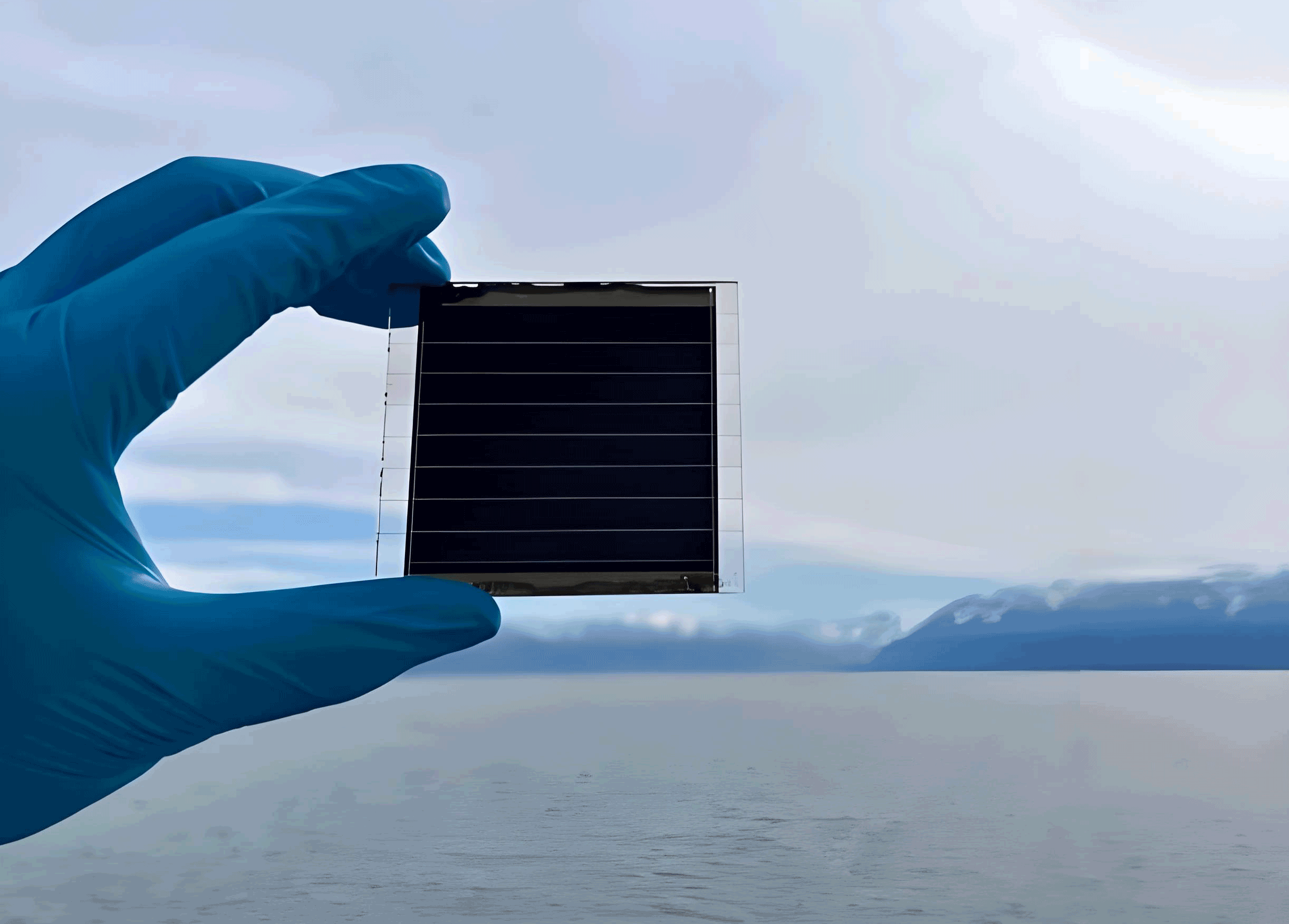
To illustrate the performance metrics of various solar cell technologies, we present a comparative table that summarizes their efficiencies based on recent studies. This table highlights how perovskite solar cells stack up against other types, such as silicon and CIGS cells, in terms of standardized measurements. Note that the data reflects typical values from literature, and the perovskite organic tandem cell’s achievement underscores its competitive edge.
| Solar Cell Type | Efficiency (%) | Active Area (cm²) | Key Features |
|---|---|---|---|
| Perovskite Organic Tandem | 26.4 | 1.0 | Flexible, high near-IR absorption |
| Single-Junction Perovskite | 25.5 | 1.0 | Easily tunable bandgap |
| Silicon | 26.7 | 1.0 | Mature technology, high stability |
| CIGS | 23.4 | 1.0 | Thin-film, moderate cost |
| Organic Photovoltaic | 18.2 | 1.0 | Lightweight, but lower efficiency |
As we delve deeper into the material science of perovskite solar cells, it is essential to understand the charge transport mechanisms that govern their performance. The drift-diffusion model provides a framework for analyzing current density in these devices, expressed as:
$$ J = q \mu n E + q D \frac{dn}{dx} $$
In this equation, \( J \) is the current density, \( q \) is the electron charge, \( \mu \) is the mobility, \( n \) is the carrier density, \( E \) is the electric field, and \( D \) is the diffusion coefficient. For perovskite materials, high carrier mobility and long diffusion lengths contribute to superior performance, often exceeding those of traditional semiconductors. Moreover, the defect tolerance of perovskites reduces recombination losses, which can be modeled using the Shockley-Read-Hall recombination rate:
$$ R = \frac{np – n_i^2}{\tau_p (n + n_1) + \tau_n (p + p_1)} $$
Here, \( n \) and \( p \) are electron and hole densities, \( n_i \) is the intrinsic carrier density, and \( \tau \) represents carrier lifetimes. By minimizing \( R \) through material engineering, perovskite solar cells achieve higher fill factors and open-circuit voltages.
The development of tandem structures has been a game-changer for perovskite solar cells. In a typical perovskite organic tandem solar cell, the top subcell made of perovskite captures high-energy photons, while the bottom organic subcell absorbs lower-energy photons in the near-infrared. The interconnection between these layers is crucial, often involving transparent conductive oxides to ensure efficient charge transfer. The overall efficiency of a tandem cell can be approximated by the sum of the subcell efficiencies, but in practice, it depends on the current matching condition. The current density matching for series-connected tandem cells is given by:
$$ J_{top} = J_{bottom} $$
where \( J_{top} \) and \( J_{bottom} \) are the current densities of the top and bottom subcells, respectively. Achieving this balance requires precise control over the thickness and composition of each layer, as demonstrated in the recent record-breaking device. To quantify the performance gains, we can use the following equation for tandem efficiency:
$$ \eta_{tandem} = \frac{(J_{sc,top} \times V_{oc,top} \times FF_{top}) + (J_{sc,bottom} \times V_{oc,bottom} \times FF_{bottom})}{P_{in}} \times 100\% $$
In the case of the perovskite organic tandem solar cell, the innovative organic acceptor with asymmetric structure enabled a high \( J_{sc} \) in the near-infrared region, leading to an overall efficiency boost. Experimental data from ultrafast spectroscopy confirmed efficient charge collection and minimal energy loss, which are critical for maintaining high fill factors.
Another key aspect of perovskite solar cells is their stability and scalability. While efficiency records are impressive, long-term operational stability remains a challenge due to factors like moisture sensitivity and ion migration. Researchers have been exploring encapsulation techniques and material modifications to enhance durability. For example, the use of 2D perovskites or additives can improve thermal stability, as described by the Arrhenius equation for degradation rates:
$$ k = A e^{-\frac{E_a}{RT}} $$
where \( k \) is the rate constant, \( A \) is the pre-exponential factor, \( E_a \) is the activation energy, \( R \) is the gas constant, and \( T \) is the temperature. By increasing \( E_a \) through chemical engineering, the lifespan of perovskite solar cells can be extended, making them more viable for real-world applications.
To further illustrate the progress in perovskite solar cell research, we present a table detailing the evolution of efficiency records over the past decade. This table emphasizes how rapid innovations have propelled perovskite solar cells to the forefront of photovoltaic technology.
| Year | Efficiency (%) | Cell Configuration | Notable Improvements |
|---|---|---|---|
| 2015 | 20.1 | Single-Junction | Introduction of mixed perovskites |
| 2017 | 22.7 | Single-Junction | Enhanced hole transport layers |
| 2019 | 24.2 | Tandem with Silicon | Better current matching |
| 2021 | 25.5 | Single-Junction | Defect passivation techniques |
| 2023 | 26.1 | Perovskite-Perovskite Tandem | Bandgap tuning for broader absorption |
| 2025 | 26.4 | Perovskite Organic Tandem | Asymmetric organic acceptors |
In addition to efficiency, the economic viability of perovskite solar cells is a critical consideration. The levelized cost of energy (LCOE) is a common metric used to compare different energy sources, and it can be calculated as:
$$ LCOE = \frac{\sum_{t=1}^{n} \frac{I_t + M_t}{(1 + r)^t}}{\sum_{t=1}^{n} \frac{E_t}{(1 + r)^t}} $$
Here, \( I_t \) is the investment cost in year \( t \), \( M_t \) is the maintenance cost, \( E_t \) is the energy output, \( r \) is the discount rate, and \( n \) is the lifetime of the system. For perovskite solar cells, the potential for low-temperature processing and abundant raw materials could significantly reduce \( I_t \), making them cost-competitive with silicon-based cells. However, challenges in scaling up production and ensuring long-term stability must be addressed to realize this potential.
The integration of perovskite solar cells into flexible and wearable devices represents a promising application area. The mechanical flexibility of perovskite layers, combined with their high efficiency, enables their use in unconventional forms, such as smart textiles and portable electronics. The power output of such devices can be modeled using the following equation for a flexible solar module:
$$ P_{out} = \eta \times A \times G $$
where \( A \) is the active area and \( G \) is the solar irradiance. For instance, in a wearable application with an area of 0.05 cm², as tested in the recent record, the power output can be substantial enough to charge small electronics. The ability to maintain performance under bending stress is quantified by the strain tolerance, which for perovskite solar cells can be high due to their crystalline structure.
Looking ahead, the future of perovskite solar cell research lies in overcoming the efficiency-stability trade-off. Multi-junction designs, such as all-perovskite tandems, offer a path to efficiencies beyond 30%, as predicted by the detailed balance limit. The theoretical maximum efficiency for a tandem solar cell with an infinite number of junctions is given by the Shockley-Queisser limit extended to multiple bandgaps:
$$ \eta_{max} = \frac{\int_{0}^{\infty} \frac{E}{h \nu} J_{ph}(E) dE}{P_{in}} $$
where \( J_{ph}(E) \) is the photocurrent density as a function of photon energy. By continuously refining material properties and device architectures, perovskite solar cells are poised to approach these theoretical limits. Moreover, the use of machine learning for high-throughput screening of perovskite compositions could accelerate discovery, as described by predictive models based on density functional theory.
In conclusion, the advancements in perovskite solar cell technology, particularly the recent efficiency record of 26.4%, demonstrate the immense potential of these devices to contribute to a sustainable energy future. Through innovative material designs, such as asymmetric organic acceptors, and sophisticated tandem configurations, perovskite solar cells have overcome previous limitations in near-infrared absorption. The integration of tables and equations in this article has provided a quantitative foundation for understanding these developments. As research progresses, we anticipate further breakthroughs that will enhance the commercial feasibility of perovskite solar cells, enabling their widespread adoption in various applications, from drones to everyday wearables. The journey of perovskite solar cells from lab to market is well underway, and I am excited to be part of this transformative era in photovoltaics.
To summarize key parameters in a concise manner, we include a final table that outlines the typical values for high-performance perovskite solar cells, based on aggregated data from recent studies. This serves as a quick reference for researchers and enthusiasts alike.
| Parameter | Symbol | Typical Value | Unit |
|---|---|---|---|
| Short-Circuit Current Density | \( J_{sc} \) | 25-30 | mA/cm² |
| Open-Circuit Voltage | \( V_{oc} \) | 1.1-1.2 | V |
| Fill Factor | FF | 0.8-0.85 | — |
| Efficiency | η | 25-26.4 | % |
| Bandgap Energy | \( E_g \) | 1.5-1.6 | eV |
| Carrier Lifetime | τ | 1-10 | μs |
Throughout this discussion, we have emphasized the importance of perovskite solar cells in advancing renewable energy technologies. The mathematical models and empirical data presented here underscore the rapid progress in this field, and I am confident that ongoing research will continue to push the boundaries of what is possible. The synergy between material science and device engineering will undoubtedly lead to even higher efficiencies and broader applications for perovskite solar cells in the years to come.