
In recent years, we have witnessed remarkable progress in the field of sustainable energy, with perovskite solar cells emerging as a promising candidate for next-generation photovoltaics. These cells offer high power conversion efficiencies and low-temperature solution processability, making them attractive for large-scale deployment. However, challenges related to stability under operational conditions have hindered their commercialization. Simultaneously, advancements in nuclear fusion technology, particularly in components like divertors and limiters, have enabled longer plasma confinement times, bringing us closer to practical fusion energy. In this article, we explore these breakthroughs in detail, focusing on how innovative materials and engineering approaches are addressing key limitations. We will delve into the specifics of perovskite solar cell enhancements and nuclear fusion components, using tables and equations to summarize critical data and principles.
Perovskite Solar Cells: Enhancing Efficiency and Stability
We begin by examining perovskite solar cells, which have garnered significant attention due to their rapid efficiency improvements. The typical structure of a perovskite solar cell involves a light-absorbing perovskite layer, such as methylammonium lead iodide, sandwiched between electron and hole transport layers. The power conversion efficiency (PCE) of these cells is a key metric, defined as the ratio of electrical power output to incident light power. Mathematically, this is expressed as:
$$ PCE = \frac{J_{sc} \times V_{oc} \times FF}{P_{in}} \times 100\% $$
where \( J_{sc} \) is the short-circuit current density, \( V_{oc} \) is the open-circuit voltage, \( FF \) is the fill factor, and \( P_{in} \) is the incident light power density. Recent work has focused on improving these parameters through interface engineering. For instance, we have developed a novel coupling structure involving endohedral metallofullerene molecules and polymers like polymethyl methacrylate (PMMA). This approach acts as an in-situ encapsulation layer, enhancing charge transport and protecting against environmental degradation.
The incorporation of metallofullerene molecules, such as Nd@C82, into the perovskite layer facilitates faster electron extraction and reduces recombination losses. We attribute this to the unique electronic properties of these molecules, which can be modeled using quantum mechanical principles. The Hamiltonian for an electron in such a system might include terms for electron-phonon coupling and polarization effects:
$$ \hat{H} = \hat{H}_{e} + \hat{H}_{ph} + \hat{H}_{e-ph} $$
where \( \hat{H}_{e} \) is the electronic Hamiltonian, \( \hat{H}_{ph} \) is the phonon Hamiltonian, and \( \hat{H}_{e-ph} \) represents electron-phonon interactions. This polarization调控 mechanism helps in maintaining high efficiency under stress conditions.
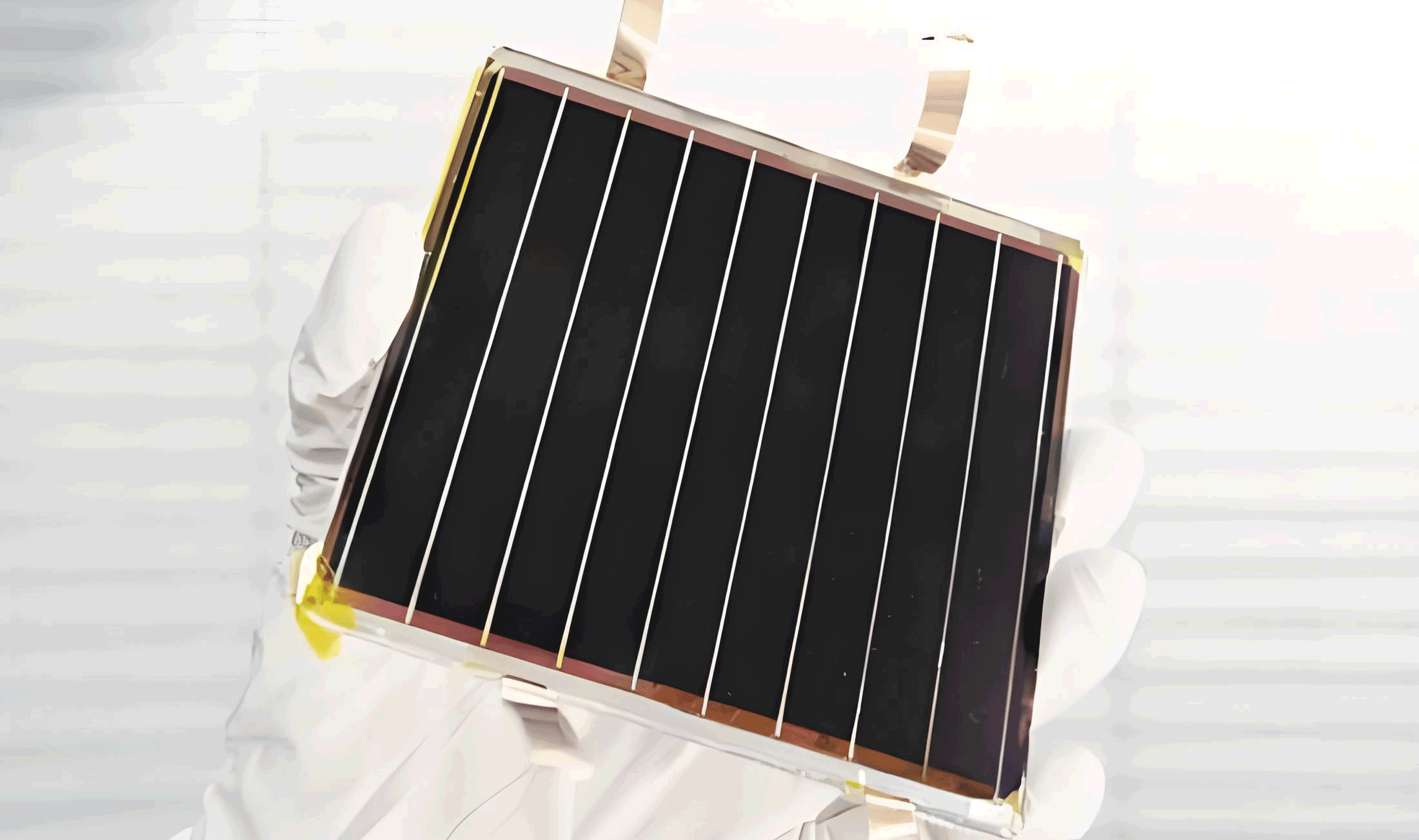
To quantify the improvements, we have conducted extensive testing on inverted perovskite solar cells and modules. The following table summarizes the key performance metrics under standard and harsh conditions:
| Device Type | Area (m²) | PCE (%) | Certified PCE (%) | Stability Test (hours) | Efficiency Retention (%) |
|---|---|---|---|---|---|
| Inverted Perovskite Solar Cell | 0.08 | 26.78 | 26.29 | 1000 | >99 |
| Perovskite Module | 16 | 23.08 | – | – | – |
These results demonstrate that the modified perovskite solar cells maintain over 99% of their initial efficiency after 1000 hours under damp heat conditions (ISOS-D-3 standard). This is a significant achievement, as stability has been a major bottleneck for perovskite solar cell commercialization. We further analyzed the degradation kinetics using the Arrhenius equation to predict lifetime:
$$ k = A e^{-E_a / RT} $$
where \( k \) is the rate constant, \( A \) is the pre-exponential factor, \( E_a \) is the activation energy, \( R \) is the gas constant, and \( T \) is the temperature. Our findings indicate that the encapsulation layer increases \( E_a \), slowing down degradation.
Another critical aspect is the charge carrier dynamics in perovskite solar cells. The diffusion length of electrons and holes can be described by:
$$ L = \sqrt{D \tau} $$
where \( D \) is the diffusion coefficient and \( \tau \) is the carrier lifetime. With the metallofullerene-PMMA coupling, we observed enhanced \( L \) values, leading to higher \( J_{sc} \) and \( FF \). This improvement is crucial for achieving high PCE in large-area perovskite solar cells. Moreover, the fill factor can be optimized by minimizing series resistance (\( R_s \)) and maximizing shunt resistance (\( R_{sh} \)), as shown in the equation:
$$ FF = \frac{V_{mp} J_{mp}}{V_{oc} J_{sc}} \approx \frac{V_{oc} – \frac{kT}{q} \ln\left(\frac{V_{oc} q}{kT} + 0.72\right)}{V_{oc} + \frac{kT}{q}} \left(1 – \frac{R_s}{V_{oc}/J_{sc}}\right) $$
where \( V_{mp} \) and \( J_{mp} \) are the voltage and current at maximum power point, \( k \) is Boltzmann’s constant, \( T \) is temperature, and \( q \) is electron charge. Our devices show reduced \( R_s \) due to better interface contacts.
Nuclear Fusion Components: Enabling Steady-State Operation
Shifting focus to nuclear fusion, we explore advancements in plasma-facing components, which are essential for achieving sustained fusion reactions. In tokamak devices, the divertor and limiter are critical parts that handle extreme heat loads. The energy confinement time (\( \tau_E \)) is a key parameter for fusion feasibility, related to the Lawson criterion for ignition:
$$ n \tau_E T > 3 \times 10^{21} \, \text{keV s m}^{-3} $$
where \( n \) is plasma density and \( T \) is temperature. Recent experiments have demonstrated long-pulse, high-confinement mode (H-mode) operations with temperatures exceeding 100 million degrees Celsius and durations over 1000 seconds. This progress relies on robust materials that can withstand high thermal fluxes and particle erosion.
We have contributed to developing tungsten-copper (W-Cu) composites for divertor and limiter applications. These materials combine the high melting point of tungsten with the excellent thermal conductivity of copper. The thermal stress (\( \sigma \)) in such components under heat flux (\( q \)) can be estimated using:
$$ \sigma = \alpha E \Delta T $$
where \( \alpha \) is the coefficient of thermal expansion, \( E \) is Young’s modulus, and \( \Delta T \) is the temperature gradient. To mitigate this, we optimized the composite microstructure, achieving a thermal conductivity above 200 W/m·K and a strength of over 500 MPa at elevated temperatures.
The following table summarizes performance data from recent fusion experiments involving these components:
| Component | Material | Heat Flux (MW/m²) | Plasma Duration (s) | Temperature (°C) |
|---|---|---|---|---|
| Divertor | W-Cu Composite | 10-20 | 1066 | >1000 |
| Limiter | W-Cu Composite | 5-15 | 1066 | >1000 |
These results highlight the durability of W-Cu components under steady-state H-mode conditions. The development process involved solving challenges like plasma-material interactions and precision manufacturing. For instance, the sputtering yield (\( Y \)) of tungsten under plasma bombardment can be modeled with:
$$ Y = \frac{K \sqrt{E}}{U_0} \left(1 – \sqrt{\frac{E_{th}}{E}}\right) $$
where \( K \) is a constant, \( E \) is incident energy, \( U_0 \) is surface binding energy, and \( E_{th} \) is threshold energy. Our composites exhibit reduced \( Y \), minimizing impurity influx into the plasma.
Furthermore, the cooling efficiency of these components is vital. We applied computational fluid dynamics to design microchannel coolers, where the heat transfer coefficient (\( h \)) is given by:
$$ h = \frac{Nu \cdot k}{D_h} $$
with \( Nu \) as Nusselt number, \( k \) as thermal conductivity, and \( D_h \) as hydraulic diameter. This design ensures effective heat dissipation, preventing thermal overload.
Comparative Analysis and Future Outlook
In comparing perovskite solar cells and fusion components, we note that both fields benefit from advanced materials science. For perovskite solar cells, the focus is on organic-inorganic hybrids and interface modifications, while fusion relies on high-performance metals and composites. The table below contrasts key aspects:
| Aspect | Perovskite Solar Cell | Fusion Component |
|---|---|---|
| Primary Material | Perovskite (e.g., MAPbI3) | Tungsten-Copper Composite |
| Key Challenge | Stability under humidity/heat | Thermal load and erosion |
| Efficiency Metric | PCE (%) | Energy Confinement Time (s) |
| Recent Improvement | 26.78% PCE (small area) | 1066 s plasma duration |
Looking ahead, we anticipate further innovations in perovskite solar cells, such as the integration of multi-junction architectures to surpass the Shockley-Queisser limit. The theoretical maximum efficiency for a single-junction solar cell is approximately 33%, but tandem perovskite-silicon cells could achieve over 40%. The current-voltage characteristics of these devices can be described by the diode equation:
$$ J = J_0 \left( e^{\frac{qV}{nkT}} – 1 \right) – J_{ph} $$
where \( J_0 \) is reverse saturation current, \( n \) is ideality factor, and \( J_{ph} \) is photocurrent. Enhanced interface engineering in perovskite solar cells reduces \( J_0 \) and improves \( n \).
For fusion, the path forward involves scaling up to reactor-grade devices. The triple product \( n T \tau_E \) must exceed specific thresholds for net energy gain. We are exploring advanced cooling techniques and real-time plasma control systems to extend operational limits. The governing equations for plasma dynamics include the magnetohydrodynamics (MHD) equations:
$$ \frac{\partial \rho}{\partial t} + \nabla \cdot (\rho \mathbf{v}) = 0 $$
$$ \rho \left( \frac{\partial \mathbf{v}}{\partial t} + \mathbf{v} \cdot \nabla \mathbf{v} \right) = -\nabla p + \mathbf{J} \times \mathbf{B} + \nabla \cdot \mathbf{\sigma} $$
where \( \rho \) is density, \( \mathbf{v} \) is velocity, \( p \) is pressure, \( \mathbf{J} \) is current density, \( \mathbf{B} \) is magnetic field, and \( \mathbf{\sigma} \) is stress tensor. Robust components like W-Cu divertors enable stable MHD operations.
Conclusion
In summary, we have detailed significant advancements in perovskite solar cell technology and nuclear fusion components. The use of metallofullerene-based encapsulation in perovskite solar cells markedly improves efficiency and stability, pushing these devices closer to commercial viability. Similarly, innovations in tungsten-copper composites for fusion applications support long-pulse plasma operations, critical for future energy systems. We believe that continued research in these areas will accelerate the transition to sustainable energy. Through collaborative efforts and interdisciplinary approaches, we can overcome remaining challenges and achieve groundbreaking performance in both perovskite solar cells and fusion energy.
As we move forward, we will focus on scaling up perovskite solar cell production and enhancing the durability of fusion components under even more extreme conditions. The synergy between materials science, engineering, and fundamental physics will drive these technologies toward practical implementation, ultimately contributing to a cleaner and more secure energy future.