
In the pursuit of sustainable energy solutions, the development of high-performance electrochemical energy storage devices has become paramount. Among these, lithium-ion batteries stand out due to their high energy density, long cycle life, low self-discharge rate, and moderate cost. As global demand for efficient energy storage grows, particularly for electric vehicles and portable electronics, the limitations of current cathode materials have prompted intensive research into alternatives. High-nickel cathode materials, characterized by their high capacity and favorable cycling performance, are regarded as the most promising candidates to replace traditional options like lithium cobalt oxide and lithium iron phosphate. However, their commercialization faces challenges such as structural instability, thermal issues, and cation mixing, which necessitate effective modification strategies. Doping modification, involving the introduction of foreign elements into the crystal lattice, has emerged as a key approach to enhance the electrochemical properties and stability of these materials. This article, from my perspective as a researcher in the field, provides a comprehensive overview of recent progress in doping modifications for high-nickel cathode materials in lithium-ion batteries, incorporating tables and formulas to summarize key findings and mechanisms.
The core challenge in advancing lithium-ion battery technology lies in improving cathode materials, as their performance directly dictates the overall battery capabilities. High-nickel materials, typically with nickel content exceeding 80%, offer high energy density but suffer from drawbacks like lithium compound residues, insufficient structural stability, and limited rate performance. These issues stem from factors such as anisotropic lattice distortions, microcrack formation during cycling, and cation disordering between Li+ and Ni2+ due to their similar ionic radii. To address these, doping modification has been extensively studied, focusing on metal and non-metal elements that can integrate into the lattice to stabilize the structure, enhance ionic conductivity, and suppress detrimental phase transitions. In this discussion, I will delve into single-metal doping, dual-metal doping, and non-metal doping, highlighting their impacts on the electrochemical performance of high-nickel cathodes for lithium-ion batteries.
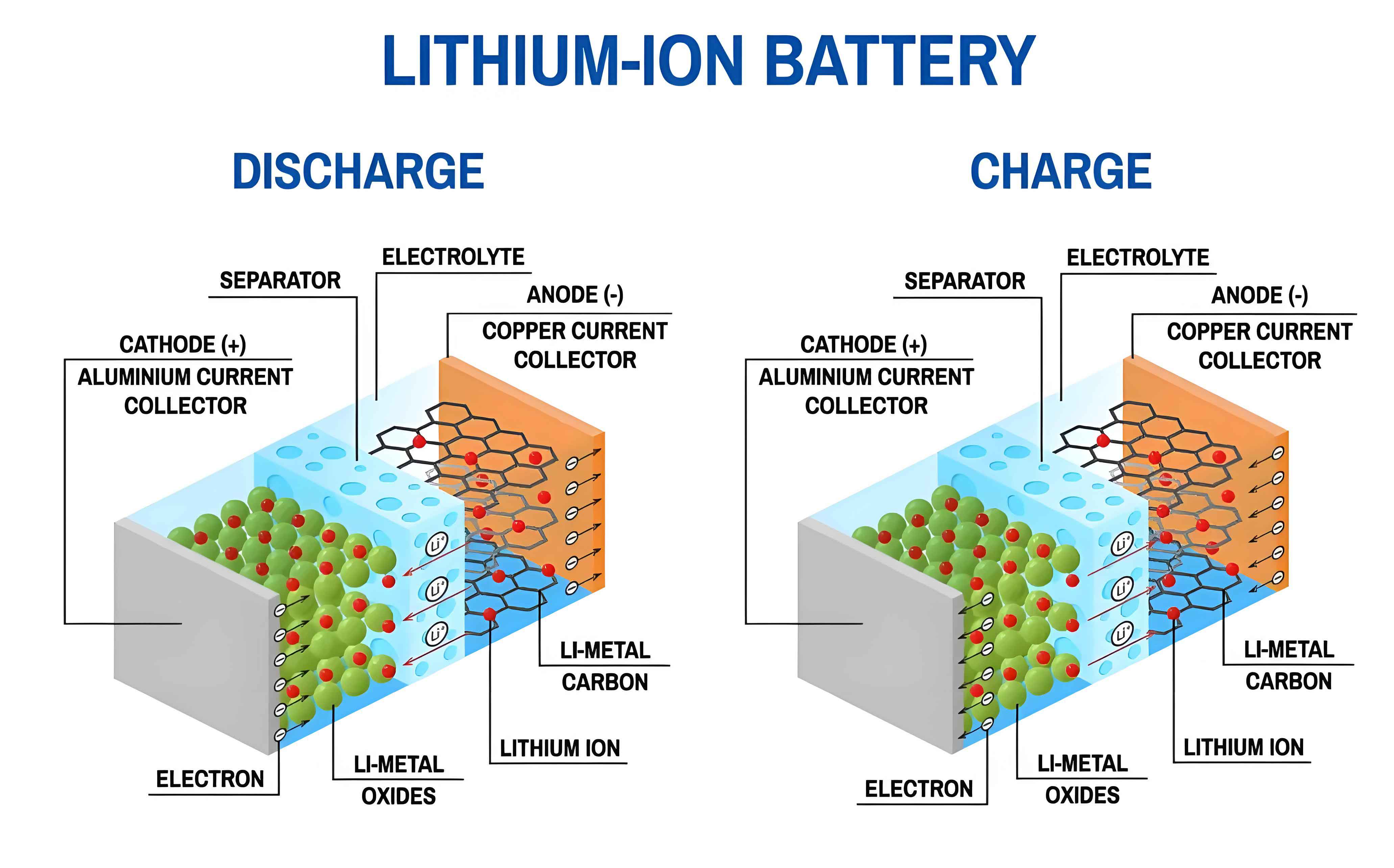
To understand the effects of doping, it is essential to consider the crystal structure of high-nickel materials, commonly represented as LiNixCoyMnzO2 (where x + y + z = 1 and x > 0.8). The layered structure allows for lithium-ion intercalation and deintercalation, but high nickel content can lead to phase transitions, such as from the hexagonal H2 to H3 phase, causing volume changes and microcracks. Doping aims to mitigate these by strengthening the metal-oxygen bonds, expanding lattice parameters, and reducing cation mixing. For instance, the ionic radius of dopants plays a critical role in lattice expansion, which can be expressed as:
$$ \Delta a = k \cdot (r_d – r_{TM}) $$
where $\Delta a$ is the change in lattice parameter, $k$ is a constant, $r_d$ is the ionic radius of the dopant, and $r_{TM}$ is the ionic radius of the transition metal being replaced. This expansion often facilitates lithium-ion diffusion, improving rate capability in lithium-ion batteries. Additionally, the bond dissociation energy of dopant-oxygen bonds, such as Al—O or W—O, contributes to structural stability, which can be quantified using formulas like:
$$ E_{bond} = \frac{D \cdot Z_1 Z_2}{r} $$
where $E_{bond}$ is the bond energy, $D$ is a constant, $Z_1$ and $Z_2$ are the charges of the ions, and $r$ is the bond length. Higher bond energies enhance thermal and electrochemical stability, crucial for the long-term performance of lithium-ion batteries.
Single-metal doping involves introducing one type of metal ion into the high-nickel cathode lattice. Common dopants include Al3+, W6+, and Zr4+, each offering unique benefits. Aluminum doping, for example, leverages the strong Al—O bond to reduce anisotropic lattice distortion and suppress microcracks. In my analysis, Al3+ doping in materials like LiNi0.9Co0.05Mn0.05O2 has shown improved cycle stability, with capacity retention exceeding 95% after 200 cycles at 1 C rate. This is attributed to widened lithium-ion diffusion channels and stabilized interfacial properties. However, excessive Al3+ doping can degrade capacity, highlighting the need for optimal concentration control, typically below 5 mol%. Tungsten doping, with W6+, introduces high valence states that strengthen the crystal structure by forming robust W—O bonds. Research indicates that W6+ doping in LiNi0.95Co0.04Al0.01O2 mitigates H2–H3 phase transitions, leading to a capacity retention of 77.4% after 1,000 cycles. The mechanism involves suppression of microcracks and protection against electrolyte corrosion. Zirconium doping, using Zr4+, promotes charge balance by reducing Ni3+ to Ni2+, thereby enhancing capacity. It also occupies lithium sites to prevent layer-to-spinel transformations, improving stability. For instance, Zr4+-doped LiNi0.8Co0.1Mn0.1O2 exhibits reduced cation mixing and better thermal performance, which is vital for the safety of lithium-ion batteries. To summarize these effects, I present Table 1, which compares key parameters and performance metrics for single-metal dopants in high-nickel cathodes for lithium-ion batteries.
| Dopant Ion | Ionic Radius (Å) | Voltage (V) | Current Density (C) | Specific Capacity (mAh/g) After Doping | Specific Capacity (mAh/g) Before Doping | Cycle Performance (Retention after cycles) | Key Mechanism |
|---|---|---|---|---|---|---|---|
| Al3+ | 0.535 | 4.3 | 0.1 | 215.3 | 211.3 | 60.6% @ 100th | Strengthens Al—O bonds, widens Li+ pathways |
| W6+ | 0.60 | 4.3 | 0.5 | 213.37 | 206.08 | 99.5% @ 300th | Inhibits phase transitions, forms stable W—O bonds |
| Zr4+ | 0.72 | 4.4 | 0.1 | 225.2 | 230.1 | 83% @ 100th | Reduces cation mixing, stabilizes lattice structure |
The electrochemical performance enhancements from single-metal doping can be further analyzed through diffusion kinetics. The lithium-ion diffusion coefficient ($D_{Li}$) often increases with doping, as described by the Arrhenius equation:
$$ D_{Li} = D_0 \exp\left(-\frac{E_a}{RT}\right) $$
where $D_0$ is the pre-exponential factor, $E_a$ is the activation energy, $R$ is the gas constant, and $T$ is the temperature. Doping reduces $E_a$ by expanding lattice spacing, thereby boosting $D_{Li}$ and rate capability in lithium-ion batteries. For example, Al3+ doping has been shown to lower $E_a$ by up to 20%, facilitating faster charge-discharge cycles. This is critical for applications requiring high-power lithium-ion batteries, such as electric vehicles.
Dual-metal doping combines two different metal ions to synergistically improve high-nickel cathode properties. This approach leverages complementary effects, such as structural stabilization and surface protection. Zirconium-aluminum co-doping, for instance, integrates the high bond strength of Zr—O and Al—O to reduce cation mixing and suppress microcracks. In my review, co-doped LiNi0.83Co0.12Mn0.05O2 with Zr4+ and Al3+ demonstrated a capacity retention of 99% at 1°C, significantly higher than the 70% for undoped materials. The coupling effect creates a self-forming interface layer that enhances voltage stability. Magnesium-zirconium co-doping, as seen in Li0.994Mg0.06(Ni0.925Co0.03Mn0.045)0.996Zr0.04O2, expands lattice parameters and reduces particle agglomeration, leading to improved electronic conductivity and cycle life. Aluminum-magnesium co-doping, synthesized via solid-solid interdiffusion, stabilizes the crystal structure and inhibits Li+/Ni2+ mixing, achieving 72% capacity retention after 200 cycles at 4.6 V. The synergistic mechanisms can be quantified using formulas like the effective doping concentration ($C_{eff}$):
$$ C_{eff} = \sum_{i=1}^{n} \alpha_i C_i $$
where $\alpha_i$ is a weighting factor for dopant $i$ based on its ionic charge and radius, and $C_i$ is its concentration. This model helps optimize dual-dopant ratios for maximum performance in lithium-ion batteries. Table 2 summarizes the effects of dual-metal doping on high-nickel cathodes for lithium-ion batteries, highlighting key combinations and outcomes.
| Dopant Combination | Material Example | Voltage (V) | Current Density (C) | Specific Capacity (mAh/g) After Doping | Cycle Performance (Retention after cycles) | Synergistic Mechanism |
|---|---|---|---|---|---|---|
| Zr4+-Al3+ | LiNi0.83Co0.12Mn0.05O2 | 3.0-4.3 | 1 | ~200 | 99% @ 100th | Reduces cation mixing, forms protective interface |
| Mg2+-Zr4+ | Li0.994Mg0.06(Ni0.925Co0.03Mn0.045)0.996Zr0.04O2 | 4.3 | 0.5 | ~210 | 85% @ 200th | Expands lattice, enhances electronic conductivity |
| Al3+-Mg2+ | LiNi0.95Co0.03Al0.01Mg0.01O2 | 4.6 | 0.5 | ~220 | 72% @ 200th | Stabilizes structure, inhibits phase transitions |
The structural benefits of dual-metal doping also relate to the suppression of phase transitions. The H2–H3 phase change, common in high-nickel materials, involves a volume change ($\Delta V$) that can be mitigated by doping. This can be expressed as:
$$ \Delta V = V_{H3} – V_{H2} $$
where $V_{H2}$ and $V_{H3}$ are the unit cell volumes in respective phases. Doping with elements like Zr4+ and Al3+ reduces $\Delta V$ by up to 30%, decreasing microcrack formation and prolonging cycle life in lithium-ion batteries. Additionally, the enhanced thermal stability from co-doping is crucial for safety, as it lowers the risk of thermal runaway in lithium-ion batteries.
Non-metal doping involves incorporating elements such as boron, phosphorus, and fluorine into high-nickel cathodes. These dopants modify the electronic structure and surface chemistry, leading to improved conductivity and stability. Boron doping, with B3+, occupies tetrahedral sites to block transition metal migration, thereby stabilizing the crystal structure. In my assessment, B-doped LiNi0.9Co0.05Mn0.05O2 shows reduced microcracking and enhanced rate performance, delivering 157.13 mAh/g at 10 C. The mechanism involves strengthened B—O bonds and improved lithium-ion diffusion kinetics. Phosphorus and fluorine doping, often used together, optimize the surface layer and bulk properties. Fluorine doping, via F− substitution for O2−, stabilizes the layered structure and reduces oxygen release, enhancing thermal stability. For example, F-doped LiNi0.8Co0.1Mn0.1O2 maintains ordered layers after cycling, with capacity retention of 96.8% after 100 cycles. Phosphorus doping, with P5+, increases electronic conductivity by creating polaron states, and when co-doped with fluorine, it improves reversibility and suppresses polarization. The effects can be modeled using the electrical conductivity ($\sigma$) formula:
$$ \sigma = n e \mu $$
where $n$ is the charge carrier concentration, $e$ is the electron charge, and $\mu$ is the mobility. Non-metal doping often increases $n$ by introducing defects or altering the band structure, boosting $\sigma$ and overall performance in lithium-ion batteries. Table 3 compares non-metal dopants in high-nickel cathodes for lithium-ion batteries, detailing their impacts on electrochemical properties.
| Dopant Ion | Ionic Radius (Å) | Voltage (V) | Current Density (C) | Specific Capacity (mAh/g) After Doping | Specific Capacity (mAh/g) Before Doping | Cycle Performance (Retention after cycles) | Key Mechanism |
|---|---|---|---|---|---|---|---|
| B3+ | 0.83 | 4.3 | 0.1 | 194.3 | 179 | 64.15% @ 100th | Blocks cation migration, stabilizes structure |
| F− | 1.33 | 4.3 | 0.5 | ~180 | ~175 | 96.8% @ 100th | Reduces oxygen release, enhances thermal stability |
| S2− | 1.84 | 4.5 | 0.05 | 270.5 | 261.3 | 81.1% @ 600th | Modifies surface chemistry, improves conductivity |
The optimization of non-metal doping requires careful control of concentration and distribution. For instance, excessive fluorine doping can lead to lattice distortion, while optimal levels (e.g., below 0.06 mol%) enhance performance. The doping efficiency ($\eta_d$) can be approximated as:
$$ \eta_d = \frac{\Delta C}{\Delta C_{max}} \times 100\% $$
where $\Delta C$ is the observed capacity improvement and $\Delta C_{max}$ is the theoretical maximum based on dopant properties. In lithium-ion batteries, non-metal doping typically achieves $\eta_d$ values of 70-90%, indicating high effectiveness in modifying cathode materials.
In conclusion, doping modification is a powerful strategy to overcome the limitations of high-nickel cathode materials in lithium-ion batteries. Through single-metal, dual-metal, and non-metal doping, researchers have made significant strides in enhancing structural stability, electrochemical performance, and safety. Key mechanisms include strengthening metal-oxygen bonds, expanding lattice parameters, reducing cation mixing, and suppressing phase transitions. From my perspective, future work should focus on several areas. First, the introduction of high-valence metal ions like Nb5+ or Ta5+ could further stabilize the crystal structure by increasing bond energies. Second, rational design of dopant combinations and concentrations, possibly using computational models like density functional theory (DFT), can optimize performance. For example, DFT calculations can predict the formation energy ($E_f$) of doped systems:
$$ E_f = E_{doped} – E_{undoped} – \sum_i n_i \mu_i $$
where $E_{doped}$ and $E_{undoped}$ are the total energies of doped and undoped systems, $n_i$ is the number of dopant atoms, and $\mu_i$ is their chemical potential. Negative $E_f$ values indicate stable doping, guiding experimental efforts. Third, advanced characterization techniques, such as in situ X-ray diffraction and electron microscopy, should be employed to monitor doping effects in real-time during lithium-ion battery operation. Additionally, scalability and cost-effectiveness of doping methods need consideration for commercial adoption in lithium-ion batteries. The integration of doping with other strategies, like surface coating or nanostructuring, may yield synergistic benefits. Ultimately, these efforts will contribute to the development of next-generation lithium-ion batteries with higher energy density, longer cycle life, and improved safety, supporting the global transition to sustainable energy. As research progresses, I believe that doping modification will remain a cornerstone in advancing high-nickel cathode materials, paving the way for more efficient and reliable lithium-ion batteries in diverse applications.