
In recent years, perovskite solar cells have emerged as a leading photovoltaic technology due to their exceptional light absorption, tunable bandgaps, and long carrier diffusion lengths. The inverted (p-i-n) structure of perovskite solar cells offers advantages such as simplified fabrication, reduced hysteresis, and compatibility with tandem devices. A critical component in these cells is the hole-transporting layer (HTL), which facilitates efficient charge extraction and minimizes recombination losses. Among various HTLs, anchoring-based self-assembled monolayers (SAMs) have gained prominence for their ability to form uniform, ultra-thin films on transparent conducting oxide (TCO) electrodes, thereby enhancing the performance of perovskite solar cells. These SAMs consist of three key molecular components: terminal groups, spacer groups, and anchoring groups, each playing a vital role in optimizing interface properties, energy level alignment, and stability. This review explores the molecular design strategies and progress in SAM-based HTLs for perovskite solar cells, emphasizing structure-property relationships and future challenges.
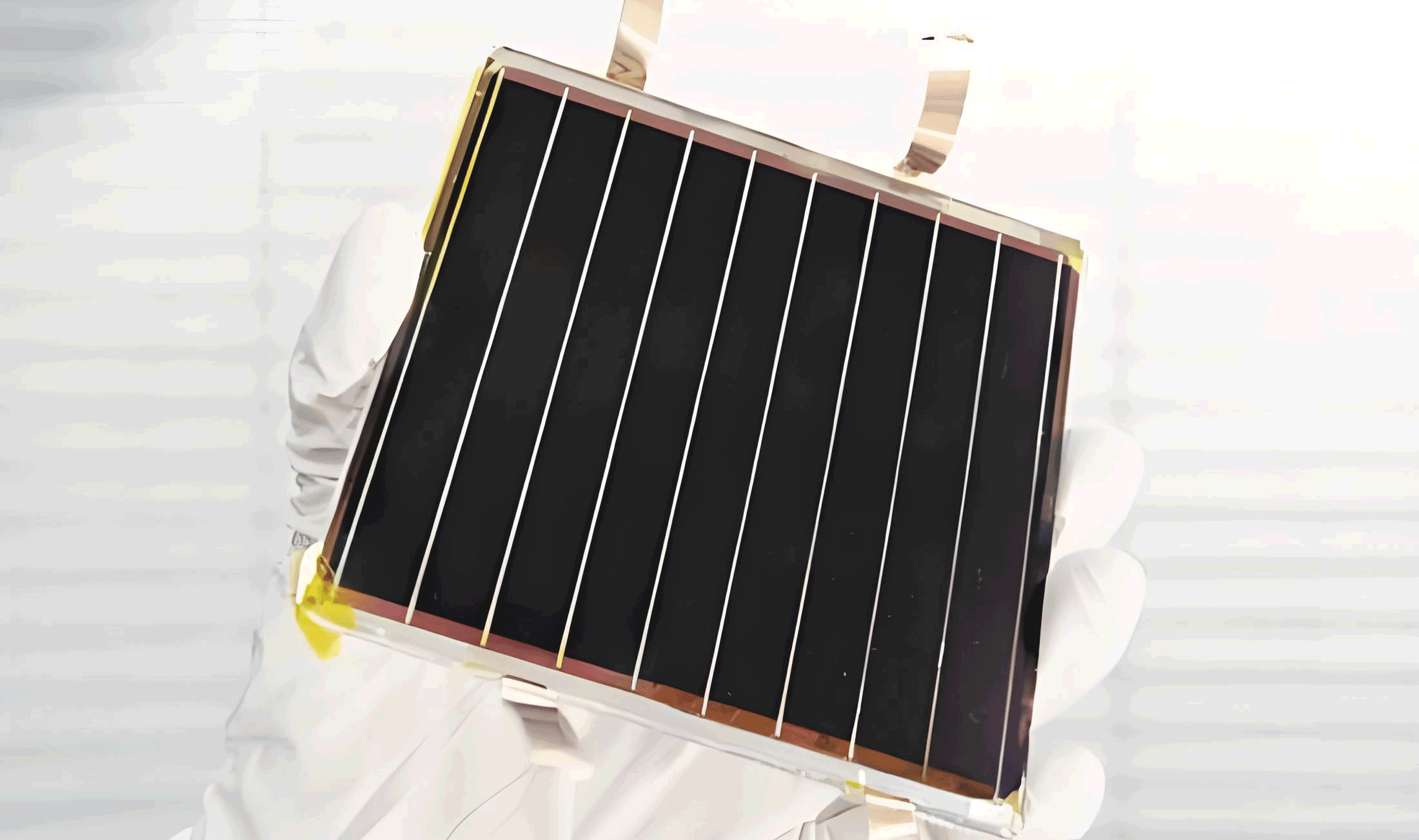
The general structure of a perovskite solar cell comprises a perovskite absorber layer (ABX3, where A = FA+, MA+, Cs+; B = Pb2+, Sn2+; X = I–, Br–, Cl–), sandwiched between electron-transporting layers (ETLs) and hole-transporting layers (HTLs). In inverted perovskite solar cells, light enters through the HTL side, which often employs materials like NiOx, PEDOT:PSS, or PTAA. However, SAM-based HTLs offer superior properties, including minimal parasitic absorption, precise energy level tuning, and enhanced stability. The molecular architecture of SAMs allows for covalent bonding to TCO substrates, forming dense monolayers that improve charge transport and reduce interfacial recombination. For instance, the power conversion efficiency (PCE) of perovskite solar cells using SAMs has exceeded 25%, rivaling traditional HTLs. The performance of a perovskite solar cell can be modeled using the diode equation:
$$ J = J_{SC} – J_0 \left( \exp\left(\frac{qV}{nkT}\right) – 1 \right) $$
where \( J \) is the current density, \( J_{SC} \) is the short-circuit current density, \( J_0 \) is the reverse saturation current, \( q \) is the electron charge, \( V \) is the voltage, \( n \) is the ideality factor, \( k \) is Boltzmann’s constant, and \( T \) is the temperature. SAMs contribute to higher \( J_{SC} \) and open-circuit voltage (\( V_{OC} \)) by optimizing the hole extraction process. The following sections delve into the molecular components of SAMs, supported by tables and equations to summarize key findings.
Terminal Groups in SAMs for Perovskite Solar Cells
Terminal groups in SAM-based HTLs directly interact with the perovskite layer, influencing hole extraction, crystal growth, and defect passivation. Common terminal groups include carbazole, triphenylamine, and phenothiazine derivatives, each offering unique electronic and structural benefits. Carbazole-based terminal groups, for example, exhibit planar structures that promote strong π-π stacking, enhancing charge transport in perovskite solar cells. The highest occupied molecular orbital (HOMO) level of the terminal group must align with the valence band maximum of the perovskite to facilitate efficient hole transfer. The energy level alignment can be described by:
$$ \Delta E = E_{\text{HOMO}} – E_{\text{VB}} $$
where \( \Delta E \) is the energy offset, \( E_{\text{HOMO}} \) is the HOMO level of the SAM, and \( E_{\text{VB}} \) is the valence band energy of the perovskite. A small \( \Delta E \) reduces interfacial energy barriers, improving the fill factor (FF) and \( V_{OC} \) of perovskite solar cells. Table 1 summarizes the properties of various terminal groups used in SAMs for perovskite solar cells.
| Terminal Group | HOMO Level (eV) | Molecular Dipole Moment (D) | PCE (%) | Key Advantages |
|---|---|---|---|---|
| Carbazole (e.g., 2PACz) | -5.2 | 1.3 | 23.5 | Planar structure, strong π-π stacking |
| Methoxy-carbazole (MeO-2PACz) | -5.1 | 1.5 | 24.8 | Improved wettability, reduced recombination |
| Brominated-carbazole (Br-2PACz) | -5.4 | 1.8 | 19.5 | Enhanced stability, defect passivation |
| Triphenylamine (TPA-CPA) | -5.3 | 1.6 | 22.1 | Non-planar, amorphous film formation |
| Phenothiazine (PTZ-CPA) | -5.0 | 2.0 | 25.2 | High dipole moment, sulfur-Pb interaction |
| Pyrene (Py3) | -5.5 | 2.5 | 26.1 | Orthogonal π-skeleton, ultra-stability |
Carbazole derivatives are widely studied due to their favorable HOMO levels and ease of functionalization. For instance, methoxy-substituted carbazole (MeO-2PACz) demonstrates a HOMO level of -5.1 eV, which aligns well with the valence band of typical perovskites (e.g., -5.4 eV for MAPbI3). This alignment minimizes energy losses and boosts the \( V_{OC} \) of perovskite solar cells. The dipole moment of SAMs, influenced by terminal groups, affects the work function of TCO substrates. The interfacial dipole moment (\( \mu \)) can be calculated as:
$$ \mu = \frac{\Delta \Phi \epsilon_0 A}{e} $$
where \( \Delta \Phi \) is the work function change, \( \epsilon_0 \) is the vacuum permittivity, \( A \) is the area, and \( e \) is the elementary charge. Halogenated carbazole groups, such as Br-2PACz, deepen the HOMO level through electron-withdrawing effects, reducing non-radiative recombination in perovskite solar cells. Similarly, phenothiazine-based terminals leverage sulfur atoms to coordinate with Pb2+ ions, passivating interface defects and enhancing the operational stability of perovskite solar cells. Extended π-conjugated systems, like those in pyrene-based SAMs, improve charge delocalization and UV resistance, contributing to PCEs over 26% in perovskite solar cells.
Spacer Groups in SAMs for Perovskite Solar Cells
Spacer groups connect terminal and anchoring units, modulating molecular packing, solubility, and charge transport in SAM-based HTLs for perovskite solar cells. Alkyl chains and conjugated aromatic groups are common spacers, each offering distinct advantages. Alkyl chains provide flexibility and control over molecular orientation, while conjugated spacers enhance electronic coupling and stability. The length and conformation of spacer groups influence the tunneling barrier for charge transport, which can be modeled using the Simmons equation for electron tunneling:
$$ J = J_0 \exp\left(-\beta d\right) $$
where \( J \) is the tunneling current density, \( J_0 \) is a constant, \( \beta \) is the decay coefficient, and \( d \) is the spacer length. Shorter alkyl chains (e.g., C2) reduce tunneling barriers, improving FF in perovskite solar cells, whereas longer chains (e.g., C6) may introduce hysteresis. Multi-anchoring spacers, such as those in triazatruxene derivatives, promote face-on orientation on TCOs, increasing surface coverage and hole extraction efficiency. Table 2 compares different spacer groups in SAMs for perovskite solar cells.
| Spacer Type | Length/Structure | Charge Decay Constant (\( \beta \), nm-1) | PCE (%) | Impact on Perovskite Solar Cells |
|---|---|---|---|---|
| Alkyl Chain (C2) | 2 carbons | 0.8 | 22.5 | Low tunneling barrier, high FF |
| Alkyl Chain (C4) | 4 carbons | 1.0 | 23.0 | Balanced transport and stability |
| Alkyl Chain (C6) | 6 carbons | 1.2 | 21.8 | Increased hysteresis, reduced FF |
| Conjugated Phenyl | Benzene ring | 0.5 | 25.5 | Enhanced delocalization, UV stability |
| Conjugated Vinyl-Phenyl | Extended π-system | 0.4 | 26.2 | Superior hole transport, low loss |
| Multi-anchoring TAT | Triazatruxene core | 0.3 | 23.5 | Face-on orientation, high coverage |
Conjugated spacers, such as phenyl or vinyl-phenyl groups, reduce the optical bandgap and improve the photostability of SAMs in perovskite solar cells. For example, MeO-PhPACz, with a phenyl spacer, exhibits a larger dipole moment (2.89 D) compared to alkyl-based MeO-2PACz (1.31 D), leading to better hole extraction and reduced voltage deficits in wide-bandgap perovskite solar cells. The HOMO-LUMO gap of conjugated SAMs can be approximated using DFT calculations:
$$ E_{\text{gap}} = E_{\text{LUMO}} – E_{\text{HOMO}} $$
where \( E_{\text{LUMO}} \) is the lowest unoccupied molecular orbital energy. Conjugated spacers lower \( E_{\text{LUMO}} \), facilitating electron blocking and minimizing recombination in perovskite solar cells. Additionally, rigid spacers inhibit molecular aggregation, ensuring uniform SAM formation and enhanced durability under operational stress. The co-deposition of SAMs with perovskite precursors, enabled by amphiphilic spacers, simplifies fabrication and scales up perovskite solar cell production.
Anchoring Groups in SAMs for Perovskite Solar Cells
Anchoring groups form covalent or coordination bonds with TCO substrates, ensuring stable SAM adhesion in perovskite solar cells. Common anchoring groups include phosphonic acid (-PO3H2), carboxylic acid (-COOH), sulfonic acid (-SO3H), and boric acid (-B(OH)2), each with distinct bonding strengths and chemical stability. Phosphonic acid groups bind strongly to metal oxides via P-O-M bonds (where M = In, Sn, Ni), but their acidity can corrode ITO, limiting the longevity of perovskite solar cells. The bonding energy (\( E_b \)) between anchoring groups and substrates can be estimated as:
$$ E_b = -\frac{\Delta G}{RT} $$
where \( \Delta G \) is the Gibbs free energy change, \( R \) is the gas constant, and \( T \) is the temperature. Carboxylic acid groups offer milder acidity and are suitable for flexible substrates, while boric acid groups provide robust bonding with minimal degradation. Table 3 outlines the characteristics of anchoring groups in SAMs for perovskite solar cells.
| Anchoring Group | Bond Type | Acidity (pKa) | Stability in Perovskite Solar Cells | PCE (%) |
|---|---|---|---|---|
| Phosphonic Acid | Covalent/Coordination | 2.1 | Moderate, prone to corrosion | 24.0 |
| Carboxylic Acid | Coordination/H-bond | 4.8 | High, compatible with NiOx | 23.5 |
| Sulfonic Acid | Covalent | -2.8 | Low, aggressive to substrates | 21.0 |
| Boric Acid | Coordination | 9.2 | Very high, minimal corrosion | 25.8 |
| Silane-based | Covalent | N/A | Exceptional, for ALD substrates | 26.1 |
Phosphonic acid anchors, as in V1036 and 2PACz, form dense monolayers on ITO, but their strong acidity accelerates interface degradation in perovskite solar cells. Boric acid-based SAMs, such as MTPA-BA, exhibit higher pKa values, reducing substrate corrosion and improving thermal stability. For instance, perovskite solar cells with boric acid SAMs retain over 90% of initial PCE after 500 hours of operation. The adsorption isotherm of SAMs on TCOs can be described by the Langmuir model:
$$ \theta = \frac{K C}{1 + K C} $$
where \( \theta \) is the surface coverage, \( K \) is the adsorption constant, and \( C \) is the SAM concentration. Multi-anchoring groups, like those in 3PATAT-C3, increase \( \theta \) by forming face-on orientations, enhancing hole selectivity in perovskite solar cells. Additionally, amphiphilic anchoring groups improve the wettability of perovskite precursors, enabling uniform coating and reduced defect density. The integration of SAMs with atomic layer deposition (ALD) techniques further strengthens interface adhesion, pushing the PCE of perovskite solar cells beyond 26%.
Conclusions and Future Perspectives
Anchoring-based self-assembled monolayers have revolutionized hole transport in inverted perovskite solar cells by offering precise molecular control, minimal thickness, and enhanced stability. Through rational design of terminal, spacer, and anchoring groups, SAMs optimize energy level alignment, reduce non-radiative recombination, and improve interface morphology in perovskite solar cells. Terminal groups like carbazole and phenothiazine facilitate efficient hole extraction, while conjugated spacers enhance charge delocalization and photostability. Anchoring groups, particularly boric acid and silane derivatives, mitigate corrosion and ensure durable substrate bonding. Despite these advances, challenges remain in scaling SAM-based HTLs for large-area perovskite solar cells and modules. The rough surfaces of FTO substrates hinder uniform SAM formation, necessitating innovative deposition methods. Furthermore, the intrinsic stability of SAMs under combined light, heat, and electric fields requires deeper investigation. Future research should focus on in situ characterization techniques to elucidate dynamic self-assembly processes and quantum tunneling effects in perovskite solar cells. By addressing these issues, SAM-based HTLs can propel perovskite solar cells toward commercial viability, achieving PCEs over 30% in tandem configurations. The continuous optimization of molecular structures will unlock new frontiers in the performance and durability of perovskite solar cells.
In summary, the progress in anchoring-based SAMs underscores their potential as next-generation HTLs for high-efficiency perovskite solar cells. The synergy between molecular engineering and device optimization will drive further innovations, solidifying the role of perovskite solar cells in the global renewable energy landscape.