
The pursuit of efficient, clean, and sustainable energy solutions is paramount in addressing the dual challenges of resource depletion and environmental pollution associated with fossil fuels. In this context, high-performance energy conversion and storage systems are critical. Since their commercialization in the 1990s, lithium-ion batteries have become the cornerstone of modern portable electronics and are rapidly powering the revolution in electric transportation and grid storage, owing to their high energy density, long cycle life, and lack of memory effect.
As the adoption of electric vehicles and advanced portable devices accelerates, consumer demand for extended range and reduced charging times has intensified. Fast-charging technology, therefore, emerges as a crucial solution to alleviate “range anxiety.” While fast charging can be achieved through high-voltage or high-current methods, the latter is more prevalent due to the lower cost implications compared to the stringent insulation and component requirements of high-voltage systems. However, implementing high-current protocols in a lithium-ion battery introduces significant challenges, including accelerated capacity fade, increased risk of thermal runaway, and shortened lifespan. Optimization must occur at both the external application level (charging protocols, thermal management, infrastructure) and the internal material level. The anode material is widely recognized as the primary bottleneck for fast-charging performance in a lithium-ion battery.
Graphite remains the dominant commercial anode material due to its ideal combination of high energy density, low working potential, excellent cycling stability, natural abundance, and mature processing technology. Nonetheless, its inherent kinetic limitations under high currents, leading to capacity decay and hazardous lithium plating, pose the key technical obstacles to achieving rapid charge and discharge in a lithium-ion battery. In this review, I systematically analyze the mechanisms and limiting factors for fast-charging graphite anodes, summarize the main challenges, and discuss the latest optimization strategies. The goal is to provide a comprehensive reference for developing high-rate, safe, and long-lasting fast-charging lithium-ion batteries.
1. Fundamental Mechanisms and Challenges for Fast-Charging Graphite
1.1 Reaction Mechanism of Graphite Electrodes
Graphite possesses a layered structure where sp2-hybridized carbon atoms form hexagonal networks stacked via van der Waals forces. Lithium ions (Li⁺) intercalate into the interlayer spaces, which is the primary storage mechanism. The reaction can be represented as:
$$ xLi^+ + xe^- + 6C \rightleftharpoons Li_xC_6 \quad (0 \leq x \leq 1) $$
This provides a theoretical specific capacity of 372 mAh g⁻¹. Additional, minor storage occurs through adsorption at edge sites and the basal plane surface.
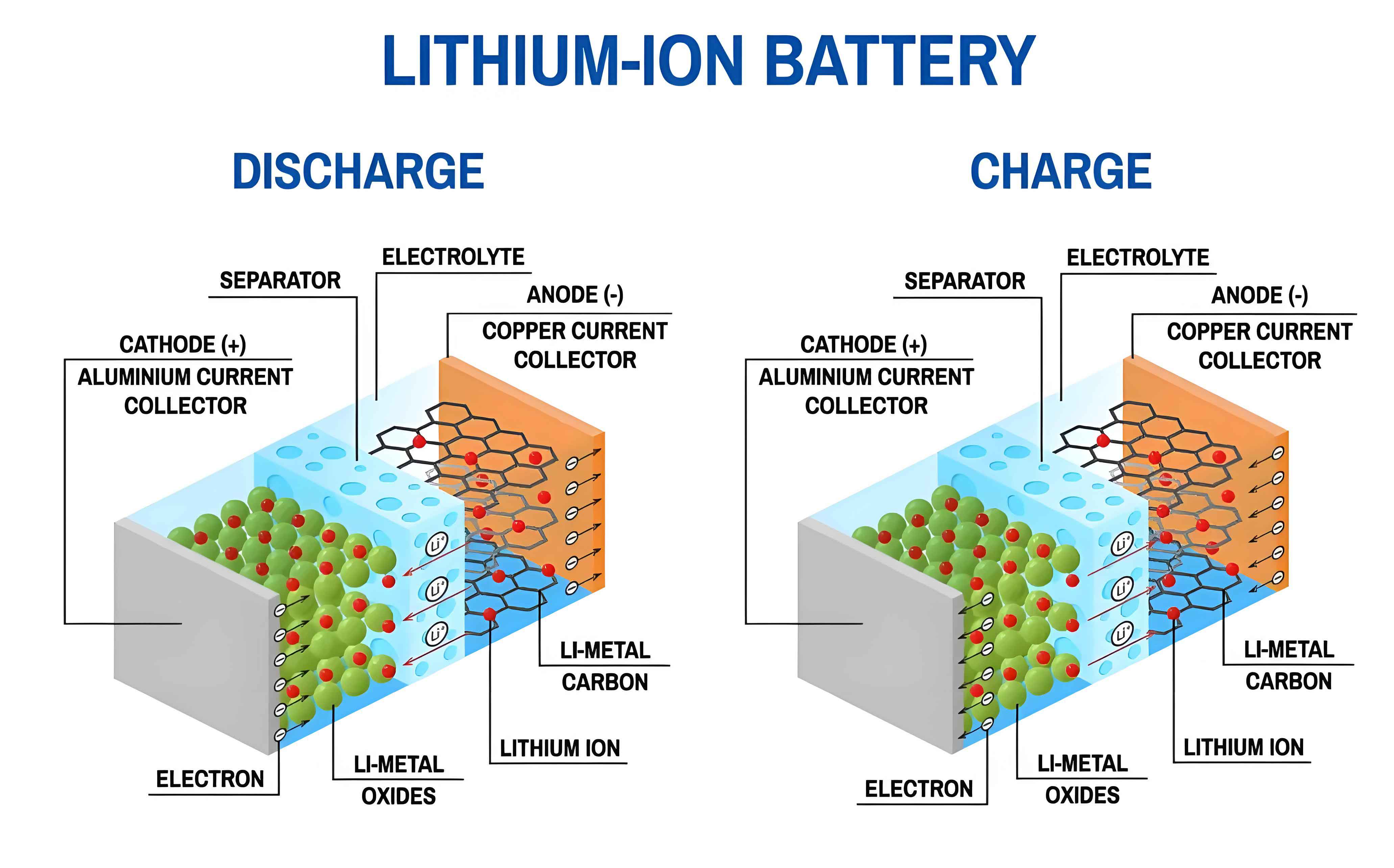
The charging process of a graphite anode in a lithium-ion battery involves a series of kinetic steps: (1) Li⁺ deintercalation from the cathode and diffusion through the Cathode Electrolyte Interphase (CEI); (2) Solvation of Li⁺ in the electrolyte; (3) Migration of solvated Li⁺ through the separator to the graphite surface; (4) Desolvation of Li⁺ at the Solid Electrolyte Interphase (SEI); and (5) Solid-state diffusion of Li⁺ within the graphite bulk. Steps (4) and (5) are identified as the most energy-intensive and rate-limiting for fast charging.
1.2 Limiting Factors and Failure Mechanisms
The fast-charging capability of graphite is constrained by kinetic limitations in both ionic transport and charge transfer processes. The overall process involves multiple resistive steps, with the solid-state diffusion of Li⁺ within the graphite lattice (with a diffusion coefficient, DLi, of ~10⁻¹⁰ cm² s⁻¹) being 2-3 orders of magnitude slower than liquid-phase diffusion or interfacial charge transfer. This makes it the rate-determining step.
Under high-current conditions, these kinetic limitations trigger several critical failure modes that degrade performance and compromise safety in a lithium-ion battery.
1. Lithium Plating and Dendrite Growth: When the Li⁺ intercalation rate cannot keep pace with the applied current, or when the local electrode potential drops below 0 V vs. Li/Li⁺, Li⁺ reduces to metallic lithium on the graphite surface instead of intercalating. This plated lithium can grow into needle-like dendrites. Consequences include:
• Irreversible loss of active lithium (“dead Li”).
• Continuous electrolyte consumption via side reactions.
• Increased impedance and polarization, creating a vicious cycle.
• Risk of internal short-circuit and thermal runaway if dendrites pierce the separator.
2. Structural Degradation and Particle Fracture: Intercalation induces a volume expansion of ~10-13%. Under fast charging, non-uniform Li⁺ concentration gradients generate significant internal stress. Coupled with constraints from inactive materials and the current collector, this stress can cause:
• Graphite particle cracking and exfoliation.
• Loss of electrical contact between active material and the current collector.
• Accelerated capacity fade and increased impedance.
3. SEI Instability and Reformation: The SEI is a passivating layer formed from electrolyte reduction. It is electronically insulating but ionically conductive. The desolvation step at the SEI carries a high energy barrier (~50–70 kJ mol⁻¹). During fast charging:
• High local current densities can rupture the SEI.
• The freshly exposed graphite surface consumes more electrolyte and active Li⁺ to reform the SEI.
• This leads to low Coulombic efficiency, rapid capacity decay, and increased interfacial resistance.
4. Thermal Runaway Risk: High-current operation generates significant irreversible Joule heat (I²R). This can lead to:
• A dangerous positive feedback loop: heat → accelerated side reactions/SEI growth → increased resistance → more heat.
• Non-uniform temperature distribution, causing localized overcharge/over-discharge.
• Decomposition of the electrolyte, producing flammable gases and potentially leading to cell venting, fire, or explosion.
2. Optimization Strategies for Fast-Charging Graphite Anodes
To overcome these challenges, an ideal fast-charging anode must exhibit low barriers for Li⁺ insertion and transport. Key strategies focus on: (1) Enhancing ionic/electronic conductivity; (2) Shortening the Li⁺ solid-state diffusion path; and (3) Suppressing lithium plating. These are achieved through multi-scale structural design, interface engineering, and electrolyte formulation.
2.1 Graphite Crystal Structure Engineering
2.1.1 Expanding the Interlayer Spacing: A slightly enlarged d-spacing between graphite layers reduces the diffusion energy barrier for Li⁺ and provides more active sites. However, excessive expansion can compromise mechanical stability. Controlled expansion via methods like low-temperature ethanol processing or edge activation has proven effective. For instance, sub-angstrom expansion (from 3.36 Å to 3.38 Å) can increase the Li⁺ diffusion coefficient (DLi) by several orders of magnitude, significantly improving rate capability and cycle life.
2.1.2 Heteroatom Doping: Introducing elements like N, B, P, F, or S into the graphite lattice alters its electronic structure and local chemistry. This can enhance electronic conductivity, create more defect sites for Li⁺ storage, and influence SEI composition. The impact of common dopants is summarized below.
| Dopant | Typical Source/Method | Effect on Fast-Charging Performance |
|---|---|---|
| Nitrogen (N) | NH₃ treatment, urea pyrolysis | Enhances electronic conductivity, introduces active sites. |
| Fluorine (F) | PTFE pyrolysis, fluorination | Promotes formation of a LiF-rich, stable SEI layer. |
| Boron (B) | Boric acid, B₂O₃ | Increases electronic conductivity, facilitates Li⁺ intercalation. |
| Phosphorus (P) | Phosphoric acid, (NH₄)₂HPO₄ | Often co-doped with N, widens interlayer spacing. |
| Sulfur (S) | Thiourea, elemental S | Can contribute to forming Li₂S in the SEI, improving ionic conductivity. |
2.2 Micro/Nano-Structural Design
2.2.1 Particle Size Optimization: Particle size critically affects the trade-off between kinetics and stability. Smaller particles shorten the Li⁺ diffusion path but increase the specific surface area, leading to more SEI formation and lower initial Coulombic efficiency. Larger particles offer higher tap density but suffer from slow solid-state diffusion. A narrow distribution of medium-sized particles (e.g., ~10-15 µm) often provides the best balance for fast-charging in a lithium-ion battery.
2.2.2 Porous Structure Fabrication: Creating pores within graphite particles provides additional channels for electrolyte wetting and Li⁺ transport, effectively shortening the diffusion distance. Methods include chemical etching (with KOH, HNO₃), use of pore-forming agents (e.g., PTFE), and laser ablation.
2.2.3 Surface Functionalization: Introducing oxygen-, nitrogen-, or fluorine-containing functional groups (e.g., -COOH, -OH, -C=O, -F) onto the graphite surface modifies its wettability, electronic properties, and interaction with the electrolyte. This can promote the formation of a more conductive and stable SEI. However, excessive functionalization may degrade the crystalline structure.
2.2.4 Surface Coating: Applying a thin, uniform coating is a highly effective strategy to protect the graphite surface, mitigate side reactions, and enhance kinetics. Coatings can be inorganic (e.g., Al₂O₃, TiO2-x, MoOx-MoPx), carbonaceous, or polymeric.
| Coating Type | Example Material | Proposed Function in Fast-Charging |
|---|---|---|
| Metal Oxide | Al₂O₃, TiO2-x | Improves wettability, acts as a physical barrier against electrolyte, reduces interfacial resistance. |
| Metal Phosphide/Chalcogenide | MoPx, MoS₂ | Catalyzes Li⁺ desolvation, forms ionically conductive SEI components (Li₃P, Li₂S). |
| Carbon | Amorphous carbon, graphene | Enhances electronic conductivity, buffers volume changes. |
| Polymer | PMMA, PDA-derived carbon | Provides flexible, ion-conducting layer, stabilizes the interface. |
2.2.5 Composite Structure Design: Combining graphite with other materials can synergistically improve performance.
• Graphite/Hard Carbon Composites: Hard carbon offers fast surface-driven kinetics, helping to homogenize current distribution and reduce local Li-plating tendency on graphite during fast charge.
• Graphite/High-Capacity Material Composites: Incorporating materials like silicon, tin oxides, or niobium oxides can increase overall capacity. The composite structure must be carefully designed to accommodate the large volume change of the high-capacity component.
• Graphite/Vertically Aligned Graphene: Vertical graphene sheets grown on graphite provide highly conductive pathways for rapid electron and ion transport.
2.3 Electrode/Electrolyte Interface Modification
The native SEI formed in situ is often heterogeneous and unstable under fast-charge conditions. Constructing an artificial SEI (ASEI) with designed composition and properties is a promising approach. An ideal ASEI for fast-charging should have high ionic conductivity, mechanical robustness, and uniformity.
| ASEI Construction Method | Brief Description | Key Materials/Examples |
|---|---|---|
| Physical Deposition | Sputtering, evaporation, or drop-casting of precursor layers. | ALD-Al₂O₃, LiF precursor solutions. |
| Chemical Reaction | In-situ chemical or electrochemical reaction on the surface. | Electrochemically formed Li₃PO₄/LiF layers. |
| Self-assembly/In-situ Polymerization | Precursor molecules polymerize or assemble on the surface. | Polydopamine coating, in-situ gel polymer electrolytes. |
A prominent example is the construction of a lithium phosphide (Li₃P)-based ASEI. Li₃P is a fast ionic conductor that can weaken the Li⁺-solvent interaction, significantly lowering the desolvation energy barrier. This has been shown to enable excellent fast-charging performance and even low-temperature operation for graphite anodes in lithium-ion batteries.
2.4 Electrolyte Functionalization
The electrolyte formulation is paramount for fast-charging, as it governs Li⁺ solvation/desolvation and migration. An optimal fast-charge electrolyte requires high ionic conductivity, a high Li⁺ transference number, and the ability to form a stable, low-impedance SEI.
2.4.1 Lithium Salts: Moving beyond conventional LiPF₆ is often necessary. Salts like LiFSI offer higher conductivity and thermal stability, and promote better SEI formation. Locally concentrated electrolytes or novel low-concentration electrolytes are also being explored to manipulate the solvation structure and interfacial chemistry.
2.4.2 Solvents and Additives: Solvent blends balancing low viscosity and good salt dissociation are key. Ether-based solvents (e.g., DOL, DME) often exhibit faster kinetics than carbonates but present challenges with high-voltage cathodes. Functional additives are crucial; they decompose preferentially to form a protective SEI. For example, film-forming additives like FEC, VC, or novel molecules like glyme-LiNO₃ can create robust interfaces that suppress Li plating and electrolyte decomposition during fast charge.
The properties of common electrolyte components are compared below:
| Component | Type/Example | Advantage for Fast-Charge | Disadvantage/Limitation |
|---|---|---|---|
| Lithium Salt | LiFSI | High conductivity, stable SEI | Corrosive to Al current collector |
| LiDFOB | Good SEI-forming ability, stable | Moderate conductivity, cost | |
| Solvent | Linear Carbonates (DMC, EMC) | Low viscosity | Poor film-forming ability alone |
| Ethers (DME, DOL) | Fast kinetics, low viscosity | Low anodic stability | |
| Additive | FEC, VC | Forms stable, thin SEI | May increase gas evolution |
| LiNO₃, CS-based additives | Suppresses Li dendrites, modifies SEI | Limited solubility in carbonates |
2.5 Other Supporting Strategies
Pre-lithiation: Compensating for the initial irreversible lithium loss by pre-lithiating the graphite anode can improve the initial Coulombic efficiency and provide a “lithium reservoir,” mitigating degradation during subsequent fast-charging cycles.
Advanced Charging Protocols: Smart charging algorithms, such as Multi-Step Constant Current (MSCC) coupled with Active Control Pulse (ACP) techniques, can dynamically control the current based on the state of charge (SOC). These protocols help manage polarization and proactively remove incipient lithium plating, extending the fast-charging cycle life of the lithium-ion battery.
Current Collector Design: Innovative 3D porous current collectors can reduce the local current density on the electrode surface, shorten Li⁺ transport pathways, and improve mechanical adhesion, collectively enhancing fast-charge capability.
3. Conclusion and Perspectives
Graphite is likely to remain the dominant anode material for commercial lithium-ion batteries in the foreseeable future. Therefore, overcoming its fast-charging limitations is of paramount importance. The primary challenges—lithium plating, structural degradation, SEI instability, and thermal risks—stem from intrinsic kinetic bottlenecks under high current densities.
This review has outlined a multi-faceted approach to optimizing graphite for fast-charging applications. Strategies span from atomic-scale crystal engineering (doping, layer spacing control) and micro/nano-structural design (size control, porosity, coating) to interface engineering (artificial SEI) and electrolyte formulation. The key is to accelerate Li⁺ transport (both in the bulk and across interfaces) while stabilizing the electrode structure and suppressing side reactions.
Despite significant progress, challenges remain for the practical implementation of these strategies. The interplay and potential synergies between different modification methods are not fully understood. Scalability, cost, and environmental impact of advanced processing techniques (e.g., ALD, CVD) need to be addressed. Furthermore, the performance validation of these advanced anodes must be conducted in full-cell configurations under realistic fast-charging protocols, not just in half-cells.
Future research should focus on: (1) In-situ/operando and multi-scale characterization to deepen the mechanistic understanding of degradation and protection under fast-charge conditions. (2) Developing cost-effective and scalable synthesis/modification routes. (3) Employing machine learning and high-throughput computational screening to discover new coating materials, dopants, and electrolyte formulations. (4) Holistic cell design that integrates the optimized anode with compatible cathodes, electrolytes, and charging algorithms.
By advancing along these directions through interdisciplinary collaboration, the next generation of high-performance lithium-ion batteries with exceptional fast-charging capability, long cycle life, and uncompromised safety can be realized, ultimately accelerating the global transition to sustainable electric mobility and energy storage.