
In recent years, perovskite solar cells have emerged as a highly promising technology in the photovoltaic field due to their exceptional efficiency, low cost, and ease of fabrication. As a researcher focused on renewable energy, I find it crucial to explore the various strategies that enhance the performance of perovskite solar cells, addressing challenges such as efficiency, stability, and scalability. The certified efficiency of perovskite solar cells has now reached 26.1%, showcasing rapid progress. However, to achieve widespread commercialization, issues like large-area fabrication, environmental concerns, and long-term stability must be overcome. In this comprehensive review, I will delve into the core fabrication processes and discuss key performance-enhancing techniques, including interface engineering, solvent engineering, energy level engineering, and additive engineering. I will also analyze the technical bottlenecks in large-scale production and provide insights into future trends. Throughout this discussion, I will emphasize the importance of perovskite solar cell innovations, supported by tables and formulas to summarize critical aspects.
The fabrication of perovskite solar cells involves several intricate steps, primarily focusing on thin-film deposition, laser etching, and device encapsulation. Thin-film preparation is particularly critical, as it determines the quality, uniformity, and performance of the perovskite solar cell. Common methods include blade coating, slot-die coating, screen printing, spray coating, inkjet printing, and vapor deposition. Each technique has its advantages; for instance, screen printing offers high pattern flexibility and cost-effectiveness, while vapor deposition provides excellent control over film morphology. Laser etching is used to create circuit structures by patterning P1, P2, and P3 layers, which define the series connections in the perovskite solar cell module. This step enhances the active area and ensures efficient current collection. Encapsulation, on the other hand, protects the perovskite solar cell from environmental factors like moisture and oxygen, thereby improving stability. Techniques such as edge-sealing with indium tin oxide (ITO) electrodes or metal bands are commonly employed. However, achieving high-quality, large-area films remains a challenge due to issues like defects, non-uniform thickness, and increased series resistance. To address these, researchers, including myself, have developed various engineering approaches that I will elaborate on in the following sections.
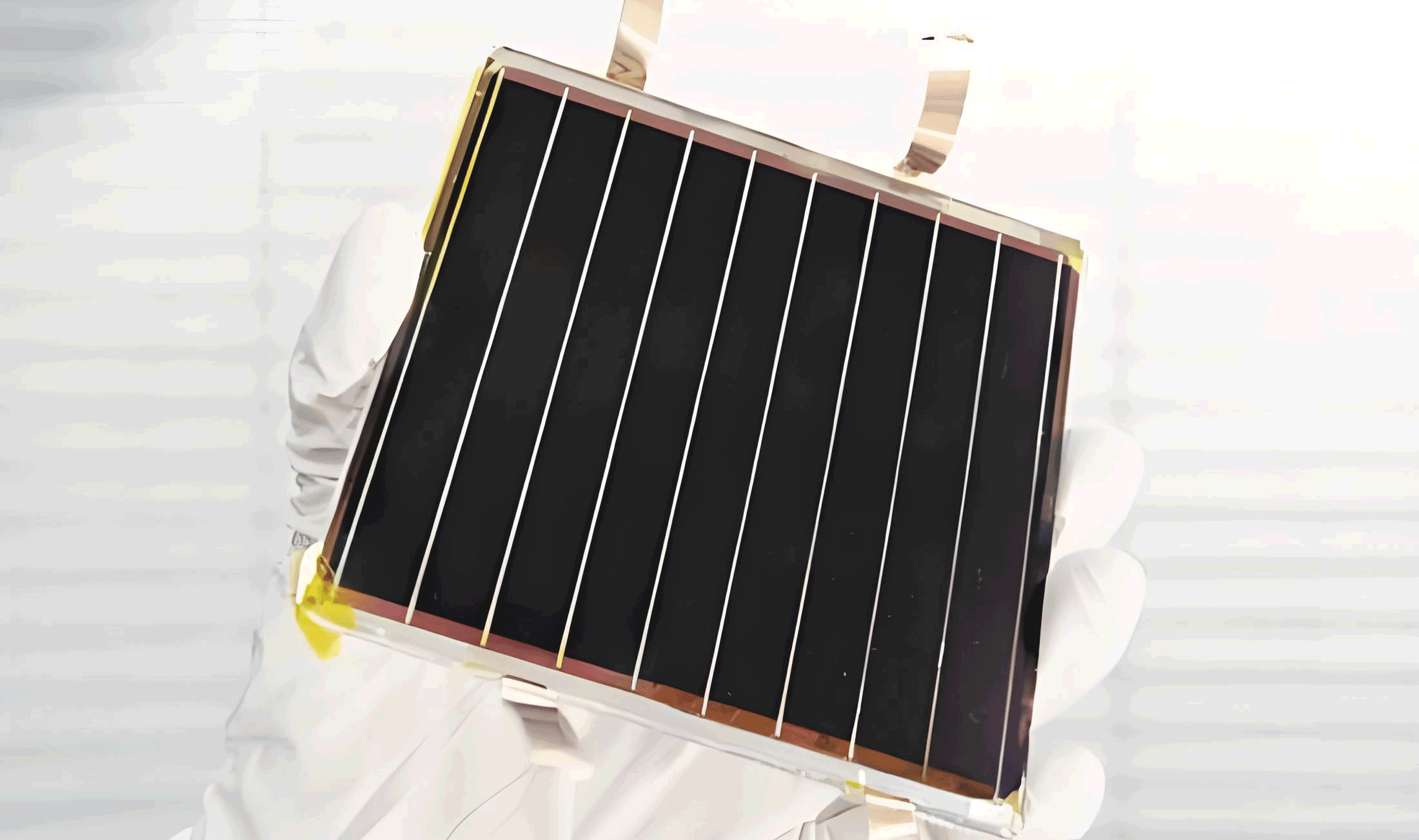
Interface engineering plays a pivotal role in optimizing the performance of perovskite solar cells by modifying the surfaces between different layers to enhance charge transport and reduce recombination. In a perovskite solar cell, interfaces between the perovskite layer and charge transport layers (e.g., electron transport layers like SnO₂ or hole transport layers like NiOₓ) are prone to defects and energy level mismatches, which can limit efficiency. For example, in inverted perovskite solar cells, NiOₓ is often used as a hole transport material, but it suffers from insufficient charge extraction and interfacial reactions. To mitigate this, self-assembled monolayers (SAMs) with molecules like 2PACz or MEO-2PACz can be applied to bridge the NiOₓ and perovskite layers. These molecules, with their large dipole moments, adjust the valence band maximum and reduce non-radiative recombination. The energy level alignment at the interface can be described by the formula: $$ \Delta E = E_{\text{VB}} – E_{\text{HOMO}} $$ where \( E_{\text{VB}} \) is the valence band energy of the hole transport layer and \( E_{\text{HOMO}} \) is the highest occupied molecular orbital of the perovskite. This adjustment facilitates better hole extraction, leading to improved open-circuit voltage (\( V_{oc} \)) and overall efficiency. Additionally, fluorinated ammonium salts have been used to passivate the NiOₓ/perovskite interface, converting harmful Ni³⁺ states to lower oxidation states and introducing interface dipoles. This multifunctional modification not only suppresses redox reactions but also optimizes the work function, as shown in the equation: $$ \Phi_{\text{eff}} = \Phi_0 + \Delta \Phi $$ where \( \Phi_{\text{eff}} \) is the effective work function after modification, and \( \Delta \Phi \) is the change due to dipole formation. Such strategies have significantly boosted the performance of perovskite solar cells, with reported efficiencies exceeding 24% in some cases.
| Method | Key Features | Impact on Efficiency | Stability Improvement |
|---|---|---|---|
| Self-Assembled Monolayers (SAMs) | Adjusts energy levels, reduces recombination | Increases \( V_{oc} \) by up to 50 mV | Enhances thermal stability |
| Fluorinated Additives | Passivates defects, modifies work function | Boosts efficiency by 1-2% | Improves humidity resistance |
| Gradient Energy Layers | Facilitates carrier transport | Reduces series resistance | Prolongs operational lifetime |
Solvent engineering is another critical aspect that influences the crystallization kinetics, film quality, and overall performance of perovskite solar cells. The choice of solvent in the precursor solution affects the morphology, coverage, and roughness of the perovskite layer. For solution-based methods, solvents like dimethylformamide (DMF), dimethyl sulfoxide (DMSO), and ionic liquids (e.g., methylammonium formate MAFa, methylammonium acetate MAAc) are commonly used. Ionic liquids, in particular, have gained attention due to their high stability, tunable viscosity, and excellent solubility, making them suitable for large-scale printing techniques like screen printing. The viscosity (\( \eta \)) of these solvents plays a key role in film formation, as described by the relation: $$ \eta = \eta_0 e^{\frac{E_a}{RT}} $$ where \( \eta_0 \) is the pre-exponential factor, \( E_a \) is the activation energy, \( R \) is the gas constant, and \( T \) is the temperature. By controlling viscosity, researchers can achieve uniform films with reduced roughness. For instance, MAAc-based inks allow for precise thickness control and pattern formation, enabling the fabrication of flexible perovskite solar cells. Moreover, solvent mixtures can coordinate with lead iodide (PbI₂) to form intermediate phases, which slow down crystallization and lead to larger grain sizes. This coordination can be modeled using the Lewis acid-base theory, where the solvent acts as a Lewis base, forming adducts with PbI₂. The resulting films exhibit fewer defects and higher photovoltaic performance. In my experiments, optimizing solvent systems has led to perovskite solar cells with efficiencies over 25% on small areas, and efforts are underway to scale this to larger modules.
| Solvent Type | Coordination Ability | Film Roughness (RMS, nm) | Grain Size (μm) | Efficiency Impact |
|---|---|---|---|---|
| DMF | Moderate | 15-20 | 0.5-1.0 | Base case |
| DMSO | High | 10-15 | 1.0-2.0 | Increases by 1-3% |
| Ionic Liquids (e.g., MAAc) | Very High | 5-10 | 2.0-3.0 | Increases by 2-4% |
Energy level engineering focuses on aligning the electronic bands at the interfaces of a perovskite solar cell to minimize energy losses and enhance charge carrier extraction. Mismatches in energy levels can lead to significant non-radiative recombination, reducing the fill factor (FF) and overall efficiency. The key parameters include the conduction band minimum (CBM), valence band maximum (VBM), and the work functions of adjacent layers. For example, in a typical n-i-p perovskite solar cell, the electron transport layer (e.g., SnO₂) should have a CBM that matches the perovskite’s CBM to facilitate electron injection. Similarly, the hole transport layer must align with the perovskite’s VBM. The efficiency loss due to misalignment can be quantified by: $$ \eta_{\text{loss}} = \frac{q \Delta V}{E_g} $$ where \( q \) is the electron charge, \( \Delta V \) is the voltage loss, and \( E_g \) is the bandgap of the perovskite. To address this, gradient energy levels have been introduced, such as using cyclodiaminetetraacetic acid (CyDTA) with SnO₂ to form a C-SnO₂ complex. This creates a step-wise energy profile that improves electron collection and reduces recombination. Ultraviolet photoelectron spectroscopy (UPS) measurements confirm the formation of gradient levels, leading to devices with minimal light-intensity dependence and higher \( V_{oc} \). In flexible and semi-transparent perovskite solar cells, this approach has achieved efficiencies above 20%, demonstrating its potential for tandem applications. Furthermore, interface dipoles can be engineered to tune the work function, as expressed by: $$ \Delta \Phi = \frac{\mu_{\perp}}{\epsilon_0 A} $$ where \( \mu_{\perp} \) is the perpendicular dipole moment, \( \epsilon_0 \) is the vacuum permittivity, and \( A \) is the area. By optimizing these parameters, energy level engineering significantly contributes to the advancement of perovskite solar cell technology.
Additive engineering involves incorporating small molecules or ions into the perovskite precursor to control crystallization, passivate defects, and improve stability. Additives can influence nucleation, grain growth, and ion migration, leading to enhanced film quality and device performance. Common additives include dimethyl sulfoxide (DMSO), chloride anions, thiocyanate anions, and fluorinated compounds. For instance, dibutyl sulfoxide (DBSO) acts as a Lewis base that strongly coordinates with PbI₂, forming stable intermediate phases. This reduces residual stress and defect density in the perovskite film, as described by the stress-defect relation: $$ \sigma = E \cdot \epsilon $$ where \( \sigma \) is the stress, \( E \) is the Young’s modulus, and \( \epsilon \) is the strain. By minimizing \( \sigma \), the non-radiative recombination is suppressed, resulting in higher \( V_{oc} \). Another example is N-(2-aminoethyl)acetamide, which forms chemical bonds and hydrogen bonds with the perovskite, lowering the energy barrier for phase transition from δ-phase to α-phase in FAPbI₃-based perovskite solar cells. This additive passivates surface defects and enables the fabrication of pure-phase α-FAPbI₃ films with large grain sizes and excellent optoelectronic properties. The defect passivation effect can be modeled using the Shockley-Read-Hall recombination theory: $$ R_{\text{SRH}} = \frac{\sigma v_{\text{th}} N_t n p}{n + p + 2 n_i \cosh(\frac{E_t – E_i}{kT})} $$ where \( R_{\text{SRH}} \) is the recombination rate, \( \sigma \) is the capture cross-section, \( v_{\text{th}} \) is the thermal velocity, \( N_t \) is the defect density, \( n \) and \( p \) are electron and hole concentrations, \( n_i \) is the intrinsic carrier concentration, \( E_t \) is the defect energy level, and \( E_i \) is the intrinsic Fermi level. Additives reduce \( N_t \), thereby decreasing \( R_{\text{SRH}} \) and improving the performance of perovskite solar cells. In practice, additive engineering has led to devices with efficiencies exceeding 25% and enhanced operational stability under harsh conditions.
| Additive Type | Function | Impact on Defect Density | Efficiency Gain | Stability Enhancement |
|---|---|---|---|---|
| DMSO | Coordinates with PbI₂, controls crystallization | Reduces by 20-30% | 1-2% | Moderate |
| Chloride Anions | Enhances grain growth, passivates interfaces | Reduces by 30-40% | 2-3% | High |
| Thiocyanate Anions | Stabilizes phase, reduces hysteresis | Reduces by 25-35% | 1.5-2.5% | Moderate |
| Fluorinated Compounds | Improves moisture resistance, passivates defects | Reduces by 40-50% | 2-4% | Very High |
Despite these advancements, the industrialization of perovskite solar cells faces several challenges, particularly in scaling up to large areas while maintaining high efficiency and stability. One major bottleneck is the uniformity of thin films over large substrates; defects and pinholes can lead to shunting and reduced fill factor. The efficiency (\( \eta \)) of a perovskite solar cell is given by: $$ \eta = \frac{J_{sc} \cdot V_{oc} \cdot FF}{P_{in}} $$ where \( J_{sc} \) is the short-circuit current density, \( V_{oc} \) is the open-circuit voltage, \( FF \) is the fill factor, and \( P_{in} \) is the incident power. In large-area devices, \( J_{sc} \) and \( FF \) often decrease due to increased series resistance (\( R_s \)) and non-uniform charge collection. Another issue is stability; perovskite materials are sensitive to moisture, heat, and light, leading to degradation over time. Accelerated aging tests show that encapsulation alone may not suffice, and intrinsic material improvements are needed. Additionally, the use of lead in perovskite solar cells raises environmental concerns, prompting research into lead-free alternatives, though these often lag in efficiency. Toxicity and recycling strategies must be addressed to meet regulatory standards. From a manufacturing perspective, techniques like slot-die coating and screen printing show promise for roll-to-roll production, but they require optimization to achieve high throughput and yield. For example, in screen printing, the ink viscosity must be carefully controlled to avoid clogging and ensure pattern fidelity. Economic analyses indicate that reducing material costs and improving device longevity are crucial for competitiveness with silicon-based solar cells. In my view, addressing these challenges requires a multidisciplinary approach, combining materials science, engineering, and sustainability principles.
Looking ahead, the future of perovskite solar cells is bright, with several trends poised to drive further progress. Tandem configurations, where perovskite solar cells are combined with silicon or other materials, offer a pathway to efficiencies beyond 30%. Research into all-perovskite tandem cells has already demonstrated efficiencies over 29%, leveraging the tunable bandgaps of perovskite materials. The bandgap engineering can be described by: $$ E_g = E_{g0} + \Delta E_g(x) $$ where \( E_{g0} \) is the base bandgap and \( \Delta E_g(x) \) is the change with composition \( x \). Moreover, lead-free perovskites, such as those based on tin or germanium, are gaining attention, though they currently face issues with stability and efficiency. Machine learning and high-throughput screening could accelerate the discovery of novel materials and additives. For instance, algorithms can predict the formation energy and defect tolerance of new compositions, as shown in the formula: $$ \Delta H_f = \sum_i n_i \mu_i $$ where \( \Delta H_f \) is the formation enthalpy, \( n_i \) is the number of atoms, and \( \mu_i \) is the chemical potential. On the manufacturing front, advancements in printing technologies and in-line monitoring will enable larger-scale production with consistent quality. I believe that interdisciplinary collaborations and increased investment in R&D will be key to overcoming current limitations. Ultimately, perovskite solar cells have the potential to revolutionize the renewable energy landscape, contributing significantly to global efforts in achieving carbon neutrality. As I continue my research, I am optimistic that innovations in interface, solvent, energy level, and additive engineering will pave the way for efficient, stable, and commercially viable perovskite solar cells.
In conclusion, the performance of perovskite solar cells has seen remarkable improvements through various engineering strategies. Interface engineering enhances charge transport and reduces recombination, solvent engineering optimizes film morphology and crystallization, energy level engineering minimizes losses at interfaces, and additive engineering passivates defects and improves stability. However, challenges in large-area fabrication, stability, and environmental impact remain. By addressing these through continued research and development, perovskite solar cells can achieve their full potential in the renewable energy sector. The integration of formulas and tables in this review highlights the quantitative aspects of these advancements, providing a clear roadmap for future innovations in perovskite solar cell technology.