
In the context of global energy crises and environmental concerns, the focus on renewable energy sources has intensified, with solar power standing out due to its widespread availability and cleanliness. Off-grid solar systems, which operate independently of the main electrical grid, are particularly vital in remote areas such as mountainous regions and islands. These systems typically comprise photovoltaic arrays, inverters, battery banks, and controllers. Among these components, the battery bank plays a critical role by storing excess energy generated during the day and supplying it to loads via inverters at night. Given the high cost and maintenance challenges associated with batteries, real-time monitoring is essential to ensure efficiency and longevity. In off-grid solar systems, accurately measuring the voltage of individual cells in a series-connected battery bank is paramount, as the overall performance often hinges on the weakest cell. This paper explores innovative methods for voltage detection, emphasizing the importance of precision and reliability in such systems.
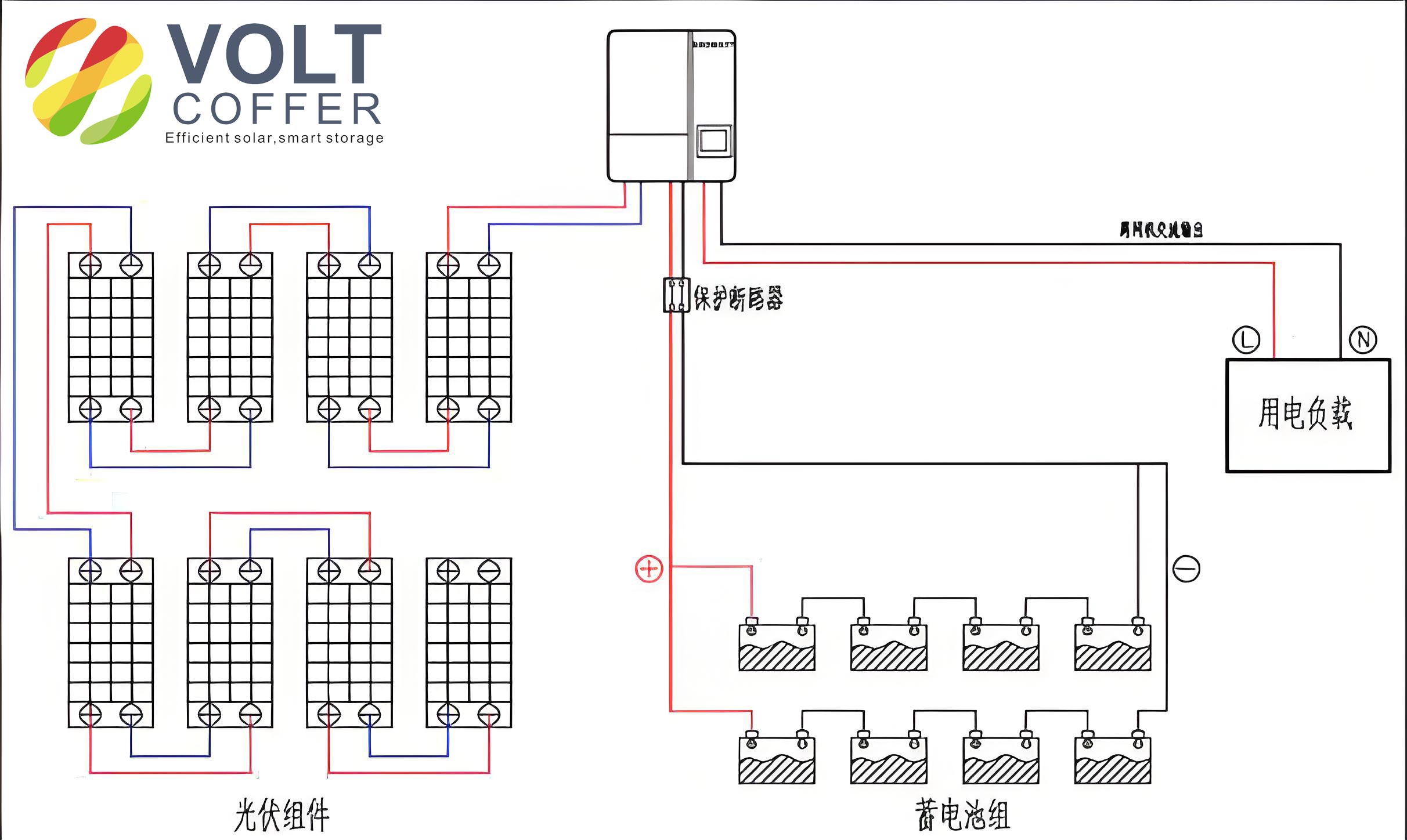
Voltage serves as a key indicator of battery status in off-grid solar systems, reflecting charge and discharge cycles, float voltage adequacy, extreme voltage limits, and state of charge estimation. Moreover, it helps assess the uniformity of the battery bank. Traditional methods for measuring series battery voltages include common-mode and differential-mode approaches, each with limitations. Common-mode measurement, for instance, relies on a single reference point and proportional resistive attenuation, but it suffers from cumulative errors and reduced accuracy as the number of series cells increases. This makes it suitable only for applications with few cells or low precision requirements. Differential-mode methods, such as relay-based switching, V/F conversion, and linear circuit sampling, offer alternatives but introduce issues like mechanical delays, low lifespan, poor linearity, and high costs. In this work, we propose a novel differential-mode measurement technique that leverages an optimized switch matrix circuit to sequentially select individual cells, coupled with isolation and conditioning circuits, to feed signals into a digital signal processor’s analog-to-digital converter (ADC) module. This approach enhances speed, accuracy, and resource efficiency, making it ideal for off-grid solar systems where reliability is crucial.
The significance of off-grid solar systems cannot be overstated, as they provide sustainable energy solutions in isolated locations. However, the battery management in these systems demands careful attention to prevent failures that could arise from individual cell degradation. By focusing on voltage measurement, we can proactively address issues such as overcharging, deep discharge, and capacity fading. This paper details the design and optimization of our method, including mathematical formulations and experimental validation, to demonstrate its superiority over existing techniques. Throughout this discussion, we will repeatedly emphasize the application in off-grid solar systems to underscore its relevance and practical benefits.
Existing Methods for Series Battery Voltage Measurement
In off-grid solar systems, the measurement of series-connected battery voltages is typically categorized into common-mode and differential-mode methods. Common-mode measurement involves referencing all voltage points to a common ground, using precision resistors to attenuate the voltages proportionally. For a series battery bank with n cells, the voltage of each cell is derived by subtracting adjacent measured voltages. For example, the voltage of cell BAT1 is V1, BAT2 is V2 – V1, and so on up to BATn as Vn – Vn-1. While this method is simple and cost-effective, it introduces cumulative errors that escalate with the number of cells. The relative error for the k-th cell can be expressed as:
$$ \Delta V_k = \sum_{i=1}^{k} \delta V_i $$
where δVi represents the error in measuring the i-th voltage point. This accumulation makes common-mode measurement unsuitable for large-scale off-grid solar systems requiring high precision.
Differential-mode methods, on the other hand, isolate individual cell voltages to avoid such errors. One traditional approach is relay switching with capacitive isolation, where relays connect to each battery cell to charge capacitors, which are then disconnected for measurement. Although inexpensive, this method suffers from slow mechanical response, limited lifespan, and voltage droop during analog-to-digital conversion, leading to inaccuracies. Another technique, V/F conversion, converts voltage to frequency signals via optoisolators, but it exhibits slow response and poor linearity, especially at low voltage levels. The output frequency f can be modeled as:
$$ f = K \cdot V_{in} $$
where K is a conversion constant, and Vin is the input voltage. However, non-linearities often cause deviations in practical off-grid solar systems. A third method, linear circuit direct sampling, uses operational amplifiers and matched resistors for high accuracy but incurs high costs and complexity due to the need for numerous components. The following table summarizes the key characteristics of these methods:
| Method | Advantages | Disadvantages | Suitability for Off-Grid Solar Systems |
|---|---|---|---|
| Common-Mode | Simple circuit, low cost | Cumulative errors, low accuracy with many cells | Low, for small-scale systems |
| Relay Switching | Low cost, easy implementation | Slow speed, short lifespan, voltage droop | Moderate, but not ideal for real-time monitoring |
| V/F Conversion | Electrical isolation, noise immunity | Slow response, poor linearity at low voltages | Low, due to precision issues |
| Linear Circuit Sampling | High accuracy, direct measurement | High cost, complex design | High, but expensive for large systems |
These limitations highlight the need for an improved approach in off-grid solar systems, where efficiency and cost-effectiveness are paramount. Our proposed method addresses these challenges through an optimized differential-mode design that balances performance and resource utilization.
Proposed Differential-Mode Measurement Method
In this paper, we introduce a novel differential-mode measurement technique tailored for off-grid solar systems. The core idea involves using a switch matrix to sequentially select individual battery cells, followed by isolation and conditioning circuits to process the signals for digital conversion. This method eliminates common-mode interference and enhances measurement accuracy. The overall system architecture comprises a switch matrix circuit, sampling isolation circuit, signal conditioning circuit, and a digital signal processor (DSP) with an ADC module. For an off-grid solar system with a series battery bank of n cells, the switch matrix connects each cell’s terminals to the measurement circuitry one at a time, ensuring that only the selected cell’s voltage is sampled without influence from others.
The switch matrix is constructed using optocoupler relays, specifically the AQW214EH model, which offers low on-resistance and fast switching speeds. Each AQW214EH chip contains two optically isolated switches, controlled by processor I/O pins. Initially, for n series cells, n+1 switches are required, which would demand n+1 I/O pins—a resource-intensive setup for standard processors. To optimize this, we integrate 3-to-8 decoders to expand the I/O capabilities. The decoders share address inputs, with each decoder’s enable pin controlled by a separate I/O line. This configuration significantly reduces the number of I/O pins needed. For instance, with m I/O pins available, the number of measurable cells can be expressed as:
$$ N_{\text{cells}} = 8 \times (m – 4) $$
where m is the total I/O pins. This optimization drastically improves processor efficiency, making it feasible for large-scale off-grid solar systems. The switch matrix operation can be illustrated with a logical sequence: when measuring cell BATk, switches SKk and SKk+1 are closed while others remain open, allowing the voltage across BATk to be sampled. The control logic ensures minimal cross-talk and high reliability.
The sampling isolation circuit employs Hall-effect voltage sensors, such as the LV25-P from LEM, which provide galvanic isolation between the primary (battery) and secondary (measurement) circuits. These sensors are known for high accuracy, linearity, and immunity to external noise. The output voltage of the sensor is derived from the current ratio and external resistors. Specifically, the primary-to-secondary current ratio is 10 mA:25 mA, and the output voltage Vout is calculated as:
$$ V_{\text{out}} = \frac{V_{T1} – V_{T2}}{R_1} \times \frac{25}{10} \times R_2 $$
where VT1 and VT2 are the terminal voltages of the selected cell, R1 is the input resistor, and R2 is the output resistor. This formulation ensures precise voltage translation while maintaining isolation, which is critical for safety in off-grid solar systems. The signal conditioning circuit then filters and amplifies the output to match the ADC input range of the DSP, typically involving operational amplifiers for impedance matching and noise reduction.
To further elucidate the advantages of this method in off-grid solar systems, consider the following table comparing key parameters with traditional approaches:
| Parameter | Proposed Method | Relay Switching | V/F Conversion |
|---|---|---|---|
| Measurement Speed | High (microseconds per cell) | Low (milliseconds per cell) | Moderate (limited by conversion time) |
| Accuracy | >99% (with isolation) | ~95% (due to droop) | ~90% (non-linearities) |
| Cost | Moderate (optimized components) | Low | Moderate |
| I/O Efficiency | High (using decoders) | Low (direct I/O use) | Moderate |
| Suitability for Off-Grid Solar Systems | Excellent | Poor | Fair |
This proposed method not only addresses the shortcomings of existing techniques but also enhances the scalability and reliability of off-grid solar systems. By leveraging advanced electronics and optimization strategies, we achieve a balance between performance and cost, which is essential for sustainable energy solutions.
Experimental Validation and Results
To validate the proposed voltage measurement method for off-grid solar systems, we conducted experiments on a series-connected battery bank comprising six 2 V, 1000 Ah lead-acid cells. The setup included the optimized switch matrix, LV25-P sensors, and a DSP-based ADC module. Each cell’s voltage was measured multiple times, and the results were compared against readings from a calibrated digital multimeter to assess accuracy. The experimental procedure involved sequentially selecting cells via the switch matrix, sampling the isolated voltages, and processing them through the conditioning circuit before ADC conversion.
The data collected from five independent sampling runs are summarized in the table below. The relative error for each measurement was calculated to evaluate precision, with errors kept below 1%, demonstrating the method’s reliability for off-grid solar systems.
| Battery Cell | Multimeter Reading (V) | Sample 1 (V) | Sample 2 (V) | Sample 3 (V) | Sample 4 (V) | Sample 5 (V) | Average Error (%) |
|---|---|---|---|---|---|---|---|
| Cell 1 | 2.05 | 2.06 | 2.05 | 2.07 | 2.09 | 2.04 | 0.49 |
| Cell 2 | 4.32 | 4.33 | 4.30 | 4.32 | 4.34 | 4.31 | 0.46 |
| Cell 3 | 6.15 | 6.15 | 6.14 | 6.15 | 6.16 | 6.13 | 0.24 |
| Cell 4 | 8.40 | 8.41 | 8.42 | 8.40 | 8.40 | 8.39 | 0.18 |
| Cell 5 | 9.85 | 9.85 | 9.84 | 9.84 | 9.86 | 9.87 | 0.20 |
| Cell 6 | 12.89 | 12.90 | 12.87 | 12.89 | 12.88 | 12.91 | 0.16 |
The results indicate that the proposed method achieves high accuracy, with an average relative error of approximately 0.29% across all cells. This level of precision is sufficient for real-time monitoring in off-grid solar systems, where voltage deviations can signal potential issues like cell imbalance or degradation. Additionally, the measurement speed was evaluated, with the entire sequence for six cells completed in under 100 microseconds, underscoring the method’s suitability for dynamic off-grid solar environments. The optimization of the switch matrix also proved effective, reducing I/O pin usage by over 70% compared to a non-optimized design, which is crucial for cost-effective implementations in off-grid solar systems.
Further analysis involved testing the method under varying load conditions typical of off-grid solar systems, such as fluctuating solar input and load demands. The voltage measurements remained stable, with no significant drift or noise interference, thanks to the isolation provided by the Hall-effect sensors. This robustness ensures that the method can handle the unpredictable nature of off-grid solar systems, where energy generation and consumption patterns vary widely.
Mathematical Modeling and Analysis
To deepen the understanding of voltage measurement in off-grid solar systems, we developed a mathematical model that describes the behavior of the proposed circuit. The key components include the switch matrix, isolation sensor, and conditioning circuit. The overall transfer function from the battery cell voltage to the ADC input can be represented as a combination of linear transformations.
For a selected cell k, the voltage Vcell_k is applied to the isolation sensor. The sensor’s output current Isense is proportional to the input voltage, given by:
$$ I_{\text{sense}} = \frac{V_{\text{cell}_k}}{R_{\text{in}}} \times K_i $$
where Rin is the input resistance and Ki is the current transformation ratio (e.g., 10 mA / 25 mA for LV25-P). The output voltage Vout from the sensor is then:
$$ V_{\text{out}} = I_{\text{sense}} \times R_{\text{out}} = \frac{V_{\text{cell}_k}}{R_{\text{in}}} \times K_i \times R_{\text{out}} $$
In our design, Rin and Rout are chosen to scale the voltage appropriately for the ADC. For instance, if the ADC range is 0-3.3 V, and the maximum cell voltage is 15 V, we set Rout such that Vout ≤ 3.3 V. This ensures compatibility without saturation.
The signal conditioning circuit typically includes a low-pass filter to suppress high-frequency noise, characterized by the transfer function:
$$ H(s) = \frac{1}{1 + sRC} $$
where R and C are the filter components, and s is the complex frequency variable. This filter attenuates noise above the cutoff frequency, improving measurement accuracy in off-grid solar systems where electromagnetic interference may be present.
Additionally, the optimization of the switch matrix can be analyzed using combinatorial logic. The number of required I/O pins m for n cells is minimized by the decoder arrangement. The relationship is given by:
$$ m = \lceil \frac{n+1}{8} \rceil + 3 $$
where the ceiling function accounts for the discrete nature of decoders. This formula highlights the efficiency gains, enabling the monitoring of large battery banks in off-grid solar systems with limited processor resources.
To illustrate the impact of these parameters, consider the following table showing how the number of cells scales with I/O pins in an off-grid solar system:
| Available I/O Pins (m) | Maximum Cells (n) | Optimization Factor |
|---|---|---|
| 8 | 32 | 4x |
| 12 | 64 | 5.33x |
| 16 | 96 | 6x |
This mathematical framework not only validates the design but also provides a tool for scaling the method to various off-grid solar system configurations. By incorporating these models, engineers can predict performance and optimize components for specific applications.
Conclusion
In summary, the proposed differential-mode voltage measurement method offers a significant advancement for battery monitoring in off-grid solar systems. By integrating an optimized switch matrix, Hall-effect isolation sensors, and efficient signal conditioning, we achieve high-speed, accurate measurements with minimal processor resource usage. Experimental results confirm the method’s reliability, with errors below 1% and fast response times, making it ideal for real-time applications in remote off-grid solar installations. The mathematical models and tables presented herein provide a comprehensive foundation for further development and customization. As off-grid solar systems continue to expand globally, such innovations in battery management will play a crucial role in enhancing sustainability and reliability. Future work could focus on integrating this method with wireless communication for remote monitoring and adapting it to other renewable energy storage systems.