
Accurate State of Charge (SOC) estimation stands as a cornerstone for the safe, reliable, and efficient operation of lithium-ion battery management systems (BMS). It is critical for preventing overcharge and over-discharge, optimizing energy utilization, and predicting the remaining range in electric vehicles and energy storage applications. However, the inherent non-linear characteristics of the lithium-ion battery, influenced by factors like aging, temperature, and varying load conditions, make precise SOC estimation a significant technical challenge. This paper addresses this challenge by proposing a novel, high-fidelity hybrid algorithm that synergistically combines the Grey Wolf Optimizer (GWO) for model parameter identification with a robust Singular Value Decomposition-based Multi-Innovation Unscented Kalman Filter (SVD-MIUKF) for state estimation.
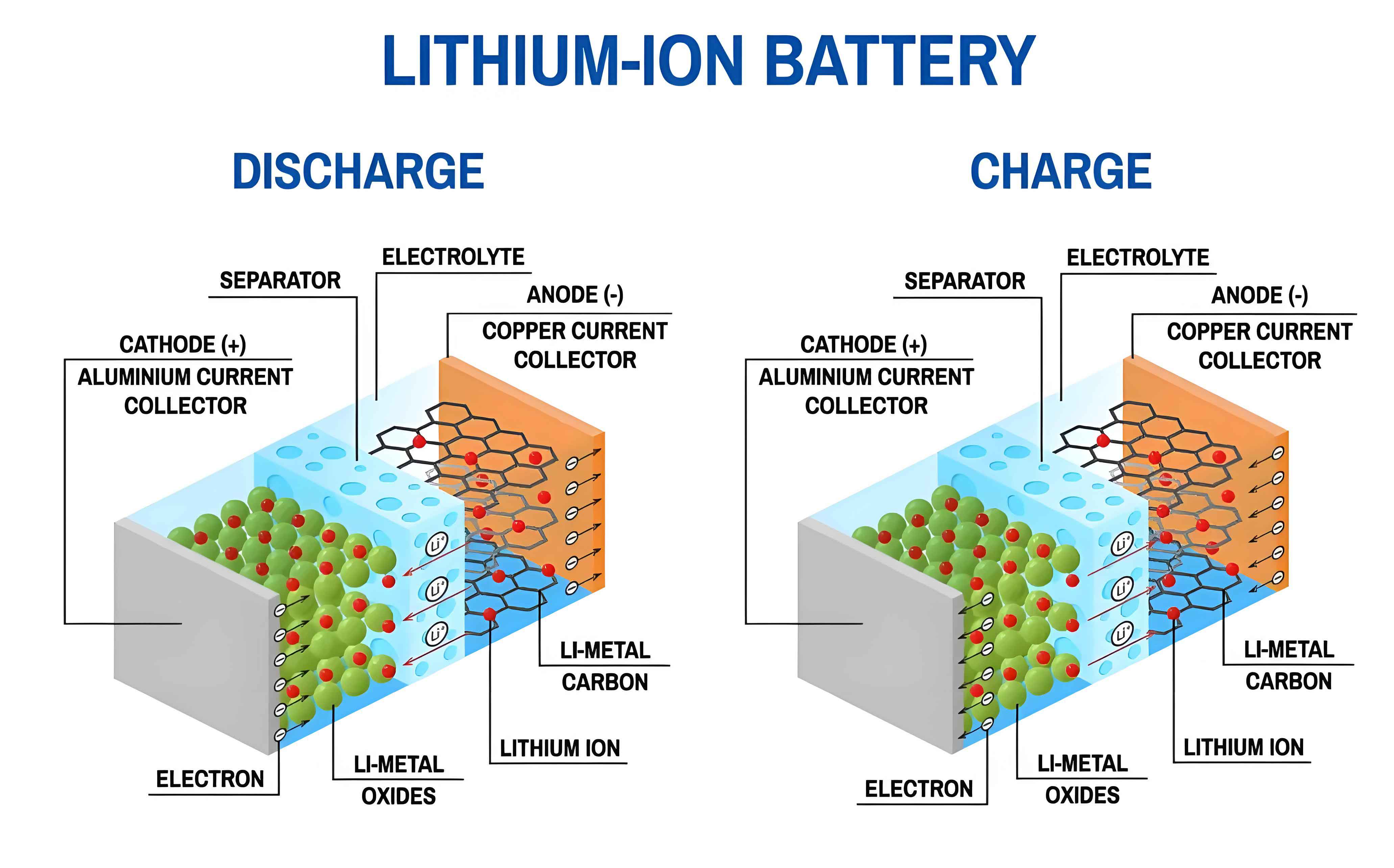
The established methods for SOC estimation are broadly categorized into three groups: experimental, data-driven, and model-based techniques. Experimental methods, such as Coulomb counting (Ampere-hour integration) and open-circuit voltage (OCV) methods, are simple but suffer from cumulative errors and the requirement for long rest periods, respectively. Data-driven approaches, including neural networks and support vector machines, can model complex non-linear relationships but demand extensive training data and lack physical interpretability. Model-based methods, particularly those employing Kalman Filter (KF) variants, offer a powerful framework by integrating a mathematical model of the lithium-ion battery with real-time measurement data. The Extended Kalman Filter (EKF) linearizes non-linear functions, which can introduce errors. The Unscented Kalman Filter (UKF) addresses this using the unscented transform, providing better performance for non-linear systems like the lithium-ion battery. The Multi-Innovation Unscented Kalman Filter (MIUKF) further enhances this by utilizing a moving window of past innovations to improve robustness against noise and model inaccuracies. Nevertheless, the performance of these filters is highly sensitive to the accuracy of the equivalent circuit model parameters and the numerical stability of covariance matrix operations. Furthermore, the optimal size of the innovation window in MIUKF is typically set empirically, which may not be optimal across diverse operating conditions for the lithium-ion battery.
To overcome these limitations, this work introduces a comprehensive two-stage optimization framework. First, a metaheuristic algorithm, the Grey Wolf Optimizer (GWO), is employed for precise parameter identification of the lithium-ion battery’s second-order RC equivalent circuit model. GWO mimics the social hierarchy and hunting behavior of grey wolves, effectively balancing global exploration and local exploitation to find optimal model parameters (Ohmic resistance $$R_0$$, polarization resistances $$R_1, R_2$$, and capacitances $$C_1, C_2$$) that minimize the error between simulated and measured terminal voltage. The fitness function for this optimization is the Root Mean Square Error (RMSE):
$$
\text{Fitness: } \varepsilon_{\text{RMSE}} = \sqrt{ \frac{1}{m} \sum_{i=1}^{m} \left( U_{\text{meas},i} – U_{\text{model},i} \right)^2 }
$$
Second, the core estimation algorithm, SVD-MIUKF, is structurally enhanced. The standard UKF/MIUKF relies on Cholesky decomposition for sigma-point generation, which can fail or become numerically unstable if the state covariance matrix becomes ill-conditioned or singular. We replace this with Singular Value Decomposition (SVD), a more robust matrix factorization technique. For a covariance matrix $$P_{k-1}$$, its SVD is given by:
$$
P_{k-1} = U_{k-1} \begin{bmatrix} S_{k-1} & 0 \\ 0 & 1 \end{bmatrix} V_{k-1}^T
$$
where $$U$$ and $$V$$ are orthogonal matrices and $$S$$ is a diagonal matrix of singular values. Let $$\Sigma = \begin{bmatrix} S_{k-1} & 0 \\ 0 & 1 \end{bmatrix}$$, the matrix square root required for sigma-point generation is computed as $$B = U \Sigma^{1/2}$$. This substitution ensures superior numerical stability during the filtering process for the lithium-ion battery state estimation. The standard UKF prediction and update steps are then followed, with the multi-innovation aspect incorporated by using a window of past residuals to update the noise covariance matrices adaptively:
$$
\begin{aligned}
e_k &= y_k – \hat{y}_{k|k-1} \\
Q_k &= \eta_Q Q_{k-1} + (1 – \eta_Q) e_k e_k^T \\
R_k &= \eta_R R_{k-1} + (1 – \eta_R) e_k e_k^T
\end{aligned}
$$
where $$e_k$$ is the innovation (measurement residual), and $$\eta_Q, \eta_R$$ are adaptive forgetting factors.
The final and key innovation is the integration of GWO to optimize the SVD-MIUKF algorithm itself. Instead of a fixed or empirically chosen window length for the multi-innovation matrix, GWO is used to dynamically search for the optimal window size. The position of each “wolf” in the GWO population represents a candidate window size. The fitness for this second GWO loop is the SOC estimation error over a validation dataset:
$$
\text{GWO-SVD-MIUKF Fitness: } f = \frac{1}{N} \sum_{k=1}^{N} (SOC_{\text{true},k} – SOC_{\text{est},k})^2
$$
By iteratively updating the positions of the alpha, beta, and delta wolves (representing the best solutions), GWO converges to an optimal or near-optimal innovation window size that minimizes the SOC estimation error for the given lithium-ion battery operating profile. The complete workflow of the proposed GWO-SVD-MIUKF hybrid algorithm is therefore: 1) Use GWO to identify optimal model parameters $$(R_0, R_1, R_2, C_1, C_2)$$; 2) Use another GWO instance to find the optimal moving window size for the MIUKF; 3) Execute the SVD-MIUKF algorithm with the optimized parameters and window size for real-time SOC estimation.
To validate the proposed method, extensive experiments were conducted using the publicly available INR 18650-20R lithium-ion battery dataset. The GWO’s effectiveness in parameter identification was first evaluated against other common optimizers like Particle Swarm Optimization (PSO), Genetic Algorithm (GA), and Differential Evolution (DE) on Hybrid Pulse Power Characterization (HPPC) test data. The results, shown in the table below, demonstrate GWO’s superior performance in minimizing the voltage simulation error for the lithium-ion battery model.
| Optimization Algorithm | Maximum Voltage Error (V) | Average Voltage Error (V) |
|---|---|---|
| Grey Wolf Optimizer (GWO) | 0.0179 | 0.0027 |
| Particle Swarm Optimization (PSO) | 0.0186 | 0.0045 |
| Genetic Algorithm (GA) | 0.0196 | 0.0056 |
| Differential Evolution (DE) | 0.0247 | 0.0037 |
The SOC estimation capability of the full GWO-SVD-MIUKF algorithm was then rigorously tested under four distinct and demanding driving cycles: Dynamic Stress Test (DST), US06, Beijing Driving Schedule-DST (BJDST), and Federal Urban Driving Schedule (FUDS). These cycles represent a wide range of dynamic load conditions that a lithium-ion battery might experience in real-world applications. The proposed method was compared against three benchmark algorithms: the standard Extended Kalman Filter (EKF), the Unscented Kalman Filter (UKF), and the SVD-MIUKF without GWO window optimization.
The results unequivocally demonstrate the superiority of the GWO-SVD-MIUKF hybrid approach. In all test scenarios, the SOC estimation curve produced by our method adhered most closely to the reference SOC, exhibiting minimal deviation and excellent tracking of sudden changes in current load. Quantitatively, the performance was assessed using two standard metrics: Root Mean Square Error (RMSE) and Mean Absolute Error (MAE). The following table summarizes the estimation errors for all algorithms across the four driving cycles, highlighting the consistent advantage of the proposed method for the lithium-ion battery.
| Driving Cycle | Algorithm | RMSE | MAE |
|---|---|---|---|
| DST | GWO-SVD-MIUKF | 0.0026 | 0.0024 |
| SVD-MIUKF | 0.0034 | 0.0032 | |
| UKF | 0.0060 | 0.0060 | |
| EKF | 0.0072 | 0.0072 | |
| US06 | GWO-SVD-MIUKF | 0.0020 | 0.0019 |
| SVD-MIUKF | 0.0029 | 0.0025 | |
| UKF | 0.0027 | 0.0027 | |
| EKF | 0.0036 | 0.0035 | |
| BJDST | GWO-SVD-MIUKF | 0.0091 | 0.0091 |
| SVD-MIUKF | 0.0122 | 0.0122 | |
| UKF | 0.0261 | 0.0261 | |
| EKF | 0.0299 | 0.0299 | |
| FUDS | GWO-SVD-MIUKF | 0.0044 | 0.0041 |
| SVD-MIUKF | 0.0063 | 0.0058 | |
| UKF | 0.0122 | 0.0122 | |
| EKF | 0.0145 | 0.0145 |
As the data indicates, the GWO-SVD-MIUKF algorithm consistently achieved the lowest RMSE and MAE values. Its error remained around 0.20% (e.g., RMSE of 0.0020 corresponds to 0.2% for a SOC range of 0-1), significantly outperforming the other methods. The SVD-MIUKF showed better performance than UKF and EKF, confirming the benefit of the multi-innovation approach and SVD stabilization. However, the additional layer of GWO-based optimization of the model parameters and, crucially, the innovation window size provided the final boost in accuracy and adaptive capability for the lithium-ion battery SOC estimation task. The algorithm also demonstrated rapid convergence from an initial SOC error, proving its robustness in practical BMS applications where the initial state may be unknown.
In conclusion, this paper presents a highly accurate and robust hybrid algorithm for estimating the State of Charge of lithium-ion batteries. The proposed GWO-SVD-MIUKF method successfully addresses key limitations in existing model-based approaches through a dual-optimization strategy. The Grey Wolf Optimizer ensures precise model parameter identification and dynamically tailors the filter’s innovation window for optimal performance. The integration of Singular Value Decomposition into the Multi-Innovation Unscented Kalman Filter guarantees numerical stability and reliability. Experimental validation on a standard public dataset under multiple dynamic load profiles confirms that this method offers superior estimation accuracy, with errors controlled within approximately 0.20%, along with strong convergence properties. This advancement contributes significantly to the development of more reliable and efficient battery management systems for the ever-growing applications of lithium-ion battery technology.